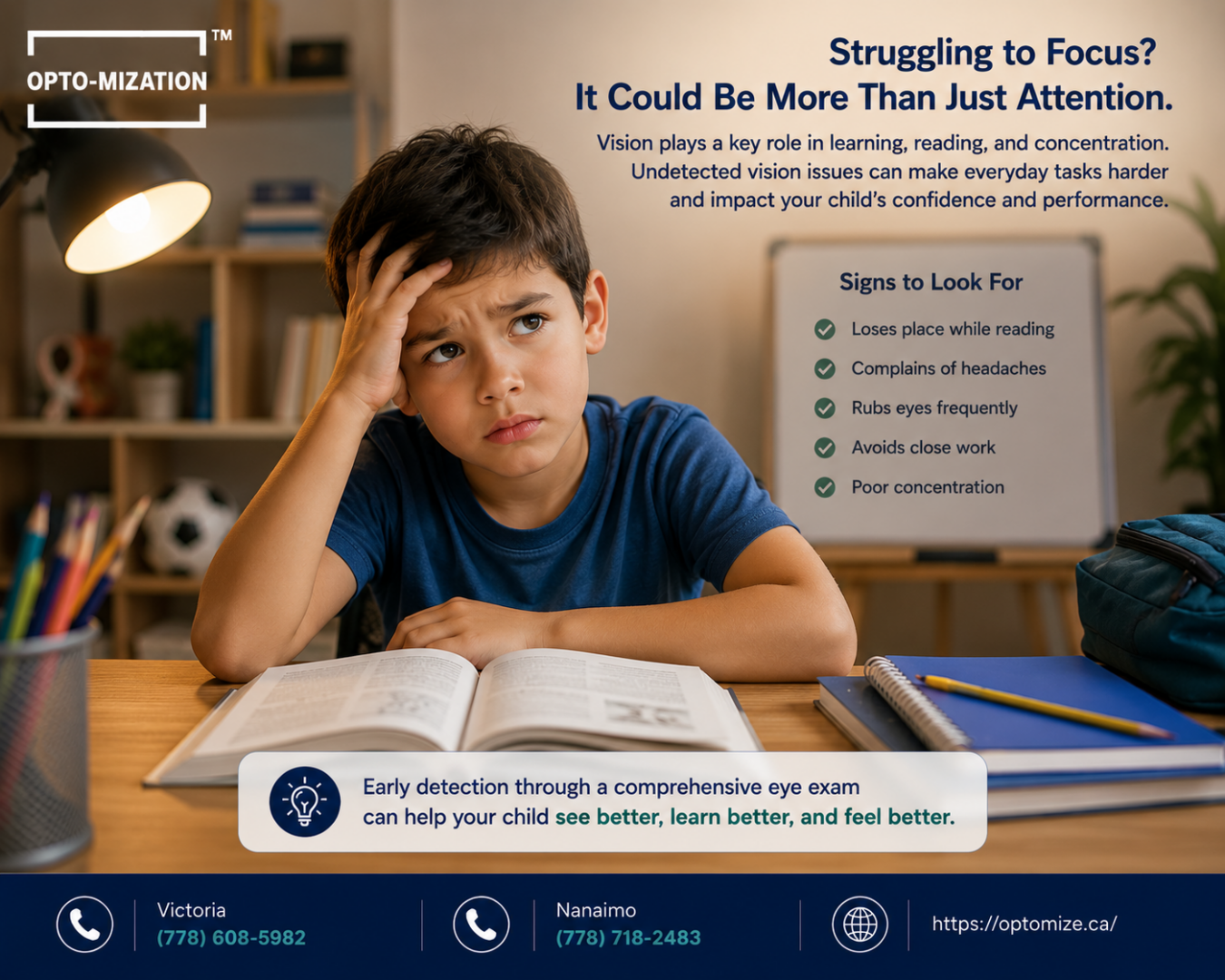
When a child can identify individual words but still resists reading, the problem usually isn’t vocabulary or intelligence — it’s that reading has become physically or cognitively uncomfortable. Visual processing difficulties, binocular vision issues, and phonological processing challenges can all make reading feel like hard work, even when the words look familiar. Identifying the root cause early makes a significant difference in outcomes.
You’ve watched your child sound out words correctly. You know they’re smart. But the moment a book comes out, they complain of headaches, go quiet, make excuses, or simply shut down. This pattern confuses and worries a lot of parents, and it’s more common than most people realize. Knowing the words and wanting to read them are two very different things when reading doesn’t feel comfortable.
Key Takeaways
- Reading avoidance in children who know their words often signals a visual, neurological, or processing issue rather than a lack of effort or motivation.
- Binocular vision dysfunction — where the two eyes don’t work together properly — is one of the most frequently missed causes of reading difficulty in school-aged children.
- Symptoms like skipping lines, losing place, rereading the same sentence, or complaining of tired eyes after short sessions are red flags worth investigating.
- Dyslexia and reading disabilities don’t always mean a child can’t decode words — they can struggle with fluency, comprehension, and sustained effort even when individual words are readable.
- A behavioural optometry or developmental vision evaluation can uncover problems a standard eye chart test will completely miss.
- Early intervention significantly improves outcomes — children who receive targeted support before age 10 show measurably better long-term reading fluency.
What’s Really Going On When a Child Avoids Reading
The instinct many parents have is to assume their child is being lazy or distracted. That framing rarely helps, and it’s usually wrong. When a child avoids reading despite knowing the words, they are almost always telling you something true about their experience of reading — it feels bad in some way they may not have the vocabulary to explain.
Children don’t typically say “my eyes hurt when I track across a line” or “the words seem to jump on the page.” They say they’re bored, they’re tired, their head hurts, or they just don’t want to. Those complaints are real symptoms being filtered through a child’s limited ability to describe a sensory experience.
The Visual System Does More Than See Letters
Reading requires the eyes to perform a very specific set of tasks: tracking smoothly left to right, jumping accurately from the end of one line to the beginning of the next, maintaining focus on close objects for sustained periods, and keeping both eyes aimed at exactly the same point on the page. If any part of this system is off, reading becomes exhausting fast.
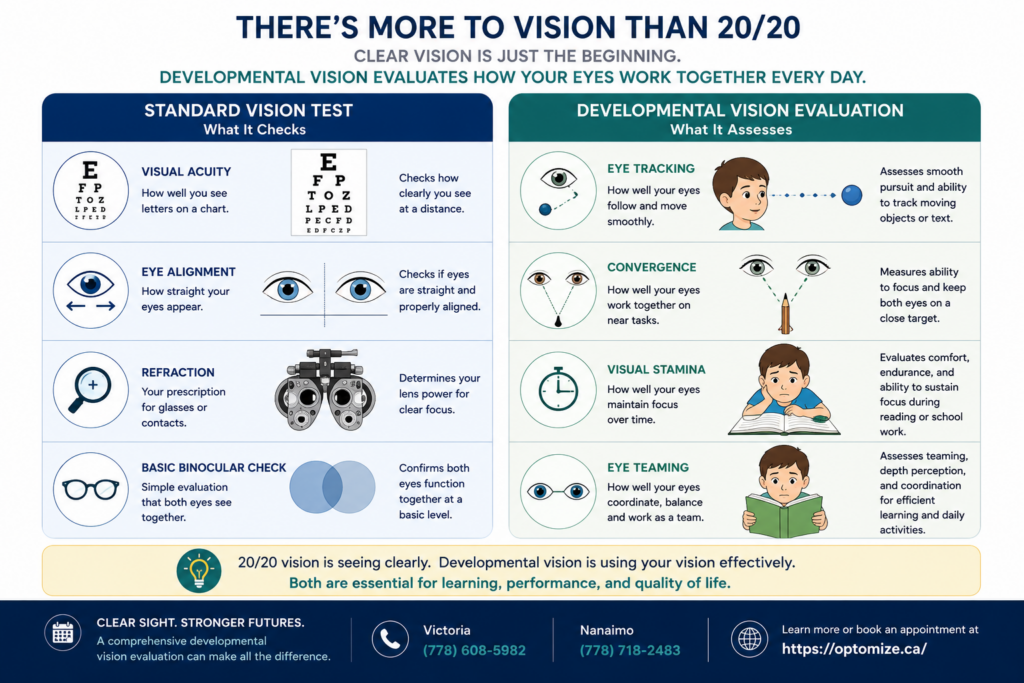
Research estimates that up to 80% of learning in the classroom is visually based, yet standard school vision screenings only test distance acuity — essentially whether a child can read a chart across a room. They do not test convergence, tracking, or visual stamina, which are the skills most critical for reading. A child can pass a school vision screening and still have a significant functional vision problem.
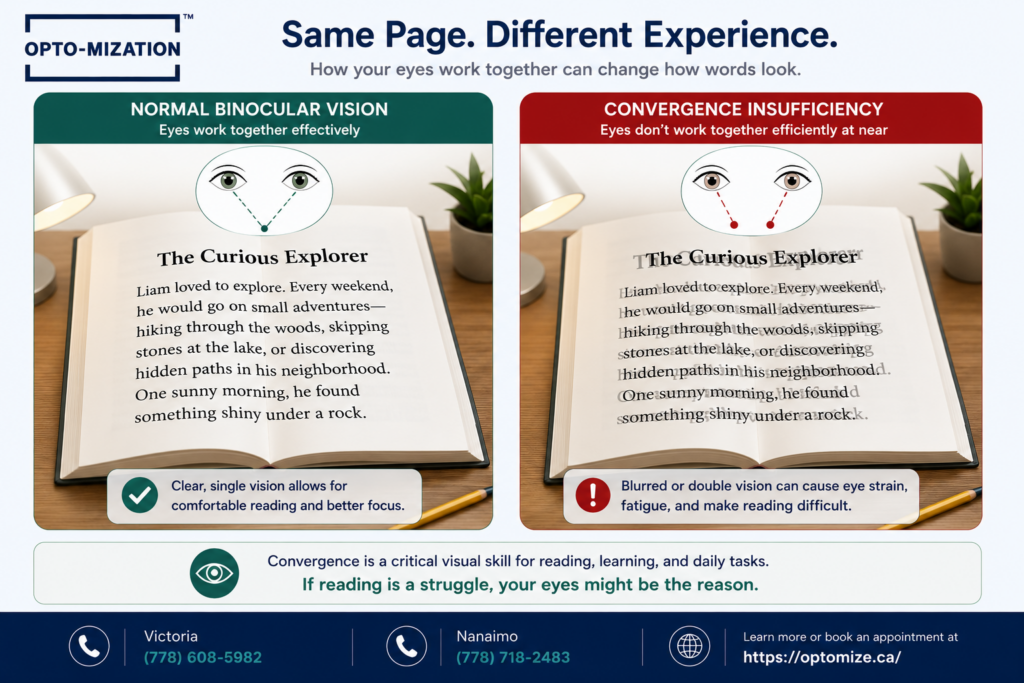
This is why so many reading difficulties go unidentified for years. The child sees letters clearly enough but struggles with the mechanics of moving through text comfortably. Words might blur after a few minutes. Lines might appear to shift or overlap. The child’s brain eventually learns that reading leads to discomfort, and avoidance becomes the predictable response.
Is It a Vision Problem or a Reading Disability? The Overlap Is Real
Parents often think of vision problems and reading disabilities as entirely separate categories. In practice, they frequently overlap and can be difficult to distinguish without professional evaluation. Both can produce almost identical symptoms: slow reading, frequent re-reading, poor comprehension, avoidance, and fatigue.
Studies suggest that between 20 and 25 percent of children have some form of vision problem significant enough to interfere with learning, and a meaningful subset of children diagnosed with dyslexia or reading disabilities also have an undiagnosed binocular vision disorder contributing to their symptoms. Treating the vision component doesn’t eliminate a reading disability, but it can substantially reduce the child’s total reading burden.
Dyslexia, specifically, involves difficulty with phonological processing — the ability to connect sounds to letters and decode unfamiliar words quickly. A child with dyslexia may know a word when they see it in isolation but struggle to process it quickly enough within a flowing sentence to maintain meaning. That experience of falling behind in real-time during reading is deeply discouraging, and avoidance is a rational response to it.
Signs That Warrant a Closer Look
Not every child who dislikes reading has a diagnosable condition, but certain patterns are worth taking seriously. The following tend to separate typical reading resistance from something that needs professional attention:
- Complaints of headaches or eye tiredness specifically during or after reading (not during screen time or other activities)
- Skipping lines, losing place frequently, or needing a finger to track
- Reading the same line twice without noticing
- Words seeming to blur, move, or “swim” on the page
- Closing or covering one eye while reading
- Significantly better reading performance when text is read aloud to them versus when they read independently
- Strong verbal ability but poor reading output — “smarter than their reading suggests”
Several of these symptoms, particularly eyes slow to focus when switching between distances, can be a direct indicator of accommodative dysfunction — the eye’s difficulty changing focal length smoothly. This is entirely treatable but often missed.
The Connection Between Discomfort and Avoidance
Children are remarkably good at avoiding discomfort without understanding why something is uncomfortable. If reading produces headaches, double vision, or blurred text after a few minutes, a child’s brain will associate books with that physical experience. The avoidance isn’t a character flaw — it’s a learned protective response.
Behavioural research on reading motivation in children consistently finds that avoidance behaviours intensify when a child has repeated failure experiences with reading, regardless of the underlying cause. By the time a child reaches age 8 or 9 with unaddressed reading difficulties, negative self-concept around reading can become a secondary barrier that persists even after the root issue is treated. This is why early identification matters so much — the window where intervention feels low-stakes and natural closes faster than most parents expect.
It’s also worth noting that some children read perfectly well in short bursts but fall apart after ten minutes. That pattern specifically points toward visual stamina issues rather than word recognition problems. The child who can read one paragraph enthusiastically but refuses to continue is often experiencing genuine fatigue, not boredom.
What the Evaluation Process Actually Looks Like
Parents are often surprised by how different a developmental or behavioural vision evaluation is from a standard eye exam. A routine optometry appointment typically takes ten to fifteen minutes and covers distance and near acuity, basic eye health, and a prescription check. A developmental vision evaluation can take an hour or more and tests entirely different functions.
Step-by-Step: What a Developmental Vision Evaluation Covers
- Case history and symptom intake: The practitioner gathers detailed information about when symptoms occur, how long reading sessions last before problems begin, academic history, and any prior evaluations. This context shapes which tests are prioritized.
- Visual acuity at near range: Unlike a standard test using a distance chart, this measures how clearly the child sees at reading distance — a much more relevant measure for book-related difficulties.
- Eye tracking assessment: The child follows a target while the practitioner observes how smoothly and accurately their eyes move. Jerky, effortful tracking is a clear signal of a functional problem.
- Convergence testing: This checks whether both eyes can aim at the same point simultaneously at close range. Convergence insufficiency is one of the most common and treatable causes of reading-related discomfort in children.
- Accommodative function: The evaluation tests how quickly and accurately the eye changes focus between distances. Children with accommodative lag — where focus lags behind where the eye is pointed — often experience blur during sustained close work.
- Visual processing screening: Some practitioners also screen for visual processing skills including visual memory, figure-ground discrimination, and visual sequencing, which relate directly to reading fluency.
Symptoms like light sensitivity during reading or watery eyes after reading sessions are also worth mentioning during the intake, as they can indicate tear film instability or photophobia that adds to reading fatigue.
Comparison: What Different Evaluations Detect
| Evaluation Type | What It Tests | What It Misses |
| School vision screening | Distance acuity (20/20 chart) | Tracking, convergence, near focus, stamina |
| Standard optometry exam | Acuity, basic eye health, prescription | Eye teaming, tracking quality, visual processing |
| Developmental vision evaluation | Full binocular function, tracking, convergence, accommodation, near acuity | Phonological processing (separate assessment) |
| Psychoeducational assessment | Reading processing, phonological skills, working memory, dyslexia screening | Visual motor function, binocular vision |
Common Mistakes Parents Make When a Child Avoids Reading
- Assuming it’s purely motivational. Pushing harder, offering rewards, or taking away screen time treats reading avoidance as a behavior problem rather than a symptom. This often increases anxiety around reading without addressing anything real.
- Relying solely on school assessments. Teachers are skilled at identifying academic delays, but they’re not equipped to detect binocular vision dysfunction or convergence insufficiency. A school reading assessment and a vision-based assessment are measuring different things entirely.
- Waiting to “see if they grow out of it.” Visual processing delays and learning differences rarely resolve on their own without targeted support. Waiting typically means a child accumulates more negative reading experiences and falls further behind in vocabulary and comprehension.
- Treating the symptom instead of the cause. Larger print, audiobooks, and reduced reading load are useful accommodations, but they don’t address the underlying reason reading is hard. A child who gets accommodations without a diagnosis often continues to struggle and never builds reading fluency.
- Overlooking symptoms that seem unrelated. Complaints about pressure behind eyes after homework, or noticing that distorted vision straight lines appear on a page, can be the clearest signals a child gives that something is wrong visually — and these get dismissed as complaints more often than they should be.
Children who receive a developmental vision evaluation and vision therapy for diagnosed binocular vision disorders show statistically significant improvements in reading speed, comprehension, and sustained reading time compared to control groups receiving only standard optometric care. In clinical studies, vision therapy completion rates correlate with measurable improvements in academic performance, particularly in grades 1 through 4 where reading fluency is most formatively established.
Frequently Asked Questions
What are three warning signs of dyslexia?
Three consistent early warning signs are: difficulty connecting letters to their sounds even after repeated practice, unusually slow or laboured reading compared to peers of the same age, and trouble spelling familiar words correctly — particularly when writing from memory rather than copying. It’s worth noting that dyslexia exists on a spectrum, and some children compensate well enough that their difficulties only become apparent when reading demands increase around grades 3 or 4.
What are the 5 pillars of dyslexia?
The five areas most commonly cited in structured literacy frameworks for addressing dyslexia are: phonological awareness, phonics, fluency, vocabulary, and comprehension. Effective dyslexia intervention addresses all five systematically rather than focusing only on letter-sound knowledge. A child who has strong vocabulary and listening comprehension but poor phonological awareness, for example, needs a very different instructional approach than one who struggles across all five areas.
What is the 777 rule for kids?
The 777 rule for children’s sleep recommends that children aged 7 and under sleep approximately 11 hours per night, those aged 7 to 12 sleep around 10 hours, and teenagers sleep at least 9 hours. While this isn’t directly a reading rule, chronic sleep deprivation significantly impairs visual processing, attention, and working memory — all of which directly affect reading performance and effort tolerance. A tired child reads less willingly and retains less.
Why does my child avoid reading?
The most common reasons children avoid reading despite knowing their words include undiagnosed visual processing issues (particularly binocular vision problems), phonological processing difficulties that slow reading speed enough to break comprehension, accumulated negative associations with reading built up over time, and anxiety about being seen to struggle. The single most useful step is a comprehensive evaluation — not just a standard eye test — to separate visual causes from language-processing causes, because the interventions are very different.
What are five warning signs that a student may have a reading disability?
Five key warning signs to watch for are: reading pace that is noticeably slower than same-age peers; frequent guessing at words based on first letters rather than full decoding; poor retention of what was just read, even when comprehension seemed fine during reading; avoidance of any activity involving reading including games or menus; and a significant gap between how well a child understands content when it’s read aloud to them versus when they read it independently. That last sign, in particular, points toward a decoding or visual processing barrier rather than an intelligence or comprehension issue.
Final Thoughts: What a Child’s Reading Avoidance Is Actually Telling You
A child who avoids reading despite knowing the words is not choosing to be difficult. They’re responding to a reading experience that is genuinely harder for them than it looks from the outside. That gap between “they know the words” and “they won’t read” is exactly where most functional vision and reading processing issues live.
The good news is that these issues are diagnosable and, in most cases, highly treatable. A thorough developmental vision evaluation can identify whether a visual component is contributing, and a psychoeducational assessment can clarify whether a reading disability like dyslexia is part of the picture. Most families who get clear answers find they’ve been addressing the wrong problem for months or years.
If your child’s reading avoidance has persisted across more than one school term, or if you recognize several of the warning signs described above, it’s worth booking a comprehensive evaluation rather than waiting.
Ready to Find Out What’s Actually Going On?
At Opto-Mization, we work with children whose reading difficulties have been missed, misunderstood, or attributed to effort rather than visual function. A developmental vision evaluation goes far beyond a standard eye test — it assesses the full range of visual skills your child needs to read comfortably and effectively.
If your child avoids reading, complains of tired eyes, loses their place frequently, or seems “smarter than their reading suggests,” that pattern deserves a proper look. Our team is experienced in identifying the visual contributors that schools and standard optometry appointments routinely miss.
Call Opto-Mization today: (778) 608-5982
Give your child the clarity they deserve — and the reading experience that finally feels manageable.