When you look up from a screen or book and the world briefly looks blurry, your eyes are working through a process called accommodation, the lens of your eye physically changes shape to shift focus between distances. This lag is normal in small doses, but when it becomes frequent, slow, or uncomfortable, it can signal a condition called accommodative insufficiency or accommodative infacility that deserves a professional evaluation.
You glance up from your phone mid-conversation and your friend’s face is a soft blur for two or three seconds. You leave a movie theatre and the street signs won’t snap into focus right away. These moments feel odd, sometimes alarming, and they happen to people of all ages. The good news is there’s a clear biological explanation, and knowing what’s behind it helps you figure out when to simply blink it off and when to book an eye exam.
Key Takeaways
- Your eye’s lens changes shape to focus at different distances, a process called accommodation, and that shift takes a small but measurable amount of time.
- Extended near work (screens, reading) can temporarily fatigue the ciliary muscle, making refocusing slower and less precise.
- Accommodative infacility is a specific condition where the eye struggles to switch focus efficiently between near and far targets, even when each distance can be seen clearly on its own.
- Age-related changes begin affecting accommodation in the early 40s, but children and young adults can also experience accommodation problems.
- Untreated accommodation issues are linked to headaches, reading difficulties, and digital eye strain.
- Vision therapy and targeted exercises can significantly improve accommodative flexibility when a clinical problem is identified. In addition, specialized glasses can help reduce strain on the accommodative system, supporting more comfortable and efficient visual performance throughout the day.
What Actually Happens Inside Your Eye When You Shift Focus?
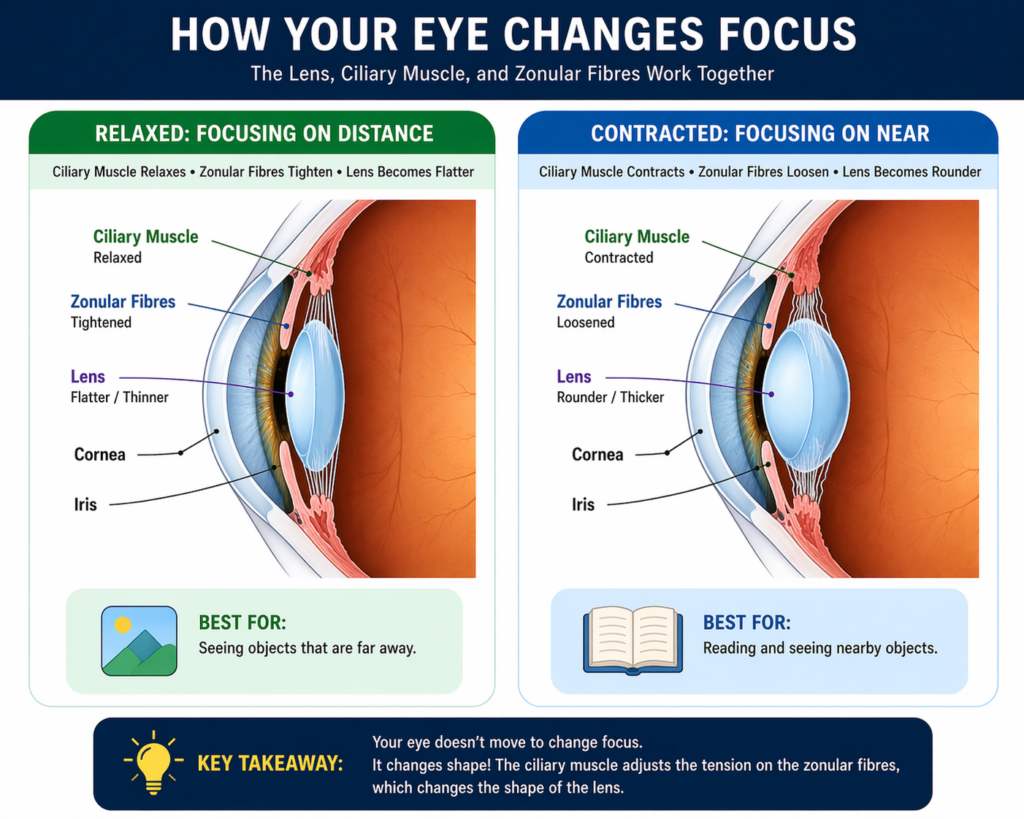
The lens of your eye is not rigid like a camera lens. It’s a flexible, gel-like structure suspended by tiny fibres called zonules, which are attached to the ciliary muscle that encircles it. When you look at something close, the ciliary muscle contracts, the zonules loosen, and the lens rounds up to increase its optical power. When you look into the distance, the muscle relaxes, the zonules pull taut, and the lens flattens out.
This entire cycle is called accommodation, and it happens dozens of times a minute without you ever thinking about it. The brief blur you notice when switching from near to far is simply the mechanical and neurological lag while the system resets. Under normal conditions, that lag is under a second and largely imperceptible.
Research into accommodative response time shows that a healthy young adult can complete a full near-to-far focus shift in approximately 0.3 to 1 second. When that response stretches beyond 1.5 to 2 seconds consistently, or when the image never fully sharpens at one distance, clinicians begin investigating accommodative dysfunction as a contributing factor.
Why Does the Blur Last Longer After Heavy Screen Use?
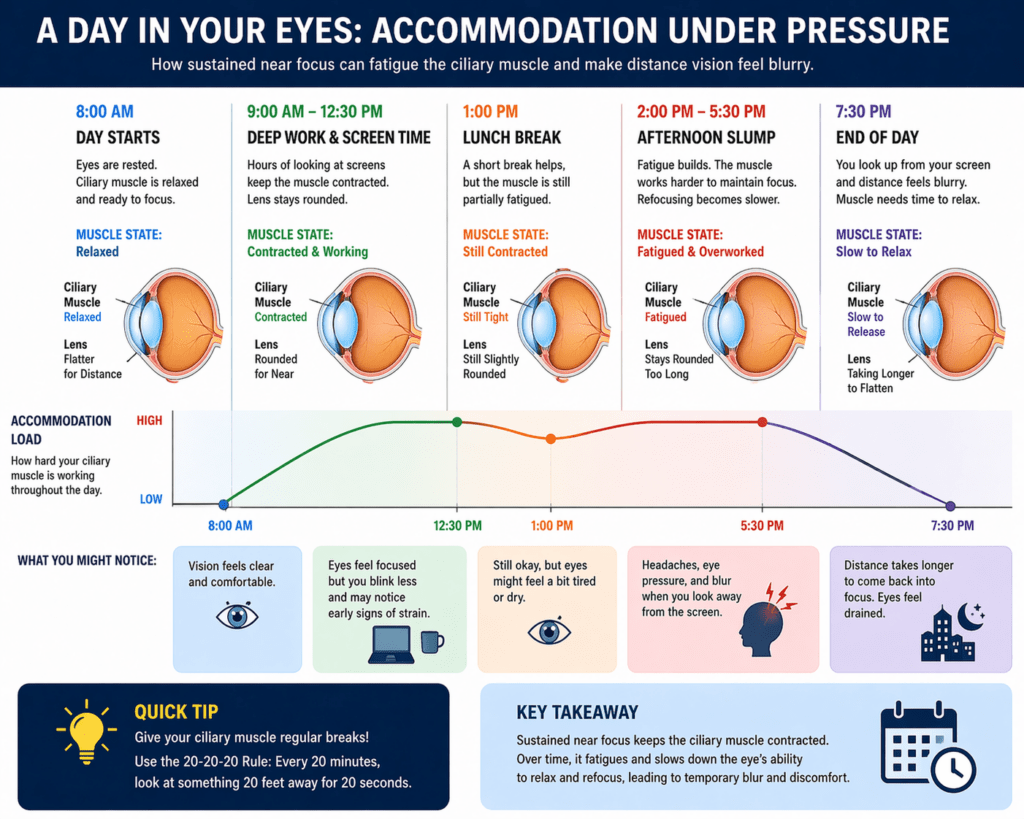
The ciliary muscle is exactly that: a muscle. Like any muscle held in one position for a prolonged period, it can fatigue. When you spend extended time focused at a fixed close distance — a phone screen, a laptop, a paperback — the ciliary muscle stays contracted and the lens remains in its rounded, high-power shape. Over time, it resists releasing back to the relaxed state needed for clear distance vision.
This phenomenon is sometimes called “accommodative spasm” or “pseudo-myopia” in more pronounced cases, because the eye temporarily behaves as if it’s short-sighted even when it isn’t. The blur after looking up from a screen is essentially the muscle unwinding from hours of sustained contraction.
Studies on digital eye strain suggest that adults who spend six or more hours per day on screens report significantly higher rates of blur, headaches, and difficulty refocusing compared to those with lower screen exposure. The prevalence of these symptoms has increased markedly over the past decade as remote and hybrid work became standard practice.
How Is Normal Adjustment Different from an Actual Vision Problem?
This is where the distinction matters. Occasional, brief blur when switching distances is a normal physiological response. It does not automatically mean something is wrong with your eyes. The question is how often it happens, how long the blur lasts, and whether it’s accompanied by other symptoms.
| Characteristic | Normal Adjustment | Possible Dysfunction |
| Duration of blur | Under 1 second | 2+ seconds, or persistent |
| Frequency | Occasional, after long near tasks | Every time, even after short tasks |
| Associated symptoms | None, or mild eye tiredness | Headaches, double vision, nausea, avoidance of reading |
| Clears with blinking | Yes, quickly | Sometimes, but not reliably |
| Impact on daily tasks | Negligible | Affects driving, sport, or reading comprehension |
Problems with eye teaming can also compound accommodation difficulty. When the two eyes don’t coordinate efficiently, the brain receives competing or misaligned signals, which forces the accommodation system to work harder than it should just to produce a single, clear image.
The Age Factor: Why This Gets More Noticeable Over Time
The amplitude of accommodation, the total range over which the eye can adjust, peaks in childhood and declines steadily from the late teens onward. By the mid-40s, most people have lost enough accommodative range that near vision without glasses becomes genuinely difficult, a condition known as presbyopia. This is why many people first notice prolonged refocus lag in their 40s, even if they’ve had perfect vision their entire lives.
For those already managing presbyopia, options like presbyopia eye drops represent one of the newer approaches to managing this decline in accommodative flexibility. These are not a substitute for a comprehensive assessment, but they can be part of a broader management plan.
Younger people are not immune. Children and teenagers with accommodative insufficiency often go undiagnosed for years because standard distance vision tests — the letter chart on the wall — do not measure the efficiency or endurance of the accommodation system. A child who can read the 20/20 line clearly can still have significant accommodation dysfunction.
Step-by-Step: What Happens During a Thorough Accommodation Assessment
- Case history review: The clinician asks about screen time habits, reading duration, headache frequency, and any avoidance of near tasks, contexts that a standard vision screening won’t capture.
- Monocular accommodative amplitude testing: Each eye is tested individually using a near target moved progressively closer until it first blurs. This measures the total available accommodative range for that eye.
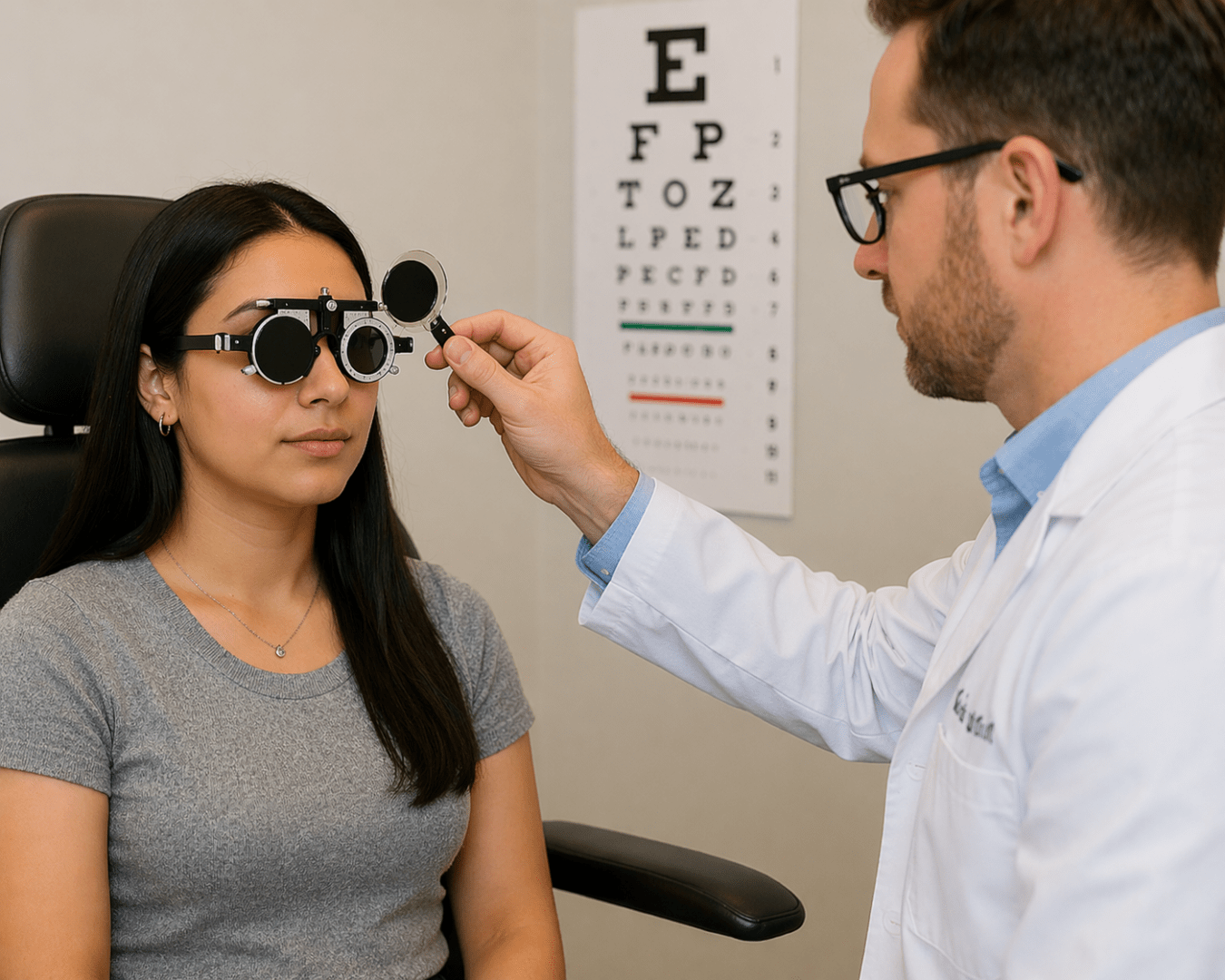
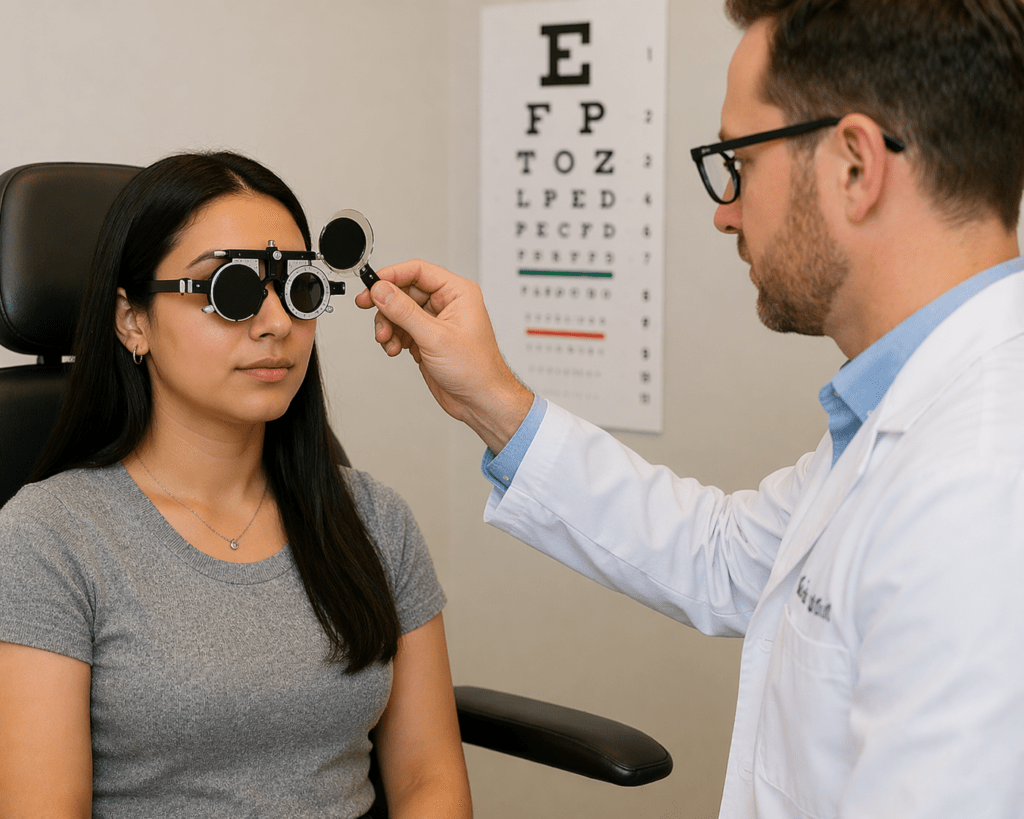
- Accommodative facility testing: The patient rapidly alternates focus between a near target and a far target using flipper lenses. The number of clear cycles completed per minute reveals how efficiently the system can switch — this directly tests the near-to-far lag you experience daily.
- Binocular vision evaluation: Eye alignment, convergence, and binocular vision dysfunction screening ensure accommodation isn’t being compromised by a coordination problem.
- Near point of convergence: Measures how close an object can be brought before the eyes can no longer maintain single binocular vision — often reduced in people with accommodation and convergence problems together.
- Review and clinical interpretation: Results are combined to determine whether findings represent normal variation, accommodative insufficiency, accommodative infacility, or another binocular vision condition — each of which has a different management pathway.
Common Mistakes People Make When Dealing With This Symptom
- Assuming it’s just tiredness and ignoring it: Fatigue is often the trigger, but persistent difficulty switching focus can indicate a treatable condition that won’t resolve on its own with rest.
- Self-diagnosing as nearsighted: Temporary refocus blur after screens is not the same as myopia. Getting glasses based on a symptom that’s actually accommodative spasm can sometimes overcorrect and worsen the underlying issue.
- Skipping the 20-20-20 rule during long work sessions: The rule exists precisely to prevent ciliary muscle fatigue from building up over hours. Most people know about it and skip it anyway.
- Assuming a “passed” vision screening means everything is fine: School vision screenings and standard 20/20 tests do not assess accommodation, eye teaming, or visual alignment under sustained near work conditions.
- Treating the symptom without finding the cause: Using lubricating drops or reducing screen brightness may ease discomfort temporarily but does nothing for an underlying accommodation or binocular vision problem that needs therapeutic intervention.
| Condition | Core Problem | Primary Symptom | Common Management |
| Accommodative Insufficiency | Reduced amplitude of accommodation | Blur at near, eye fatigue | Plus lenses, vision therapy |
| Accommodative Infacility | Slow or inefficient focus switching | Delayed refocus near-to-far | Accommodative flipper training, vision therapy |
| Accommodative Spasm | Ciliary muscle won’t relax | Persistent blur at distance | Cycloplegic drops, task modification |
| Presbyopia | Age-related lens stiffening | Near blur, slow near-to-far shift | Reading glasses, multifocals, drops |
Frequently Asked Questions
Is it normal for my vision to blur for a few seconds when I look up from my phone?
Yes, brief blur after sustained near work is a normal physiological response. Your ciliary muscle has been held in a contracted state and takes a moment to relax back to distance focus. If this happens only occasionally and clears within a second or two without other symptoms, it typically reflects normal accommodation lag rather than a clinical problem. That said, if it’s happening every time you look up, lasting several seconds, or coming with headaches or double vision, it’s worth getting a full binocular vision assessment.
Is this issue related to getting older?
Age is absolutely a factor, but it’s not the only one. The accommodative range declines throughout life, and people in their 40s and beyond tend to notice slower refocus because the lens has lost some of its elasticity — this is presbyopia. However, children and young adults can experience accommodation problems too, often unrelated to aging. In younger patients, the issue is usually one of muscle efficiency or coordination rather than structural lens stiffening, and it often responds well to vision therapy.
What is the 20-20-20 rule to help with this?
The 20-20-20 rule recommends that for every 20 minutes of near work, you take a 20-second break and look at something at least 20 feet away. The logic is straightforward: shifting your focus to a far target gives the ciliary muscle a chance to relax from its contracted near-focus state, reducing cumulative fatigue over the course of a work session. It won’t correct an existing accommodation problem, but it’s a well-supported habit for reducing digital eye strain and slowing the buildup of accommodation fatigue during long screen days.
Could this mean I need glasses?
It could, but not necessarily in the way you might expect. If the blur at distance persists even after resting your eyes, a refractive error like myopia may be present and glasses would be appropriate. However, if the blur clears after a few seconds and distance vision is otherwise fine, the issue may be accommodative rather than refractive — meaning standard distance glasses wouldn’t address it. The right answer comes from a comprehensive exam that tests accommodation and binocular vision alongside standard refraction, not from a quick vision screening alone.
How do I know if I have Accommodative Infacility?
Accommodative infacility is specifically characterised by difficulty switching focus efficiently between near and far distances, even when each distance can be seen clearly on its own. Common signs include slow refocus when looking up from reading, blur that takes several seconds to resolve, headaches or fatigue during tasks requiring repeated distance changes (like copying from a board), and difficulty sustaining focus during sport or driving. The only way to confirm it is through clinical testing — specifically accommodative facility testing with flipper lenses — which is not part of a routine eye exam unless you or your clinician request it.
Clinical studies on accommodative infacility have found that vision therapy programmes using flipper lens exercises completed over 12 to 16 weeks produce statistically significant improvements in accommodative facility scores in both children and adults. The gains tend to be durable when the full programme is completed under supervised care.
Final Thoughts
That brief blur when you look up from your phone isn’t something to catastrophise, but it also isn’t something to keep ignoring if it’s happening repeatedly, lasting longer than it should, or making everyday tasks harder than they used to be. Your accommodation system is doing remarkable work every time it shifts focus, and like any system, it performs better when it’s healthy, well-trained, and not being pushed to exhaustion by hours of unbroken near work.
The difference between “this is normal” and “this needs attention” is something a thorough binocular vision assessment can answer clearly. If you’ve been noticing slow refocus, persistent blur, headaches at the end of screen-heavy days, or any of the symptoms described above, getting a proper evaluation is the most useful next step you can take.
Ready to Get a Clear Answer?
At Opto-Mization, our team specializes in functional vision assessments that go well beyond the standard letter chart. We test accommodation, binocular vision, eye teaming, and visual processing to give you a complete picture of how your visual system is actually performing and a clear plan if something needs attention.
If slow focus switching, blur after near work, or persistent visual fatigue is affecting your day, book a comprehensive assessment with Opto-Mization today.
Call us: +1 778-608-5982