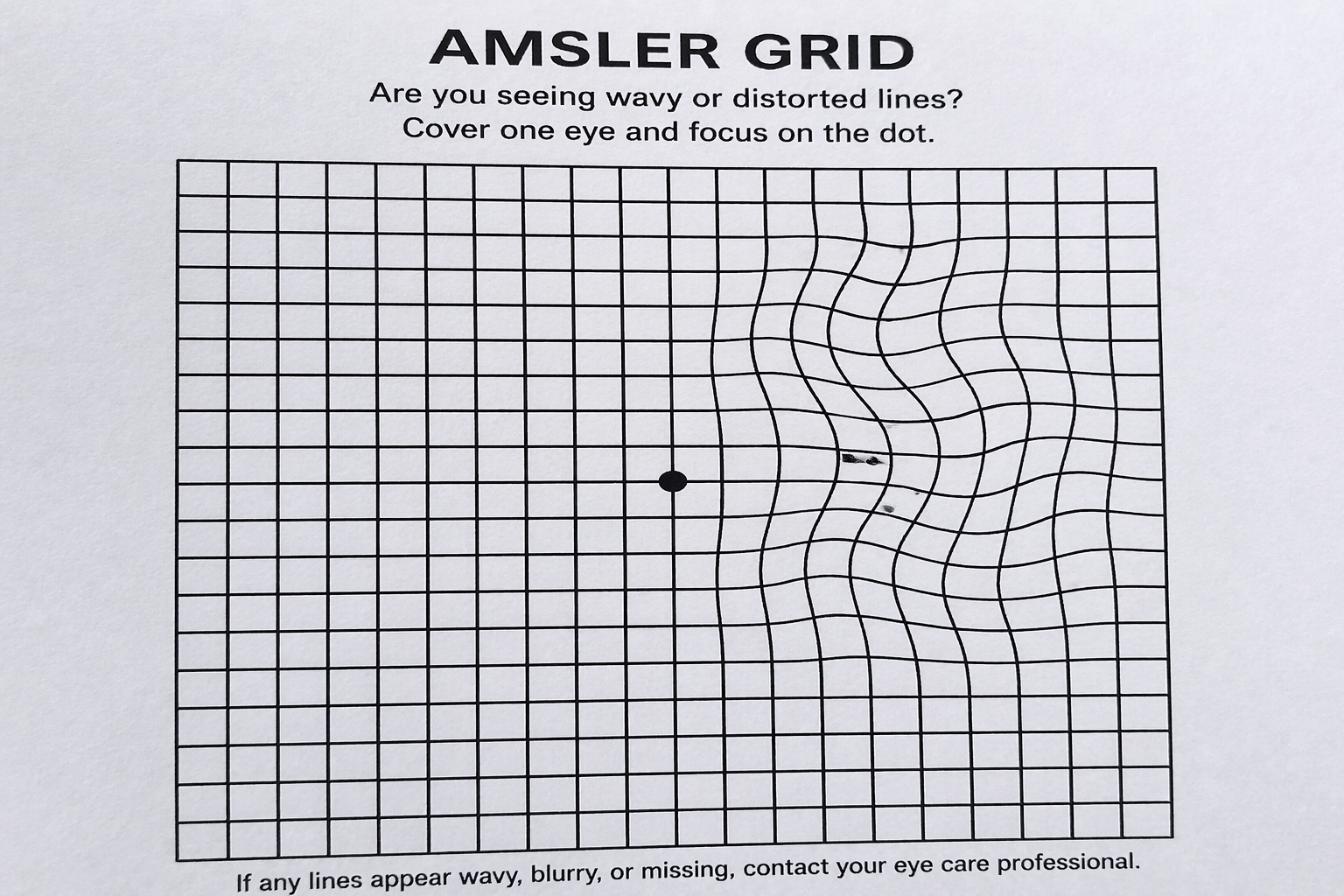
Straight lines appearing bent, wavy, or warped is a visual symptom called metamorphopsia, and it signals that something is interfering with how your eye or brain processes spatial information. The cause can range from a dry patch on the cornea to macular degeneration or a binocular vision problem. In many cases, people with macular degeneration may also develop binocular vision dysfunction (BVD), as changes in the macula can disrupt how the eyes work together. This can affect more than just clarity, it may impair balance, make reading more difficult, and increase overall visual strain. That’s why a comprehensive eye exam that includes binocular vision assessment is essential to identify the root cause and guide effective treatment.
You glance at a doorframe, a shelf edge, or a tiled floor and something feels slightly off. The lines that should be perfectly straight look subtly curved, bowed, or like they’re gently rippling. You blink. You rub your eyes. The distortion is still there. This experience is more common than most people realize, and it often points to something worth investigating rather than ignoring.
Key Takeaways
- Warped or bent straight lines are a symptom called metamorphopsia, not a diagnosis in itself.
- The most common causes include macular degeneration, epiretinal membrane, macular edema, and binocular vision dysfunction.
- Even subtle distortion can be an early warning sign of a serious retinal or neurological condition.
- The Amsler Grid is a simple self-test that can help you track changes in central vision distortion.
- Distortion that appears suddenly or worsens quickly warrants urgent evaluation, not a wait-and-see approach.
- Treatment options vary widely depending on the cause, from vision therapy to injections to surgical intervention.
What Is Actually Happening When Lines Look Bent?
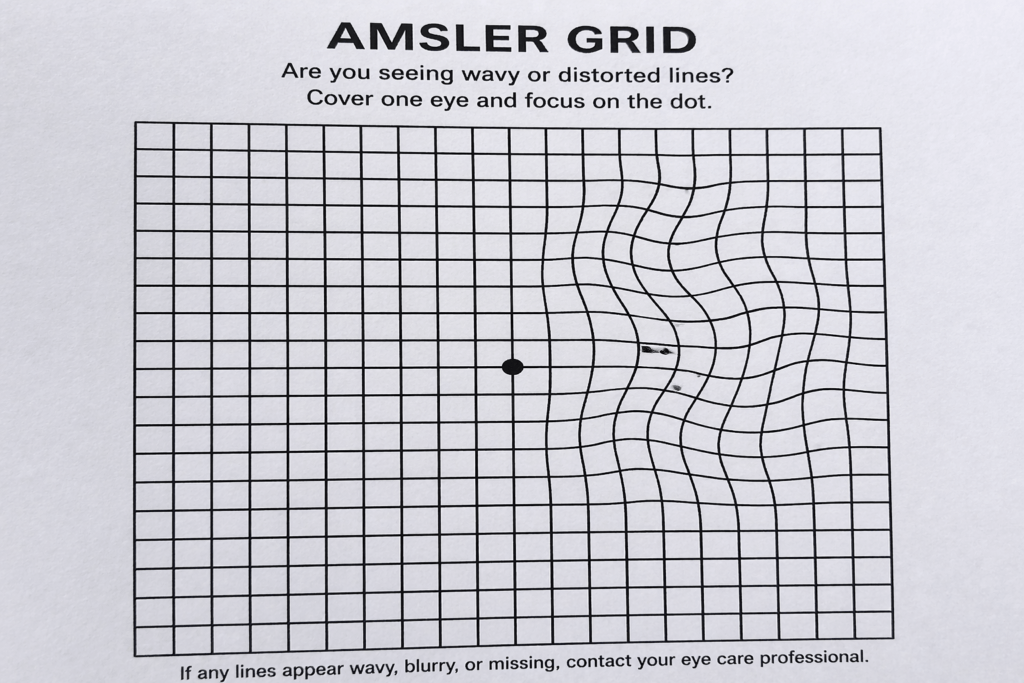
Your visual system is built to detect edges and straight lines with remarkable precision. The photoreceptor cells in your macula, the central region of your retina, are packed densely and arranged in an orderly grid. When those cells are displaced, swollen, or damaged, the spatial map they send to your brain gets distorted. Your brain then interprets that corrupted signal as bent or wavy geometry, even when the actual lines in front of you are perfectly straight.
Think of it like a camera sensor that’s been partially warped. The lens may be fine, the image may be clear, but the underlying structure receiving that image is no longer flat. The result is predictable: straight inputs produce curved outputs.
Metamorphopsia affects an estimated 5 to 10 percent of people over the age of 65, largely driven by the increasing prevalence of age-related macular degeneration in older populations. It is one of the most underreported visual symptoms because many people initially attribute it to fatigue or a dirty lens.
What Are the Most Common Causes of Distorted Straight Lines?
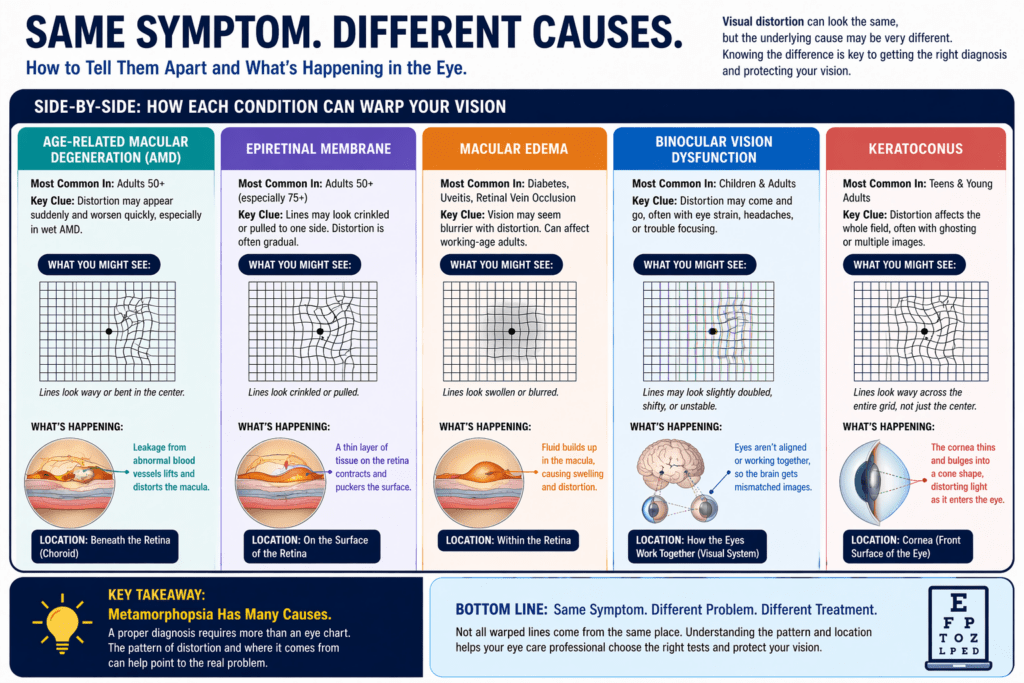
Visual distortion rarely has a single universal cause. Several distinct conditions can produce the same warped-line symptom, and distinguishing between them requires specific diagnostic tools. Here are the most frequently identified culprits.
Age-Related Macular Degeneration (AMD)
AMD is the leading cause of metamorphopsia in adults over 50. In wet AMD, abnormal blood vessels grow beneath the retina and leak fluid, physically lifting and distorting the photoreceptor layer. Even a tiny elevation of the macula can cause lines to bow noticeably. Early AMD often presents with subtle distortion before any measurable vision loss appears on a standard eye chart, which makes the symptom especially important not to dismiss.
Epiretinal Membrane
An epiretinal membrane is a thin layer of fibrous tissue that grows across the surface of the macula. As it contracts, it pulls and puckers the retinal tissue beneath it, distorting the precise arrangement of photoreceptors. The resulting symptom is often described as lines that look slightly crinkled or pulled to one side rather than uniformly wavy.
Epiretinal membranes are found in approximately 2 percent of people over 50 and in up to 20 percent of those over 75. Most cases are idiopathic, meaning no underlying cause is identified, though the condition also occurs following retinal tears, inflammation, or previous eye surgery.
Macular Edema
Swelling of the macula, known as macular edema, can develop as a complication of diabetes, uveitis, or retinal vein occlusion. The fluid accumulation thickens and distorts the retinal layers, creating the same warped visual output as structural changes do. Diabetic macular edema is one of the most common causes of visual distortion in working-age adults globally.
Binocular Vision Dysfunction
Not all distortion originates in the retina. When the two eyes are not properly coordinated, the brain receives slightly mismatched images that it struggles to fuse into a single clear picture. This can produce a subtle warping or instability in straight lines, particularly noticeable when reading or focusing at close range. Learning more about binocular vision dysfunction reveals how widespread and underdiagnosed this issue is, often masquerading as headaches, fatigue, or spatial confusion rather than obvious double vision.
Corneal Irregularities
Conditions like keratoconus, where the cornea gradually thins and bulges into a cone shape, can also distort how light enters the eye and how edges appear. Unlike macular distortion, corneal-based distortion often affects the entire visual field rather than just the central zone, and it frequently co-occurs with ghosting or multiple overlapping images.
How Do Different Conditions Compare?
| Condition | Type of Distortion | Location in Eye | Urgency |
| Wet AMD | Central wavy or bowed lines | Retina (macula) | Urgent |
| Epiretinal Membrane | Lines pulled or crinkled | Retinal surface | Monitor or surgical review |
| Diabetic Macular Edema | Central blurring and distortion | Retina (fluid) | Urgent |
| Binocular Vision Dysfunction | Subtle spatial instability | Eye coordination/brain | Non-urgent but needs care |
| Keratoconus | Ghosting, irregular distortion | Cornea | Progressive monitoring needed |
How to Test Yourself Using the Amsler Grid
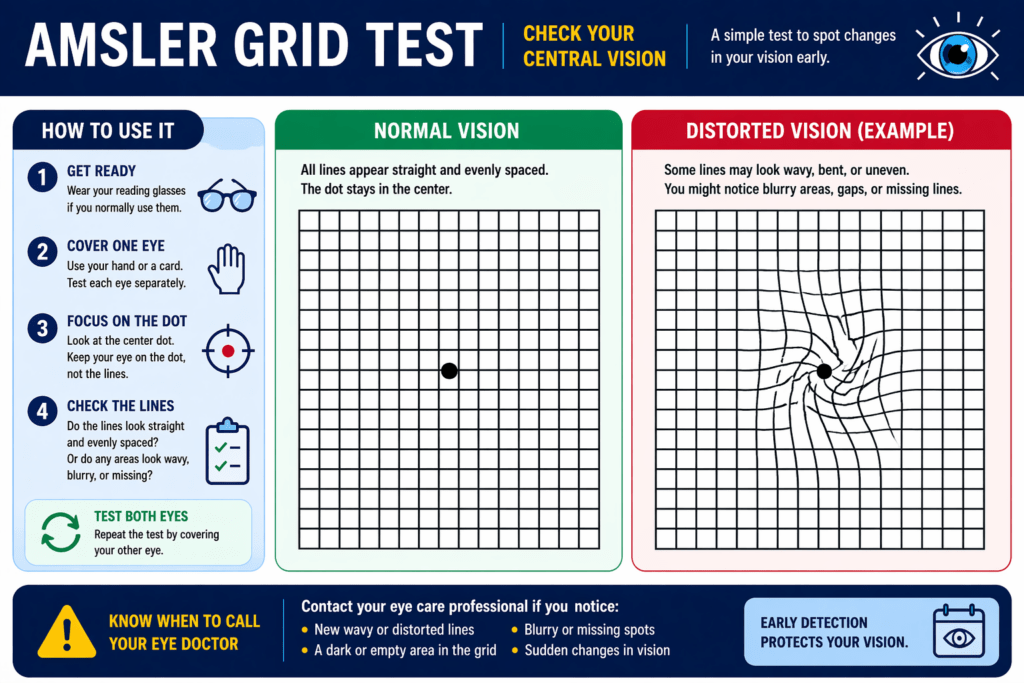
The Amsler Grid is a simple black-and-white grid pattern, originally developed by Swiss ophthalmologist Marc Amsler, that lets you check your central vision for distortion at home. While it doesn’t replace a professional exam, it’s a useful early-warning tool and is recommended by retinal specialists for monitoring known macular conditions.
- Set up correctly: Hold the grid at your normal reading distance, roughly 30 to 35 centimeters from your face, in good lighting. Wear your reading glasses if you normally use them.
- Cover one eye: Test each eye individually. Close or cover your left eye and focus your right eye on the central dot.
- Observe the grid: While keeping your gaze fixed on the center dot, notice whether any of the surrounding lines appear wavy, bent, missing, or blurry. Don’t move your eye around the grid.
- Repeat for the other eye: Cover your right eye and repeat the same process with your left eye, again focusing on the center dot.
- Note your results: If any lines look distorted or any areas of the grid appear missing, record which eye and which location on the grid was affected. This information will be valuable for your eye care provider.
- Act on abnormal results: Any distortion on the Amsler Grid, even subtle waviness, warrants a professional evaluation. Don’t wait for it to worsen before booking an appointment.
What About Vision Distortion and Neurological Conditions?
Distorted lines aren’t always a retinal story. The visual cortex and the pathways connecting your eyes to your brain can also produce warped perception when disrupted. Migraines with aura, for instance, cause temporary geometric distortions, zigzag patterns, or shimmering arcs that resolve on their own within 20 to 60 minutes.
Multiple sclerosis can affect the optic nerve and visual pathways, with optic neuritis being one of the earliest presenting symptoms in approximately 15 to 20 percent of MS cases. Visual symptoms from MS-related optic neuritis typically include blurred or dimmed vision, color desaturation, and sometimes spatial distortion, particularly during physical exertion or heat exposure — a phenomenon known as Uhthoff’s sign.
Good visual alignment between the two eyes and the brain’s processing centers is more interconnected with overall body mechanics than most people expect. Neck position, posture, and cervicogenic tension can genuinely affect how visual information is processed, contributing to spatial distortions that aren’t rooted in the eye at all.
Common Mistakes People Make When They Notice Visual Distortion
- Assuming it’s just tired eyes: Fatigue-related blur tends to resolve after rest. Persistent distortion of straight lines does not, and the distinction matters enormously.
- Waiting too long to get checked: Wet AMD can progress significantly within days or weeks. Delayed treatment allows irreversible damage to accumulate.
- Only testing with both eyes open: Mild distortion in one eye is easily masked by the healthy eye when both are open. Always test each eye individually with the Amsler Grid.
- Attributing it to a new glasses prescription: New lenses can cause a brief adjustment period, but true metamorphopsia doesn’t resolve once the adjustment phase ends.
- Overlooking binocular factors: Patients sometimes undergo extensive retinal investigations when the underlying issue is actually poor eye teaming, particularly in younger adults and children who present with spatial instability rather than blur.
What Diagnostic Tools Do Eye Specialists Use?
| Diagnostic Tool | What It Detects | Best For |
| Optical Coherence Tomography (OCT) | Retinal layer thickness, fluid, membranes | AMD, epiretinal membrane, edema |
| Fundus Photography | Retinal surface changes, drusen, bleeds | AMD monitoring, diabetic retinopathy |
| Binocular Vision Assessment | Eye alignment, convergence, tracking | BVD, convergence insufficiency |
| Corneal Topography | Corneal shape and irregularities | Keratoconus, post-surgical distortion |
| Amsler Grid (clinical version) | Central field distortion mapping | Monitoring known macular conditions |
Anti-VEGF injections have become the standard of care for wet AMD, with studies showing that early treatment can stabilize vision in over 90 percent of patients and improve vision in roughly one-third. The earlier treatment begins after symptom onset, the better the visual outcome tends to be.
For conditions involving the brain and visual processing pathways rather than the eye itself, neuroimaging and specialized perceptual testing are also commonly used alongside standard ophthalmic workups.
Frequently Asked Questions
Why do straight lines look bent?
Straight lines appear bent when the photoreceptor cells in your macula are displaced or distorted, usually due to fluid, tissue growth, or structural damage affecting the retina. The brain receives a spatially incorrect signal from the affected cells and renders it as curved geometry. Binocular vision problems and corneal irregularities can also produce a similar effect through different mechanisms.
What causes distorted lines in vision?
The most common causes include age-related macular degeneration, epiretinal membrane, diabetic macular edema, and binocular vision dysfunction. Less frequently, distorted lines can result from keratoconus, optic neuritis related to multiple sclerosis, or ocular migraine. A comprehensive dilated eye exam combined with OCT imaging is typically needed to identify the exact cause.
What are the first signs of MS in the eyes?
Optic neuritis is frequently the first ocular sign of multiple sclerosis, presenting as sudden blurred or dimmed vision, pain with eye movement, and reduced color saturation, particularly with red. Some patients also notice spatial distortion or difficulty with contrast. Symptoms typically affect one eye at a time and may partially or fully resolve, though permanent optic nerve damage can occur without treatment.
What is the distortion of straight lines that is seen with AMD called?
The clinical term is metamorphopsia, derived from the Greek words for “changed” and “form.” In AMD, the growth of abnormal blood vessels beneath the retina or the accumulation of drusen deposits physically lifts or distorts the macular tissue, causing straight lines to appear wavy or bowed. Metamorphopsia in AMD is monitored using the Amsler Grid and tracked with optical coherence tomography to detect changes in retinal structure over time.
What is distorted or warped vision?
Distorted or warped vision, clinically called metamorphopsia when it involves spatial distortion, refers to any visual experience where shapes, lines, or objects appear altered in form without an actual change in the object itself. It differs from blurred vision, which involves reduced clarity, and from double vision, which involves seeing two separate images. Distortion specifically means the spatial arrangement of what you see is being misrepresented by your visual system, whether at the level of the eye or the brain. People experiencing age-related changes may also want to explore how presbyopia eye drops fit into broader age-related vision management, as the conditions sometimes coexist.
Final Thoughts: Don’t Let Distortion Become Normal
The visual system is remarkably good at compensating. When distortion develops gradually, the brain learns to work around it, which means you might not notice how significant the change has become until meaningful damage has already occurred. That’s what makes subtle warping of straight lines such an important early signal.
Whether the cause is a retinal condition, a binocular coordination problem, or something involving the broader visual pathway, getting clarity on what’s happening is always worth the effort. Watching and waiting is rarely the right strategy when the structure responsible for your central vision is involved.
If straight lines have started looking anything less than straight to you, the team at Opto-Mization offers comprehensive vision assessments designed to identify exactly what’s driving that distortion, whether it’s retinal, binocular, or neurological. Reach out directly at +1 778-608-5982 to schedule your evaluation and get a clear picture of what your visual system is actually doing.