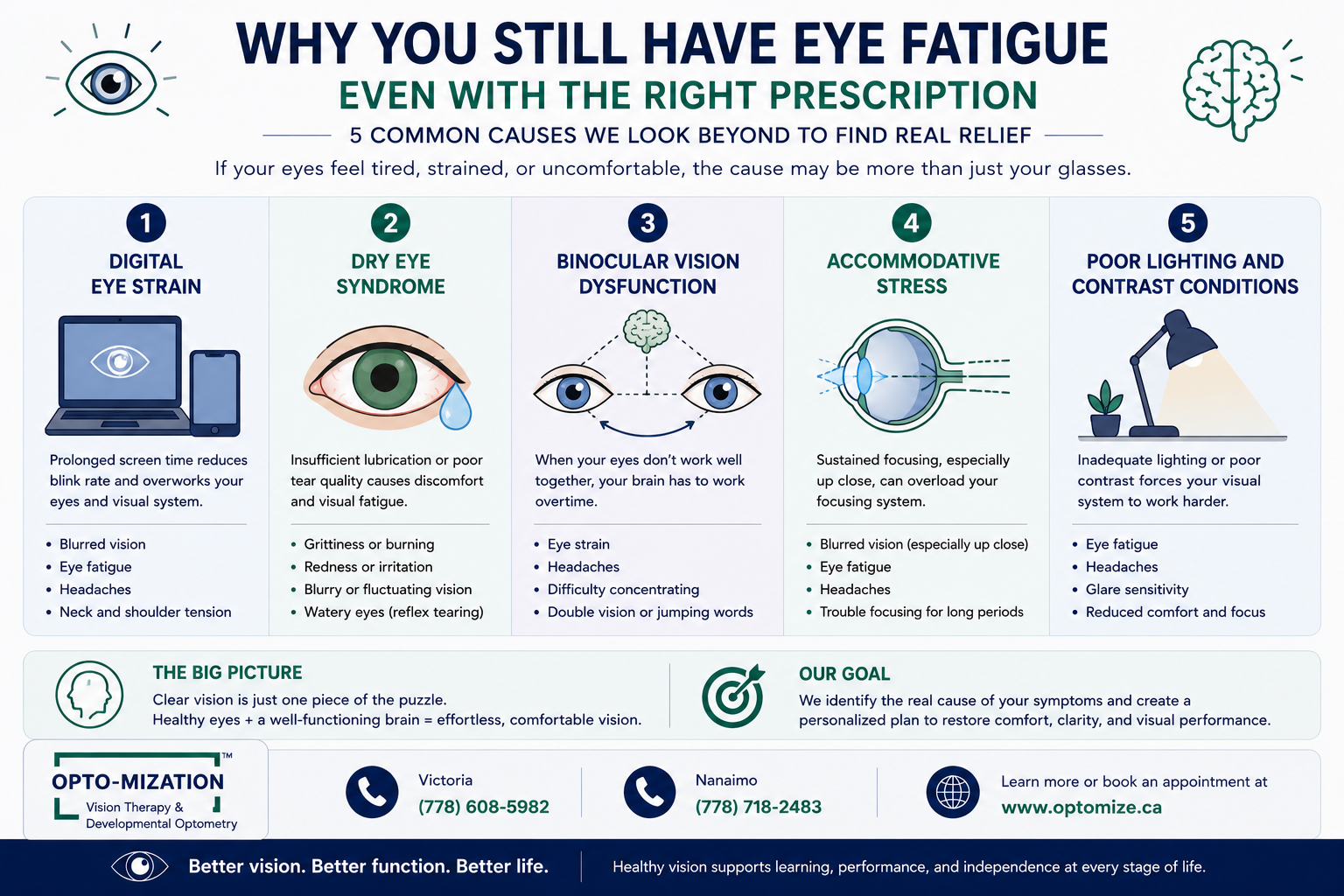
A correct prescription fixes your refractive error, but it does not address every reason your eyes can feel fatigued. Digital eye strain, dry eyes, poor lighting, binocular vision problems, and sleep disruption are all common causes of eye tiredness that persist even with perfectly fitting lenses. If your eyes feel tired regularly, a functional eye exam can identify what a standard prescription check may miss.
You got your eyes checked. The prescription is accurate. The lenses are new. And yet, by mid-afternoon, your eyes feel heavy, dry, or just plain exhausted. It is one of the more frustrating experiences people bring to eye care appointments, and the answer is almost never as simple as “your prescription is wrong.”
Key Takeaways
- A prescription corrects how clearly you see, but does not resolve every source of visual stress.
- Digital eye strain from prolonged screen use is one of the most common causes of eye fatigue, regardless of prescription accuracy.
- Dry eye syndrome, binocular vision dysfunction, and poor lighting can all create persistent tiredness even with correct lenses.
- Eye fatigue that worsens as the day progresses often points to a functional vision problem rather than a refractive one.
- Lifestyle adjustments and a thorough functional exam can uncover issues a routine prescription check is not designed to catch.
- Persistent eye fatigue should not be ignored, especially if it is accompanied by headaches, blurred vision, or nausea.
Things You Must Know
1. A Standard Eye Exam and a Functional Eye Exam Are Not the Same Thing
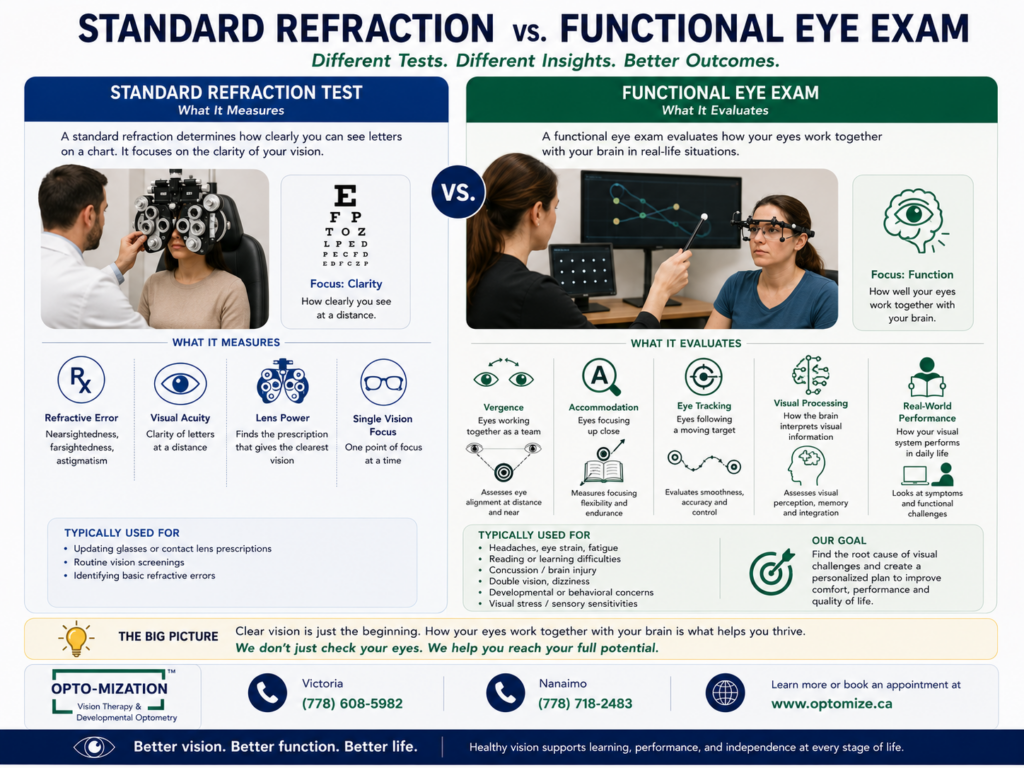
A routine eye exam primarily checks your visual acuity and determines your refractive prescription. It is excellent at telling you whether you need glasses or a stronger lens. A functional eye exam goes further, evaluating how well your eyes work together, how they track and focus, and whether your visual system is putting in more effort than it should. If tired eyes are your main complaint, the functional exam is often where the real answer lives.
2. Eye Fatigue Patterns Tell You a Lot
Pay attention to when your tiredness peaks. If your eyes feel fine in the morning and progressively worse by evening, that pattern strongly suggests a demand-related cause, such as prolonged near work, screen exposure, or a binocular vision issue that compounds over time. You can read more about this pattern in this detailed breakdown of why eyes feel fine in the morning but worse at night. Tiredness that appears immediately and stays constant points to something different, possibly dryness, lens tolerance, or an underlying health factor.
3. Uncorrected Binocular Vision Problems Are Frequently Overlooked
Binocular vision dysfunction means your two eyes struggle to work together as a coordinated team. Your brain has to exert extra effort to keep the images from each eye fused into one clear picture. This constant compensation can drain the visual system rapidly, producing fatigue, headaches, and occasionally nausea. It does not show up on a standard prescription test, which is part of why it goes undiagnosed so often.
—
What a Correct Prescription Actually Does (and Doesn’t Do)
Your prescription corrects for refractive errors: nearsightedness, farsightedness, and astigmatism. When your lenses are calibrated correctly, light focuses properly on your retina and you see clearly. That is genuinely important, but clarity of vision is only one part of how your visual system functions.
Your eyes also need to converge accurately on close objects, sustain focus for long periods, move smoothly across a page or screen, and coordinate as a matched pair. None of those abilities are measured in a standard prescription exam. So when you ask “why do my eyes feel tired even when my prescription is correct,” the honest answer is that your prescription was never designed to fix those things.
The Most Common Reasons Your Eyes Feel Tired Despite Correct Lenses
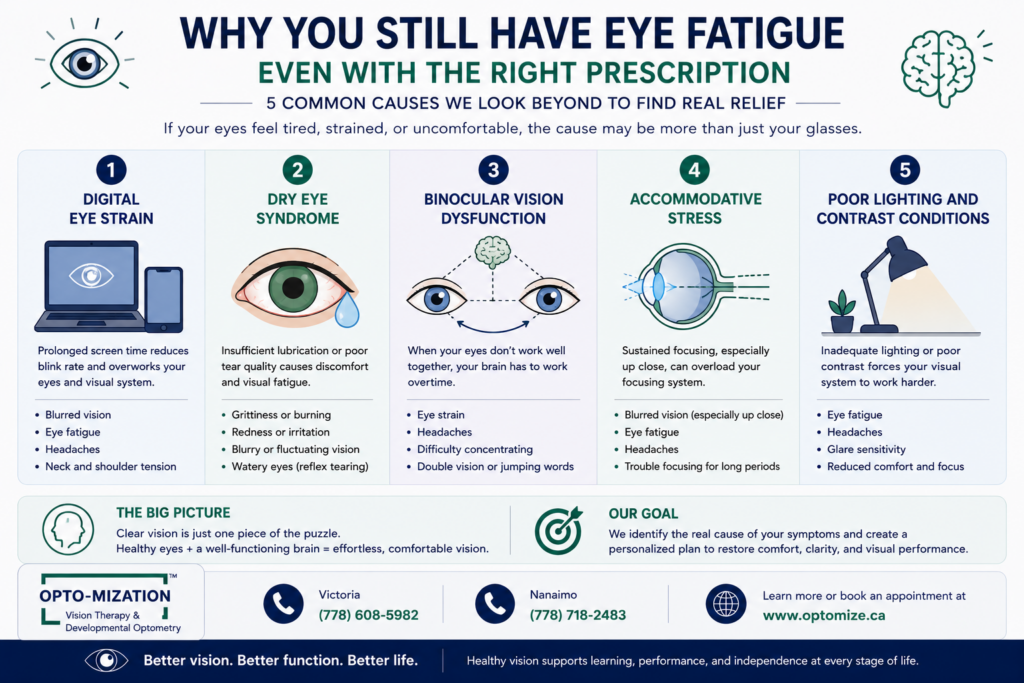
Digital Eye Strain
Screens are one of the biggest contributors to visual fatigue in modern life. When you look at a digital display, you tend to blink less frequently, which dries the ocular surface. The contrast, brightness, and refresh patterns of screens also demand sustained focusing effort in a way that reading printed text does not.
Research suggests that people blink roughly 50 percent less often when looking at screens compared to other activities, significantly reducing the natural moisture layer that keeps the eye surface comfortable and clear.
Corrective lenses do not change how often you blink or how your eyes respond to screen glare. If you spend six or more hours a day on screens, eye fatigue is almost inevitable without deliberate visual breaks, regardless of your prescription status.
Dry Eye Syndrome
Dry eye is not just a comfort issue. When the tear film is unstable, your vision fluctuates slightly throughout the day, forcing your visual system to constantly re-focus. That micro-adjustment process is exhausting over time. You might experience this as grittiness, burning, or that tired, heavy-eyelid feeling that arrives by mid-afternoon.
Dry eye is influenced by environmental factors as well, including air conditioning, indoor heating, and seasonal allergens. For anyone spending long hours in climate-controlled offices, this is a major contributing factor that lenses alone cannot address. If you notice that your eyes feel worse in air-conditioned spaces or during allergy season, persistent eye discomfort without visible redness may be worth investigating with a specialist.
Binocular Vision Dysfunction
As mentioned above, binocular vision dysfunction is underdiagnosed precisely because it does not affect how clearly you see individual objects. Your acuity can be 20/20 and your prescription perfectly calibrated, yet if your eyes are not pointing at exactly the same target at the same time, your brain works overtime to create a single, stable image. That neurological effort produces real physical fatigue.
Accommodative Stress
Accommodation is the process by which your eye’s natural lens changes shape to focus at different distances. When you switch repeatedly between a screen, a document, and a colleague across the room, your ciliary muscles are constantly adjusting. Over a full workday, that sustained muscular activity adds up. People in their late 30s and 40s often notice this more as the accommodative system becomes less flexible with age, a condition known as presbyopia even in its early stages.
Poor Lighting and Contrast Conditions
Working in low light, under harsh fluorescent overhead lighting, or in a space where your screen is significantly brighter than the surrounding environment forces your pupils to constantly adjust. That adaptive effort is tiring. Glare from windows or reflective surfaces compounds the problem. Correct lenses do nothing to fix a poorly lit workspace.
How to Tell Which Cause Is Affecting You
| Symptom Pattern | Likely Contributing Cause | Suggested Next Step |
| Eyes fine in the morning, worse by evening | Screen overload, accommodative fatigue, binocular vision | Functional eye exam, screen habits review |
| Gritty, burning sensation throughout the day | Dry eye syndrome, environment | Tear film assessment, lubricating drops |
| Tiredness with headaches behind the eyes | Binocular vision dysfunction, convergence issues | Binocular vision testing |
| Nausea or dizziness when scrolling screens | Visual-vestibular mismatch, vergence dysfunction | See a specialist, review why scrolling causes nausea |
| Straight lines appear slightly wavy or off | Potential retinal or macular concern | Prompt eye exam, read about why straight lines look distorted |
Practical Steps to Reduce Eye Fatigue at Work
- Apply the 20-20-20 rule. Every 20 minutes, look at something at least 20 feet away for a minimum of 20 seconds. This relaxes the accommodative muscle and reduces sustained near-focus strain.
- Adjust your monitor position and brightness. The top of your screen should sit at or just below eye level. Screen brightness should roughly match the ambient light in your room, not exceed it.
- Increase your blink rate deliberately. Set a reminder if needed. Intentional blinking during screen work refreshes the tear film and reduces surface dryness.
- Use preservative-free lubricating eye drops. If dryness is a factor, artificial tears used two or three times a day can maintain the tear film between blinks. Ask your eye care provider which formulation suits your tear profile.
- Review your workspace lighting. Avoid working with a bright window directly behind your monitor. Position your desk so windows are to the side, and use a desk lamp to balance ambient light.
- Request a functional vision assessment. If the steps above do not resolve your fatigue within a few weeks, a functional exam is the clearest path to an actual diagnosis.
Common Mistakes People Make When Dealing With Eye Fatigue
- Assuming a new prescription will fix everything. If the root cause is dry eye, binocular dysfunction, or screen habits, updating your lenses will not produce much improvement on its own.
- Ignoring fatigue patterns. Most people mention eye tiredness as a general complaint without noting when it peaks, how long it lasts, or what activities trigger it. That information is genuinely useful for diagnosis.
- Self-treating with over-the-counter drops without identifying the underlying cause. Lubricating drops help with surface dryness, but if the root issue is binocular vision or accommodative stress, drops will provide only temporary relief.
- Waiting too long to seek an assessment. Eye fatigue that persists for weeks or is accompanied by headaches, blurred vision, or distorted images warrants a professional evaluation sooner rather than later.
- Relying only on blue light glasses as a complete solution. Blue light filtering lenses may reduce some discomfort for certain users, but the research on their effectiveness for eye fatigue is mixed. They do not address dry eye, binocular dysfunction, or accommodative stress.
Studies examining blue light filtering lenses have produced inconsistent findings regarding their impact on eye strain symptoms, with several systematic reviews concluding that current evidence does not strongly support them as a primary treatment for digital eye strain.
When Eye Fatigue Points to Something More Serious
Most eye fatigue is not dangerous, but some patterns deserve prompt attention. If your tiredness is accompanied by pain inside the eye, sudden changes in vision, double vision that you cannot voluntarily correct, or the appearance of distorted lines, those are signals worth taking seriously.
Certain neurological conditions, including multiple sclerosis and early-stage macular degeneration, can first present as visual fatigue or subtle changes in how the eyes work together, making thorough examination important when fatigue is persistent or unexplained.
Fatigue alone is rarely an emergency, but it is your visual system’s way of communicating that something is asking too much of it. Listening to that signal early usually leads to a faster and simpler resolution.
Frequently Asked Questions
Is “Digital Eye Strain” causing my tired eyes?
It is very likely a significant factor if you spend several hours a day on screens. Digital eye strain, also called computer vision syndrome, results from reduced blinking, sustained near focus, and the contrast demands of screen environments. The good news is it responds well to behavioral changes like the 20-20-20 rule, adjusted screen positioning, and intentional blink habits. A functional assessment can confirm whether digital strain is the primary driver or whether other factors are also at play.
Why do my eyes feel exhausted even though my prescription is correct?
Because a prescription only corrects how sharply you see at various distances. It does not fix how well your eyes work together, how effectively they sustain focus over hours of near work, or whether your tear film is stable. Binocular vision dysfunction, dry eye, accommodative fatigue, and screen habits are all separate systems that a prescription does not address. If those systems are under stress, fatigue will persist regardless of lens accuracy.
Can dry eyes or allergies make my vision feel strained?
Yes, and both are underestimated contributors. Dry eye creates an unstable tear film that causes your vision to fluctuate slightly, forcing continuous micro-adjustments from your focusing system. Allergies introduce inflammation and irritation that can make sustained visual tasks uncomfortable and tiring. Seasonal or environmental allergies affecting the eyes often worsen in spring and fall, and people in offices with low humidity are especially prone to dry eye flares throughout the year.
How can I relieve eye strain at my desk?
Start with the basics: take regular breaks using the 20-20-20 rule, position your monitor at or slightly below eye level, match your screen brightness to your ambient room lighting, and blink deliberately during screen use. If dryness is a persistent problem, preservative-free lubricating drops can help maintain tear film stability. Adjusting the color temperature of your screen to warmer tones in the evening may also reduce some discomfort. If these changes do not bring improvement within a few weeks, it is worth getting a functional eye exam to investigate other causes.
How do I know if the eye strain is a sign of a larger issue?
Most eye fatigue has a straightforward explanation and responds to simple changes. However, you should seek a professional assessment promptly if your fatigue is accompanied by eye pain, persistent double vision, sudden blurring, or any distortion in straight lines or shapes. Fatigue that does not improve after addressing screen habits and dryness, or that progressively worsens over weeks, also warrants a thorough examination. A functional eye exam will evaluate whether binocular vision, accommodative function, or a structural issue may be involved.
—
Your Eyes Are Telling You Something Worth Hearing
Tired eyes with a correct prescription are not a mystery without a solution. They are a clear signal that one or more parts of your visual system is working harder than it should. For many people, the answer is a combination of better screen habits, addressing dry eye, and getting a proper functional assessment that looks beyond refractive error.
If you have been living with persistent eye fatigue and the usual explanations have not been enough, Opto-Mization provides thorough functional eye care designed to find what standard exams often overlook. Call us at (778) 608-5982 to schedule your assessment and get a clearer picture of what your visual system actually needs.