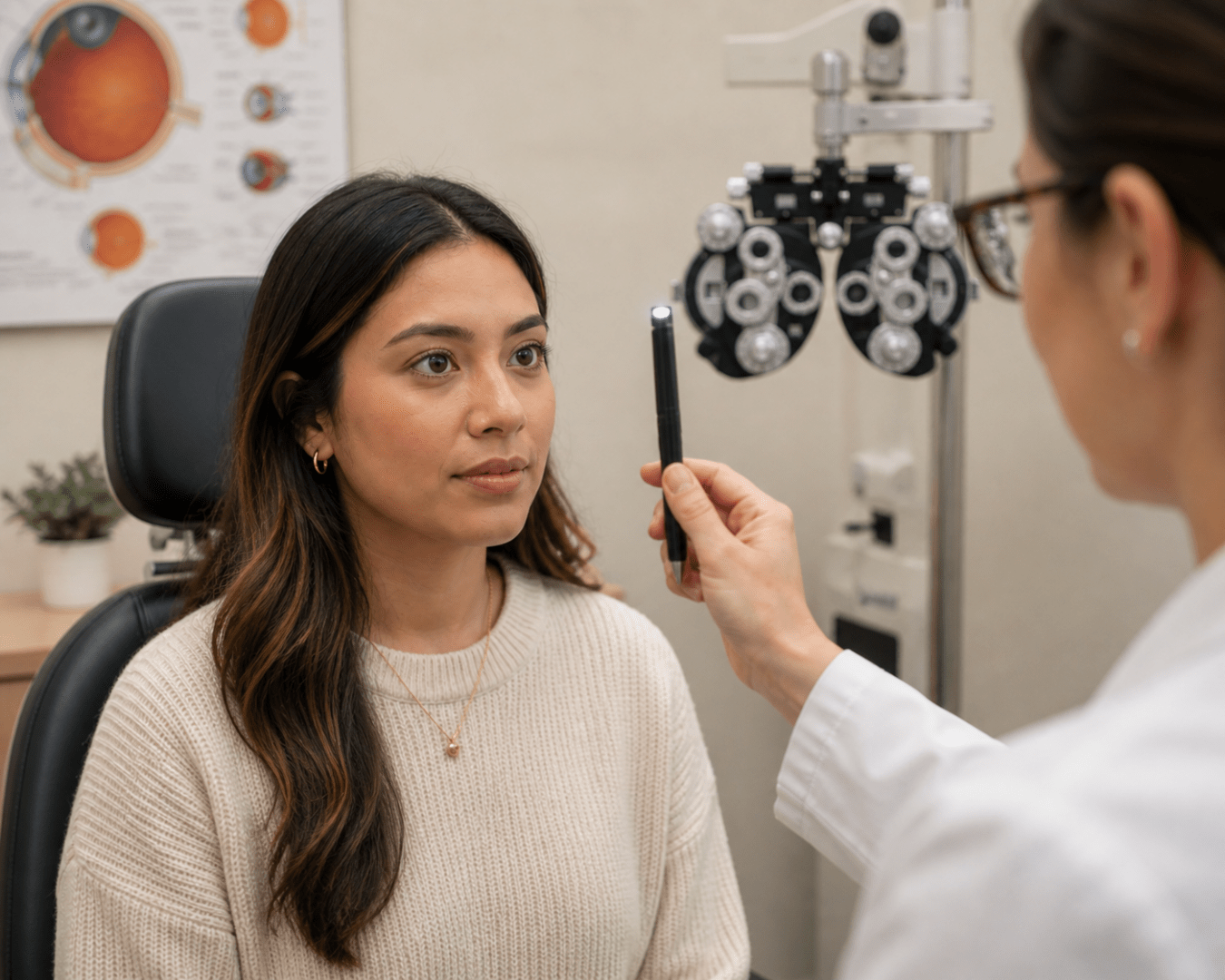
A functional eye exam goes beyond checking whether you need glasses. It evaluates how your eyes work together, process visual information, and sustain focus over time. Preparing means gathering your symptom history, understanding what tests will be performed, and knowing what to do with the results so you can make informed decisions about follow-up care.
Most people walk into a functional eye exam unsure of what sets it apart from a routine visit. You might have been referred by a doctor, recommended by a teacher, or simply noticed that something feels off with your vision even though your last prescription check came back normal. That disconnect is exactly what a functional exam is designed to investigate.
Key Takeaways
- A functional eye exam evaluates visual processing, eye teaming, tracking, and focus — not just sharpness of sight.
- Bringing a written symptom history and any previous eye exam records makes the appointment significantly more productive.
- The exam itself involves a series of non-invasive tests that can take anywhere from 60 to 90 minutes, sometimes longer for complex cases.
- You may not need to do anything after the exam, or you may receive a recommendation for vision therapy, lenses, or further testing — the results guide the next step.
- Children and adults alike can benefit, especially those experiencing reading difficulties, headaches after screen time, or balance issues with no obvious cause.
- Symptoms like watery eyes, light sensitivity, or pressure behind eyes are often worth mentioning during intake, as they can point to functional vision problems.
What Makes a Functional Eye Exam Different?
A standard eye exam answers one primary question: how clearly can you see at various distances? A functional exam asks a different set of questions entirely. Can your eyes converge accurately when reading? Do they track smoothly across a line of text? Can you shift focus quickly between near and far without strain or blur?
These are the visual skills that underpin reading fluency, sustained concentration, and comfortable computer use. When they break down, the effects often look like attention problems, fatigue, or even anxiety rather than an obvious eye issue. That’s why so many people go years without an accurate explanation for what they’re experiencing.
Research suggests that a significant portion of children diagnosed with learning disabilities actually have an underlying, untreated vision problem contributing to their difficulties, not a cognitive deficit. Functional vision assessments are often the tool that surfaces these cases after years of misidentification.
Before the Exam: How to Prepare Properly
The quality of a functional eye exam depends heavily on what you bring to it. Unlike a routine checkup, where the clinician leads everything, a functional exam is a collaborative process. Your observations matter.
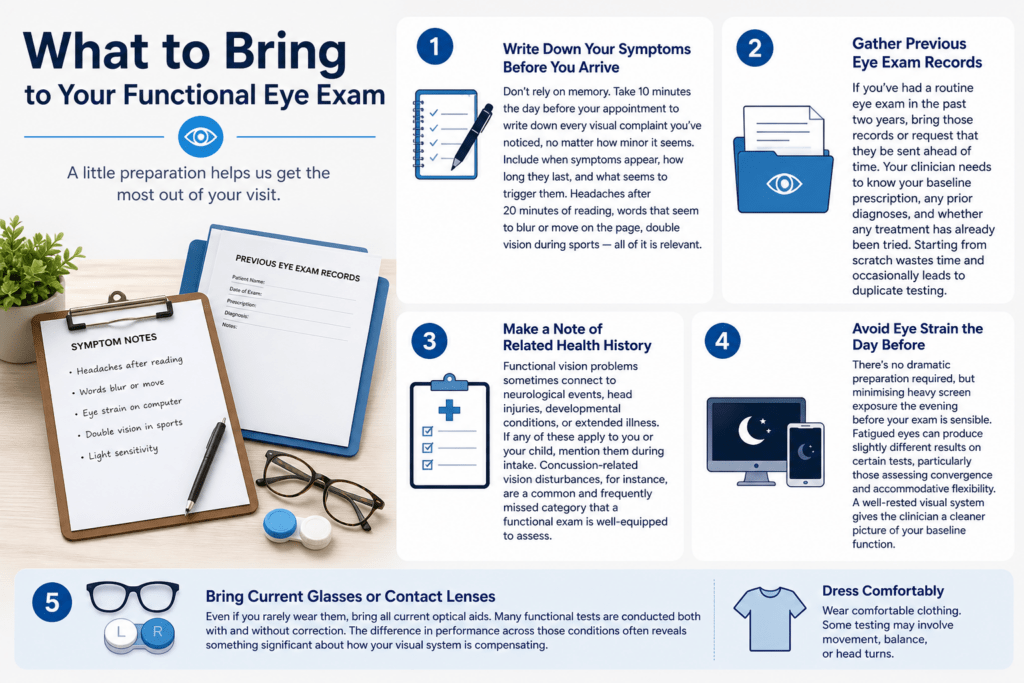
Step 1 — Write Down Your Symptoms Before You Arrive
Don’t rely on memory. Take 10 minutes the day before your appointment to write down every visual complaint you’ve noticed, no matter how minor it seems. Include when symptoms appear, how long they last, and what seems to trigger them. Headaches after 20 minutes of reading, words that seem to blur or move on the page, double vision during sports, all of it is relevant.
Step 2 — Gather Previous Eye Exam Records
If you’ve had a routine eye exam in the past two years, bring those records or request that they be sent ahead of time. Your clinician needs to know your baseline prescription, any prior diagnoses, and whether any treatment has already been tried. Starting from scratch wastes time and occasionally leads to duplicate testing.
Step 3 — Make a Note of Related Health History
Functional vision problems sometimes connect to neurological events, head injuries, developmental conditions, or extended illness. If any of these apply to you or your child, mention them during intake. Concussion-related vision disturbances, for instance, are a common and frequently missed category that a functional exam is well-equipped to assess.
Step 4 — Avoid Eye Strain the Day Before
There’s no dramatic preparation required, but minimising heavy screen exposure the evening before your exam is sensible. Fatigued eyes can produce slightly different results on certain tests, particularly those assessing convergence and accommodative flexibility. A well-rested visual system gives the clinician a cleaner picture of your baseline function.
Step 5 — Bring Current Glasses or Contact Lenses
Even if you rarely wear them, bring all current optical aids. Many functional tests are conducted both with and without correction. The difference in performance across those conditions often reveals something significant about how your visual system is compensating.
During the Exam: What Tests Are Actually Involved?
Functional eye exams don’t follow a single standardised format. The tests selected depend on your symptoms, age, and the specialty of the clinic. That said, most comprehensive assessments cover a predictable set of functional vision skills.
| Test / Assessment | What It Measures | Why It Matters |
| Convergence insufficiency test | Whether eyes can turn inward together at near distances | Difficulty here causes eyestrain and blurred text during reading |
| Saccadic eye movement tracking | How accurately the eyes jump between fixed points | Poor saccades cause line skipping and slow reading speed |
| Accommodative facility | How quickly the eye refocuses between near and far targets | Slow facility causes fatigue and blur when switching tasks |
| Stereo vision / depth perception | Whether both eyes contribute equally to 3D perception | Deficits affect sports performance and spatial judgement |
| Visual perceptual testing | How the brain processes and interprets visual input | Affects reading comprehension, letter recognition, and copying tasks |
| Binocular vision evaluation | Overall eye teaming coordination and alignment | Core measure of how well both eyes work as a unified system |
A comprehensive functional eye exam typically takes between 60 and 90 minutes, and in some cases up to two hours when visual perceptual assessments are included. This is considerably longer than a standard eye exam, which usually runs 20 to 30 minutes. Clinics often ask that patients arrive a few minutes early to complete detailed intake forms covering developmental and academic history.
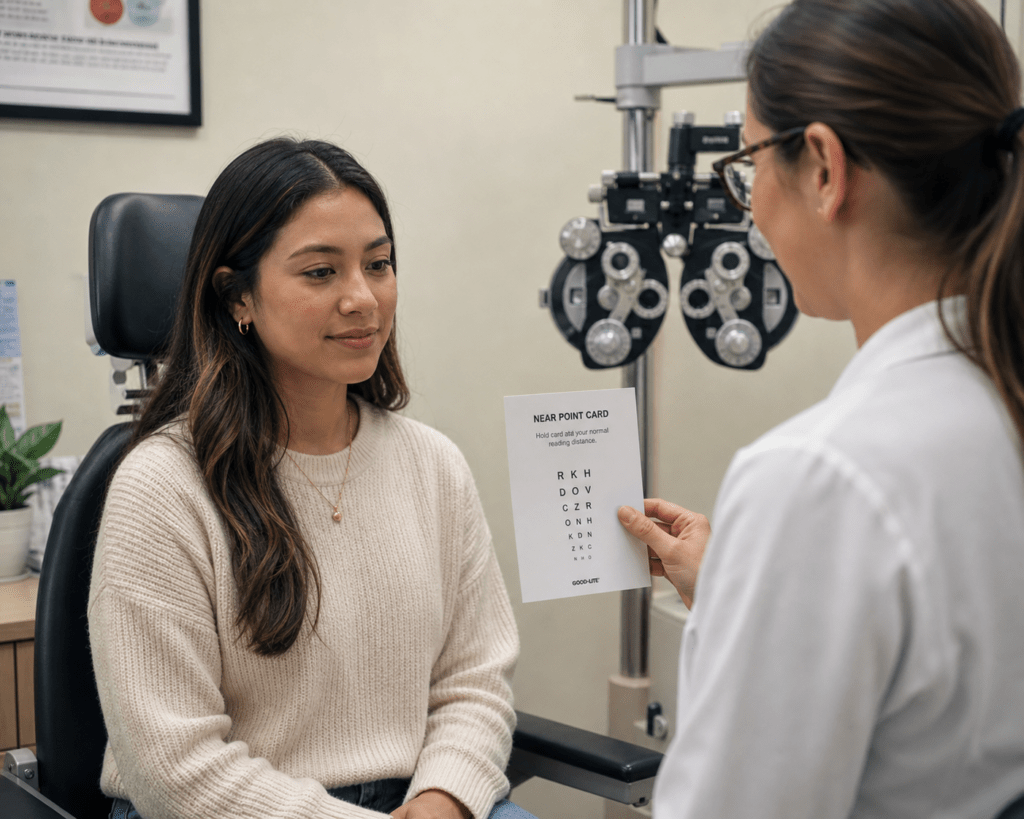
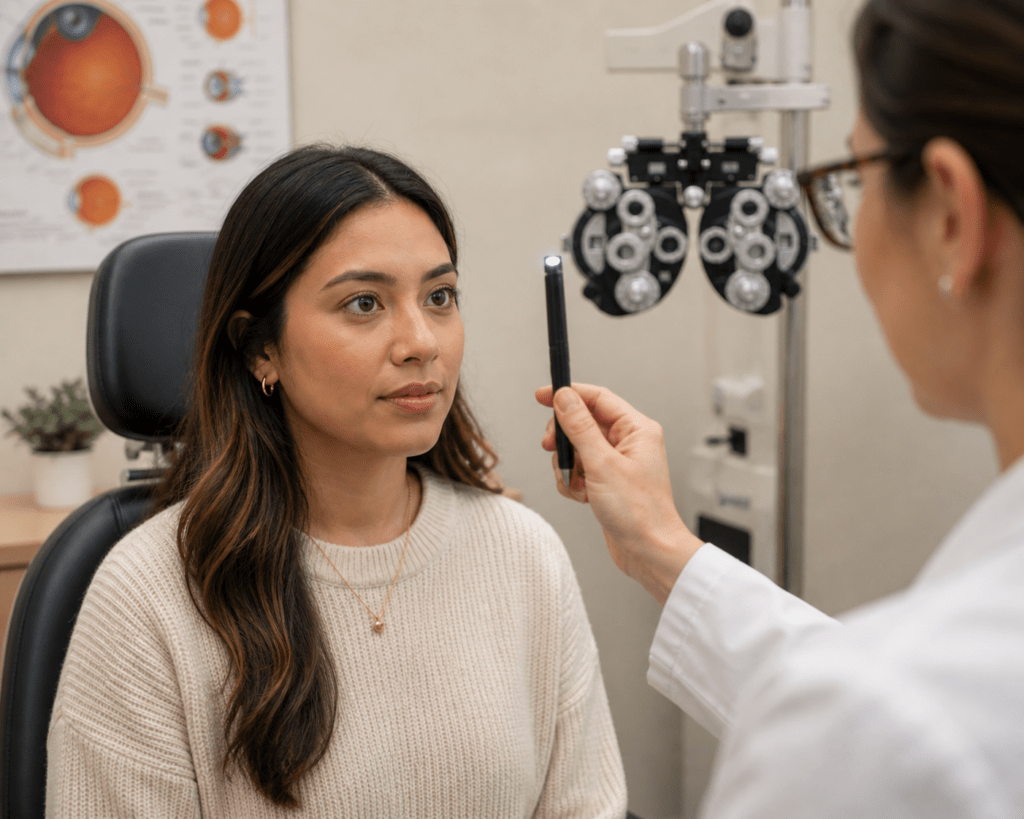
Some tests involve equipment like prism bars, polarised lenses, or handheld near-point cards. Others are entirely behavioural, the clinician watches how your eyes move during a reading task rather than using any instrument at all. None of these tests are painful or invasive.
What Happens After the Exam?
After the testing phase is complete, the clinician will review findings with you. This is a critical part of the appointment, make sure you understand what was found before you leave, and don’t hesitate to ask questions if the terminology isn’t clear.
Outcomes generally fall into one of several categories:
- No significant functional issues found — your exam results are within normal ranges, and symptoms may have another cause worth exploring separately.
- A prescription update recommended — in some cases, the right lens prescription (including prism lenses) can resolve functional difficulties without further intervention.
- Vision therapy recommended — a structured programme of exercises designed to retrain specific visual skills. Duration varies based on the nature and severity of the deficits identified.
- Referral for additional assessment — if results suggest a neurological or developmental component, a referral to a specialist may be the appropriate next step.
Vision therapy programmes for conditions like convergence insufficiency typically run for 12 to 24 weeks of weekly in-office sessions, with daily home exercises between visits. Clinical studies have shown measurable improvement in symptoms and functional performance in a majority of patients who complete the full programme.
Common Mistakes People Make When Approaching This Exam
- Dismissing mild symptoms as unimportant. Things like occasional double vision or reading fatigue are often brushed off as tiredness. These are exactly the symptoms worth documenting, because they are often the most diagnostically useful.
- Assuming a normal routine exam ruled out all vision problems. Standard exams don’t test eye teaming, tracking, or processing. A clean result from one does not mean functional vision is intact.
- Not bringing previous records. Without baseline data, the clinician may need to re-establish context that already exists somewhere in your records.
- Expecting the exam to be like a standard checkup. The pace is slower and more observational. Some patients find it odd to be asked to read aloud or track a moving target with a pen. This is normal.
- Assuming vision therapy is the only possible outcome. Many people avoid booking an exam because they fear being locked into a long treatment plan. Results don’t always lead there, and even when they do, you have a say in whether and how to proceed.
- Not asking the clinician to explain the scoring. Functional vision tests produce numerical results that can be compared to age-based norms. Ask where your scores fall and what the clinical significance is.
How Does Functional Vision Affect Daily Life?
It helps to understand the real-world impact before walking into the exam room. Functional vision problems don’t announce themselves obviously. Instead, they show up as difficulty finishing assignments, frustration with reading that seems disproportionate, or unexplained fatigue during tasks that shouldn’t feel demanding.
Studies in educational settings have found that children with undiagnosed functional vision problems are statistically more likely to be flagged for behavioural concerns and reading support, despite average or above-average cognitive ability. When the visual deficit is treated, academic performance often improves without any change to the educational approach itself.
Adults aren’t immune either. Screen-heavy work environments make demands on visual stamina that simply didn’t exist a generation ago. Symptoms like chronic headaches, difficulty concentrating late in the workday, or discomfort in bright environments can all trace back to functional vision inefficiencies rather than stress or screen time itself.
| Symptom | Possible Functional Vision Connection |
| Headaches after reading or screen use | Accommodative stress or convergence insufficiency |
| Skipping lines while reading | Poor saccadic tracking control |
| Words appearing to move or blur | Binocular instability or vergence disorder |
| Difficulty with depth perception in sports | Stereo vision deficit or suppression |
| Fatigue after short periods of close work | Reduced accommodative stamina |
Frequently Asked Questions
Is a functional eye exam covered by insurance?
Coverage varies widely by provider and region. In many cases, the initial assessment is at least partially covered under vision care or extended health plans, but vision therapy sessions may require separate approval. It’s worth calling your insurance provider ahead of the appointment and asking specifically about functional or developmental vision assessments, since the billing codes differ from a standard exam.
Can I pass a routine eye exam and still need a functional one?
Absolutely — and this is one of the most common sources of confusion. A routine exam confirms whether you need corrective lenses for distance or near vision. It doesn’t evaluate whether your eyes work together efficiently, track smoothly, or sustain focus under demand. Many people with 20/20 visual acuity have significant functional vision deficits that a standard exam simply isn’t designed to detect.
Do I automatically need vision therapy if I take this exam?
No. The exam is diagnostic, not prescriptive. Some people walk away with a simple lens adjustment, some with a referral, and some with confirmation that their vision is functioning well and another cause for their symptoms should be explored. Vision therapy is one possible outcome, not a guaranteed one, and you always have the option to discuss the findings before deciding on any next steps.
Can adults benefit from these exams?
Yes, and more adults than expected have functional vision issues that were simply never identified. Acquired brain injuries, prolonged illness, and the increasing demands of digital work environments can all create or worsen functional vision problems in adulthood. The visual system remains somewhat adaptable throughout life, and adults often respond well to appropriate treatment when the underlying issue is properly identified.
How is this different from a “developmental” eye exam?
The terms are often used interchangeably, but there’s a subtle distinction in some clinical contexts. A developmental eye exam tends to emphasise visual development in children, including how the visual system matures in relation to milestones like reading readiness. A functional exam is broader and can be applied to any age where the concern is how visual skills perform under real-world demands. In practice, many practitioners offer both under the same appointment structure.
Final Thoughts: Going In Prepared Makes a Real Difference
A functional eye exam is one of those appointments where your preparation directly affects the outcome. The clinician can only work with what they observe and what you report. Coming in with a clear symptom history, your previous records, and a realistic understanding of what the exam involves puts both you and your practitioner in the best position to identify what’s actually going on.
If you’ve been living with visual discomfort, unexplained reading difficulties, or persistent headaches that haven’t responded to other treatments, this type of assessment is often where answers finally surface. The process isn’t complicated. It just requires the right kind of exam to ask the right questions.
Ready to Book a Functional Eye Exam?
The team at Opto-Mization specialises in comprehensive functional vision assessments for children and adults. Whether you’re coming in with a long list of symptoms or simply want a deeper look at how your visual system is performing, we’re here to help you get real answers.
Call us today (778) 608-5982 to schedule your assessment or ask any questions about what the process involves.