
Dizziness in grocery stores, busy hallways, and crowded spaces is often caused by a condition called visual vertigo, where your visual system becomes overwhelmed by movement and pattern-heavy environments. Your eyes and brain struggle to process competing motion signals, triggering disorientation, nausea, or unsteadiness. A functional eye exam can help identify whether a visual processing issue is at the root of your symptoms.
You fill up a cart, turn down the cereal aisle, and suddenly the floor feels like it’s tilting. The shelves seem to shimmer. You reach for something to steady yourself and feel vaguely nauseous. Sound familiar? You’re not imagining it, and you’re not alone. For many people, busy visual environments are a genuine trigger for dizziness and disorientation. The reason why is often rooted in how your eyes and brain work together.
Key Takeaways
- Dizziness in crowded or visually busy spaces is commonly linked to a condition called visual vertigo or visual dependency syndrome.
- Grocery stores, malls, and busy hallways are high-trigger environments because of their combination of motion, fluorescent lighting, and repetitive patterns.
- The cause is often a mismatch between what your eyes see and what your inner ear and body feel.
- A functional eye exam can detect binocular vision problems and visual processing issues that contribute to these symptoms.
- Treatment options exist, including vision therapy and prism lenses, and they can significantly reduce or eliminate symptoms.
- Avoiding these environments is not a long-term solution and can actually make sensitivity worse over time.
Things You Must Know
1. This Is Not “Just Anxiety”
Many people are told their symptoms are anxiety-related and leave it at that. While anxiety can certainly play a role, visual vertigo has a distinct physiological component. If your dizziness consistently happens in visually complex environments and improves in calm, open spaces, there’s a good chance your visual system is the primary driver. Getting a proper assessment matters before drawing conclusions.
2. Your Prescription Being “Normal” Doesn’t Rule This Out
A standard eye exam checks whether you can see clearly at a distance. It does not evaluate how well your two eyes work together, how efficiently your brain processes moving visual information, or how your visual system communicates with your vestibular (balance) system. Someone with 20/20 vision can absolutely experience visual vertigo. If you haven’t had a functional eye exam focused on binocular vision and visual processing, that’s the logical next step.
3. Avoidance Makes the Problem Worse
It’s natural to start avoiding the places that trigger symptoms. But avoiding visually complex environments causes your brain to become even more sensitive to them over time. The visual system loses its tolerance for sensory input it rarely encounters. Structured exposure, combined with proper treatment, tends to produce far better long-term results than avoidance alone.
What Is Actually Happening When You Feel Dizzy in a Store?
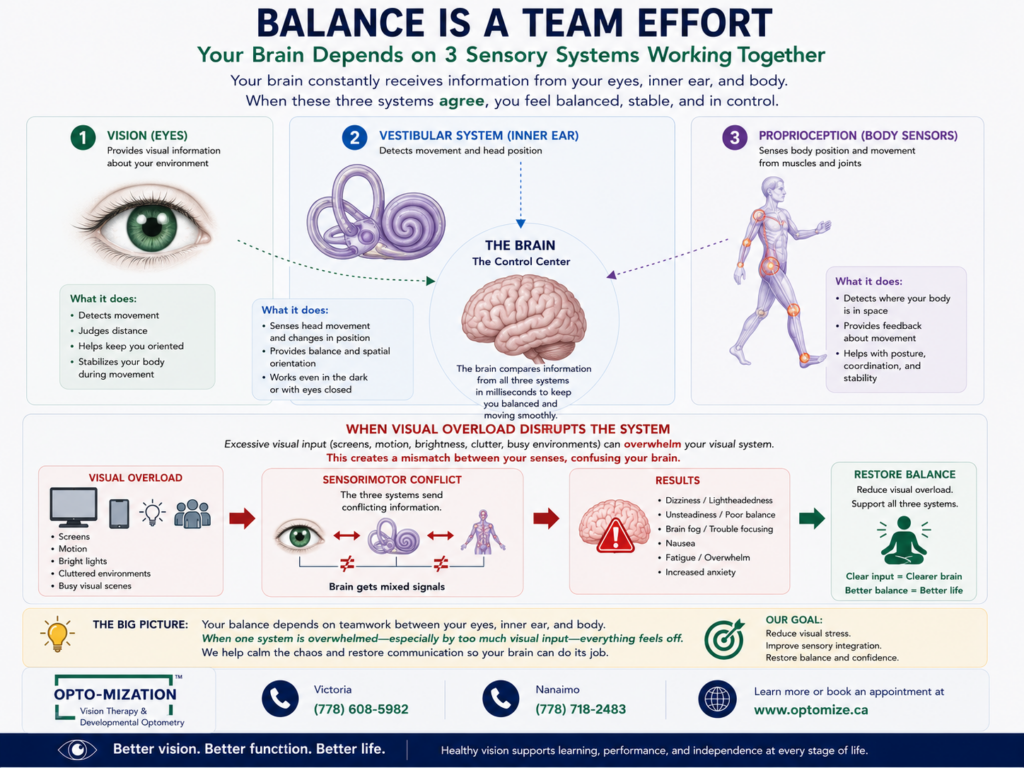
Your sense of balance depends on three systems working together: your inner ear (vestibular system), your muscles and joints (proprioception), and your eyes (visual system). Under normal circumstances, these three sources of information agree with each other. You stay upright, oriented, and comfortable.
In a grocery store, something breaks that agreement. You’re standing still, but your eyes are receiving a flood of conflicting motion signals: other shoppers moving in multiple directions, flickering overhead lighting, rows of repeating patterns, carts rolling past, and bright colors shifting in your peripheral vision. Your brain gets contradictory data. Your body says you’re stationary. Your eyes say you’re surrounded by movement. The result is disorientation, and sometimes nausea, dizziness, or a floating sensation.
Research suggests that people with vestibular disorders are significantly more likely to report visual environments as a primary dizziness trigger, with grocery stores and shopping malls frequently cited as the most common locations where symptoms occur.
Why Grocery Stores and Crowded Rooms Are Uniquely Bad Triggers
Not every busy place triggers symptoms equally. Grocery stores, big-box retail environments, and crowded hallways tend to be the worst offenders for a specific set of reasons.
| Environmental Factor | Why It Triggers Dizziness | Common Locations |
| Repetitive visual patterns | Overstimulates motion-sensitive neurons in the visual cortex | Grocery store shelves, tile floors, escalators |
| Fluorescent/flickering lighting | Creates a subliminal strobe effect that disrupts visual stability | Supermarkets, offices, big-box stores |
| Peripheral motion from crowds | Activates the brain’s motion-detection system without actual self-movement | Malls, transit hubs, crowded hallways |
| Wide open visual fields with movement at edges | Peripheral vision is more motion-sensitive than central vision | Big box stores, warehouses, airports |
| High visual contrast | Sharp contrast transitions increase cognitive load on visual processing | Checkered floors, striped clothing, product displays |
The combination of these factors in a single space, such as a grocery store with its fluorescent lights, tiled floors, and dozens of people moving at different speeds, creates a uniquely overwhelming sensory load for someone whose visual system is struggling to keep up.

Could a Vision Problem Be the Root Cause?
Visual vertigo doesn’t always mean your inner ear is damaged. In many cases, the problem originates in the visual system itself. When your two eyes don’t aim at targets in perfect coordination, a condition called binocular vision dysfunction, your brain receives slightly inconsistent images. It works overtime to fuse those images into one coherent picture. That extra strain is usually tolerable in a quiet environment, but in a visually chaotic space, the system breaks down.
Studies on binocular vision dysfunction indicate that symptoms such as dizziness, spatial disorientation, and motion sensitivity are underdiagnosed because they are frequently attributed to vestibular disorders or anxiety rather than evaluated within an optometric context.
Other visual contributors can include eye fatigue from uncorrected or improperly corrected prescriptions, convergence insufficiency (difficulty focusing on near objects), and problems with how the visual system handles contrast or peripheral motion. If you also notice that your eyes feel worse later in the day or that symptoms increase during tasks requiring sustained focus, visual fatigue may be compounding the problem.
Occasionally, people describe visual distortions alongside their dizziness, such as the sense that straight shelves look bent or off-angle. This can be a separate but related sign worth investigating. Issues like these, where straight lines appear distorted or warped, can signal problems with binocular alignment or other aspects of visual processing that a standard exam won’t catch.
When Should You Be Concerned About Something More Serious?
While visual vertigo is common and often treatable, certain symptoms alongside dizziness warrant prompt medical attention. It’s worth being clear about which signs should lead you to a doctor rather than an optometrist first.
- Sudden severe dizziness with no known trigger, especially if accompanied by headache or vision changes
- Dizziness that comes with hearing loss, ringing in the ears, or a sensation of ear fullness
- Loss of balance that causes you to fall
- Dizziness after a head injury
- Double vision or sudden changes in how clearly you can see
These symptoms may point to vestibular conditions like BPPV (benign paroxysmal positional vertigo), Meniere’s disease, or in rare cases, neurological issues. If none of these apply and your dizziness is primarily tied to visually busy environments, an optometric evaluation focused on visual processing and binocular function is a sensible place to start. Some people also report eye discomfort without any visible redness alongside these symptoms, which can be another sign of underlying visual system stress.
What Happens During a Functional Eye Exam for This Kind of Dizziness?
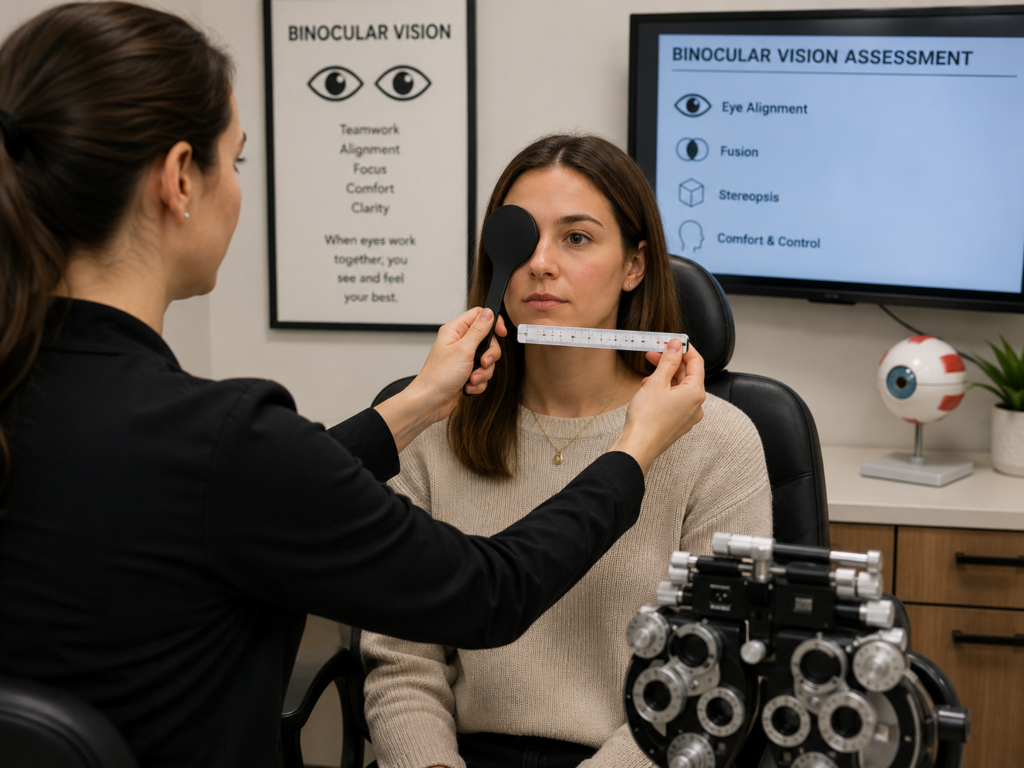
A standard prescription exam checks your distance vision. A functional eye exam goes considerably further. It evaluates how your eyes track moving objects, how well they converge and diverge together, how your brain processes motion in peripheral vision, and whether your visual system is contributing to balance and orientation problems.
- Case history review: The clinician will ask specifically about when and where dizziness occurs, how long symptoms have been present, and whether they worsen in particular environments or at certain times of day.
- Binocular vision testing: This evaluates whether both eyes are pointing and focusing in precise coordination. Even a small misalignment can create significant processing strain.
- Eye tracking and movement testing: How smoothly your eyes follow a moving target, and whether they jump ahead or lag behind, offers important clues about visual stability.
- Vergence flexibility testing: This checks how efficiently your eyes switch between focusing at different distances, which matters a great deal in busy environments where objects are at varying depths.
- Motion sensitivity assessment: Some functional exams include assessments of how your visual system responds to moving backgrounds or optic flow patterns that mimic store environments.
- Findings review and options discussion: The clinician explains what was found and discusses whether vision therapy, prism lenses, or a prescription adjustment may help.
What Are the Treatment Options?
Vision therapy programs targeting binocular dysfunction and visual motion sensitivity have shown meaningful symptom reduction in patients with visually induced dizziness, with some studies reporting improvement in the majority of participants who complete a structured course of treatment.
| Treatment Approach | Best For | Notes |
| Prism lenses | Binocular vision misalignment | Alters how light enters each eye to reduce the brain’s fusion effort |
| Vision therapy | Eye teaming, tracking, and motion sensitivity issues | Structured exercises to retrain the visual system’s processing |
| Prescription correction | Uncorrected or improperly corrected refractive errors | Sometimes a simple update eliminates most symptoms |
| Vestibular rehabilitation (with a physiotherapist) | Mixed vestibular and visual contributions | Often works best in combination with optometric treatment |
| Gradual visual exposure therapy | Sensitivity due to avoidance patterns | Supervised reintroduction to trigger environments to rebuild tolerance |
Common Mistakes People Make When Dealing With This
- Waiting years before getting assessed. Many people assume the dizziness will resolve on its own. For some it does, but for others the visual dependency deepens over time the longer it goes untreated.
- Relying only on an ENT or GP without a visual assessment. If inner ear and neurological causes have been ruled out and dizziness persists, optometric evaluation is the logical next step that is often skipped.
- Changing prescriptions repeatedly without checking binocular function. A new prescription may temporarily reduce symptoms, but if the underlying eye teaming issue isn’t addressed, symptoms tend to return. It’s worth asking whether your eyes feel tired even with the correct prescription, as this can indicate a binocular issue that goes beyond lens power.
- Assuming sunglasses or tinted lenses are the solution. While tinting can help in some light-sensitivity cases, it’s not a treatment for visual motion sensitivity or binocular dysfunction.
- Treating it purely as a mental health issue. Anxiety management is valuable, but if the visual system is the root driver, cognitive strategies alone won’t resolve the physical cause.
Frequently Asked Questions
What exactly is visual vertigo or “supermarket syndrome”?
Visual vertigo (sometimes called “supermarket syndrome” informally) is a condition where visually complex or motion-rich environments trigger dizziness, nausea, or spatial disorientation. It happens when the visual system becomes the dominant sense for balance, and that system becomes overwhelmed by too much competing visual motion. It’s distinct from inner ear vertigo but can coexist with vestibular disorders.
Why are grocery stores and crowded rooms the biggest triggers?
These environments combine multiple high-risk factors at once: repetitive patterns, unpredictable peripheral motion from other people, flickering fluorescent lights, and high visual contrast. Any one of these factors can be challenging. Together, they create a situation where the brain receives more conflicting visual information than it can comfortably process in real time, especially if there’s an underlying visual system vulnerability.
Does this mean I have a medical condition?
Not necessarily in a serious sense. Visual vertigo exists on a spectrum. Some people experience it mildly after periods of illness or stress, and it resolves on its own. Others have a persistent binocular vision issue that makes them chronically susceptible. A proper assessment helps determine whether your symptoms have a specific, treatable cause or whether they reflect a temporary sensitivity that will settle down naturally.
What can I do to prevent or reduce the dizziness?
Short-term, grounding strategies help: focusing on a single fixed point rather than scanning broadly, shopping during quieter hours with softer lighting, using a cart for physical stability, and wearing non-polarized lenses if you currently use polarized sunglasses indoors. Long-term, addressing the root cause through a functional eye exam and appropriate treatment produces better outcomes than avoidance or environmental management alone.
How is this treated if it becomes a regular problem?
Treatment depends on what assessment reveals. Binocular vision issues often respond well to prism lenses or a targeted vision therapy program. If the prescription is contributing to the problem, a correction update may help significantly. For more complex cases involving both vestibular and visual components, a collaborative approach between an optometrist and a vestibular physiotherapist can be very effective. The starting point in all cases is getting the right evaluation done.
You Don’t Have to Keep Avoiding the Grocery Store
Dizziness in crowded places is disruptive, and it can quietly start reshaping how you live, which stores you visit, which routes you take, and how much you rely on others. But it’s not something you simply have to accept. For a large number of people experiencing these symptoms, there is a clear visual cause and a clear treatment path.
If you’ve ruled out inner ear and neurological causes and the dizziness keeps coming back in visually busy environments, your eyes and how they work together deserve a much closer look.
Opto-Mization offers functional eye exams specifically designed to identify the binocular vision and visual processing issues that standard exams miss. If grocery stores, malls, or crowded rooms are consistently affecting your quality of life, call (778) 608-5982 to book an assessment and find out what’s actually driving your symptoms.