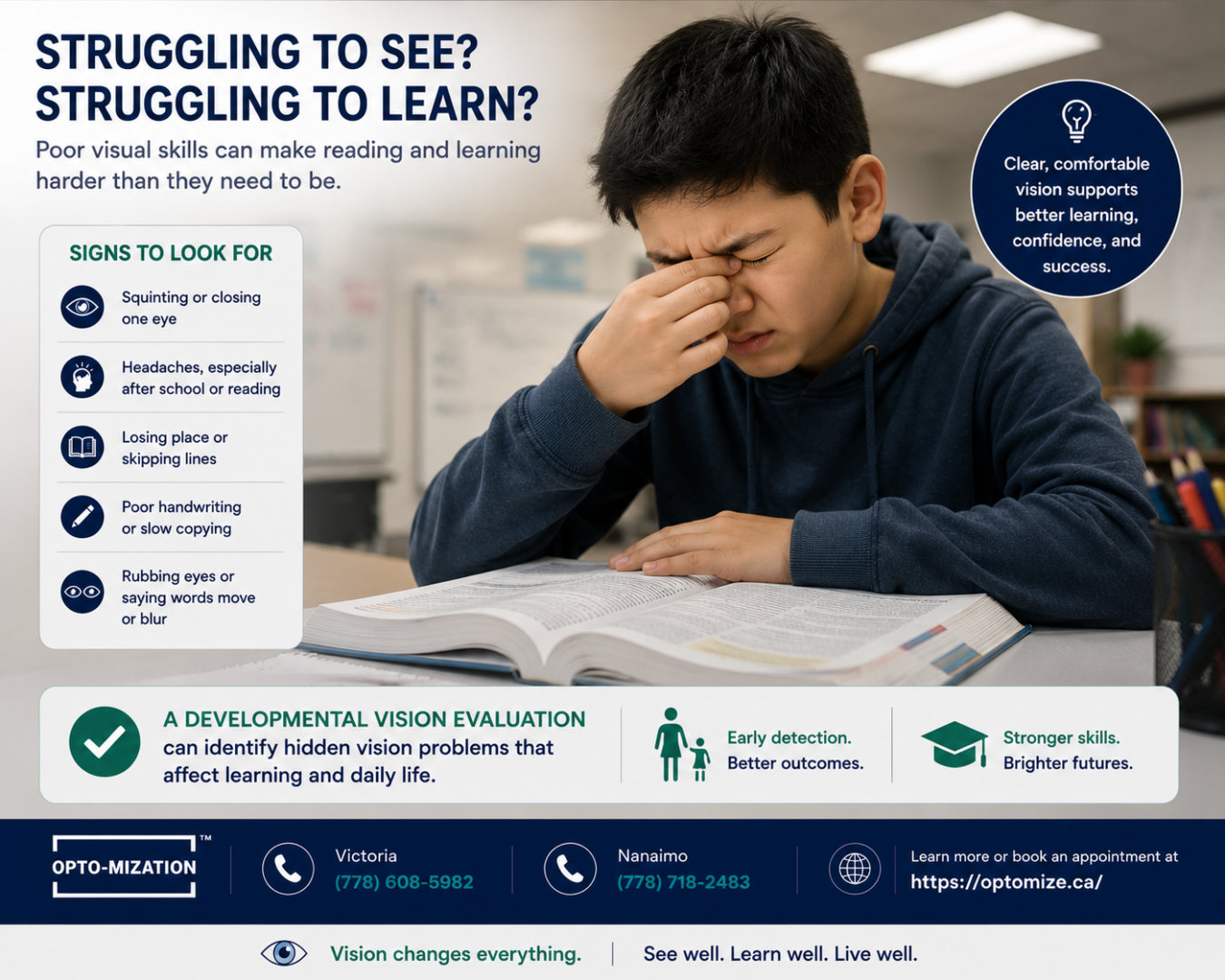
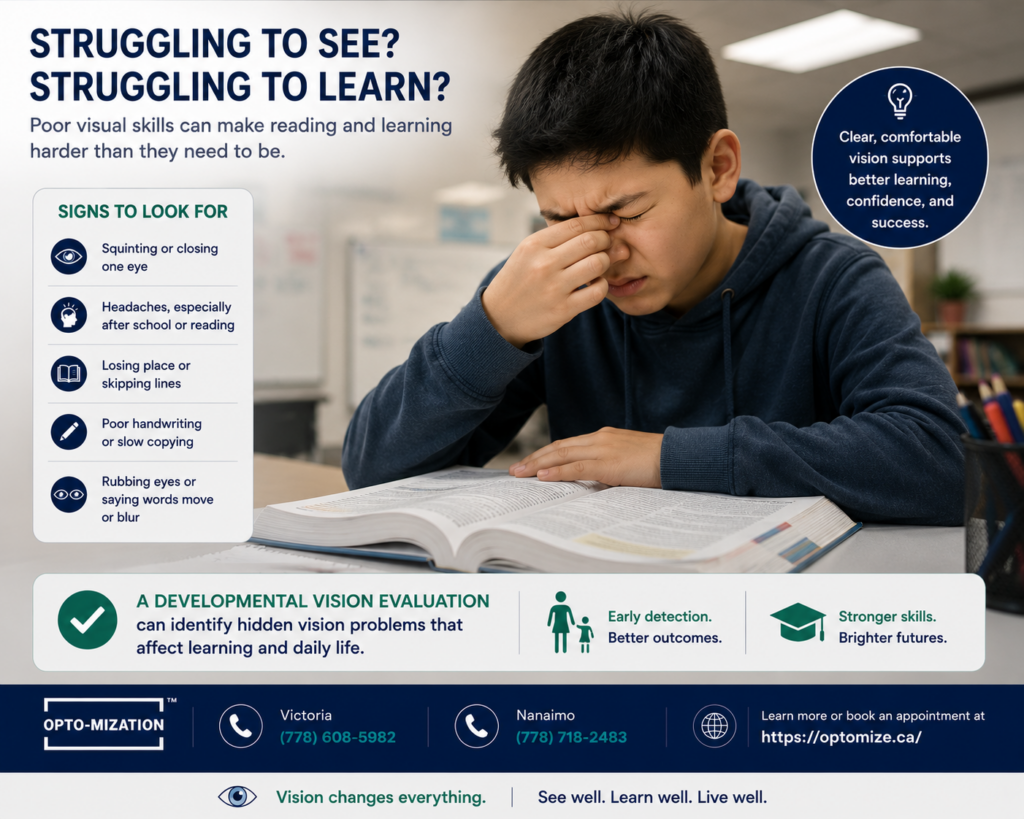
Busy patterns, dense text, and brightly lit environments overwhelm the eyes because the visual system struggles to filter and process competing sensory input simultaneously. This is often linked to visual stress, pattern glare, or an underlying condition like convergence insufficiency or sensory processing sensitivity. The right eye exam can identify what’s driving the discomfort and point toward real solutions.
You walk into a fluorescent-lit classroom, glance at a striped shirt, or try to read a page packed with small print and suddenly your eyes ache, your head throbs, and you just want to look away. It doesn’t feel like a minor annoyance. It feels like your brain is pushing an emergency stop button. That reaction is real, and it’s not something you have to simply live with.
Key Takeaways
- Visual overwhelm from patterns and busy environments is a recognized phenomenon often called visual stress or Meares-Irlen syndrome, not simply “sensitive eyes.”
- Crowded text creates a processing challenge because the brain must suppress surrounding letters to read a target word, a function that can fail in some visual systems.
- Bright fluorescent lighting produces flicker and high-contrast glare that forces the eye’s photoreceptors into overdrive, triggering physical discomfort.
- Convergence insufficiency, binocular vision dysfunction, and magnocellular pathway weakness are three clinical conditions commonly found in people who struggle with these environments.
- Tinted lenses, vision therapy, and lighting modifications can significantly reduce or eliminate symptoms once the root cause is identified.
- Children in classroom settings are disproportionately affected, and the symptoms are frequently mistaken for attention difficulties or reading disorders.
What Actually Happens in Your Visual System When It’s Overwhelmed
Your eyes don’t just passively record light. They’re part of a complex processing network where the retina, optic nerve, lateral geniculate nucleus, and visual cortex work together in milliseconds to make sense of what you’re seeing. When that pipeline is healthy and efficient, your brain filters out visual noise automatically.
When something in that chain is misfiring or overloaded, the filtering breaks down. Competing visual signals pile up without being resolved. The result isn’t just discomfort; it’s often physical, including headaches behind the eyes, nausea, fatigue after short reading sessions, and a sensation that text or patterns are moving even when they’re stationary.
Why Do Stripes and Repeating Patterns Cause So Much Distress?
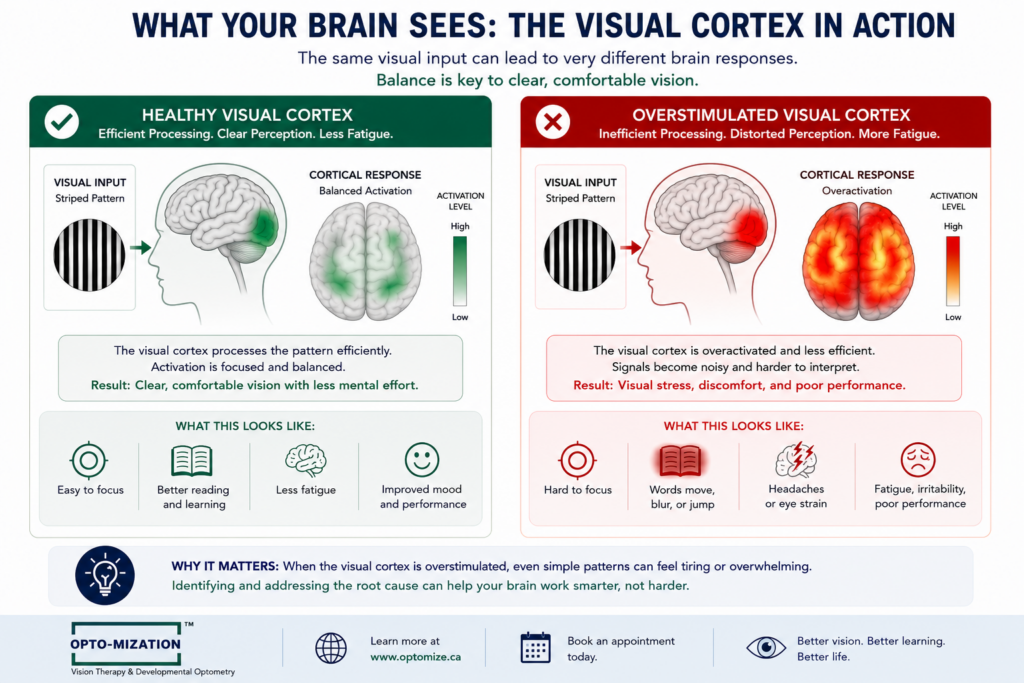
High-contrast repeating patterns, particularly black and white stripes, are among the strongest known triggers of visual cortex hyperactivation. Research in visual neuroscience has shown that these patterns produce abnormally high levels of neural activity in the primary visual cortex compared to random or natural images. In people with visual stress or photosensitive migraine, this activation crosses a threshold that triggers discomfort, perceived motion, or even seizure activity in extreme cases.
This is sometimes called the “pattern glare” response. The spatial frequency of the stripes matters a lot: patterns with a spatial frequency of around three cycles per degree are the most likely to provoke symptoms. That’s roughly the spacing you’d see on tightly lined paper, venetian blinds at a distance, or certain fabric textures.
Think about what happens when you look at an escalator handrail, a tile floor with a bold grid, or a closely printed spreadsheet. If your eyes start to water, blur, or feel strained within seconds, that’s pattern glare at work.
Why Is Crowded Text So Physically Uncomfortable to Read?
Reading researchers refer to a phenomenon called “crowding,” where letters that are physically close together interfere with each other’s recognition. The brain must isolate a single target letter from its neighbors, and this process is significantly slower and more error-prone when letter spacing is tight. Studies estimate that the crowding effect can reduce reading speed by 20 to 50 percent in individuals with reduced visual attention span, even when their visual acuity is technically normal on a standard eye chart.
This is a critical distinction. Someone might pass a 20/20 vision test and still find dense text genuinely painful to process. Standard acuity tests measure how clearly you see a single letter at a distance. They don’t test how well your visual system handles multiple simultaneous inputs in close proximity, which is exactly what reading requires on every single line.
For people with binocular vision dysfunction or a weak magnocellular visual pathway (the part of the system responsible for motion detection and spatial awareness), reading a tightly typeset page feels like trying to tune into a radio station while three other stations are playing on the same frequency.
If you experience distorted vision straight lines while reading printed text, that’s a related symptom worth investigating alongside crowding sensitivity.
What Makes Bright Classrooms So Hard on the Eyes?
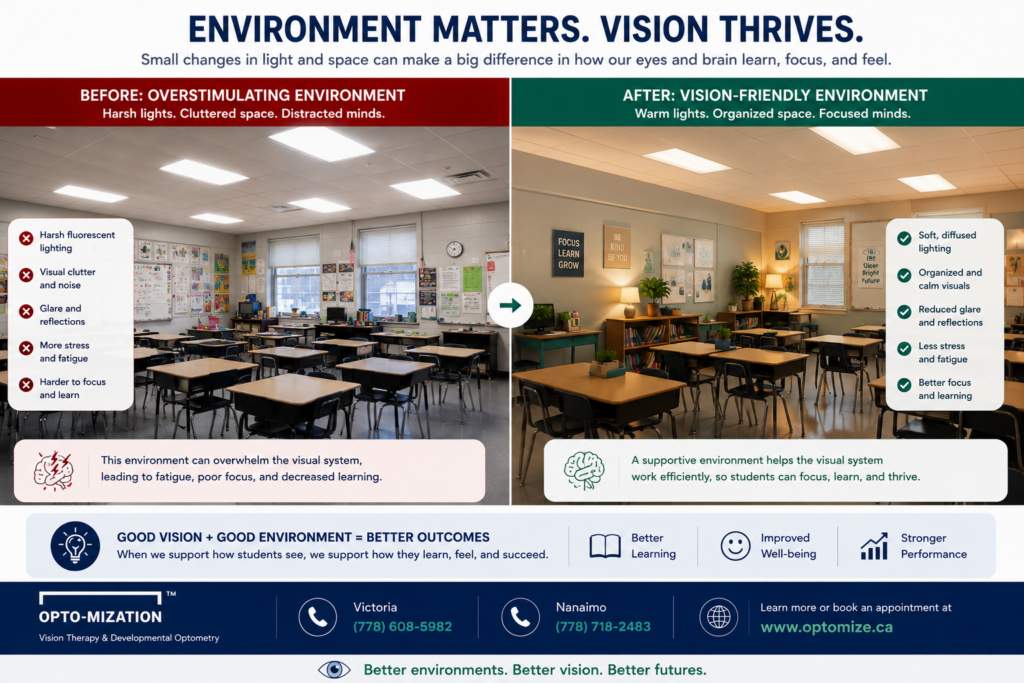
Standard fluorescent classroom lighting typically operates at an illuminance between 300 and 500 lux and produces flicker at a rate tied to the local electrical supply frequency, usually 100 or 120 cycles per second. While this flicker is imperceptible to most people consciously, studies in photobiology suggest that a subset of the population detects it subconsciously, with the visual cortex registering a pulsing stimulus that contributes to eye strain, headaches, and cognitive fatigue over sessions as short as 20 to 30 minutes.
Beyond flicker, classroom environments stack multiple visual stressors simultaneously. There’s the whiteboard glare, the contrast between a bright window and a dim corner of the room, the visual noise of posters and text on every wall, and the demand to track a moving teacher while also reading static text. For a child whose visual system is still developing, or an adult with undiagnosed light sensitivity, this combination is genuinely exhausting.
What gets misread as inattention or poor focus in a classroom is often a child whose visual system has simply hit its processing ceiling. The behavior looks like distraction. The cause is physiological.
Clinical Conditions That Drive These Symptoms
Visual overwhelm isn’t a single diagnosis. Several distinct conditions can produce overlapping symptoms. Understanding which one applies changes the treatment path completely.
| Condition | Key Symptoms | Most Common Trigger |
| Visual Stress (Meares-Irlen) | Pattern distortion, text movement, eye strain | Crowded text, striped patterns |
| Convergence Insufficiency | Double vision, headaches, avoidance of near tasks | Reading, screens, close-up work |
| Binocular Vision Dysfunction | Eye fatigue, difficulty tracking, depth perception issues | Busy visual environments |
| Photophobia | Pain or discomfort in bright light, squinting | Fluorescent lighting, sunlight |
| Magnocellular Pathway Weakness | Poor contrast sensitivity, reading instability | Dense text, high-contrast patterns |
Conditions like convergence insufficiency are surprisingly common. An estimated 5 to 10 percent of the population has some degree of convergence difficulty, yet it’s routinely missed by standard school vision screenings because those tests only check distance acuity. If your eyes are slow to focus when switching between near and far distances, that’s worth flagging to a specialist.
Is This Connected to Neurodivergence or Sensory Processing?
NEEDS CITATION
Research published in developmental vision journals has found elevated rates of visual stress and binocular vision dysfunction among individuals with ADHD, autism spectrum disorder, and dyslexia compared to neurotypical populations. Some estimates suggest that up to 65 percent of individuals with dyslexia show measurable visual processing differences, though the causal relationship between visual factors and reading difficulties continues to be studied and debated.
Visual overwhelm and sensory processing sensitivity often overlap, but they’re not the same thing. Someone might have sensory processing disorder driven by neurological differences, or they might have a purely optical condition where the mechanical function of the eyes or visual pathways isn’t working efficiently. In some people, both are present and compound each other.
The practical implication is that an occupational therapy assessment and a comprehensive functional vision exam are not competing solutions. They address different layers of the same experience. A specialist who understands both domains can help untangle which symptoms belong where.
Some people also notice pressure behind eyes during or after high-stimulation visual environments, which can be a sign of eye muscle strain or elevated intraocular tension during intense focusing efforts.
Step-by-Step: What to Do When Visual Environments Overwhelm You
- Track your triggers specifically. Note which environments, patterns, or tasks cause symptoms and how quickly they appear. This information is genuinely useful at a clinical appointment and helps distinguish between photophobia, pattern glare, and binocular strain.
- Request a functional or behavioral vision exam, not just a standard acuity check. Ask specifically about convergence, binocular alignment, and contrast sensitivity testing. These tests aren’t always included in routine eye exams unless requested.
- Try an overlay or tinted lens trial. Colored overlays placed on printed text can immediately reduce pattern glare for people with visual stress. If overlays help, a clinician can determine whether precision-tinted spectacle lenses would provide more durable relief.
- Modify your immediate environment while awaiting assessment. Swap fluorescent bulbs for warm LED alternatives where possible, increase text size and line spacing on digital devices, and use matte screen protectors to reduce glare.
- Follow through with any recommended vision therapy. For convergence insufficiency and some forms of binocular dysfunction, a structured vision therapy program produces measurable improvement in symptoms over a 12 to 24 week period for most patients.
Common Mistakes People Make When Dealing With This
- Assuming 20/20 means there’s no visual problem. Visual acuity is one small part of how the visual system works. Many people with significant binocular dysfunction or visual stress score perfectly on standard charts.
- Using sunglasses indoors as a long-term solution. Dark lenses inside cause the pupils to dilate, which can actually make light sensitivity worse over time by lowering the visual system’s adaptation threshold.
- Ignoring watery eyes causes as unrelated. Excessive tearing in visually busy environments can be a reflex response to visual strain, not just dryness or allergies.
- Attributing all symptoms to screen time. While screens can contribute to visual fatigue, they rarely cause the underlying binocular or processing issue. Reducing screen time may ease symptoms temporarily without addressing the root cause.
- Waiting until symptoms become severe before seeking assessment. Early identification, especially in children, dramatically improves outcomes and can prevent years of compensatory behaviors like avoidance of reading or academic underperformance.
Frequently Asked Questions
Why do stripes and repeating patterns hurt my eyes?
Repeating high-contrast patterns activate the visual cortex at abnormally high levels, a response researchers associate with pattern glare. In susceptible individuals, this activation triggers real physical discomfort, perceived movement in static images, and headaches. The spatial frequency of the pattern, not just its brightness, determines how strong the trigger effect is.
Why is crowded text so difficult to read?
Crowded text forces the visual system to isolate individual letters from competing neighbors, a process called lateral inhibition. When binocular coordination or the magnocellular visual pathway isn’t functioning efficiently, this filtering breaks down and reading becomes physically effortful even if you can see each letter clearly in isolation. The result is slower reading speed, fatigue, and sometimes the sensation that words are moving on the page.
What makes bright classrooms so physically uncomfortable?
Fluorescent lighting contributes flicker, high-contrast glare, and a color temperature that many visually sensitive people find harsh. Classrooms also stack visual stressors: busy walls, whiteboard reflections, window glare, and constant visual tracking demands. For children with developing visual systems or undiagnosed light sensitivity, this combination can exceed the visual system’s comfortable processing range within minutes.
Is this related to sensory processing issues or neurodivergence?
There is a significant overlap between visual stress symptoms and conditions like ADHD, autism, and dyslexia, but the relationship is not straightforward. Some individuals have a neurological basis for their sensitivity, while others have a purely functional vision condition. Many have both. A comprehensive functional vision assessment can identify which visual factors are contributing, regardless of any neurodevelopmental diagnosis.
What can I do to relieve this visual strain?
Start by tracking your specific triggers and booking a functional vision exam that includes binocular and convergence testing. Colored overlays and precision-tinted lenses help many people with visual stress almost immediately. Environmental changes like warmer lighting and increased text spacing provide measurable relief while a longer-term treatment plan is developed. Vision therapy is an effective option for binocular conditions when indicated.
Clinical studies on precision tinted lenses for visual stress have found that approximately 40 to 60 percent of individuals who respond positively to colored overlays in initial screening also show measurable improvement in reading speed and comfort with individually prescribed spectral tints after three to six months of use.
What You Should Take Away From All of This
If busy environments, striped patterns, or brightly lit spaces genuinely affect your eyes, that’s not a quirk or an exaggeration. It’s a real physiological response rooted in how your visual system is processing competing stimuli. The good news is that identifying the specific cause, whether it’s visual stress, convergence insufficiency, binocular dysfunction, or photosensitivity, opens up targeted options that can genuinely change daily life.
The worst outcome is accepting this as permanent and unchangeable. The best outcome starts with a proper examination from someone who tests beyond 20/20.
At Opto-Mization, we specialize in functional vision assessments that go well beyond standard acuity testing. If busy patterns, dense text, or bright rooms are making your daily life harder than it should be, our team can identify what’s driving those symptoms and map out a path forward. Call us at (778) 608-5982 to book your assessment. Understanding what your visual system actually needs is the first step toward genuine relief.