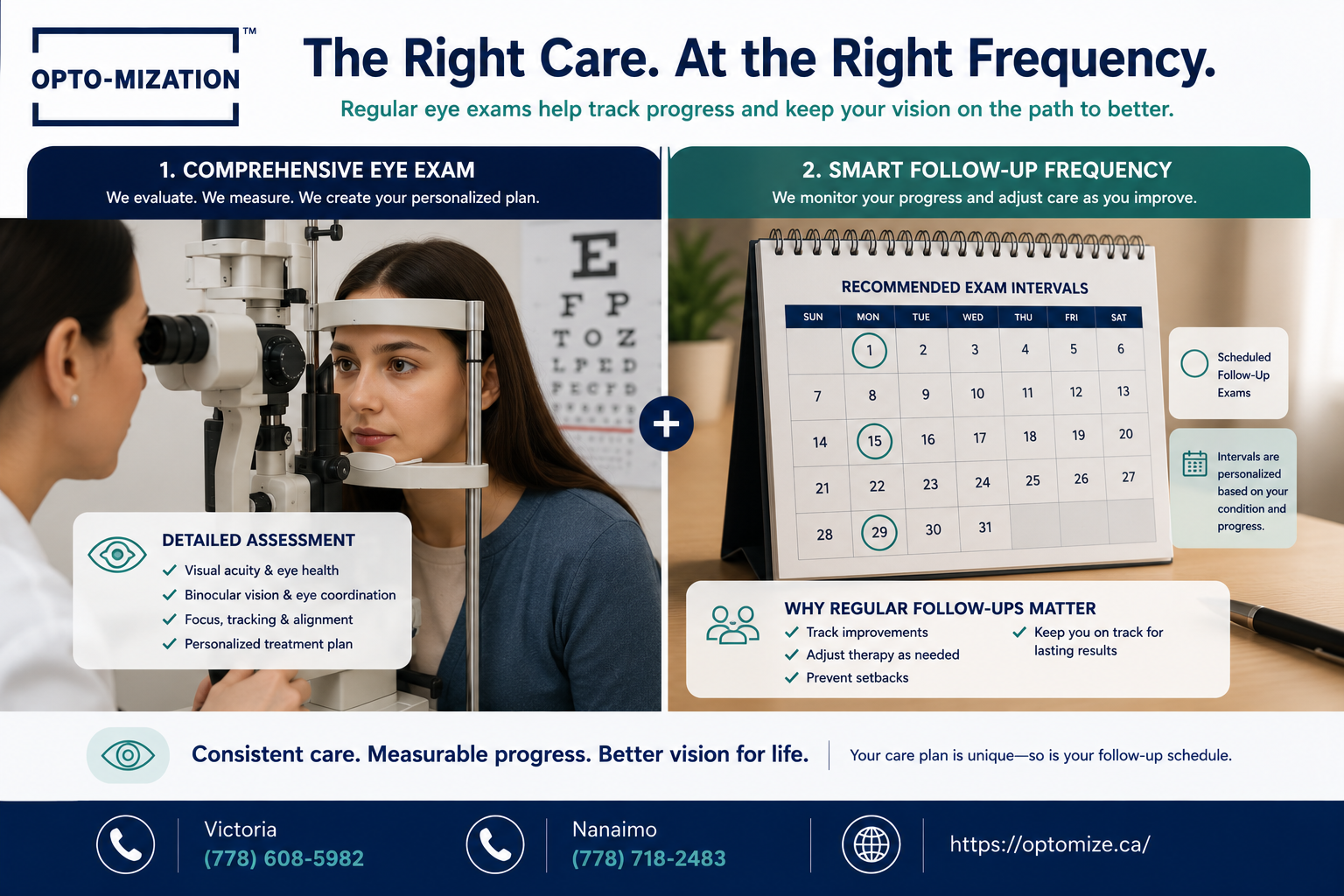
Most adults do not need an eye exam every single year without exception. The right frequency depends on your age, risk factors, existing conditions, and symptoms you are currently experiencing. Some people genuinely need exams every six months, while low-risk adults with stable vision may safely stretch to every two years.
There is a persistent belief that skipping your annual eye exam is a health risk on par with skipping a physical. That is not entirely accurate. Eye exam frequency is not one-size-fits-all, and for many healthy adults, annual visits are simply not necessary. For others, once a year is not nearly enough. Knowing which category you fall into can save you time, money, and more importantly, protect your long-term vision health.
Key Takeaways
- Low-risk adults aged 18 to 60 with stable vision and no symptoms can typically have an eye exam every one to two years rather than annually.
- Certain conditions, including diabetes, glaucoma, macular degeneration, and a family history of eye disease, require more frequent exams, sometimes every three to six months.
- Children need more frequent monitoring than most adults because their eyes are still developing and vision problems can affect learning and development.
- New or changing symptoms, such as sudden floaters, light sensitivity, blurred vision, or eye pain, should prompt a visit regardless of when your last exam was.
- A vision screening at a pharmacy or school is not a substitute for a comprehensive eye exam performed by an optometrist.
- Your prescription history matters. If your prescription has been stable for two or more years, you are less likely to need updates as frequently.
What Actually Determines How Often You Need an Eye Exam?
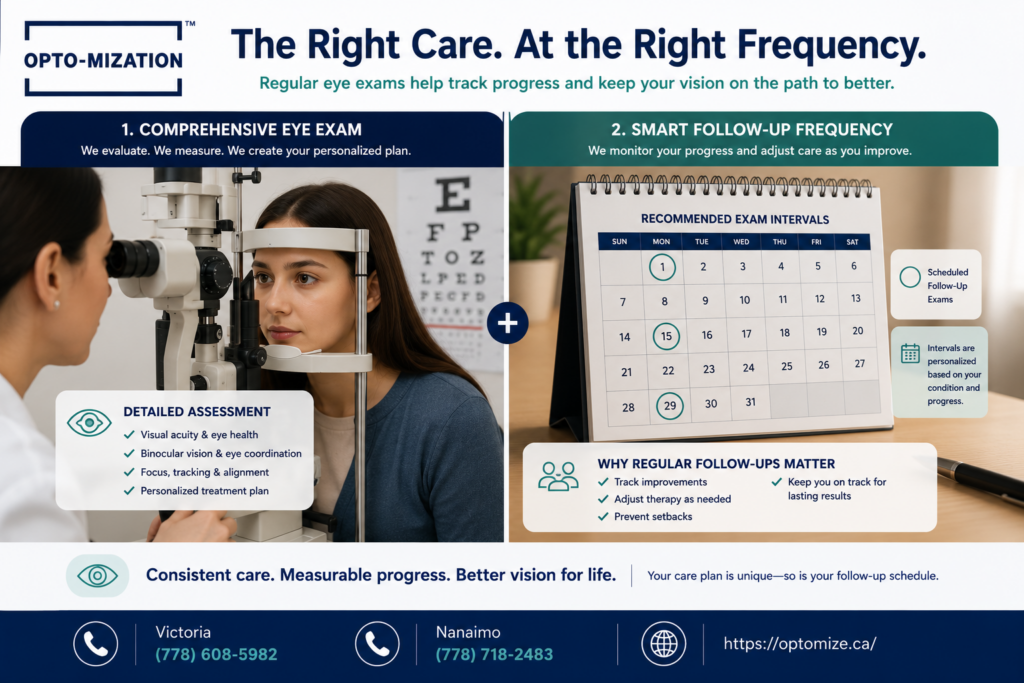
The “annual exam” recommendation comes largely from optometric associations and is a sensible default for a broad population. But it was never intended to be a rigid universal rule. In practice, optometrists tailor exam schedules to the individual patient, not to a calendar.
The key variables are age, medical history, prescription stability, and current symptoms. If all four of those are low-risk, there is a reasonable clinical case for spacing exams to every 18 to 24 months. If even one of those factors is elevated, more frequent visits become genuinely important.
Age-Based Baselines for Eye Exam Frequency
| Age Group | Recommended Frequency | Why It Matters |
| Infants (6–12 months) | Once, before age 1 | Early detection of congenital conditions |
| Children (2–5 years) | At least once in this range | Amblyopia and alignment issues peak early |
| School-age children (6–18) | Annually | Prescriptions shift rapidly; affects learning |
| Adults (18–39, low risk) | Every 1–2 years | Stable vision, low disease risk |
| Adults (40–64) | Every 1–2 years | Presbyopia onset, early glaucoma risk rises |
| Adults (65+) | Annually or more | Cataracts, macular degeneration, glaucoma all accelerate |
When Should You Go More Often Than Once a Year?
Several conditions push eye care into a monitoring category rather than a routine checkup category. When that shift happens, annual visits simply are not enough to catch changes in time.
People with diabetes face a significantly elevated risk of diabetic retinopathy, with studies estimating that roughly one in three people with diabetes has some degree of retinopathy. For those patients, optometrists typically recommend exams every six to twelve months depending on how well blood sugar is controlled, rather than waiting for symptoms to appear.
Glaucoma is often called the silent thief of sight because it causes irreversible peripheral vision loss before most patients notice any change in their day-to-day vision. Patients with elevated intraocular pressure or a confirmed diagnosis are often seen every three to six months, and some cases require monitoring even more frequently during active treatment phases.
Beyond chronic conditions, certain symptoms should send you to an optometrist right away, regardless of your last visit. These include:
- Sudden onset of floaters or flashes, especially if accompanied by a shadow or curtain across your vision
- Sudden blurring in one eye that was not there before
- Sensitivity to light that appeared without obvious cause like a cold or screen overuse
- Difficulty with near to far adjustment that feels new or significantly worse
- Persistent eye pain that does not resolve within 24 to 48 hours
- Episodes where straight lines appear bent or wavy, which can signal macular disease
If you experience distorted sight when looking at objects that should have clean, straight lines, that warrants an urgent appointment rather than a wait-and-see approach. Macular conditions that cause this symptom can progress quickly.
When Is It Actually Okay to Go Less Often?
This is the part most people do not hear from their eye care provider, partly because clinics benefit from annual bookings and partly because recommending less frequent care requires confidence in the individual patient’s risk profile.
For healthy adults between 18 and 39 with no risk factors, stable prescriptions, and no symptoms, major optometric bodies including the American Optometric Association acknowledge that a two-year exam interval is clinically appropriate. The annual recommendation is more of a conservative population-wide guideline than a hard clinical threshold for every patient in this group.
If your last two to three exams have shown little to no prescription change, your optometrist has noted no signs of early disease, and you are not experiencing any new symptoms, a conversation about extending your interval is reasonable. That said, this decision should come from your optometrist, not from your own judgment about how well you can see.
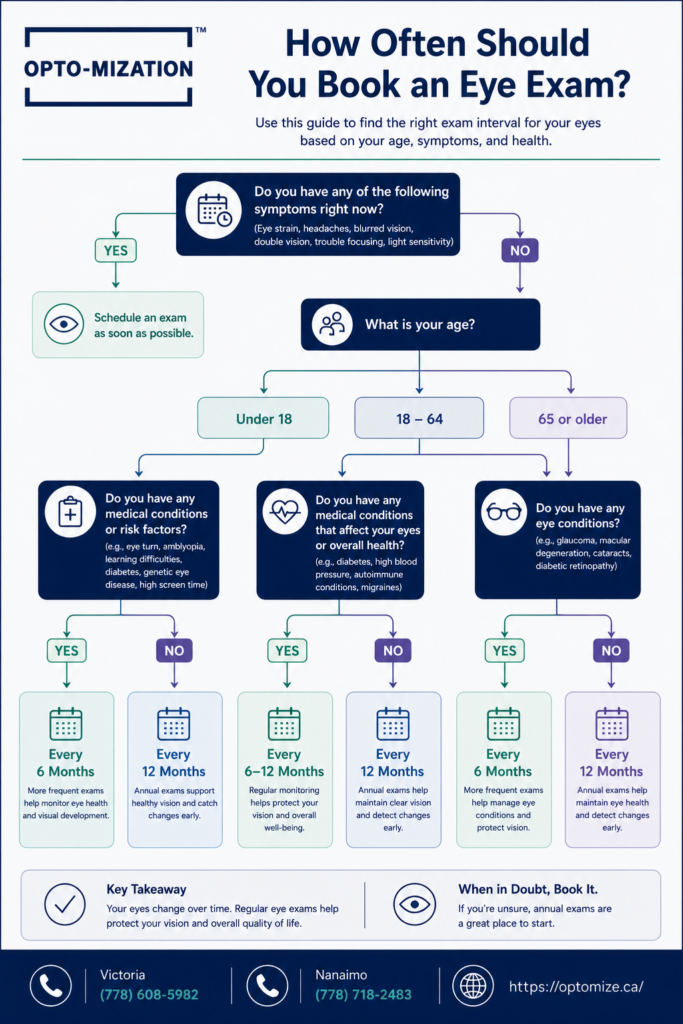
How to Know if a Symptom Warrants an Earlier Visit
One of the most practical things an optometrist can tell a patient is how to self-triage between symptoms that need immediate attention and ones that can wait for a scheduled appointment. Most people are not taught this distinction.
Step-by-Step: Deciding Whether to Book an Urgent vs. Routine Appointment
- Note when the symptom started. Sudden onset, especially within hours or a day, is a red flag. Gradual changes over weeks or months are more likely to be prescription-related.
- Check if it affects one eye or both. Symptoms affecting only one eye, particularly vision loss or distortion, are more likely to indicate a structural or vascular problem requiring prompt evaluation.
- Assess if the symptom interferes with daily tasks. If you cannot drive, read, or work comfortably because of the symptom, do not wait for your next scheduled visit.
- Test with the Amsler grid if available. This simple grid test, available to print at home, helps detect macular distortion. If lines appear wavy or missing sections, contact your optometrist the same day.
- Consider associated symptoms. If vision changes come alongside headache, dizziness, or nausea (some people find they get nauseous with visual stress), that combination can indicate neurological involvement and should be assessed urgently.
- When in doubt, call your optometrist’s office. Most clinics can advise over the phone whether you need to come in immediately or whether booking a standard appointment within the next few weeks is appropriate.
Common Mistakes People Make About Eye Exam Timing
- Assuming clear vision means healthy eyes. Conditions like glaucoma and early macular degeneration can progress significantly without any noticeable impact on central vision until damage is severe.
- Using an online prescription renewal as a substitute for a full exam. Renewing your glasses or contact lens prescription online does not include a health assessment of your eye structure, pressure, or retina.
- Waiting until symptoms are severe before booking. By the time pain, significant blur, or obvious distortion appear, some conditions have already progressed to a point where full recovery is less certain.
- Relying on school or pharmacy vision screenings. These check basic visual acuity at a fixed distance and miss a wide range of conditions that a functional eye exam would catch, including binocular vision disorders, early retinal changes, and pressure abnormalities.
- Skipping follow-up appointments after a prescription change. A significant prescription update warrants a follow-up in six to twelve months to confirm the new correction is stable and adequate.
Comparing Exam Frequency by Risk Profile
| Risk Profile | Suggested Interval | Examples |
| Low risk | Every 24 months | Healthy adult 18–39, stable prescription, no symptoms |
| Moderate risk | Every 12 months | Adult 40+, contact lens wearer, family history of glaucoma |
| High risk | Every 6 months | Diabetic patient, confirmed glaucoma, high myopia |
| Active condition | Every 3–6 months or as directed | Retinal disease, recent eye surgery, rapidly changing prescription |
High myopia, defined as a prescription of -6.00 diopters or greater, carries a significantly elevated lifetime risk of retinal detachment, myopic macular degeneration, and glaucoma compared to the general population. Patients in this category are typically advised to have annual or more frequent dilated fundus exams even if they feel their vision is stable.
Frequently Asked Questions
Do children need annual eye exams?
Yes, school-age children generally benefit from annual eye exams because their prescriptions can change quickly and vision problems directly affect reading, concentration, and classroom performance. Children often do not report vision difficulty because they assume everyone sees the way they do. An annual exam catches shifts in prescription and binocular function before they create learning barriers.
Does my insurance cover annual eye exams?
Coverage varies considerably depending on your plan and province or state. Many extended health plans cover one comprehensive eye exam per year, while some cover every two years for adults. Contact lens wearers sometimes have separate allowances. It is worth checking your specific plan, as many people discover they have coverage they have never used.
Why do I need an exam if I can see fine?
Several serious eye conditions, including glaucoma, diabetic retinopathy, and early macular degeneration, develop without causing noticeable vision changes until significant damage has already occurred. An eye exam evaluates the health of your retina, optic nerve, and intraocular pressure, not just how sharp your vision is at a particular distance. Seeing clearly is not the same as having healthy eyes.
Can I get my prescription renewed online?
Online prescription renewal services can update your glasses or contact lens numbers, but they are not a substitute for a comprehensive eye exam. They typically assess visual acuity only and do not include evaluation of eye pressure, retinal health, binocular vision, or any structural assessment. If your eyes have been stable and you only need a refractive update, some platforms may be acceptable, but they should not replace periodic in-person exams.
Is a vision screening the same as an eye exam?
No, and confusing the two is one of the most common misunderstandings in eye health. A vision screening checks how well you can see letters on a chart at a standard distance and takes only a few minutes. A comprehensive eye exam includes retinal evaluation, pressure testing, binocular function, colour vision, peripheral vision, and a detailed health history review. Many conditions that screenings miss entirely are detectable in a full exam.
The Bottom Line on Eye Exam Frequency
The honest answer to whether you need an annual eye exam is: it depends, and your symptoms and history matter more than the calendar. If you are a low-risk adult with stable vision and no symptoms, every 18 to 24 months is clinically defensible. If you have diabetes, glaucoma risk, or any of the symptoms described in this article, you likely need to be seen more often than you are now.
The worst approach is to use “I can see fine” as a reason to defer care indefinitely. Vision is slow to self-report problems, and the conditions that matter most, glaucoma, macular degeneration, retinal issues, give you very little warning before the damage is real.
Ready to Find Out How Often You Actually Need to Be Seen?
At Opto-Mization, we do not hand every patient the same annual schedule. We review your history, current symptoms, and risk factors to give you a care plan that actually fits your eyes. Whether you have not been seen in three years or you are navigating a condition that requires close monitoring, we can help you figure out exactly where you stand.
Call us at (778) 608-5982 to book a comprehensive exam or ask about your recommended exam schedule. Your eyes are too important to manage on guesswork.