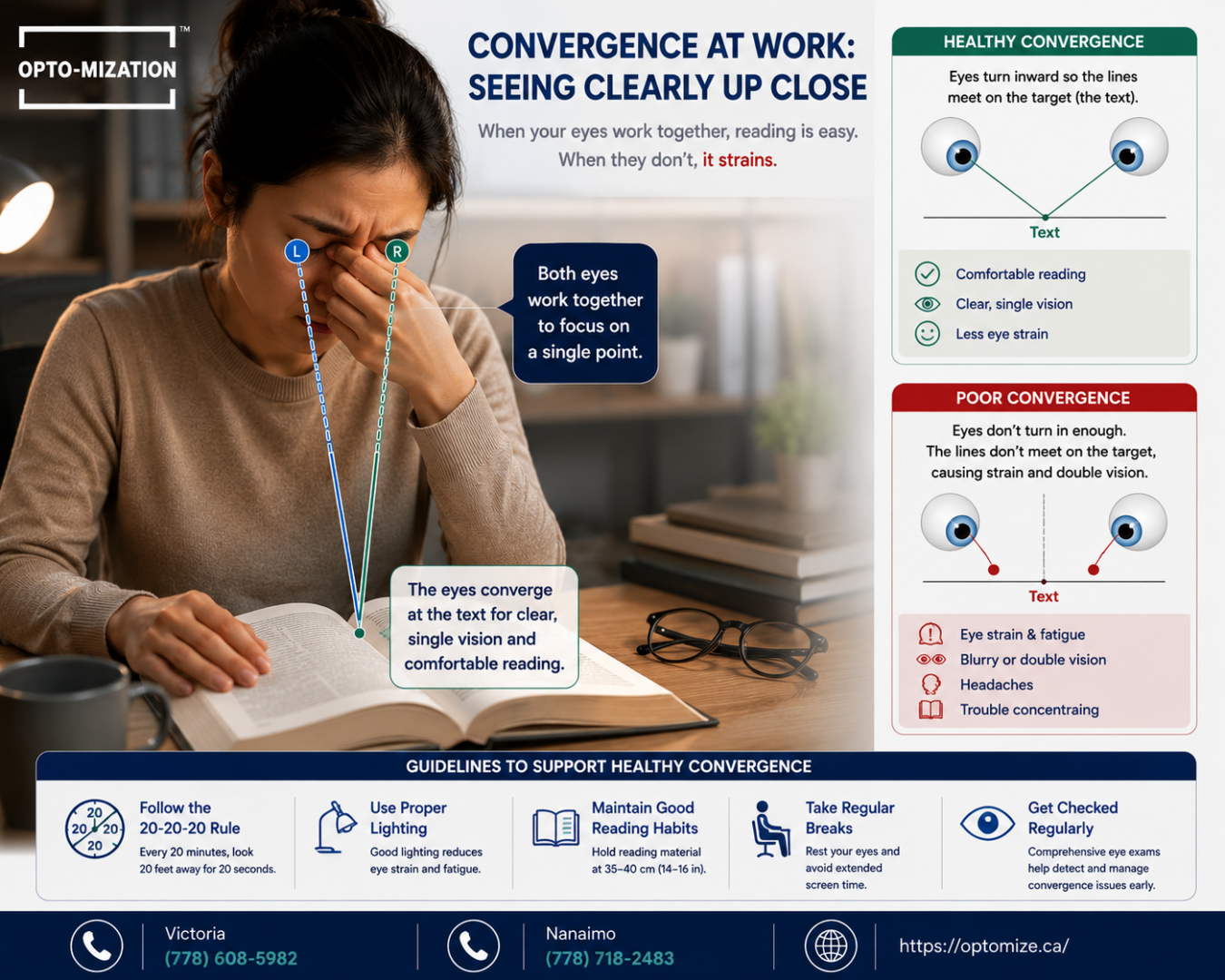
Yes, vision problems can absolutely make reading feel exhausting even when you test at 20/20. Visual acuity measures sharpness at a distance, but reading demands sustained focusing, eye coordination, and rapid eye movement — skills that acuity tests never assess. Conditions like convergence insufficiency, accommodative dysfunction, and binocular vision disorders frequently cause reading fatigue while going completely undetected on a standard eye chart.
You passed your eye exam. The optometrist said your vision is perfect. So why does reading a page for twenty minutes leave you with a dull headache, heavy eyes, and a desperate urge to stop? The problem almost certainly isn’t laziness or screen addiction. It’s a gap between what “20/20” actually measures and what reading actually demands from your visual system.
Key Takeaways
- 20/20 vision measures distance sharpness only — it says nothing about how well your eyes focus up close, coordinate together, or sustain effort during prolonged reading.
- Conditions like convergence insufficiency, accommodative dysfunction, and vertical heterophoria are common causes of reading fatigue but are routinely missed on standard exams.
- Symptoms like eye strain, blurry text after a few minutes, skipping lines, or losing your place are functional vision problems, not attention or literacy issues.
- A functional or binocular vision assessment is a fundamentally different test from a standard acuity check, and it’s the right tool for diagnosing reading-related vision problems.
- Most reading-related vision disorders are highly treatable with vision therapy, prism lenses, or updated prescriptions targeting near-work demands.
What Does 20/20 Actually Mean?
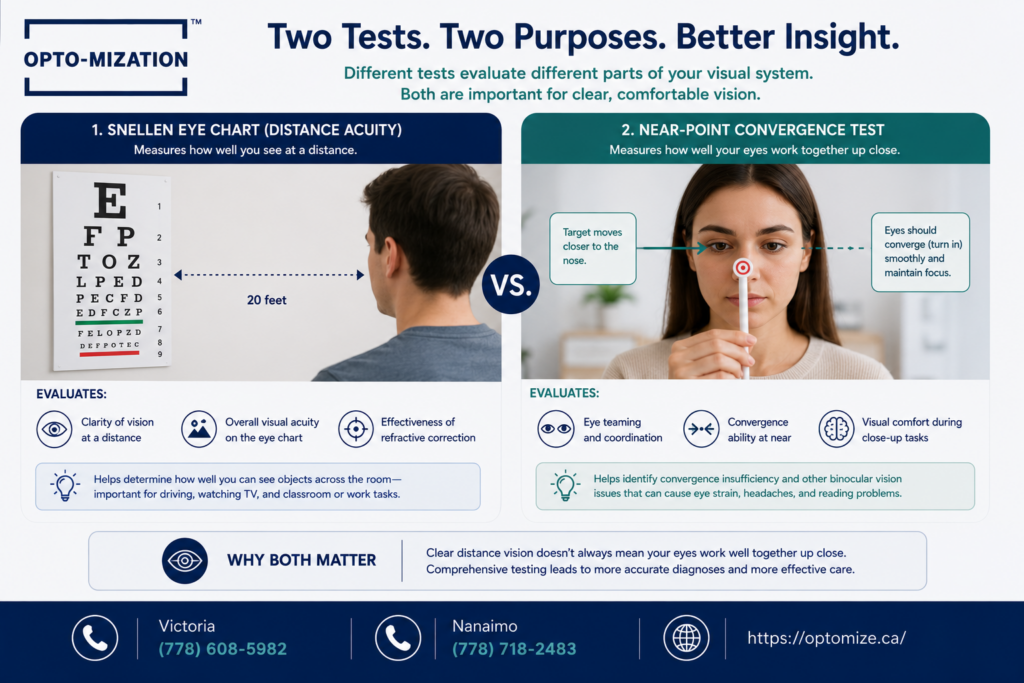
The Snellen chart, the one with the big “E” at the top, was designed in 1862 to measure one specific thing: whether you can resolve fine detail at 20 feet. A person with 20/20 vision can see at 20 feet what a typically sighted person sees at 20 feet. That’s it. That’s the entire scope of the measurement.
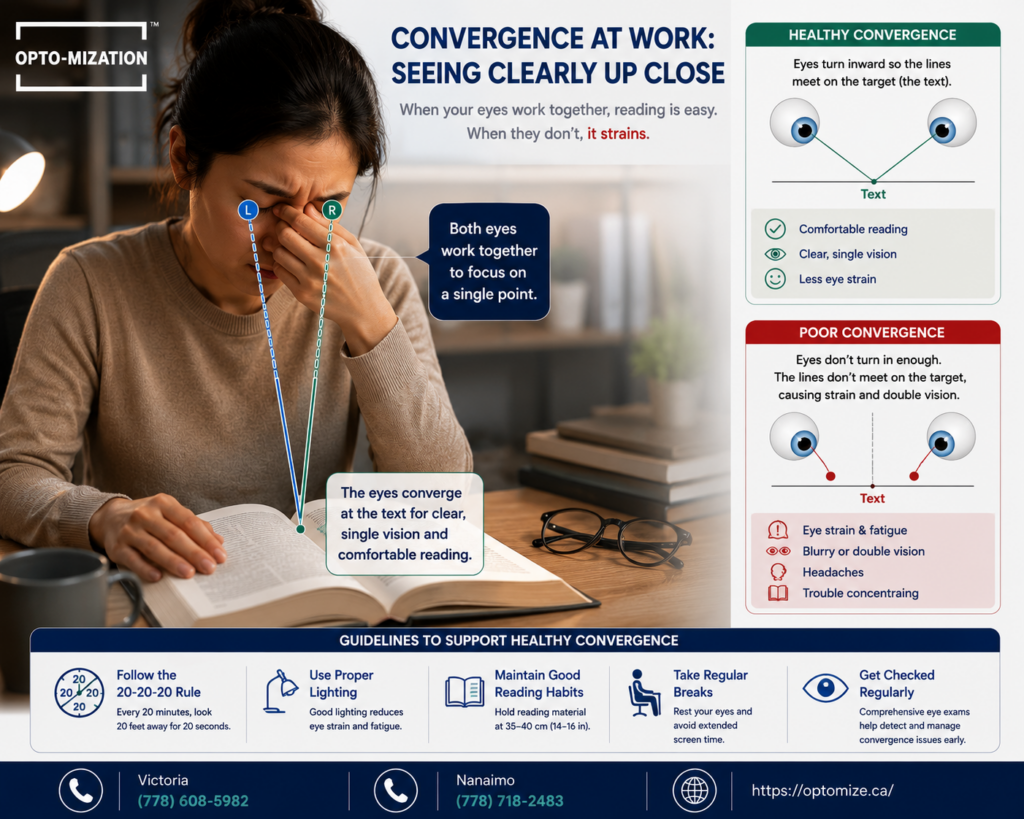
Reading a book or a screen is the opposite of that task. It requires your eyes to converge inward, your lenses to flex for near focus, both eyes to move together in precise coordinated jumps (called saccades), and your visual system to sustain all of that without drifting or blurring for as long as you’re reading. None of those abilities show up on a distance acuity test.
Think of it like testing an athlete’s sprint speed and concluding they’re fit for a marathon. The test isn’t wrong — it’s just measuring something completely different.
Which Vision Conditions Actually Cause Reading Fatigue?
Several distinct conditions are responsible for reading-related tiredness, and they’re more common than most people expect. The frustrating part is that many patients have seen multiple eye care providers without receiving a diagnosis because these conditions require specific testing to detect.
Convergence Insufficiency
Convergence insufficiency is one of the most prevalent binocular vision disorders, affecting an estimated 2–13% of the general population. It occurs when the eyes struggle to turn inward together to focus on a near target. During reading, the visual system must continuously maintain this inward alignment — and when it can’t do so efficiently, it burns through neurological effort just to keep text single and in focus. The result is fatigue that sets in within minutes, often accompanied by double vision, words that seem to move, or a sensation that text is vibrating slightly on the page.
Accommodative Dysfunction
Accommodation is the process your eye’s lens uses to shift focus from one distance to another. When this system is sluggish, imprecise, or has reduced stamina, reading demands more effort than it should. You might find that text sharpens up after a few seconds of staring, or that it progressively blurs as you read longer. Both are signs of accommodative dysfunction rather than a simple prescription issue.
If you also notice that your eyes are slow to focus when you glance up from a book to look across the room, that’s a meaningful clinical signal worth investigating.
Vertical Heterophoria and Binocular Vision Misalignment
Vertical heterophoria is a subtle vertical misalignment between the two eyes that the brain must constantly compensate for to maintain single, clear vision. Even a misalignment of just 0.5 prism diopters can trigger significant symptoms in some patients, including chronic headaches, difficulty reading for extended periods, and neck tension from unconsciously tilting the head to reduce the visual mismatch. Because the compensation is largely automatic and invisible, patients rarely suspect their eyes are working against each other.
Dry Eye and Ocular Surface Issues
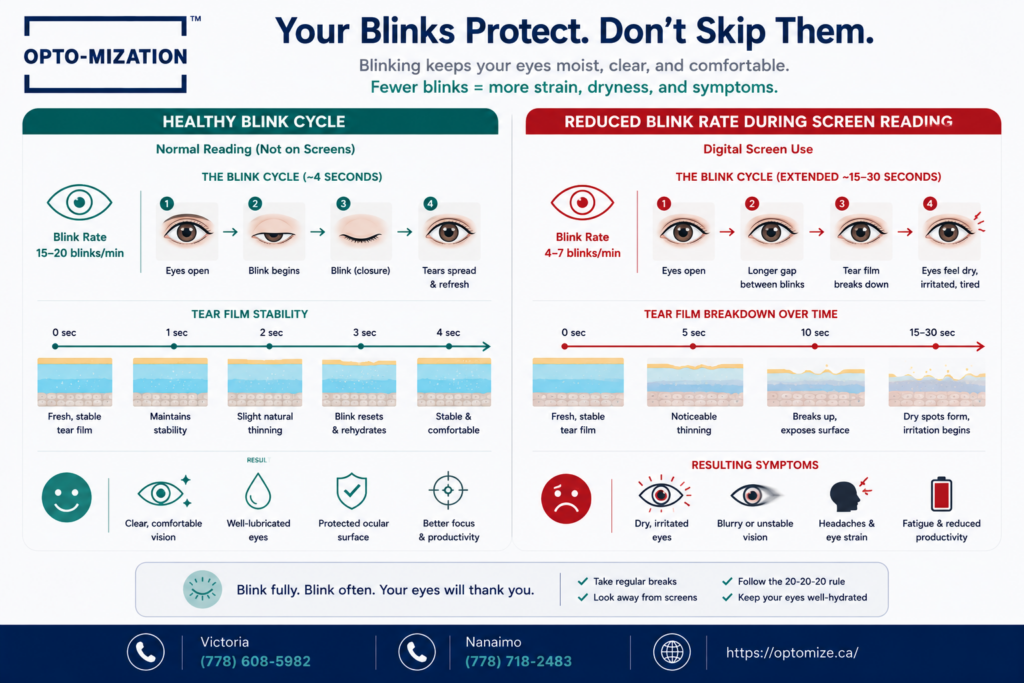
Dry eye is frequently underestimated as a reading discomfort trigger. During reading, blink rate drops significantly compared to normal activity — sometimes by more than half. When the tear film breaks down faster than blinks can restore it, the ocular surface becomes irritated and vision temporarily destabilizes. This creates a cycle of squinting, refocusing, and fatigue that feels muscular but is actually surface-level. Watery eyes causes can sometimes trace back to dry eye as well, since the eye overproduces reflex tears when the baseline tear film is insufficient.
How Reading Demands Compare to Distance Vision Tasks
| Visual Demand | Distance Vision (20/20 Test) | Reading / Near Work |
| Focus Distance | 20 feet (relaxed) | 12–16 inches (active effort) |
| Eye Convergence | Minimal | Sustained and demanding |
| Accommodation | Near-zero lens flexing | Continuous lens adjustment |
| Eye Movement | Static fixation | Rapid saccades across lines |
| Sustained Duration | Seconds (for the test) | 20–90+ minutes per session |
| Detected by Snellen Chart? | Yes | No |
What Does Reading-Related Visual Fatigue Actually Feel Like?
Most people describe the experience as “my eyes are just tired,” but the underlying sensations are more specific than that. Recognizing the pattern helps clarify whether the problem is visual or something else entirely.
- Text becomes blurry after 10–20 minutes of reading, then clears up when you look away briefly
- Words seem to move, shimmer, or crowd together on the page
- You frequently lose your place or find yourself re-reading the same line
- A dull headache develops around the eyes or temples, often worse in the afternoon
- Sensitivity to the brightness of the page or screen builds as reading continues
- Closing one eye temporarily makes reading feel easier (a red flag for binocular vision dysfunction)
Some of these symptoms overlap with light sensitivity, and the two conditions can coexist. If reading under fluorescent lighting feels disproportionately harsh, both issues may need to be addressed together.
How Is Reading-Related Vision Fatigue Properly Assessed?
Step-by-Step: What a Functional Vision Assessment Covers
- Case history focused on near-work symptoms: A clinician trained in functional vision will ask specifically about reading duration before fatigue sets in, headache patterns, and whether digital screens feel worse than printed text. This context shapes which tests are prioritized.
- Near point of convergence (NPC) testing: A target is moved slowly toward the nose while both eyes track it. The point at which one eye drifts outward reveals whether convergence is within normal range or insufficient for sustained near work.
- Accommodative amplitude and facility testing: Flipper lenses are used to measure how quickly and accurately the eye can shift focus between near and far targets, and how long it can sustain accurate near focus without degrading.
- Cover test and prism assessment: These tests detect misalignments, including subtle vertical phorias, that the brain is compensating for at measurable neurological cost during reading.
- Ocular surface and tear film evaluation: Assessing tear film stability is especially relevant for anyone experiencing fatigue specifically on screens, where blink rate suppression is most pronounced.
- Review and discussion of findings: A comprehensive summary explains which systems are contributing to symptoms and what treatment options are appropriate, from vision therapy to prism lenses to near-task-specific prescriptions.
Why Standard Eye Exams Often Miss These Conditions
A standard comprehensive eye exam is primarily designed to detect refractive errors, screen for ocular disease, and check health of the retina and anterior structures. The near-point convergence test, for example, is often not included in routine exams at many practices, even though convergence insufficiency is one of the most common causes of reading-related complaints in school-age children and adults. Studies have found that a significant proportion of patients with confirmed convergence insufficiency had previously passed standard eye exams and been told their vision was normal.
This isn’t a failure of eye care generally — it’s a scope-of-practice issue. Detecting and treating binocular vision dysfunction often requires additional training in functional or developmental optometry. Not every practice offers this level of assessment, which means patients sometimes cycle through multiple exams before someone looks at the right things.
If you’re also experiencing pressure behind eyes alongside reading fatigue, that combination is worth flagging specifically when you book an appointment, as it can help direct the clinician toward the appropriate assessment pathway.
Common Mistakes People Make When Dealing With Reading Fatigue
- Assuming the problem is the screen: Switching from digital to print doesn’t resolve binocular vision dysfunction. If your eyes strain while reading a physical book too, the issue is the visual system, not the medium.
- Relying on the 20-20-20 rule as a complete solution: Taking breaks every 20 minutes helps manage symptoms but doesn’t treat the underlying condition. It’s like taking painkillers for a broken bone.
- Attributing symptoms to aging too early: Accommodative dysfunction and convergence problems affect people in their 20s and 30s, not just those with presbyopia. Young adults with these complaints are sometimes dismissed without proper investigation.
- Dismissing the problem as psychological: Reading avoidance, poor comprehension, and apparent attention problems in children and adults are sometimes rooted in visual discomfort rather than cognition or motivation.
- Not mentioning reading-specific symptoms during an eye exam: Clinicians are more likely to test the right things when patients explicitly describe when and how symptoms occur, not just that their “eyes are tired.”
Reading Fatigue Compared to Other Nearby Symptoms
| Symptom | Likely Contributing Condition | Requires Functional Assessment? |
| Fatigue within 15–20 minutes of reading | Convergence insufficiency, accommodative dysfunction | Yes |
| Words moving or doubling briefly | Binocular misalignment, convergence insufficiency | Yes |
| Headache above the eyebrows or temples | Accommodative strain, vertical heterophoria | Yes |
| Nausea when reading on a moving vehicle or scrolling | Vestibular-visual mismatch, binocular instability | Yes |
| Eyes watering after prolonged reading | Dry eye with reflex tearing, ocular surface stress | Yes |
Research into visual contributions to reading difficulty has found that up to 80% of children referred for reading support may have at least one undiagnosed visual efficiency problem contributing to their difficulties. In adults, similar patterns emerge, particularly in those who rely heavily on near work for their occupation and who have never had a functional vision assessment despite years of experiencing symptoms.
If scrolling on your phone specifically triggers nausea or dizziness, that pattern is worth investigating separately. Nausea when scrolling phone often involves a mismatch between visual and vestibular signals that functional vision assessment can help identify.
Frequently Asked Questions
Why do my eyes feel so tired when I read?
Reading demands sustained convergence, accommodation, and coordinated eye movement across lines of text. When any of these systems is inefficient or misaligned, the visual system compensates by working harder than it should to maintain clear, single vision. That compensatory effort is what registers as fatigue. Common culprits include convergence insufficiency, accommodative dysfunction, and binocular misalignment — none of which appear on a standard distance acuity test.
What are the first signs of presbyopia?
Presbyopia typically first appears in the early to mid-40s and presents as difficulty reading small text at a normal arm’s length, a tendency to hold reading material further away to see it clearly, and increased fatigue during near tasks that previously felt effortless. It’s caused by a gradual stiffening of the eye’s lens, which reduces its ability to flex for close focus. Unlike convergence insufficiency, presbyopia is a purely age-related structural change rather than a coordination or efficiency problem.
What does visual fatigue feel like?
Visual fatigue has a recognizable pattern: it typically builds over the course of a reading session rather than appearing immediately. Eyes begin to feel heavy or sore, text may blur slightly before sharpening when you look away, and a headache may develop around the eye sockets or temples. Some people experience a compelling urge to close one eye, which temporarily reduces the coordination demand and briefly relieves discomfort — a strong indicator that binocular vision is involved.
What are the first signs of MS in the eyes?
Optic neuritis, inflammation of the optic nerve, is frequently one of the first clinical signs associated with multiple sclerosis. It typically presents as sudden blurred or dimmed vision in one eye, pain with eye movement, and sometimes a loss of color saturation (colors appear washed out). If you experience sudden vision changes in one eye accompanied by pain, that warrants urgent medical evaluation rather than a standard optometry appointment.
What are 5 warning signs of MS?
The five commonly cited early warning signs of MS include: sudden or progressive vision changes or pain in one eye (optic neuritis), numbness or tingling in the limbs or face, unexplained muscle weakness or coordination difficulties, balance problems or vertigo, and extreme fatigue disproportionate to activity level. Vision symptoms in MS are typically unilateral (one eye), sudden in onset, and accompanied by other neurological symptoms — which distinguishes them from the bilateral, effort-related fatigue of functional vision disorders. Any sudden neurological symptoms should be assessed by a physician promptly.
Final Thoughts: 20/20 Is Not the Whole Story
Passing a standard vision test tells you one thing and one thing only: you can distinguish a certain level of detail at a specific distance. It doesn’t tell you how your eyes perform under the sustained, coordinated demands of reading. It doesn’t measure whether your eyes work together efficiently, whether your focusing system has adequate stamina, or whether the effort of near work is costing you more neurological energy than it should.
If reading has felt like a physical effort rather than a natural activity, that experience is clinically meaningful. It points toward a functional vision assessment rather than another distance acuity check.
At Opto-Mization, our team assesses the full picture of visual function, not just sharpness at a distance. We examine convergence, accommodation, binocular coordination, and ocular surface health to understand why reading feels the way it does for you specifically. If any of the symptoms in this article sound familiar, we’re here to help you get a clear answer. Call us at (778) 608-5982 to book a functional vision assessment and find out what your eyes are actually doing when you read.