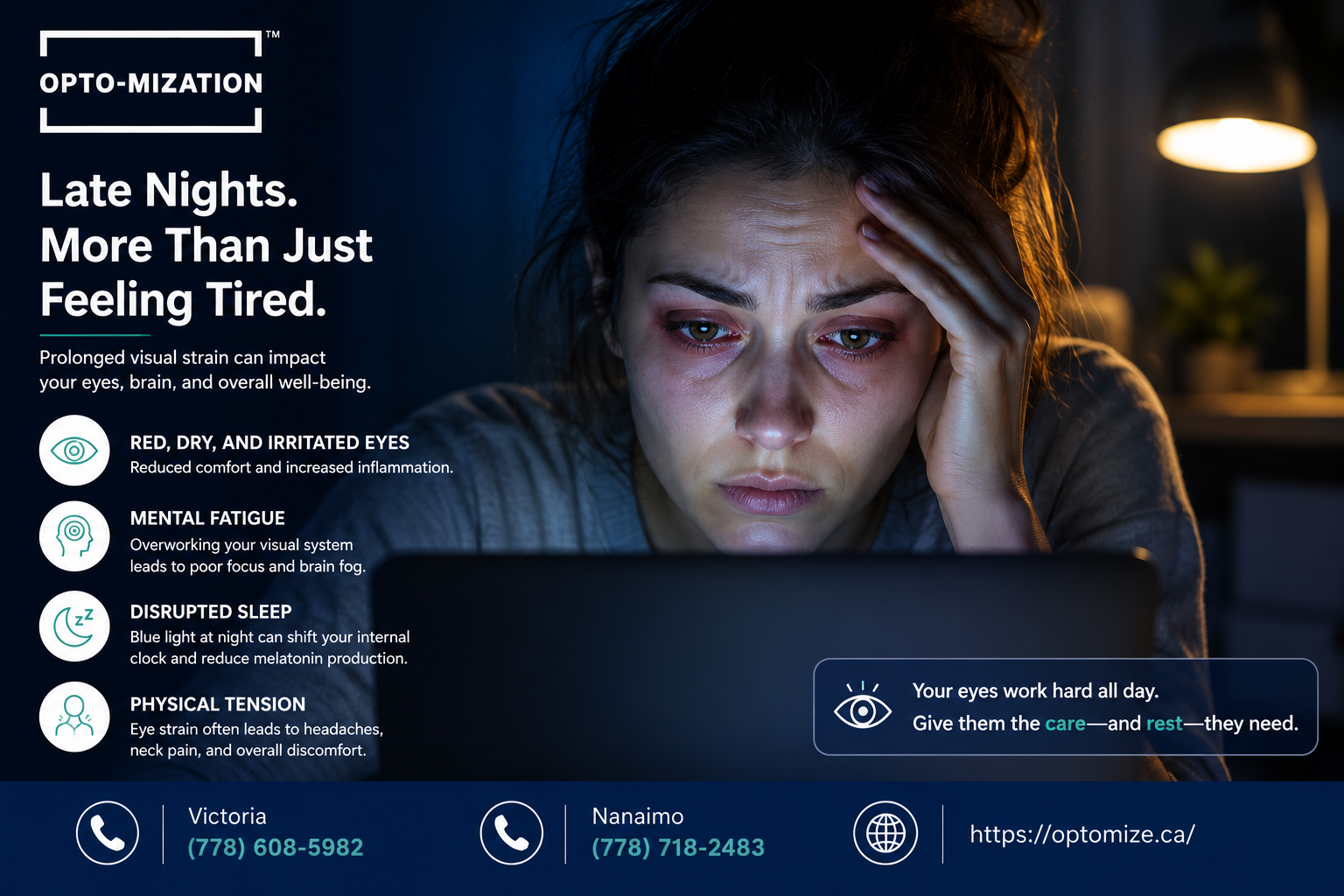
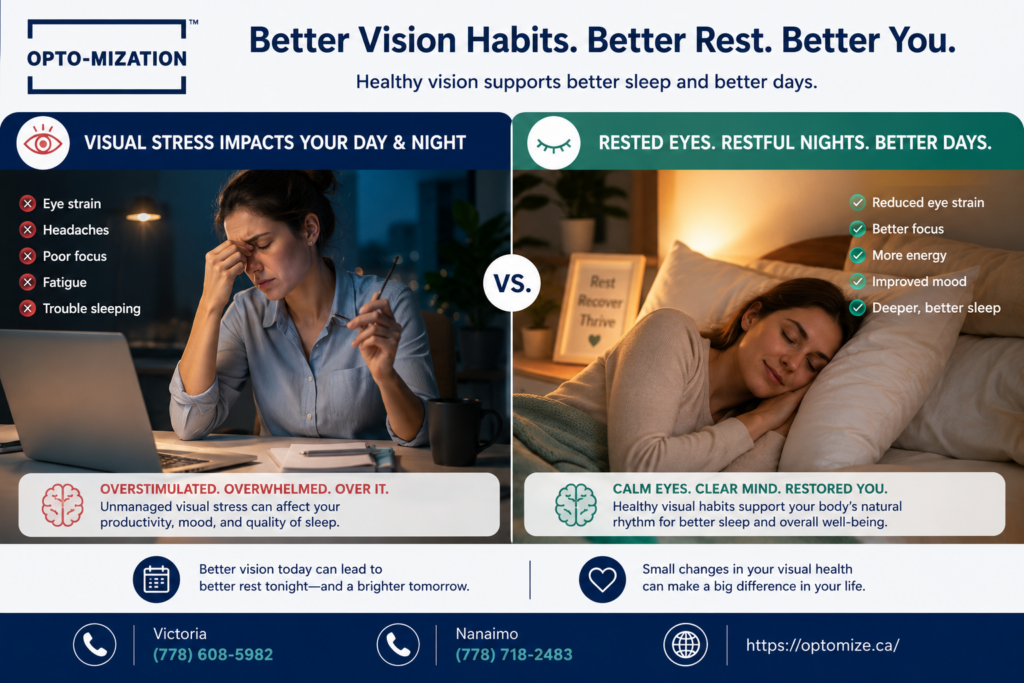
Yes, vision problems can meaningfully affect sleep quality. Conditions like uncorrected refractive errors, digital eye strain, and light sensitivity interfere with melatonin production, circadian rhythm regulation, and physical comfort at bedtime. People who experience chronic visual stress often report difficulty falling asleep, fragmented rest, and fatigue that doesn’t improve with more hours in bed.
Most people think of sleep problems as either stress-related or tied to habits like caffeine or screen time. What rarely comes up in that conversation is the role the eyes play. If your visual system is working overtime just to keep things in focus, that effort doesn’t stop the moment you close your laptop. The tension carries over. And for many people, it quietly disrupts sleep night after night without ever being identified as the cause.
Key Takeaways
- Uncorrected or poorly corrected vision forces the brain into sustained effort, which elevates stress responses that make sleep harder to initiate.
- Blue light from screens suppresses melatonin production, but the strain of focusing on a screen compounds that effect significantly.
- Conditions like binocular vision dysfunction and convergence insufficiency are often missed in standard eye exams but can cause both visual discomfort and sleep disturbance.
- People who are completely blind often have non-24-hour sleep-wake disorder because their eyes can’t deliver light signals to the brain’s internal clock.
- Simple interventions like corrective lenses, blue-light filtering, and timed visual breaks can substantially reduce sleep disruption caused by eye strain.
- Persistent sleep issues that don’t respond to typical sleep hygiene improvements are worth investigating with a functional eye assessment.
Why Your Eyes and Your Sleep Are More Connected Than You Think
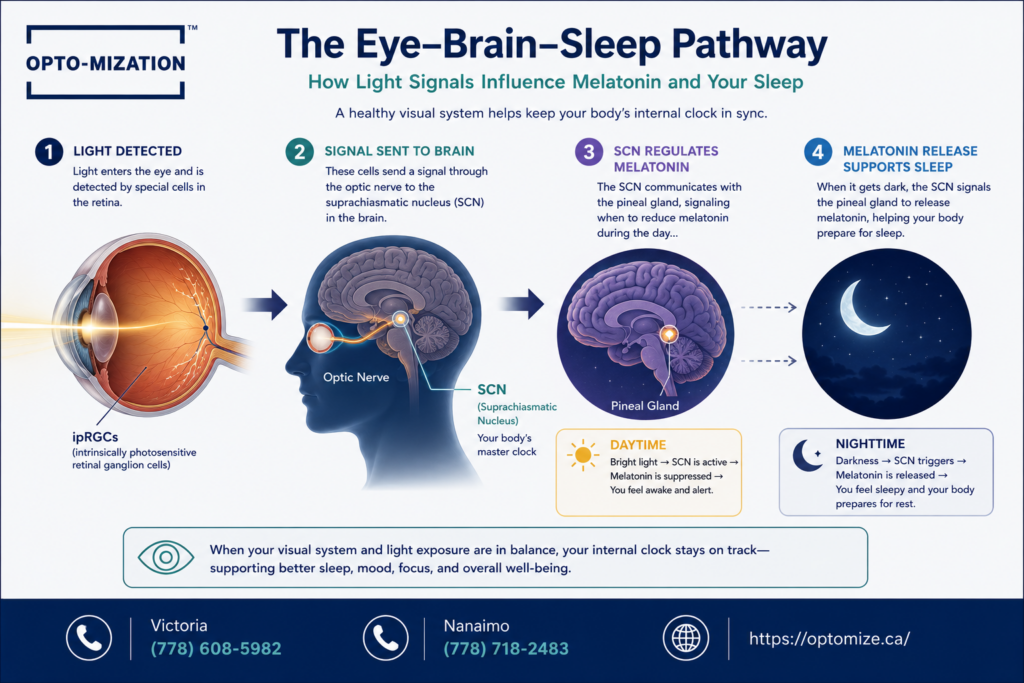
The eye isn’t just a camera for capturing images. It’s a sensory organ with a direct line to the brain’s timekeeping system. Specialized cells in the retina, called intrinsically photosensitive retinal ganglion cells, detect ambient light levels and send that information to the suprachiasmatic nucleus, the part of the brain that governs your circadian rhythm.
When that light-signaling pathway is disrupted, either by disease, structural eye problems, or chronic overstimulation, your brain’s ability to regulate the sleep-wake cycle weakens. This is why vision problems aren’t just a daytime inconvenience. They can fundamentally alter when and how well your body decides it’s time to rest.
Research suggests that adults who spend more than six hours per day on digital screens are significantly more likely to report sleep-onset difficulties compared to those with lower screen exposure. When visual strain accompanies that screen time, the effect on sleep latency is compounded further.
What Is Visual Stress and How Does It Build During the Day?
Visual stress isn’t a single diagnosis. It’s an umbrella term describing the discomfort and cognitive load that accumulates when the visual system is pushed to perform under suboptimal conditions. This can happen from uncorrected prescriptions, muscle imbalances between the two eyes, sensitivity to certain light frequencies, or extended near-work that the eye muscles weren’t designed to sustain for hours at a time.
Think of it like carrying a heavy bag all day. You might manage fine during the day, but by evening the fatigue is real, even if the bag is gone. Visual stress works similarly. The accommodative effort required to focus, converge, and track throughout the day accumulates. By bedtime, the eyes and surrounding muscles are fatigued, and the nervous system is still running a low-grade stress response in the background.
Convergence insufficiency, a condition where the eyes struggle to work together at close range, affects an estimated 5–13% of the population and is frequently undiagnosed in adults. People with this condition often report headaches, nausea when reading, and difficulty concentrating — symptoms that also correlate with poor sleep architecture.
If you’ve ever felt like your eyes are tired but your mind won’t shut off, that paradox often has a visual stress component. The muscular and neurological effort required to maintain focus creates physiological arousal that competes directly with the wind-down process sleep requires.
How Specific Vision Problems Disrupt Sleep
| Vision Problem | How It Affects Sleep | Common Symptom Overlap |
| Uncorrected myopia or hyperopia | Eye strain from constant compensation raises cortisol and tension | Headaches, fatigue, irritability |
| Binocular vision dysfunction | Misaligned eye teaming forces sustained neurological effort | Motion sensitivity, difficulty reading, nausea |
| Light sensitivity (photophobia) | Evening light exposure disrupts melatonin onset | Delayed sleep phase, difficulty falling asleep |
| Dry eye syndrome | Nighttime discomfort and irritation fragment sleep cycles | Waking at night, difficulty returning to sleep |
| Complete vision loss (blindness) | Loss of light input causes non-24-hour circadian disorder | Rotating sleep patterns, chronic insomnia |
The Blue Light Problem Is Only Part of the Story
By now, most people have heard that blue light from screens delays melatonin production and pushes back sleep timing. That’s accurate. But the blue light conversation tends to stop there, which misses something important: the strain involved in focusing on a screen for extended periods is itself a sleep disruptor, independent of the light wavelengths involved.
When you’re scrolling or working on a close screen for hours, your ciliary muscles are contracting continuously to maintain focus. Your eyes are also converging, meaning turning slightly inward to process a single image. If your visual system isn’t perfectly calibrated for this kind of sustained near work, even small inefficiencies add up. Some people get nauseous from prolonged screen use, which is actually a sign that the visual and vestibular systems are in conflict. That level of physiological stress does not simply vanish when you put the phone down.
Blue light in the 415–455 nm wavelength range is particularly effective at suppressing melatonin, with some studies showing suppression of up to 85% compared to warmer light at equivalent brightness levels. Evening exposure as brief as 90 minutes before bedtime can shift melatonin onset by 1.5 hours or more.
What Actually Happens to Sleep When Your Eyes Are Strained
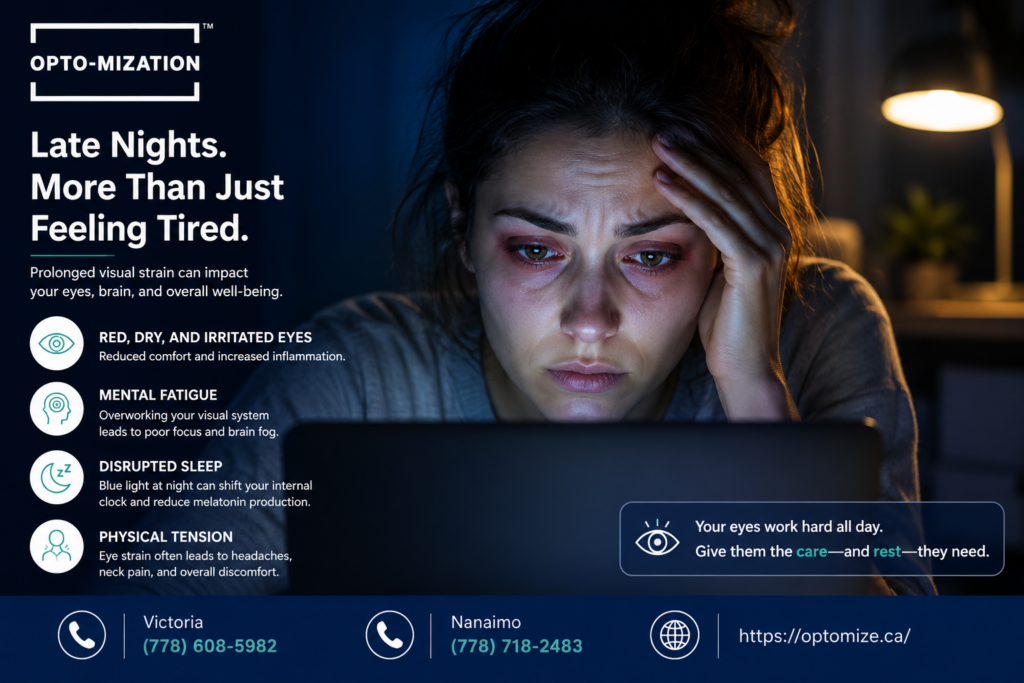
Eye strain doesn’t stay in the eyes. The tension travels. People with chronic visual stress often carry tightness through the temples, brow, and the back of the neck. This muscular tension activates the sympathetic nervous system, the same system responsible for the “fight or flight” response. Trying to fall asleep while that system is engaged is like trying to nap during a fire drill.
The result is typically extended sleep latency, meaning it takes significantly longer to fall asleep, plus lighter sleep overall as the body stays in a mild state of alert. Some people also experience eye pain that worsens at the end of the day, which creates a feedback loop where physical discomfort further delays rest.
Step-by-Step: Reducing Visual Stress Before Bed
- Stop screen use 60 minutes before sleep. This is a hard stop, not a guideline. The light and the focusing effort both need time to wind down before your nervous system can shift into rest mode.
- Apply warm, dim lighting in your evening environment. Overhead cool-white lights mimic midday light signals. Switch to lamps with warmer bulbs (2700K or below) in the two hours before bed.
- Practice the 20-20-20 rule throughout the day. Every 20 minutes of near work, look at something 20 feet away for 20 seconds. This gives the ciliary muscles a brief recovery window and reduces total accumulated strain by the evening.
- Do a slow, conscious eye relaxation exercise before lying down. Close your eyes, cup your palms gently over them (palming), and hold for 60–90 seconds. This reduces photostimulation and signals a natural visual pause.
- Schedule a functional eye exam if symptoms persist. A standard prescription check won’t identify binocular vision dysfunction or convergence issues. A functional assessment evaluates how the eyes work together under real-world demands.
The Near-to-Far Problem Most People Ignore
There’s a specific but underappreciated issue that worsens sleep for heavy screen users: the loss of easy near to far adjustment. After hours at a desk, many people find their vision stays “locked in” at near distance temporarily. Objects at arm’s length are clear, but glancing across the room feels blurry for a second or two.
This is accommodative lag, and while it usually resolves on its own, it’s a signal that the focusing system is fatigued. When the visual system is this taxed going into the evening, the brain continues to run recovery processes during what should be early sleep, reducing the time spent in deep, restorative sleep stages.
Adults with untreated accommodative dysfunction report headaches, fatigue, and poor sleep at significantly higher rates than those with corrected visual function. In clinical optometry settings, treating accommodative insufficiency has been associated with measurable improvements in daily energy levels and reported sleep quality.
Common Mistakes That Make Visual Stress Worse at Night
- Using blue light glasses but still using screens until bedtime. Blue light filters reduce one variable but don’t address the focusing and convergence load your eyes are still carrying.
- Reading on a phone in bed with the brightness set high. The combination of close focal distance, bright light, and supine posture is one of the worst possible conditions for visual rest before sleep.
- Ignoring intermittent symptoms like blurred vision or watery eyes. These are your visual system signaling overload. Pushing through consistently accumulates a strain debt that affects evening recovery.
- Assuming “passed the eye chart” means your vision is fine. Standard vision screenings test acuity at distance but don’t evaluate how the two eyes coordinate under load, which is where many sleep-affecting problems originate.
- Relying on sleep supplements without addressing the underlying visual cause. Melatonin supplements can help with timing, but they won’t resolve the physiological arousal caused by a strained visual system.
How Visual Distortions and Sensitivity Add Another Layer
People who experience distorted sight, where lines appear wavy or edges feel unstable, often have a heightened sensitivity in the visual cortex that also makes them more reactive to light changes throughout the day. This hyperreactivity doesn’t shut off in the evening. It can mean the brain stays in a more alert, stimulation-sensitive state, which competes directly with the neurological quieting that sleep requires.
This is a less-discussed but clinically relevant connection. Visual cortex sensitivity affects not just what you see, but how activated your brain stays in response to ordinary environmental light. For these individuals, even modest evening light can act as a stronger sleep disruptor than it would for someone without this sensitivity.
Frequently Asked Questions
Can eye strain from computers cause insomnia?
Eye strain from computers can contribute to insomnia by prolonging physiological arousal at the end of the day. The sustained muscular effort required to focus on a close screen, combined with blue light exposure, keeps the nervous system stimulated past the point where sleep onset typically becomes easy. This doesn’t cause clinical insomnia on its own for most people, but it consistently delays sleep onset and reduces sleep depth, particularly in those with underlying visual inefficiencies.
How does poor sleep affect my eyesight?
Sleep is when the eyes recover from daytime demands. During sleep, tear production helps lubricate and repair the ocular surface, and the visual cortex processes and consolidates information from the day. Chronic sleep deprivation is associated with increased dry eye symptoms, slower pupillary response, and reduced contrast sensitivity. Over time, poor sleep can make existing vision problems feel subjectively worse even if the prescription hasn’t changed.
Do glasses or contacts improve sleep quality?
Wearing the correct prescription reduces the compensatory effort the visual system makes throughout the day, which means you arrive at bedtime with less accumulated strain. For many people, this does translate to easier sleep onset. However, glasses and contacts only help if the prescription is accurate and current. If the underlying issue is a binocular coordination problem rather than a refractive error, corrective lenses alone won’t resolve the sleep disruption.
Can blindness affect a person’s ability to sleep?
Yes, significantly. People who are totally blind and lack light perception often develop non-24-hour sleep-wake disorder, where the circadian rhythm drifts gradually because no light signal anchors it to the 24-hour day. This causes sleep timing to shift progressively later over time, cycling through periods of good sleep and periods of severe disruption. Treatment typically involves melatonin receptor agonists timed carefully to anchor the cycle, and it remains one of the clearer demonstrations of how dependent healthy sleep is on visual light input.
What is the 20-20-20 rule to help with visual stress?
The 20-20-20 rule is a guideline for reducing digital eye strain: every 20 minutes of close-up screen or near work, shift your gaze to something at least 20 feet away for 20 seconds. This gives the ciliary muscles a recovery window and prevents the sustained contraction that leads to accommodative fatigue by the end of the day. It’s simple, costs nothing, and consistently reduces reported end-of-day eye discomfort when practiced regularly. Think of it as interval training for your focusing system rather than a marathon with no rest.
Final Thoughts: Sleep Is Where Your Eyes Recover, Not Just Your Body
The connection between visual stress and sleep isn’t a minor footnote. For a meaningful percentage of people experiencing chronic sleep difficulties, the eyes are part of the problem. And unlike many sleep disruptors, visual stress is often correctable once it’s properly identified.
The challenge is that standard eye exams often aren’t designed to catch the subtler functional issues that drive daytime strain and nighttime restlessness. If you’ve tried improving your sleep hygiene and still wake up feeling like you haven’t rested, it may be time to look more carefully at how your visual system is functioning under real-world load.
At Opto-Mization, our team conducts comprehensive functional eye assessments designed to identify exactly these kinds of issues. Whether it’s a convergence problem, accommodative dysfunction, or light sensitivity that’s quietly affecting your rest, there are practical solutions available. If sleep has become a struggle and your eyes feel like they never quite switch off, reach out to us at (778) 608-5982 to book an assessment. What you find might surprise you.