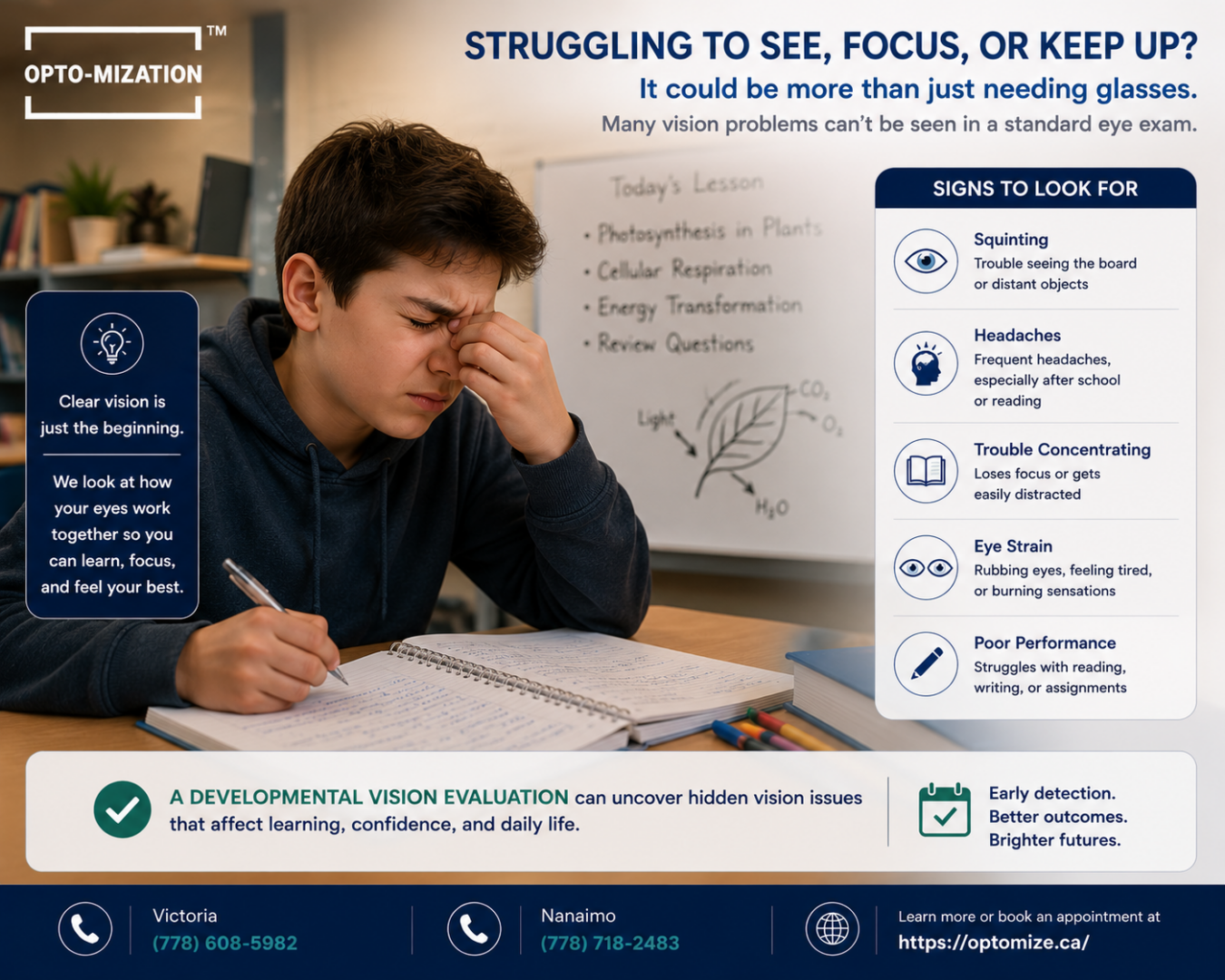
Yes, eye problems can directly cause difficulty copying notes from the board. Conditions like convergence insufficiency, accommodative dysfunction, and visual tracking deficits make it harder for the eyes to shift focus between near and far distances, track text accurately, and hold a clear image long enough to transcribe it. These issues often go undetected in standard school vision screenings.
If a student consistently falls behind when copying from the board, loses their place, or skips lines without explanation, vision may be the root cause rather than attention or effort. The challenge is that many of these visual conditions don’t cause obvious blurry vision, making them easy to miss.
Key Takeaways
- Standard school vision screenings test distance clarity but often miss focusing, tracking, and teaming problems that directly affect note-taking.
- Convergence insufficiency and accommodative dysfunction are two of the most common, underdiagnosed conditions that interfere with copying from the board.
- Symptoms like headaches after schoolwork, losing place on the page, or words appearing to move are functional vision warning signs, not just concentration issues.
- A comprehensive binocular vision assessment by a developmental optometrist can identify these conditions that a standard eye chart test will completely miss.
- Vision therapy and optical corrections have strong evidence for improving these skills, sometimes producing significant academic improvements within months.
- Early identification matters: the longer a visual deficit goes unaddressed, the more a student compensates with avoidance behaviors that compound the problem.
Why Note-Taking from the Board Is Visually Demanding
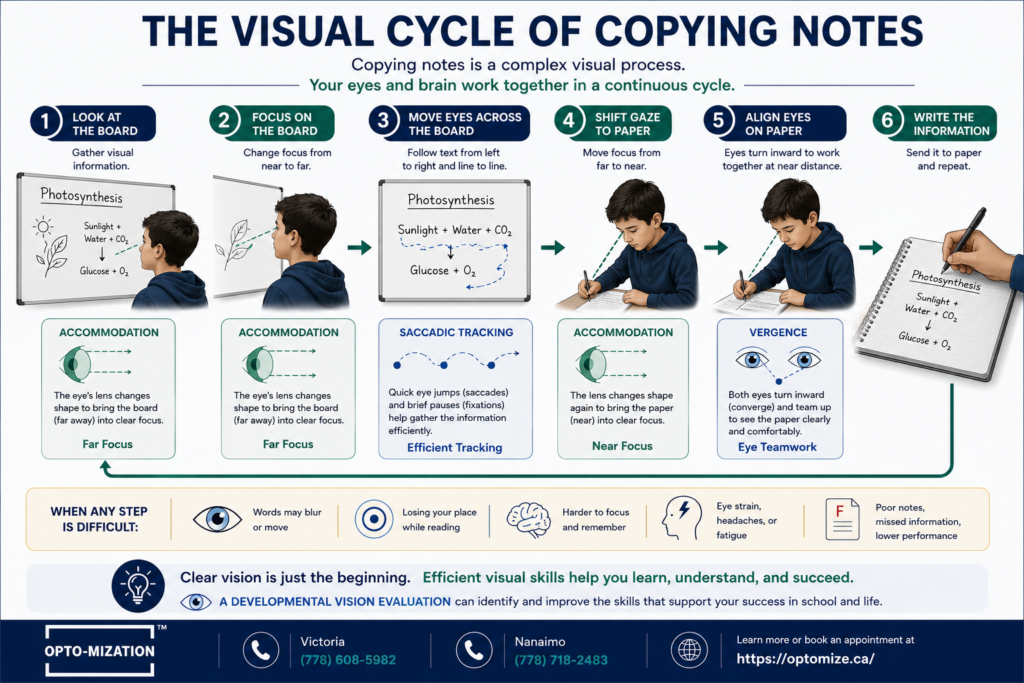
Copying notes from a whiteboard or screen isn’t a single visual task. It requires the eyes to complete a rapid, repeated cycle: look up at the board, read and process the text, look back down at the paper, find the right spot on the line, write, then start again. Each cycle demands a specific set of visual skills working together smoothly.
When any part of that cycle breaks down, the whole process becomes exhausting or inaccurate. A student might copy incomplete sentences, mix up the order of words, lose their place on the board, or give up and stop writing altogether. From a teacher’s perspective, this can look like inattention. From the student’s perspective, it can feel like failure at something peers seem to do effortlessly.
The Three Visual Skills Most Involved
Three distinct visual abilities carry the load during note-taking: accommodation (focus shifting), vergence/binocularity (eye teaming), and saccadic eye movement (visual tracking). A deficit in any one of these can disrupt the process significantly, and a deficit in multiple areas can make copying from the board feel nearly impossible.
What Are “Eye Focusing” and “Eye Teaming” Problems?
Accommodative dysfunction refers to the eyes’ inability to shift focus quickly and accurately between distances. When a student looks up at the board and then back at their notebook, the lens of each eye must rapidly adjust its shape to bring the new target into focus. In accommodative insufficiency, that lens adjustment is sluggish or incomplete, meaning the student sees a blurred image for several seconds before it clears.
Accommodative insufficiency is estimated to affect between 2% and 8% of school-age children, though many clinicians believe that figure underestimates the true prevalence due to underdiagnosis. The condition is frequently invisible on a standard 20/20 chart test because that test only measures static distance clarity, not the dynamic focusing required for sustained reading and writing tasks.
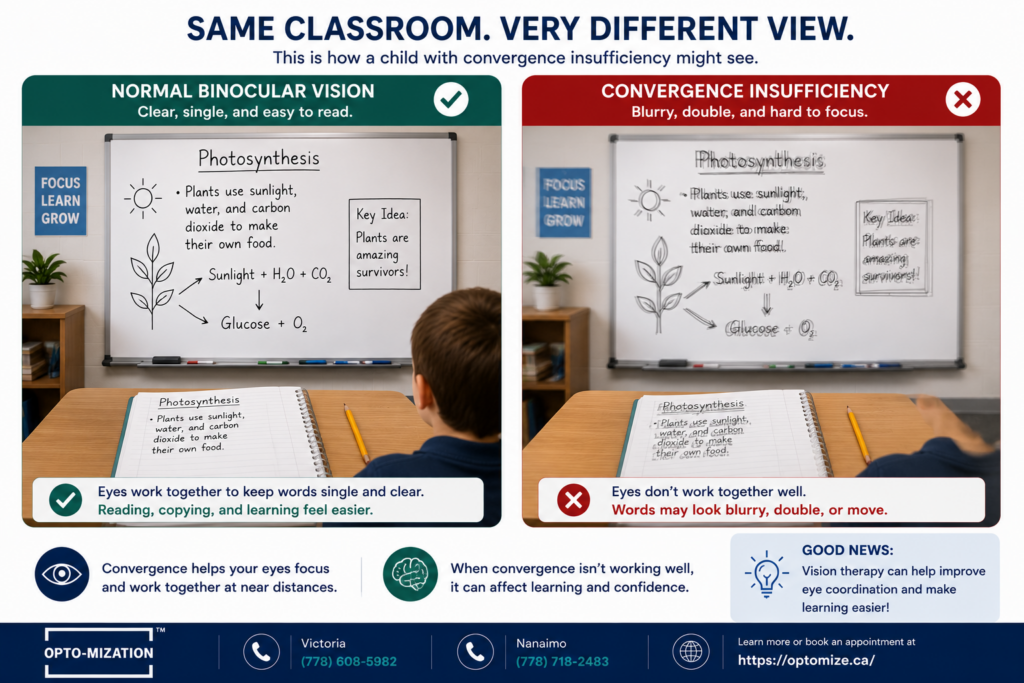
Convergence insufficiency (CI) is a binocular vision disorder where the two eyes struggle to turn inward together accurately when looking at near targets. During note-taking, the near task of writing triggers this struggle. The brain, receiving slightly misaligned images from both eyes, often suppresses one eye’s input entirely to prevent double vision. This suppression is effective in the short term, but it creates visual fatigue and reduces reading accuracy significantly over time.
Research published in peer-reviewed optometry journals has found that convergence insufficiency affects approximately 5% of school-age children and is associated with significantly higher rates of reading avoidance, reduced academic performance, and misdiagnosis as attention deficit disorder. Several studies have noted that CI symptoms overlap heavily with ADHD symptom checklists, leading to children being placed on behavioral interventions rather than receiving vision treatment.
How Do Visual Tracking Issues Affect Note-Taking?
Saccades are the quick, precise eye jumps your eyes make when moving from one point to another, such as from the end of one word to the beginning of the next, or from the board back to your notebook. In students with saccadic dysfunction, these jumps are inaccurate. The eyes overshoot or undershoot their target, requiring micro-corrections that slow down the entire reading and writing process.
Practically, this means a student lands on the wrong word on the board, copies a fragment instead of the full phrase, or loses their place entirely when returning from board to paper. Because they know they’ve lost their spot, they look up again, starting the whole fatiguing process over. If your child’s eyes are slow to focus when shifting between distances, a saccadic tracking assessment is a natural next step.
Visual processing issues add another layer. Even if the eyes track correctly and focus clearly, the brain still needs to decode, hold, and reproduce the information accurately. Students with visual memory deficits may look at a sentence on the board, glance down at their paper, and find that the words have already partially faded from their mental image. They look up again, re-read, look down, and repeat in an exhausting loop.
Isn’t Nearsightedness the Obvious Culprit?
Most parents assume that if their child can’t see the board, it must be nearsightedness (myopia). Myopia absolutely makes board text blurry from a distance and would clearly interfere with copying notes. Glasses or contact lenses correct this, and the problem resolves.
The more complicated reality is that a student can have 20/20 distance vision and still struggle significantly with copying notes. This is because myopia correction does nothing to address accommodative, vergence, or tracking deficits. A child who passed their school screening last month may still have a functional vision disorder that wasn’t tested for at all. Sometimes distorted vision of straight lines or subtle spatial distortions go unnoticed for years.
Warning Signs That Vision May Be the Root Cause
The behavioral signs of functional vision problems during note-taking are specific enough that parents and teachers can recognize them. These aren’t signs of laziness or inattention, they are the student’s nervous system coping with a visual system that isn’t functioning efficiently.
- Frequently losing place when looking from board to paper and back
- Skipping lines or words when copying, often without realizing it
- Complaining of headaches, eye strain, or fatigue specifically after written work
- Avoiding note-taking tasks or becoming frustrated during them disproportionately
- Tilting the head to one side while reading or writing
- Covering or closing one eye when trying to read
- Reporting that words “move,” “blur,” or “double” on the page or board
- Taking significantly longer to complete written work than peers of similar ability
Symptoms like light sensitivity during schoolwork or pressure behind eyes after reading sessions are also worth flagging to an optometrist, as they can accompany accommodative and binocular vision dysfunction.
Common Mistakes That Delay Diagnosis
- Relying only on school screenings. A standard school vision test checks for distance clarity at 20 feet. It does not assess convergence, accommodation, tracking, or visual processing. A “pass” on this test does not mean a student has healthy functional vision.
- Attributing symptoms to attention problems first. Many children with undiagnosed CI or accommodative dysfunction are evaluated for ADHD before anyone checks their vision comprehensively. The overlap in symptoms is significant enough that some professional bodies now recommend ruling out functional vision deficits before an ADHD diagnosis.
- Assuming glasses solve everything. Glasses correct refractive error but don’t treat binocular vision or tracking disorders. A child who already wears glasses can still have untreated functional vision problems.
- Waiting to see if the child “grows out of it.” Some visual skills do mature with age, but accommodative and convergence problems rarely self-resolve, and the academic and confidence costs of waiting are real.
- Ignoring physical symptoms as “normal tiredness.” Headaches after school, watery eyes during reading tasks, and eye rubbing after homework aren’t just regular childhood complaints. They’re the body’s signals that the visual system is under strain.
What a Proper Vision Assessment Actually Covers
A comprehensive functional vision or binocular vision exam goes far beyond checking the letters on an eye chart. The process includes specific, standardized tests for each of the visual skills involved in reading and writing tasks.
- Case history and symptom review: The optometrist collects detailed information about when symptoms occur, what tasks trigger them, and how long they’ve been present. Academic context matters here; knowing that problems appear during note-taking rather than outdoor activities points toward functional rather than refractive causes.
- Refraction assessment: Standard check for nearsightedness, farsightedness, and astigmatism. Correcting these first eliminates them as variables in the functional assessment.
- Accommodation testing: Measures the amplitude of accommodation (the maximum focusing range) and the flexibility and accuracy of focus shifts between distances. Tests include push-up amplitude, accommodative facility with flippers, and dynamic retinoscopy.
- Binocular vision and vergence testing: Evaluates how well both eyes work together at near and far distances. The near point of convergence test, along with fusional vergence ranges, identifies convergence insufficiency.
- Saccadic and pursuit tracking evaluation: Assesses the accuracy and efficiency of voluntary eye movements used in reading and copying tasks. This can be done through standardized tests like the Developmental Eye Movement (DEM) test.
- Visual processing assessment: If indicated, evaluates visual memory, visual discrimination, and visual-motor integration, all relevant to the ability to accurately copy and reproduce text.
The Convergence Insufficiency Treatment Trial (CITT), a multi-site randomized clinical trial, found that office-based vision therapy combined with home reinforcement produced significantly greater symptom reduction and improved near-point convergence compared to pencil push-ups or placebo therapy. Approximately 73% of children in the office-based vision therapy group showed improved or cured status after 12 weeks of treatment.
Visual Conditions That Affect Note-Taking: A Quick Reference
| Condition | What It Affects | Common Note-Taking Sign | Detectable on School Screening? |
| Myopia (nearsightedness) | Distance clarity | Board text appears blurry | Yes |
| Accommodative Dysfunction | Focus shifting speed/accuracy | Blurring when switching board to paper | No |
| Convergence Insufficiency | Eye teaming at near distance | Eye fatigue, words appear doubled or moving | No |
| Saccadic Dysfunction | Eye movement accuracy | Losing place, copying wrong words | No |
| Visual Memory Deficit | Holding visual information briefly | Repeated look-ups, very slow copying | No |
Frequently Asked Questions
Can basic nearsightedness affect copying notes?
Yes, uncorrected myopia will make the board appear blurry, directly preventing accurate note-taking from a distance. However, once myopia is corrected with glasses or contact lenses, the problem should largely resolve. If copying difficulties persist despite corrective lenses, a functional vision issue beyond refractive error is likely the cause and warrants a more comprehensive evaluation.
What are “eye focusing” and “eye teaming” problems?
Eye focusing problems (accommodative dysfunction) affect the eyes’ ability to shift focus clearly and quickly between distances. Eye teaming problems (binocular vision disorders like convergence insufficiency) affect how well both eyes coordinate together at a given distance. Both are distinct from acuity problems and are not detected on standard eye charts. They require specialized clinical testing to identify, and are among the most common functional vision disorders in school-age children.
How do visual tracking and visual processing issues impact note-taking?
Visual tracking refers to the accuracy of eye movements during reading and copying tasks. Poor saccadic tracking causes students to land on incorrect words, skip lines, or repeatedly lose their place. Visual processing issues affect how quickly and accurately the brain interprets and stores what the eyes see. A student with poor visual memory may need to look at the board multiple times per sentence because the mental image fades before they can write it down, creating a slow and exhausting cycle.
What are the common physical or behavioral warning signs?
Physical signs include headaches after written work, eye rubbing, squinting, head tilting, covering one eye while reading, and excessive blinking. Behavioral signs include avoiding copying tasks, becoming unusually frustrated with homework, taking much longer than expected to write things down, and frequently losing place between board and paper. These signs often appear specifically during academic work rather than during outdoor or screen-based activities, which can help narrow down a visual cause.
What should I do if my child or I am struggling with this?
The first step is scheduling a comprehensive binocular vision assessment with a developmental or behavioral optometrist, not just a standard vision screening or routine eye exam. Bring specific observations about when symptoms occur and what tasks trigger them. If a functional vision disorder is identified, treatment may include prescription lenses designed to reduce visual stress, prism lenses, or a structured vision therapy program. Academic accommodations can also support the student while treatment is underway.
Final Thoughts
Struggling to copy notes from the board is rarely a motivation problem. In many cases, the student is working harder than their peers just to keep up, all while managing a visual system that isn’t functioning the way it should. The frustrating reality is that these conditions are common, treatable, and routinely missed because standard vision screenings weren’t designed to catch them.
If you recognize these patterns in yourself or your child, a comprehensive functional vision assessment is the most direct path to answers. The sooner these issues are identified, the sooner the right support can be put in place, both in terms of vision treatment and academic accommodations that reduce the daily burden.
Ready to Find Out What’s Really Going On?
At Opto-Mization, we offer comprehensive binocular vision assessments that go well beyond the standard eye chart. If note-taking difficulties, visual fatigue, or focusing problems are affecting your child’s school experience or your own daily performance, our team can provide the detailed testing needed to identify what’s actually happening and what can be done about it.
Call us at (778) 608-5982 to book a comprehensive vision evaluation. Understanding the cause is always the first step toward a real solution.