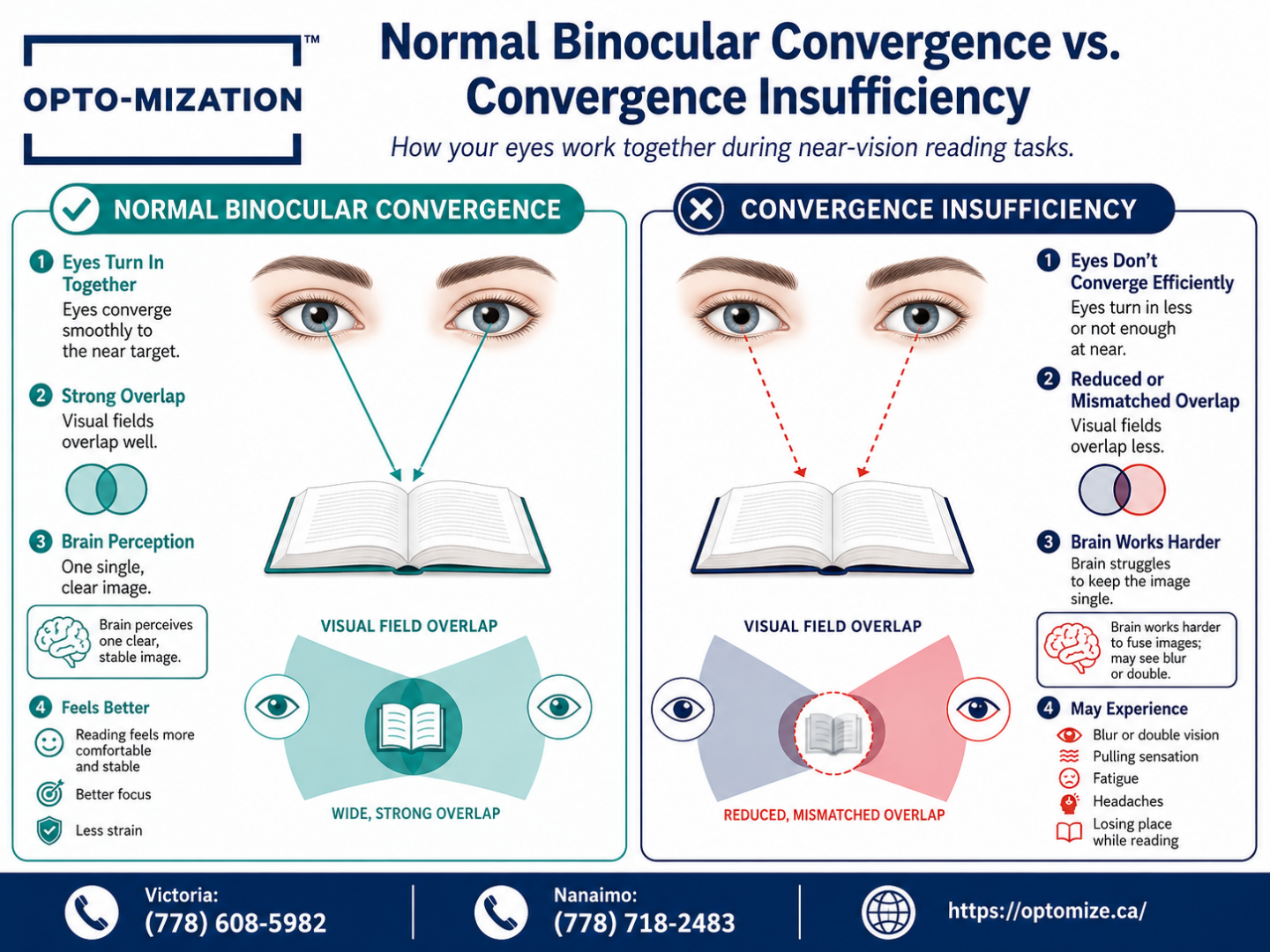
Feeling sleepy, nauseous, or mentally exhausted after reading is rarely just about being tired. In most cases, it signals an underlying visual inefficiency, such as poor eye teaming, focusing problems, or an uncorrected prescription, that forces your brain and visual system to work significantly harder than they should. A functional vision evaluation can identify whether your symptoms have a treatable cause.
Introduction
A lot of people assume they just “aren’t readers” because books make them drowsy or screens leave them feeling foggy. The reality is more specific than that. If reading consistently makes you feel unwell, your visual system is likely working against you, not with you.
These symptoms are common, often overlooked, and almost always connected to how your eyes and brain process text together. Understanding what’s actually happening is the first step toward fixing it.
Key Takeaways
- Sleepiness, nausea, and mental fatigue during reading are frequently caused by underlying visual inefficiencies, not a lack of interest or attention.
- Your brain consumes significant energy compensating for poor eye teaming, focusing instability, or subtle prescription mismatches.
- Reading-induced nausea in moving vehicles involves a conflict between visual input and your body’s balance system.
- Symptoms often worsen on screens because of additional flicker, contrast demands, and reduced blink rate.
- Many of these issues are treatable with vision therapy, updated lenses, or both.
- A standard eye exam may not catch all of the functional vision problems that cause reading-related symptoms.
Things You Must Know
1. A “Normal” Eye Exam Doesn’t Rule Out Visual Dysfunction
Standard eye exams primarily test for clarity of vision (acuity) and the health of the eye itself. They often don’t assess how well your eyes work together as a team, how efficiently they sustain focus over time, or how your visual system handles the demands of prolonged near work. Someone can pass a standard eye test and still have a significant binocular vision problem driving their symptoms.
2. Your Brain Pays the Price for Visual Compensation
When your eyes aren’t working efficiently, your brain steps in to correct the signal. This compensation is automatic and largely unconscious, but it’s cognitively expensive. The mental fatigue and drowsiness you feel after reading isn’t laziness; it’s your nervous system running at higher-than-normal load to keep your vision functional. Over time, this kind of strain compounds, especially during long reading sessions or high-demand study periods.
3. Symptoms Can Vary Widely Between People
Some people experience headaches and eye strain. Others feel sleepy almost immediately. Some get nauseated, especially when reading in motion. A few describe a sense of words “moving” on the page or lose their place constantly. These variations reflect different types of visual inefficiency, which is why identifying your specific pattern matters before choosing a treatment approach.
Why Does Reading Actually Make You Feel Sleepy?
Drowsiness during reading has a few distinct causes, and they don’t all come from the same place. The most common visual explanation involves something called accommodative fatigue, which is the eye’s focusing system struggling to hold a steady, clear image at near distances.
When your eyes work harder than they should to maintain focus on a page, your nervous system interprets that effort as exertion. Exertion signals fatigue. Your body responds the same way it would to any sustained physical effort: it tries to rest. The result is that familiar heavy-eyed feeling, even when you’re genuinely interested in what you’re reading.
Research in visual ergonomics consistently identifies accommodative insufficiency and convergence insufficiency as two of the most underdiagnosed causes of reading-related fatigue, particularly in students and working adults who spend several hours daily on near tasks.
There’s also a posture element. Many people unconsciously adopt poor head or neck positions while reading, which restricts blood flow and adds physical tension to an already strained system. That combination accelerates the fatigue response considerably.
What Causes Nausea When Reading?
Nausea from reading is more common than people realize, and it tends to fall into two categories: nausea in motion, and nausea from visual instability at rest.
Reading in a Moving Vehicle
When you read in a car, bus, or train, your eyes are focused on a stationary object (the page or screen), but your inner ear and body are registering movement. This mismatch between visual input and vestibular input is what triggers motion sickness. Your brain receives conflicting signals and interprets the conflict as a potential threat, which activates nausea as a protective response.
The vestibulo-ocular reflex, which stabilizes visual input during head movement, can be disrupted in individuals with poor eye teaming or vestibular sensitivity, making motion-related reading nausea significantly more intense for those populations.
Nausea at Rest During Reading
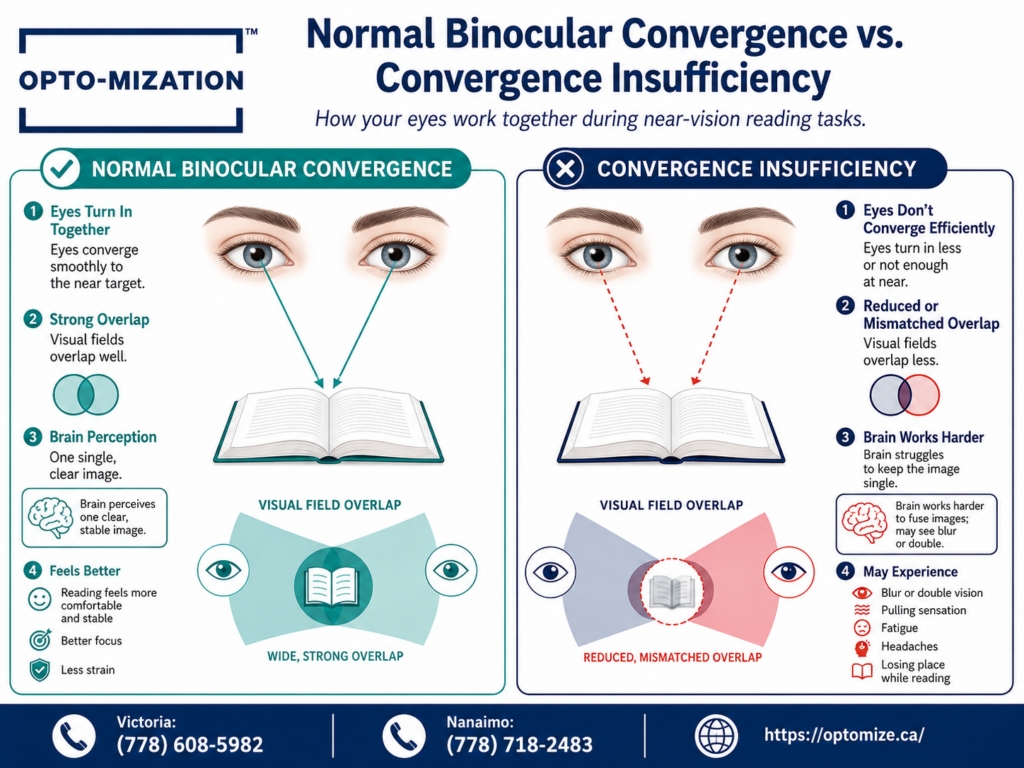
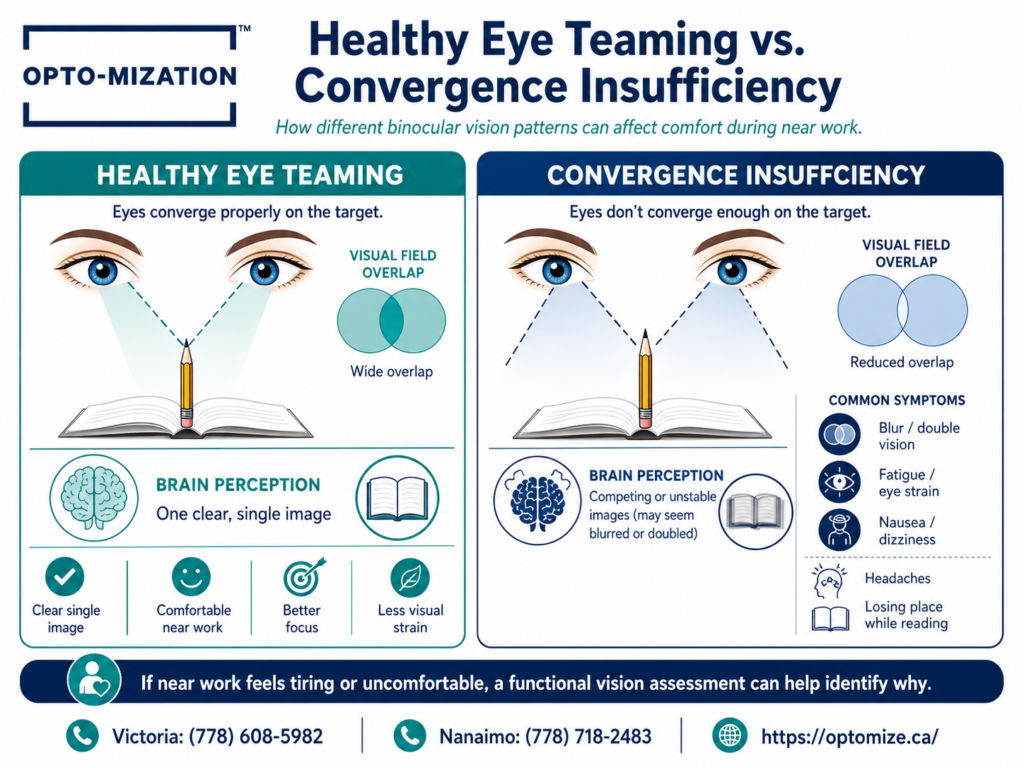
Nausea while reading in a stationary environment is a different problem. This is usually linked to binocular vision dysfunction, where the eyes don’t coordinate well enough to produce a single, stable image. The brain receives slightly different input from each eye and has to constantly reconcile the two signals. That visual instability can produce a nauseating, disorienting sensation, particularly during extended reading sessions.
If you’ve ever noticed words seeming to blur, shift, or double briefly while reading, that’s the underlying dysfunction surfacing. People with convergence insufficiency (a condition where the eyes drift outward when focusing on near objects) frequently report nausea as one of their primary symptoms.
Why Does Reading Leave You Mentally Drained?
Mental fatigue after reading is one of the most commonly dismissed symptoms, because it’s easy to attribute it to a difficult text, a long day, or general tiredness. But when it happens consistently across different materials and times of day, the visual system is almost always part of the explanation.
Reading requires a significant amount of visual-cognitive integration. Your eyes need to track lines accurately, maintain focus at a fixed distance, and coordinate both eyes to produce a clear, merged image. When any of these functions are inefficient, your brain allocates more working memory and attentional resources to the visual processing task itself, leaving fewer resources available for comprehension and retention.
Studies in educational optometry suggest that children and adults with undiagnosed binocular vision disorders demonstrate measurably lower reading comprehension scores and higher reported mental fatigue during standardized reading assessments compared to those without such conditions.
This is one reason why reading-related cognitive fatigue is especially common in people who’ve recently changed prescriptions, started new work environments, or experienced head injuries. Any disruption to the visual system’s baseline efficiency increases the cognitive overhead of near work.
If you find that your eyes feel like they are pulling, straining, or fighting each other during extended reading, that sensation is worth investigating directly. It often points to a measurable binocular vision problem rather than general tiredness.
How Vision Problems Specifically Drive These Symptoms
| Visual Condition | Primary Symptoms | Common in Reading? |
| Convergence Insufficiency | Eye strain, double vision, nausea, losing place | Yes, very common |
| Accommodative Insufficiency | Blur after sustained reading, headaches, fatigue | Yes, especially near tasks |
| Vertical Phoria | Nausea, dizziness, headaches, spatial disorientation | Yes, often misdiagnosed |
| Uncorrected Astigmatism | Blur, eye strain, fatigue, difficulty with contrast | Yes, especially at distance and near |
| Vergence Instability | Words moving, re-reading lines, mental fog | Yes, reading-specific trigger |
Many of these conditions exist on a spectrum. Someone might have a mild convergence problem that only becomes symptomatic after 20 to 30 minutes of reading, while another person feels nauseous within minutes. The severity of the visual dysfunction doesn’t always predict how severe the symptoms feel.
It’s also worth knowing that people who feel dizzy in visually busy environments, like grocery stores or crowded rooms, often share the same underlying visual processing inefficiency that makes reading difficult. The two problems frequently appear together.
Reading on Screens vs. Printed Pages: Does It Matter?
| Factor | Printed Page | Screen |
| Contrast consistency | Stable, reflective | Variable, emitted light |
| Blink rate impact | Slightly reduced | Significantly reduced |
| Pixel flicker/refresh | None | Present, varies by display type |
| Blue light exposure | Minimal | Higher, especially LED screens |
| Glare/reflection risk | Lower | Higher without proper settings |
Screens add several demands that printed pages don’t. Reduced blink rate during screen use contributes to dry eye, which adds its own layer of discomfort and blur to an already strained system. If screens consistently cause more symptoms than books, that pattern provides useful diagnostic information worth sharing with a vision specialist.
For more detail on why this happens, the explanation behind why screens hurt your eyes even when you take breaks goes deeper than most people expect.
Common Mistakes People Make When Dealing With Reading Fatigue
- Assuming it’s just a concentration problem. Difficulty focusing while reading is frequently a vision problem, not an attention disorder. Many people are referred for ADHD evaluations when the underlying issue is actually a binocular vision dysfunction.
- Stopping at the standard prescription update. Getting new glasses helps with clarity but doesn’t address how the eyes work together. A prescription that makes you see 20/20 may still leave significant binocular dysfunction unaddressed.
- Only reading in short bursts as a permanent workaround. Taking breaks can help manage symptoms but doesn’t treat the cause. If 15 minutes of reading is your threshold before discomfort starts, that threshold itself is a symptom worth evaluating.
- Attributing screen fatigue entirely to blue light. Blue light filtering products have a role, but they don’t correct tracking problems, convergence issues, or focusing instability. Relying on them without a proper evaluation can delay effective treatment.
- Ignoring symptoms that feel “mild.” Mild, chronic visual symptoms compound over time, especially as near-work demands increase with age, career changes, or educational requirements.
What to Do If Reading Consistently Makes You Feel Unwell
- Track your symptoms specifically. Note when symptoms start (immediately vs. after a period of reading), what type of reading triggers them (screen vs. print, stationary vs. moving), and what the symptoms feel like (sleepy, nauseous, headache, blurry, foggy).
- Request a functional vision evaluation. Ask your eye care provider specifically about binocular vision testing, not just a standard acuity and refraction exam. A comprehensive assessment evaluates convergence, accommodation, tracking, and eye teaming.
- Review your reading environment. Check lighting (avoid reading with a bright window directly behind the page), screen settings (reduce brightness and increase text size), and posture (maintain a comfortable distance and avoid craning your neck).
- Consider whether symptoms extend beyond reading. Dizziness in busy environments, difficulty with sports involving fast-moving objects, or sensitivity to visual motion can all connect back to the same visual system inefficiencies driving reading symptoms.
- Follow through on recommended treatment. Vision therapy, prism lenses, or updated spectacle prescriptions all take time to show their full effect. Consistency with the recommended approach matters significantly for outcomes.
Vision therapy programs targeting convergence insufficiency have demonstrated improvement rates in symptom reduction across multiple randomized controlled studies, with office-based therapy consistently outperforming home-only pencil pushup exercises in measured outcomes.
Some people also experience eye fatigue even when their prescription appears correct, which is a strong signal that the prescription alone isn’t the full picture.
Frequently Asked Questions
Why does reading make me sleepy?
Reading-induced sleepiness is commonly caused by accommodative fatigue, where the eye’s focusing system works harder than it should to maintain a clear image at near distance. This sustained effort signals the nervous system to reduce arousal. Poor lighting, suboptimal posture, and underlying binocular vision inefficiencies all amplify the effect. If it happens consistently regardless of how rested you are, a functional vision evaluation is worth pursuing.
Why do I get nauseated when reading in a moving vehicle?
When you read in a moving vehicle, your eyes are focused on a stationary page while your inner ear registers motion. This sensory conflict causes your brain to interpret the situation as a potential toxin exposure (an evolutionary response), triggering nausea. People with binocular vision problems or vestibular sensitivities tend to experience this more intensely. Looking out the window at distant objects periodically helps reduce the mismatch.
Why do I feel mentally drained after reading for a while?
Mental fatigue from reading is often the result of your brain expending extra cognitive resources to compensate for visual inefficiencies. When the eyes don’t track, focus, or team efficiently, the brain works harder just to produce a stable, readable image, leaving less capacity for comprehension and retention. This is different from ordinary tiredness. It tends to feel disproportionate to the effort involved in the reading task itself.
Can vision problems or eye strain cause these symptoms?
Yes, and more directly than most people assume. Conditions like convergence insufficiency, accommodative insufficiency, and vertical phoria are among the most common undiagnosed causes of reading-related sleepiness, nausea, and mental fatigue. These conditions don’t always show up on a standard vision screening. A comprehensive binocular vision evaluation is often needed to identify them accurately. People who frequently feel like their eyes are pulling or fighting each other during reading often have one of these underlying conditions.
How can I stop feeling sick or tired when I read?
The most effective approach depends on the cause. If the problem is a binocular vision dysfunction, vision therapy or prism lenses may significantly reduce or eliminate symptoms. If there’s a prescription issue, an updated correction helps. General strategies include optimizing your reading environment (lighting, screen settings, distance), taking structured breaks using the 20-20-20 guideline, and avoiding reading in moving vehicles when possible. Those who also feel dizzy in visually complex environments like grocery stores may find that treating the underlying vision dysfunction improves both reading tolerance and everyday spatial comfort.
Ready to Find Out What’s Actually Causing Your Symptoms?
Feeling sleepy, nauseous, or mentally depleted after reading isn’t something you have to work around permanently. In many cases, it points to a specific, treatable visual inefficiency that a standard eye exam simply doesn’t detect.
At Opto-Mization, functional vision assessments are designed to look beyond acuity and evaluate how your visual system actually performs under the demands of real-world near work. If reading has consistently felt harder than it should, that’s worth a proper look.
Call Opto-Mization at (778) 608-5982 to book a comprehensive vision evaluation and get a clearer picture of what’s driving your symptoms.
Binocular vision dysfunction is estimated to affect a significant percentage of the general population, with many cases going undetected for years due to the absence of functional vision testing in routine eye care screenings.