That pulling, straining, or “fighting” sensation in your eyes is usually a sign that your visual system is working harder than it should to keep both eyes aligned and focused together. Common causes include binocular vision dysfunction, convergence insufficiency, and digital eye strain. These conditions are treatable, and an eye exam focused on how your eyes work together is the right starting point.
Introduction
That uncomfortable tension behind your eyes, the feeling like they want to drift apart or pull in opposite directions, is not something you should just push through. It is surprisingly common, yet frequently misunderstood. Most people assume it is just tiredness or too much screen time, but the mechanics behind it often run deeper than that.
Key Takeaways
- Eye pulling and straining often point to a coordination problem between your two eyes, not just dryness or fatigue.
- Binocular vision dysfunction (BVD) is one of the most overlooked causes of chronic eye strain, headaches, and visual discomfort.
- Convergence insufficiency makes it difficult for your eyes to work together at close distances, causing a pulling sensation during reading or screen use.
- Standard eye exams check sharpness (acuity) but may not fully evaluate how your eyes function as a team, which is where problems are often missed.
- Vision therapy and corrective lenses designed for binocular function can significantly reduce or eliminate these symptoms.
- Getting the right assessment early prevents the problem from compounding over time, especially for people who work heavily on screens.
Things You Must Know
1. A Clear Prescription Does Not Rule Out a Coordination Problem
Many people with 20/20 vision still experience eye pulling and strain because their eyes are not coordinating properly as a team. Binocular vision issues are separate from refractive errors like nearsightedness or farsightedness. If your last prescription came back normal but your symptoms persist, a more specialized assessment of how your eyes work together may reveal what a standard check missed.
2. The Symptoms Are Real, Even When Imaging Looks Normal
People with binocular vision dysfunction often hear that “nothing is wrong” after basic testing. That can be frustrating, because the symptoms, including headaches, nausea, difficulty reading, and eye pulling, are genuinely disruptive. These functional issues do not always show up on scans or standard acuity tests. An assessment that includes eye teaming, tracking, and focusing evaluations gives a much clearer picture of what is actually happening.
3. Ignoring It Tends to Make It Worse
Your visual system is adaptable, but it compensates for strain in ways that can lead to secondary problems over time. Chronic suppression of one eye, increased sensitivity to light or motion, or worsening headaches are all possible downstream effects. Addressing the root cause early, rather than relying on breaks and eye drops, leads to better long-term outcomes.
What Is Actually Happening When Your Eyes Feel Like They’re Fighting Each Other?
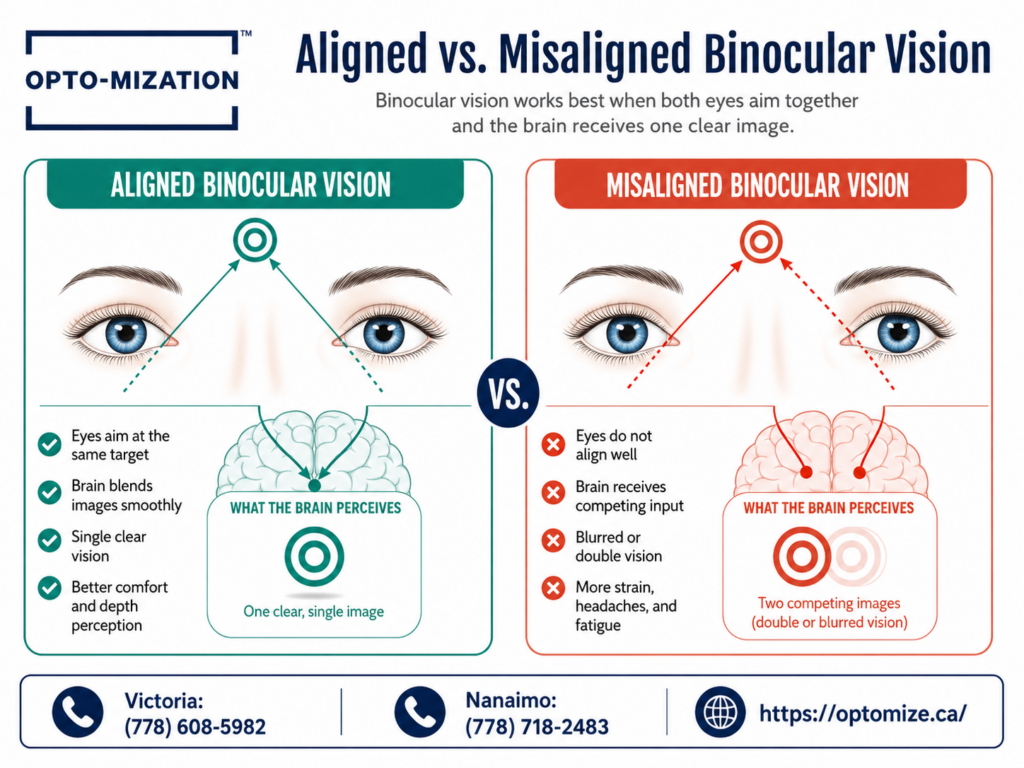
Your two eyes need to point at exactly the same spot simultaneously to create a single, clear image. This requires constant coordination between the muscles that control each eye’s position and the neural systems that keep them aligned. When that coordination breaks down even slightly, your brain has to work overtime to merge two slightly misaligned images into one.
That extra work is what you feel as strain, tension, or pulling. It is your visual system burning through effort just to maintain basic function, rather than running efficiently in the background as it should.
The Most Common Reasons Your Eyes Feel Like They’re Pulling
Binocular Vision Dysfunction (BVD)
BVD occurs when your eyes are slightly misaligned, and your brain struggles to compensate. Even a very small misalignment, one that would not be obvious to a casual observer, can cause significant symptoms. The muscles controlling your eye position work constantly to correct the gap, and over hours of use, the fatigue accumulates into that characteristic pulling feeling.
BVD is estimated to affect a significant portion of the population, yet it frequently goes undiagnosed because standard vision screenings do not include the tests needed to detect subtle misalignment. Many patients with BVD receive treatment for migraines, anxiety, or neck pain before the visual root cause is identified.
Convergence Insufficiency
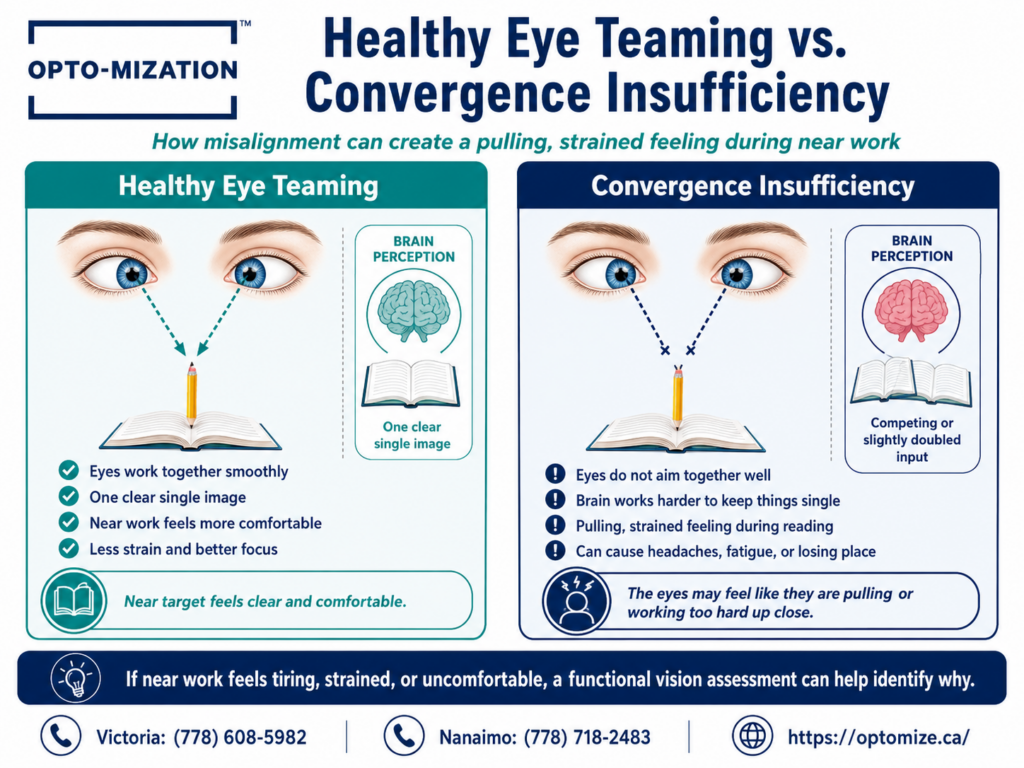
Convergence is the ability of your eyes to turn inward together when you focus on something close, like a book or a screen. Convergence insufficiency means your eyes struggle to sustain that inward position. As you read or work at close range, one or both eyes want to drift outward, and the pulling you feel is your visual system fighting against that drift.
People with convergence insufficiency often notice symptoms specifically when reading or using devices for extended periods. Words may seem to blur or move slightly, and the sensation of strain intensifies the longer the task continues. If you find yourself losing your place while reading or needing to reread the same line repeatedly, this is worth investigating. You can learn more through a specialized eye exam focused on digital eye strain in Nanaimo to see whether convergence issues are part of the picture.
Accommodative Dysfunction
Accommodation refers to your eye’s ability to shift focus between distances. When this system is strained or underperforming, your eyes may feel like they are constantly refocusing, especially when you look up from a screen to something across the room and then back again. That constant adjustment process is tiring, and it often presents as a generalized aching or pulling sensation rather than a sharp pain.
Digital Eye Strain (Computer Vision Syndrome)
Screen use reduces your blink rate significantly and forces your eyes into sustained near focus for hours at a time. This taxes both accommodation and convergence, compounding any underlying coordination difficulty. If your symptoms are worst after long screen sessions and improve on weekends or days away from devices, digital eye strain is very likely part of the equation. Practical guidance on how to prevent digital eye strain can help you reduce the daily load on your visual system between appointments.
Comparing Common Causes: Symptoms at a Glance
| Condition | Main Trigger | Key Symptoms | When It’s Worst |
| Binocular Vision Dysfunction | Eye misalignment | Pulling, headaches, dizziness, double vision | All-day use, especially afternoons |
| Convergence Insufficiency | Near focus tasks | Pulling outward, blurring text, losing place | Reading, screens, fine detail work |
| Accommodative Dysfunction | Focus switching | Aching, slow refocus, general fatigue | Distance-to-near transitions |
| Digital Eye Strain | Prolonged screen time | Dryness, burning, strain, pulling | End of screen-heavy workdays |
What Happens During a Proper Assessment
If you suspect your eyes are not working well as a team, a functional vision assessment goes well beyond checking your prescription. Here is what a thorough evaluation typically covers:
- Cover test: The examiner covers one eye at a time to detect any tendency for an eye to drift inward or outward (phoria or tropia).
- Convergence near point test: A target is moved toward your nose while you track it; this identifies how close you can maintain fusion before one eye breaks away.
- Vergence range testing: Prisms are used to measure how much misalignment your visual system can compensate for before strain sets in.
- Accommodative testing: Your examiner checks how quickly and accurately your eyes shift focus between distances.
- Eye tracking evaluation: This identifies any difficulty with smooth pursuit or saccadic eye movements, both of which affect reading and screen use.
- Binocular fusion testing: Stereopsis tests confirm whether your eyes are successfully combining their images into one three-dimensional view.
For patients dealing with persistent symptoms despite a normal prescription, adult vision therapy in Victoria addresses the functional gaps that standard testing does not always catch.
Treatment Options: What Can Actually Help
| Treatment | Best For | How It Works |
| Vision Therapy | Convergence insufficiency, BVD, tracking issues | Guided exercises retrain eye coordination and teaming efficiency |
| Prism Lenses | BVD and vertical or horizontal misalignment | Shifts the image so both eyes receive aligned input without constant muscle effort |
| Specialized Glasses/Lenses | Accommodative dysfunction, screen users | Reduces the focusing demand placed on the eye, easing strain during near work |
| Environmental Adjustments | Digital eye strain | Screen distance, lighting, monitor height, and blue light filters reduce the daily strain load |
Research on office-based vision therapy for convergence insufficiency shows high rates of improvement in symptom frequency and severity, with many patients achieving lasting results after a structured program. Outcomes tend to be strongest when therapy is combined with home-based reinforcement exercises.
Common Mistakes People Make When Dealing With Eye Strain
- Relying entirely on artificial tears: Lubricating drops help with dryness but do nothing to address the underlying coordination or focusing problem causing the pulling sensation.
- Assuming rest will fix it permanently: Breaks reduce acute symptoms, but they do not rehabilitate the underlying binocular function. Symptoms return as soon as visual demands resume.
- Stopping at the standard eye exam: A routine refraction checks your lens prescription, not how your eyes work together. If your prescription is fine but symptoms persist, you need a functional evaluation.
- Attributing everything to screen time: Screen use often amplifies symptoms, but for many people, a pre-existing binocular issue is the actual root cause. Cutting screen time is helpful but may not resolve the core problem.
- Ignoring symptoms in children or teenagers: These issues are not limited to adults. Young people with undetected convergence problems often struggle academically and are sometimes misidentified as having attention difficulties.
Studies in pediatric populations suggest that convergence insufficiency is associated with reduced reading efficiency and academic performance, yet a large proportion of affected children pass standard school vision screenings because those screenings do not test binocular function under sustained near-work conditions.
Frequently Asked Questions
Why do my eyes feel like they’re straining?
Eye straining usually means your visual system is working harder than it should to maintain clear, single vision. The most common reasons are binocular vision dysfunction, convergence insufficiency, or accommodative fatigue. Screen use intensifies all of these because it locks your eyes into sustained near focus with reduced blinking. A functional eye exam can identify which system is under stress and guide the right treatment approach.
How do I reset strained eyes?
The most immediate relief comes from the 20-20-20 rule: every 20 minutes, look at something 20 feet away for at least 20 seconds. This relaxes both the accommodative and convergence systems. Warm compresses can ease muscle tension around the eyes, and reducing screen brightness and glare helps reduce the visual load. These strategies reduce acute symptoms, but if strain is frequent or severe, an assessment of your binocular function is the more lasting solution.
How do I turn off eye strain?
There is no instant switch, but addressing the cause is what creates lasting relief. If your eyes are misaligned or poor at teamwork, prism lenses or vision therapy can reduce the constant corrective effort your muscles are making. Environmental changes, including proper screen distance, good lighting, and ergonomic monitor placement, lower the daily demand on your visual system. Treating the functional problem, rather than just managing symptoms, is what removes the strain for good.
What are three symptoms of eye strain?
The three most reported symptoms are a pulling or aching sensation in or behind the eyes, headaches that develop during or after visually demanding tasks, and blurred or occasionally doubled vision during reading or screen use. Some people also experience sensitivity to light, difficulty concentrating, or a sense that their eyes feel heavy or tired even early in the day. If you have two or more of these consistently, a binocular vision assessment is worthwhile.
What are the early signs of an eye stroke?
An eye stroke (retinal artery or vein occlusion) most commonly presents as a sudden, painless loss of vision in one eye, or a large area of blurring or darkness in part of the visual field. Unlike eye strain or binocular dysfunction, it is typically sudden in onset and does not fluctuate with rest. Other warning signs can include a graying or dimming of vision, or seeing a curtain-like shadow across part of your view. Because these symptoms can overlap with other conditions, any sudden unexplained vision change warrants urgent evaluation rather than monitoring at home.
Conclusion: Your Eyes Should Not Have to Fight to Work
That pulling, straining, or fighting sensation is your visual system sending a signal. It is telling you the work of seeing is costing more effort than it should. In many cases, the cause is a treatable coordination problem, not an inevitability you have to manage with breaks and drops.
Getting a proper assessment is the clearest path to understanding what is actually happening. Once the root cause is identified, whether it is a misalignment, a convergence difficulty, or a functional gap in how your eyes focus together, the options for relief are well-established and effective.
If you have been living with these symptoms and standard eye care has not resolved them, Opto-Mization offers assessments designed to evaluate how your eyes function as a system, not just how clearly each one sees on its own. Reach out to the team at (778) 608-5982 to schedule an evaluation and get a clearer picture of what your visual system needs.