Headaches, eye strain, and poor focus often share a single underlying cause: a breakdown in how the eyes and brain coordinate. When the visual system struggles to keep images stable, aligned, or clear under sustained demand, the brain compensates by working harder, and that extra effort shows up as head pain, fatigue behind the eyes, and an inability to concentrate. These three symptoms are not separate problems happening at the same time; they are frequently three expressions of the same functional vision problem.
For many people in Greater Victoria and Nanaimo, this connection goes undetected for years. A standard eye exam confirms that your prescription is fine, your eyes are healthy, and your 20/20 acuity is intact. What it rarely checks is how well your eyes team together, sustain focus across a page, or shift smoothly from one distance to another. Those are the skills that fail first under real-world visual demands.
Key Takeaways
- Headaches, eye strain, and difficulty concentrating are frequently symptoms of the same underlying visual coordination problem, not three separate issues.
- A 20/20 result on a standard eye exam does not rule out functional vision dysfunction; it measures clarity, not coordination or stamina.
- Binocular vision dysfunction, convergence insufficiency, and accommodative fatigue are common causes of this symptom cluster that a functional vision assessment can identify.
- Children and adults who spend long hours reading or on screens are especially vulnerable, but the problem is not caused by screen time itself.
- Targeted treatment, including vision therapy and specialized lens prescribing, addresses the root cause rather than masking the symptoms.
Things You Must Know
1. A Normal Eye Exam Result Does Not Mean Your Vision Is Working Well
Standard eye exams are designed to measure visual acuity and screen for disease. They are not designed to evaluate how well your eyes team together, sustain focus, or track across a line of text. Someone can pass every test at a routine exam and still have a significant binocular vision problem. If your headaches or focus difficulties were dismissed after a normal eye exam, the right exam may not have been performed yet.
2. The Symptoms Often Get Worse as the Day Goes On
Functional vision problems tend to be fatigue-dependent. Your eyes may feel fine in the morning but deteriorate noticeably after an hour or two of close work. Headaches that build through the afternoon, focus that collapses after reading for a short time, and eyes that feel pulled or strained by evening are all patterns that point toward a visual efficiency problem rather than a structural or neurological condition. Tracking when your symptoms peak matters when describing your experience to a clinician.
3. Children Rarely Describe What They Are Experiencing
A child avoiding reading, complaining of stomachaches before school, or labeled as inattentive in class may be experiencing visual discomfort they have no vocabulary to describe. Headaches from eye strain in children are frequently written off as anxiety or a need for glasses. If a child’s prescription has been checked and the problems persist, a functional vision evaluation is the appropriate next step.
Why These Three Symptoms Cluster Together
The visual system is not just your eyes. It includes the muscles that move and align the eyes, the focusing mechanism inside each eye, and the neural pathways that process and integrate visual information in the brain. When any part of this system works inefficiently, the brain fills the gap, and that sustained compensatory effort has a cost.
That cost is what most people describe as a headache around the temples or forehead, a burning or pulling sensation behind the eyes, and a creeping inability to hold attention on text or a screen. The three symptoms arrive together because they share a single mechanism: overwork.
Binocular Vision Dysfunction
The most common culprit is binocular vision dysfunction, a condition in which the eyes do not point at exactly the same place consistently. When the alignment drifts even slightly, the brain receives two slightly different images and has to constantly suppress or reconcile them. Over minutes and hours of reading or screen work, this process drains cognitive and physical resources. The result is exactly the cluster of symptoms described above.
Convergence insufficiency is one specific form of binocular vision dysfunction where the eyes struggle to maintain inward alignment at close range. It is one of the more common reasons a person cannot read for more than a short period without losing focus or developing a headache.
Accommodative Dysfunction
Accommodation is the eye’s ability to adjust focus as distance changes. When the focusing mechanism is sluggish or unstable, text blurs intermittently, the brain registers the inconsistency, and the visual system works harder to compensate. People with accommodative dysfunction often describe print that goes in and out of focus, a need to look away and re-engage repeatedly, and difficulty switching between a screen and a document or whiteboard.
According to NIH research on convergence insufficiency, this condition affects between 2% and 13% of school-age children and is a recognized contributor to reading difficulties, reduced academic performance, and complaints of headaches during near work.
How a Functional Vision Assessment Identifies the Root Cause
A functional vision assessment differs from a routine eye exam in both scope and intent. Rather than confirming acuity and checking ocular health, it evaluates the entire system of visual skills that determine how efficiently and comfortably you use your vision under real conditions.
At Opto-Mization, the functional eye exam process measures how well the eyes converge and diverge, how quickly and accurately they shift focus, how steadily they track across a line, how the brain processes and integrates visual information, and whether the overall visual load is creating strain. These measurements produce a picture of where the system is losing efficiency, not just whether the eyes are structurally healthy.
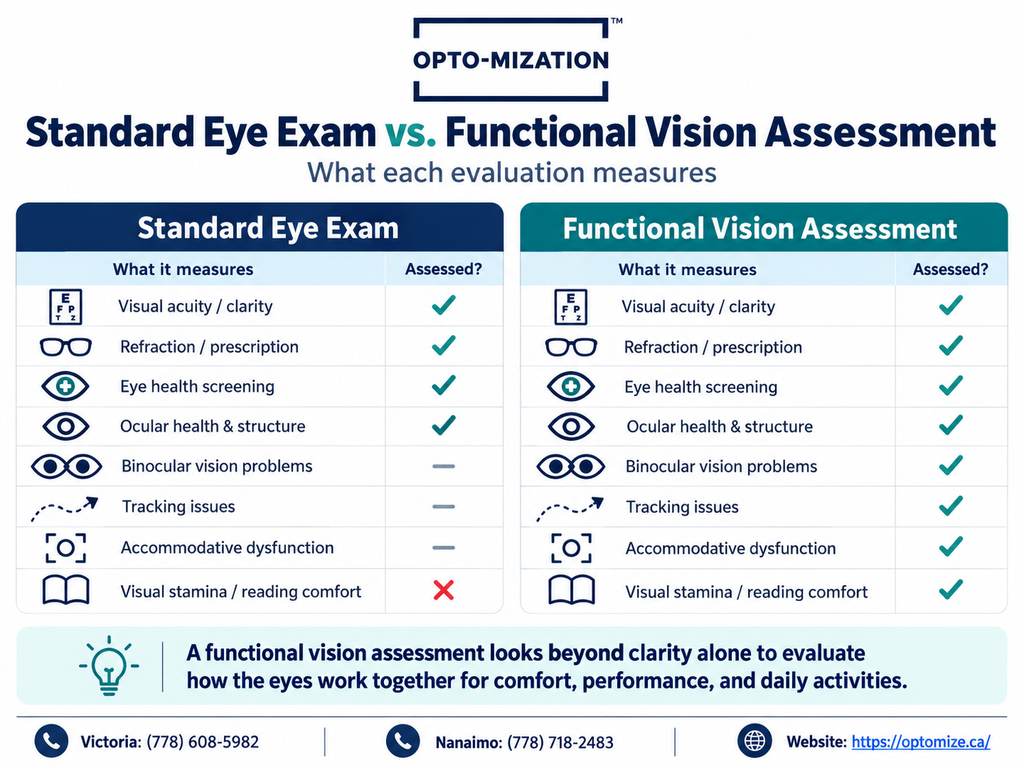
| What a Standard Exam Checks | What a Functional Vision Exam Adds |
| Visual acuity (clarity at distance and near) | Eye teaming and alignment under sustained demand |
| Refractive error (prescription) | Convergence and divergence ranges |
| Eye health and disease screening | Accommodative flexibility and stamina |
| Basic eye muscle movement | Eye tracking accuracy and saccadic control |
| Colour vision and peripheral screening | Visual processing speed and integration |
Treatment Options Once the Problem Is Identified
Knowing the specific deficit makes treatment precise. Functional vision problems respond well to targeted intervention, and the approach depends on what the assessment finds.
- Specialized lens prescribing: Prism lenses or lenses designed around functional measurements can reduce the strain the visual system places on itself, providing relief while the underlying deficit is being addressed.
- Vision therapy: A structured program of visual exercises and neurological retraining that teaches the visual system to operate more efficiently. Sessions are guided by a trained therapist and adapted as the patient progresses.
- Combined approach: Many patients benefit from both. Lenses reduce the immediate burden while vision therapy builds lasting capacity, so the system no longer requires the same compensatory effort.
- Ongoing monitoring: Progress is measured throughout treatment. Visual skills are re-evaluated at intervals to confirm improvement and adjust the program if needed.
The Convergence Insufficiency Treatment Trial, a multi-site randomized clinical trial published in peer-reviewed literature, demonstrated statistically significant reductions in symptom frequency and severity among children treated with office-based vision therapy, including headaches during near work and difficulty sustaining attention on reading tasks.
Common Mistakes People Make When These Symptoms Appear
- Assuming a normal eye exam rules out a vision problem. Acuity and eye health are only part of the picture. A functional vision assessment covers the components that standard exams skip.
- Treating each symptom separately. Taking pain relievers for headaches, using lubricating drops for eye discomfort, and trying focus techniques for concentration misses the shared root. Symptom management without a diagnosis rarely resolves the underlying issue.
- Attributing the problem entirely to screen time. Screens do not cause binocular vision dysfunction. They expose it. Reducing screen time may lower immediate discomfort, but the structural problem remains and will surface in any sustained visual task.
- Waiting to see if a child grows out of it. Visual efficiency problems in children do not self-resolve with age. They tend to worsen as academic demands increase, and the downstream effects on learning and confidence compound over time.
- Assuming medication or ADHD treatment will fix the focus problem. When attention difficulties have a visual component, treating them as purely neurological or behavioral produces incomplete results. A vision evaluation should be part of any comprehensive assessment of focus and learning difficulties.
A 2025 study in Vision Research examining ADHD and binocular dysfunction found that individuals with ADHD have a higher incidence of accommodative and non-strabismic binocular dysfunction that could impact academic performance, and that because these vision disturbances are unrelated to refractive errors, affected individuals may be classified as having normal vision and never receive the visual intervention that could improve their outcomes.
Who This Affects
| Patient Group | Common Presentation | Frequently Missed Because |
| School-age children | Avoids reading, loses place, restless, labeled inattentive | Passes school vision screening; attributed to behavior |
| Adults with desk or screen work | Afternoon headaches, eye fatigue, reduced productivity | Normal prescription; attributed to stress or posture |
| Post-concussion patients | Persistent headaches, light sensitivity, difficulty reading | Neurological focus obscures the visual component |
| High-achieving adults | Brain fog during focused work, reading comprehension fatigue | Symptoms normalized as part of a demanding lifestyle |
For people in the Victoria and Nanaimo areas who have cycled through headache treatments, tried multiple prescriptions, or been told their eyes are healthy when the symptoms persist, a specialized exam for headaches and visual stress provides the depth of evaluation that routine care does not.
Frequently Asked Questions
Why does my head hurt and my eyes can’t focus?
When the eyes struggle to maintain alignment or sustain focus, the brain works harder to compensate and produce a clear, single image. That sustained muscular and neurological effort generates a characteristic headache, typically felt around the temples, forehead, or behind the eyes, alongside difficulty holding visual attention. The two symptoms are the same problem expressed differently: one is physical strain, the other is cognitive fatigue from the same source.
Can eye strain cause lack of focus?
Yes. When visual efficiency is low, the brain devotes a disproportionate amount of its processing capacity to managing the visual task itself. Less capacity is available for comprehension, retention, and sustained attention. This is why some people who struggle to concentrate during reading or screen work find that their focus improves significantly once the underlying visual problem is identified and treated.
Is there a connection between ADHD and tension headaches?
The overlap between ADHD and visual dysfunction is well-documented enough to be clinically significant. Binocular vision problems can produce symptoms that closely resemble ADHD: distractibility, avoidance of close work, short attention spans during reading, and impulsivity triggered by discomfort. Tension-type headaches from visual strain frequently accompany this presentation. A functional vision assessment can determine whether a visual component is contributing to attention and behavior concerns, which changes the treatment path.
How do you know if headaches are vision related?
Several patterns suggest a visual origin. Headaches that begin or worsen during reading, screen work, or close tasks point toward near-vision demand as a trigger. Headaches that build through the day rather than arriving suddenly, that are felt specifically around the eyes or forehead, or that resolve when visual demand is removed are all consistent with visual strain. If a standard exam has returned normal results but headaches persist, a functional assessment examining eye teaming, focusing, and tracking is the appropriate next step.
What are bad signs of headaches?
Headaches that arrive suddenly with severe intensity, that are accompanied by neurological symptoms such as vision loss, numbness, slurred speech, or confusion, or that follow a head injury require immediate medical evaluation. Headaches with fever, neck stiffness, or that are progressively worsening over days warrant urgent assessment. These presentations fall outside functional vision and need to be ruled out before pursuing visual causes. Once serious causes are cleared, persistent or daily headaches tied to visual tasks are a reasonable focus for functional investigation.
Conclusion
Headaches, eye strain, and poor focus are frustrating on their own. When they occur together and resist standard treatment, the connection between them deserves closer examination. The visual system operates as a coordinated process between the eyes and the brain, and when that coordination breaks down, it creates exactly the cluster of symptoms that many people carry for years without a clear explanation.
A functional vision assessment identifies what a standard exam cannot: the specific efficiency deficits that force the brain to work harder than it should. Once those deficits are named, treatment addresses the root cause rather than the symptoms.
If you or your child in the Greater Victoria or Nanaimo area has been dealing with persistent headaches, eye strain, or difficulty concentrating and has already been told that their eyes look fine, the next step is an evaluation that looks at how the eyes and brain work together. Contact Opto-Mization to schedule a functional vision assessment and find out what has been missed.