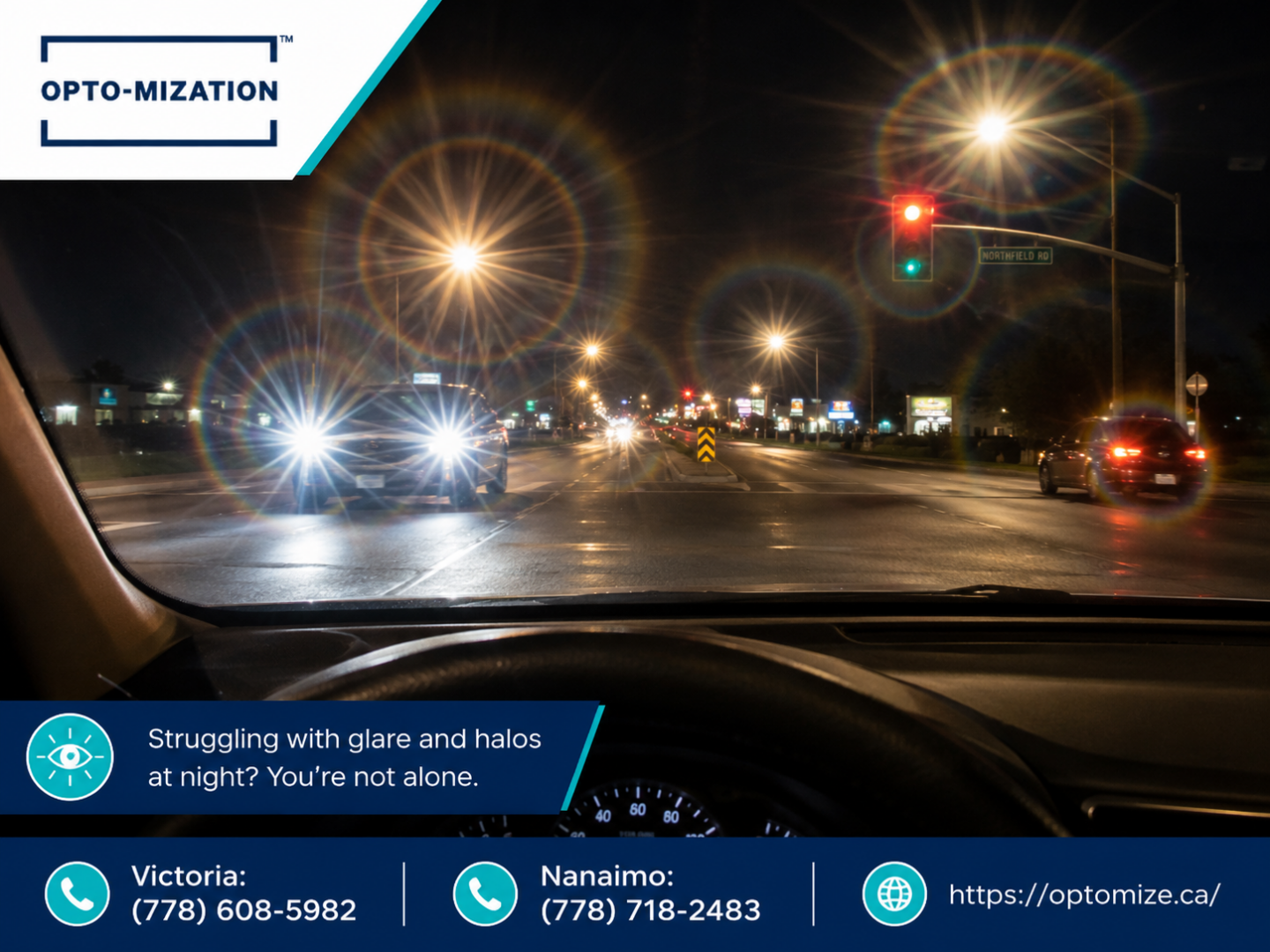
Seeing halos, glare, or starbursts around lights at night is most commonly caused by how light scatters inside your eye, and it can be linked to factors like dry eyes, cataracts, refractive errors, or previous eye surgery. While occasional night glare is normal, persistent or worsening symptoms are worth getting professionally assessed. A comprehensive eye exam can identify the underlying cause and guide you toward the right treatment.
If you’ve ever driven at night and noticed that streetlights seem to shoot out spikes, or that oncoming headlights bloom into a glowing halo, you’re not imagining it. Millions of people experience this, and the causes range from completely benign to something that genuinely needs attention. Understanding what’s happening inside your eye is the first step to figuring out what to do about it.
Key Takeaways
- Halos and starbursts around lights are caused by light scattering or diffracting inside the eye before it reaches the retina.
- The most common causes include dry eyes, astigmatism, early cataracts, large pupils, and certain types of refractive surgery.
- These symptoms are often worse at night because your pupils dilate in low light, letting in more scattered or distorted light.
- Persistent or sudden worsening of night glare should always be evaluated by an eye care professional.
- Many causes are treatable or manageable once properly diagnosed through a functional eye exam.
- Anti-reflective coatings, updated prescriptions, or medical treatment can significantly reduce symptoms in many cases.
Things You Must Know
1. Your Pupil Size Plays a Bigger Role Than Most People Realize
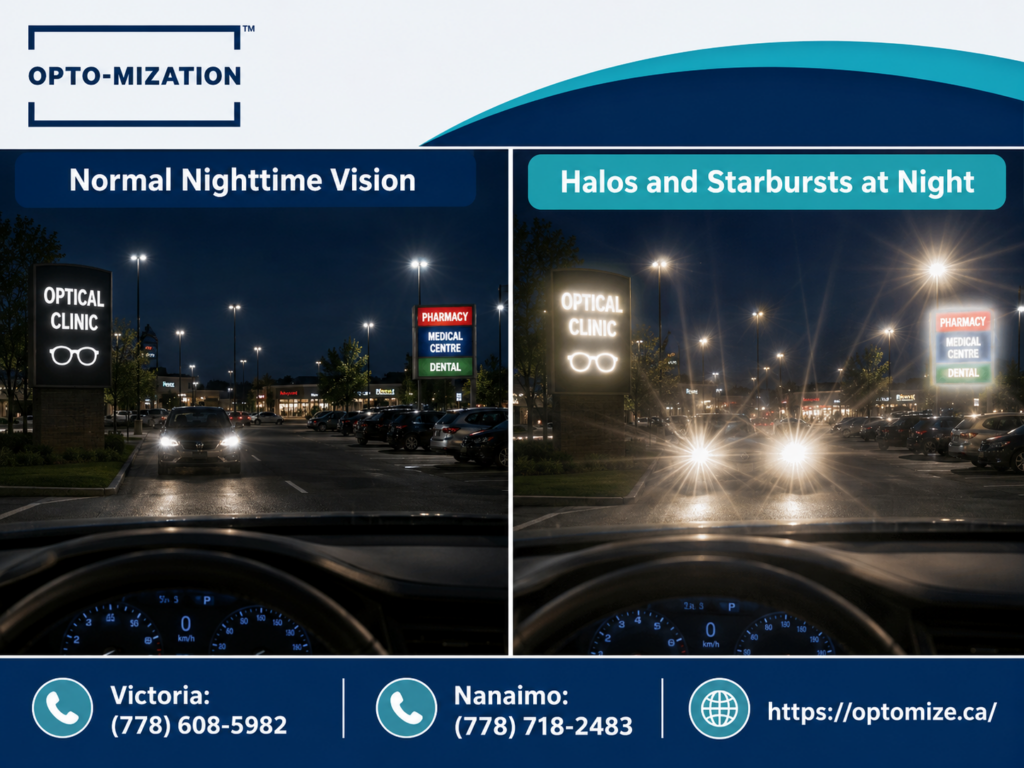
At night, your pupils dilate to let in more light. When they expand beyond the optical zone of a lens, a cornea, or a refractive correction, more light enters through the edges of your eye’s optical system where distortion is naturally higher. This is why many people notice halos or starbursts specifically in dim environments, even if their daytime vision feels perfectly fine. If this is your situation, it doesn’t automatically mean something is wrong, but it’s worth knowing what’s driving it.
2. Not All Glare Symptoms Have the Same Cause or Urgency
Dry eye-related glare tends to fluctuate and often improves after blinking. Glare from cataracts tends to be more consistent and gradually worsens over months or years. Glare after LASIK or other refractive surgery is usually tied to pupil size and corneal healing. Getting the right diagnosis matters because the treatment path for each cause is different. Treating dry eyes when the actual issue is early cataracts, for example, won’t deliver meaningful results.
3. A Standard Vision Test Won’t Always Catch This
A basic 20/20 vision check measures clarity at a specific distance under controlled lighting. It doesn’t evaluate how your eyes perform in low-contrast, low-light conditions where halos and starbursts actually show up. If you’ve been told your vision is “fine” but you’re still struggling at night, you likely need a functional eye exam that assesses how your visual system works in real-world conditions.
What Is Actually Happening Inside Your Eye?
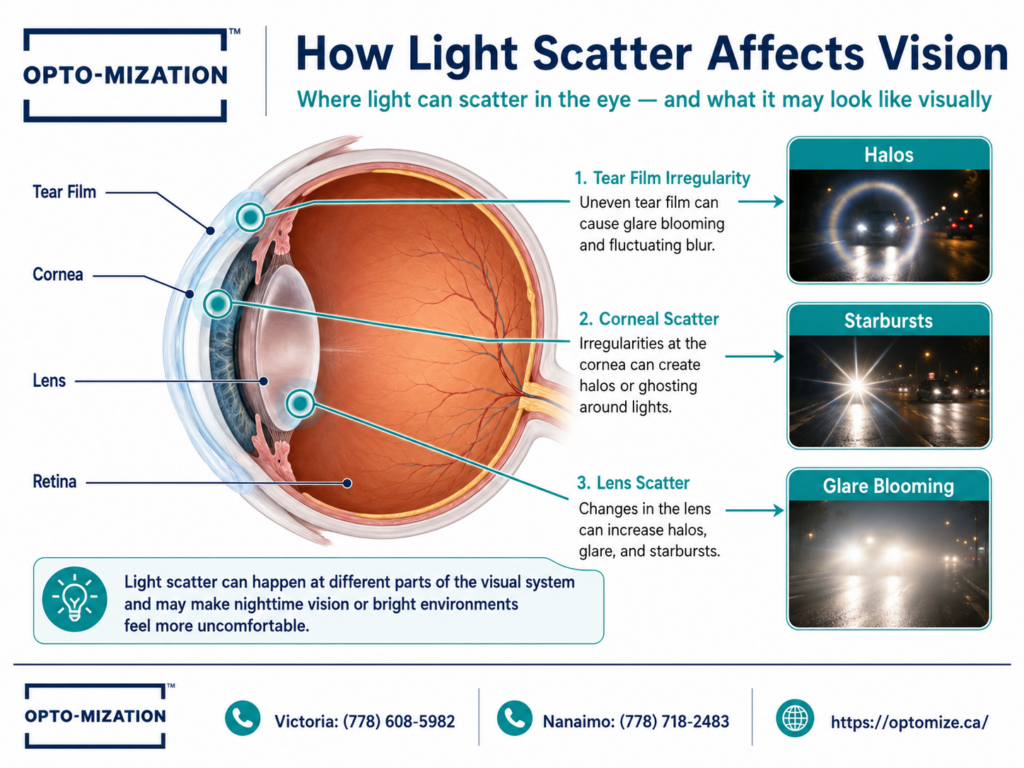
Your eye focuses light by bending it through the cornea and lens before it lands on the retina. When any part of that pathway is irregular, light rays don’t converge cleanly into a single point. Instead, they scatter, diffract, or spread out across your retina, creating the rings, spikes, or blooming glow that you see around light sources.
The effect is most noticeable around point sources of light, like headlights, streetlamps, or lit signs, because those are the situations where scattered light is most visible against a dark background. Broader, diffuse light during the day tends to mask the problem.
What Are the Most Common Causes of Night Halos and Starbursts?
Refractive Errors (Astigmatism, Myopia, Hyperopia)
Astigmatism is one of the most frequent culprits. An irregularly shaped cornea or lens bends light unevenly, which produces elongated or spiked distortions around light sources. Even mild, uncorrected astigmatism that causes no real daytime trouble can create noticeable starbursts at night. An updated glasses or contact lens prescription often makes a significant difference.
Dry Eye Disease
The tear film covering your cornea acts as the first optical surface your eye uses to focus light. When that film is unstable or thin, it creates micro-irregularities on the surface of the eye that scatter incoming light. Dry eye-related halos and glare tend to fluctuate, often changing between blinks. Many people notice their night vision worsens after long screen sessions or in air-conditioned environments. If you’ve also been experiencing eyes that feel fine in the morning but worse at night, dry eye is a strong possibility worth investigating.
Cataracts
Cataracts are among the leading causes of vision impairment worldwide, and one of their earliest symptoms is increased glare and halos at night. As the lens inside your eye becomes cloudy, it scatters light rather than transmitting it cleanly to the retina. The halos associated with cataracts tend to appear as soft, blurry rings and often come with a general reduction in contrast and colour vibrancy.
Large Pupils
Some people naturally have larger pupils than average, and others develop larger pupils as a side effect of certain medications. When your pupil is wide, more of the peripheral cornea and lens is exposed to incoming light. Those outer zones are less optically precise than the central area, which means more aberration and more visible scatter. This is especially common in younger adults with naturally large pupils who notice significant starburst effects at night despite having otherwise healthy eyes.
Post-Surgical Changes (LASIK, PRK, Cataract Surgery)
Refractive surgery permanently reshapes the cornea, and in some cases the treated optical zone may not fully cover the dilated pupil in low light. This creates a situation where the edge of the treatment zone introduces aberrations that weren’t present before surgery. For most patients this improves significantly during the healing process, but for others it can persist. A wavefront analysis can help determine how much higher-order aberration is involved.
Certain Eye Drops or Medications
Dilating drops used during an eye exam will obviously cause temporary halos. But some prescription medications, including certain antihistamines, antidepressants, and blood pressure drugs, can also affect pupil size or lens clarity in ways that impact night vision. If your symptoms started around the same time as a medication change, that’s worth mentioning to both your prescribing physician and your optometrist.
How Do Halos, Glare, and Starbursts Differ?
| Symptom | What It Looks Like | Common Association |
| Halos | Rings of light circling a source | Cataracts, high IOP, corneal edema |
| Starbursts | Spikes or rays extending from a light source | Astigmatism, post-LASIK, large pupils |
| Glare | Bright scatter that reduces contrast | Dry eyes, cataracts, dirty or scratched lenses |
| Ghosting / Double images | Second or blurred copy of a light source | Uncorrected astigmatism, irregular cornea |
What Conditions Can Make These Symptoms More Serious?
In most cases, halos and starbursts are a quality-of-life issue rather than a medical emergency. That said, a few scenarios do warrant prompt attention. Sudden onset of halos around lights, especially accompanied by eye pain, eye redness, headache, or nausea, can be a sign of acute angle-closure glaucoma, which is a true emergency. Similarly, if you notice sudden changes in vision alongside your light distortion symptoms, don’t wait for a routine appointment.
Acute angle-closure glaucoma can cause a sudden and significant increase in intraocular pressure, which creates halo symptoms as one of its warning signs. It requires immediate medical treatment to prevent permanent vision loss. It is more common in people who are farsighted, of certain ethnic backgrounds, or over the age of 60.
What Can Be Done About Night Halos and Starbursts?
Treatment depends entirely on the underlying cause, which is why self-diagnosing based on symptoms alone rarely leads anywhere useful. Here’s a general overview of the approaches typically used:
- Updated prescription: Correcting uncorrected or under-corrected astigmatism with glasses or contact lenses is often the simplest fix for starburst-type symptoms.
- Anti-reflective lens coatings: These coatings reduce surface reflections on spectacle lenses and are particularly helpful for night driving.
- Dry eye treatment: Depending on the severity, this might include lubricating drops, prescription anti-inflammatory drops, punctal plugs, or dietary and lifestyle changes.
- Cataract surgery: When cataracts are the source, surgical removal and lens implantation generally resolves the associated glare and halos significantly.
- Orthokeratology or scleral lenses: In some cases, specialty contact lenses can reshape or vault over the corneal surface in ways that reduce higher-order aberrations.
- Monitoring post-surgical changes: For patients recovering from LASIK or similar procedures, many symptoms improve on their own over the first six to twelve months as corneal healing progresses.
Common Mistakes People Make When Dealing With Night Vision Problems
- Assuming 20/20 means there’s no problem. Standard visual acuity testing doesn’t measure how your eyes perform in low-light or high-contrast situations. You can have perfect 20/20 acuity and still experience significant nighttime glare.
- Using over-the-counter “night driving glasses” without a proper diagnosis. Yellow-tinted lenses reduce some glare but don’t address the underlying cause and can actually reduce overall contrast sensitivity in some conditions.
- Delaying an exam because the symptoms only happen at night. Nighttime symptoms can still indicate a progressing condition that’s easier to address in its earlier stages.
- Attributing everything to screen time or tiredness. While digital eye strain is real, halos and starbursts specifically around point light sources at night are more often a structural or optical issue than a fatigue issue alone.
- Not mentioning medications to your eye doctor. Several systemic medications affect pupil size and lens clarity. Your optometrist needs a complete picture to interpret your symptoms accurately.
How Different Causes Compare in Terms of Onset and Treatment
| Cause | Typical Onset | Worsens Over Time? | General Treatment Direction |
| Astigmatism | Gradual or always present | Can change slowly | Updated prescription, AR coating |
| Dry Eyes | Fluctuates, often worse at end of day | Can worsen without treatment | Lubrication, lifestyle, prescription drops |
| Cataracts | Slow progression over years | Yes, predictably | Surgical removal when indicated |
| Post-LASIK | Immediately post-surgery | Usually improves with healing | Monitoring, specialty lenses if persistent |
| Large Pupils | Present in low light consistently | Stable unless other factor develops | Prescription optimization, specialty lenses |
Dry eye disease affects a significant percentage of adults, with prevalence estimates varying widely across studies but consistently showing higher rates in older adults, contact lens wearers, and people who spend extended hours on digital screens. Its impact on optical quality and nighttime visual performance is increasingly recognized as a clinical concern separate from the discomfort symptoms it also causes.
Night vision difficulties also sometimes co-occur with other visual distortions. If you’ve noticed that straight lines look distorted or warped, that’s a separate but related symptom worth addressing alongside any nighttime glare concerns, as the two can occasionally point to overlapping conditions affecting the cornea or macula.
Frequently Asked Questions
Why do I see starburst lights at night?
Starbursts around lights at night are typically caused by light diffracting or scattering inside the eye due to an irregular optical surface. Astigmatism is the most common reason, as the uneven corneal shape bends light into elongated or spiked patterns rather than a clean point. Large pupils, certain contact lens fits, and post-surgical corneal changes can also produce similar effects.
Is it normal to see halos at night?
Mild halos around bright lights in very dark conditions are fairly common and not always a sign of a problem. Your pupils dilate in low light, which naturally increases some optical imperfection. That said, halos that are noticeable every time you drive at night, are getting worse, or are accompanied by other symptoms like eye pain or reduced vision should be professionally evaluated rather than dismissed as normal.
Why do headlights look like starbursts at night?
Headlights are intense point sources of light in an otherwise dark field, which makes any optical irregularity in your eye immediately obvious. If you have even mild astigmatism or a slightly unstable tear film, that concentrated beam of light will scatter across your retina in a way that creates visible spikes or rays. This is also why the effect tends to be more pronounced with modern LED headlights, which are significantly brighter than older halogen lights.
How do you fix starburst vision at night?
The approach depends on what’s causing it. For astigmatism, an updated prescription with anti-reflective coated lenses is often highly effective. For dry eyes, consistent use of quality lubricating drops and addressing root causes can improve the tear film enough to reduce scatter. For cataracts, surgery is ultimately the most definitive solution. A thorough eye exam is the necessary starting point to figure out which path makes sense for your specific situation.
Is starburst vision serious?
In most cases, starburst vision is not a medical emergency, but it can be a meaningful safety concern, particularly when driving at night. It can also be an early indicator of a progressive condition like cataracts or uncontrolled dry eye disease. The sudden onset of halos and starbursts alongside eye pain, redness, or a rapid drop in vision is the exception: that combination warrants same-day urgent care, as it can signal a sharp rise in eye pressure.
Closing Thoughts
Halos, glare, and starbursts at night are among the most common visual complaints that people quietly put up with far longer than they need to. Whether the cause is something as simple as an outdated prescription or something that requires closer monitoring, the answer starts with getting your eyes properly examined under conditions that actually reflect how you use your vision.
If nighttime light distortion is affecting how confidently you drive, how rested your eyes feel, or just your general quality of vision, it’s worth taking seriously. Many of the causes are straightforward to address once identified.
At Opto-mization, we take a thorough approach to understanding how your visual system actually functions rather than just measuring what you can read off a chart. If you’re ready to get clear answers about what’s happening with your night vision, call us at (778) 608-5982 to book a comprehensive eye exam. Your eyes perform better than you might think with the right support.