Feeling overwhelmed by bright lights, busy patterns, or moving visuals is a real neurological experience, not an overreaction. It often points to how your visual system and brain process sensory input, and it can be connected to conditions like visual stress, sensory processing differences, migraines, or anxiety. Understanding what is happening is the first step toward managing it effectively.
If fluorescent lights make you tense, striped patterns feel almost painful to look at, or scrolling through your phone leaves you dizzy and drained, you are not imagining it. These experiences have real causes rooted in how your nervous system handles visual information. They are more common than most people realize, and they are treatable.
Key Takeaways
- Sensitivity to bright lights, patterns, and movement is a recognized symptom with neurological and visual roots.
- Conditions like visual stress, migraines, anxiety, and sensory processing differences can all contribute to these feelings.
- The visual cortex can become overloaded when it receives more stimulation than it can efficiently process.
- Symptoms often include eye strain, headaches, dizziness, nausea, and difficulty concentrating.
- Tinted lenses, vision therapy, and environmental adjustments are among the evidence-informed approaches that can help.
- A thorough assessment with a professional who understands visual processing is the right starting point.
Things You Must Know
1. This Is Not a Personality Quirk or Weakness
Many people dismiss their own symptoms because they feel embarrassed or assume they are being overly sensitive. Visual overwhelm has measurable neurological mechanisms behind it. The brain genuinely struggles to filter and process certain types of high-contrast or rapidly changing visual input, and that struggle creates real physical discomfort. Acknowledging it as a legitimate symptom is important for getting the right help.
2. The Source Can Be Visual, Neurological, or Both
Not everyone who experiences visual overwhelm has the same underlying cause. For some people, the issue originates in how the eyes themselves process contrast and light. For others, it is more about how the brain interprets the signals it receives. In many cases, both layers are involved. A professional assessment helps separate these factors, which matters because the most effective approach depends on what is actually driving the symptoms.
3. Common Environments Are Designed Without Sensitivity in Mind
Offices, schools, grocery stores, and transit spaces are filled with fluorescent lighting, tiled floors, patterned surfaces, and screens at every angle. These environments were not built with visual sensitivity in mind. Understanding this helps explain why symptoms can feel much worse in certain spaces. It also means that targeted environmental changes, alongside professional support, can make a meaningful difference in daily comfort.
What Is Actually Happening in Your Brain and Eyes?
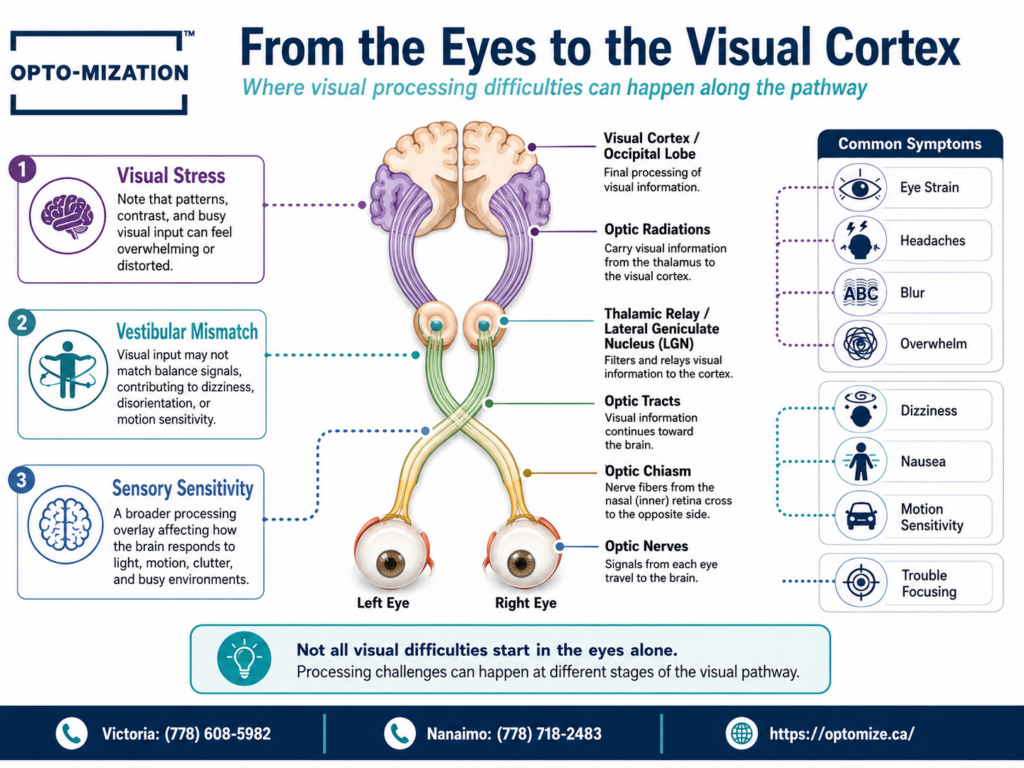
The visual system does not simply record what you see like a camera. It actively interprets, filters, and organizes incoming light signals, and it does this continuously without you thinking about it. When that system is running efficiently, it handles most environments with ease. When it is under strain, certain stimuli can trigger a cascade of discomfort.
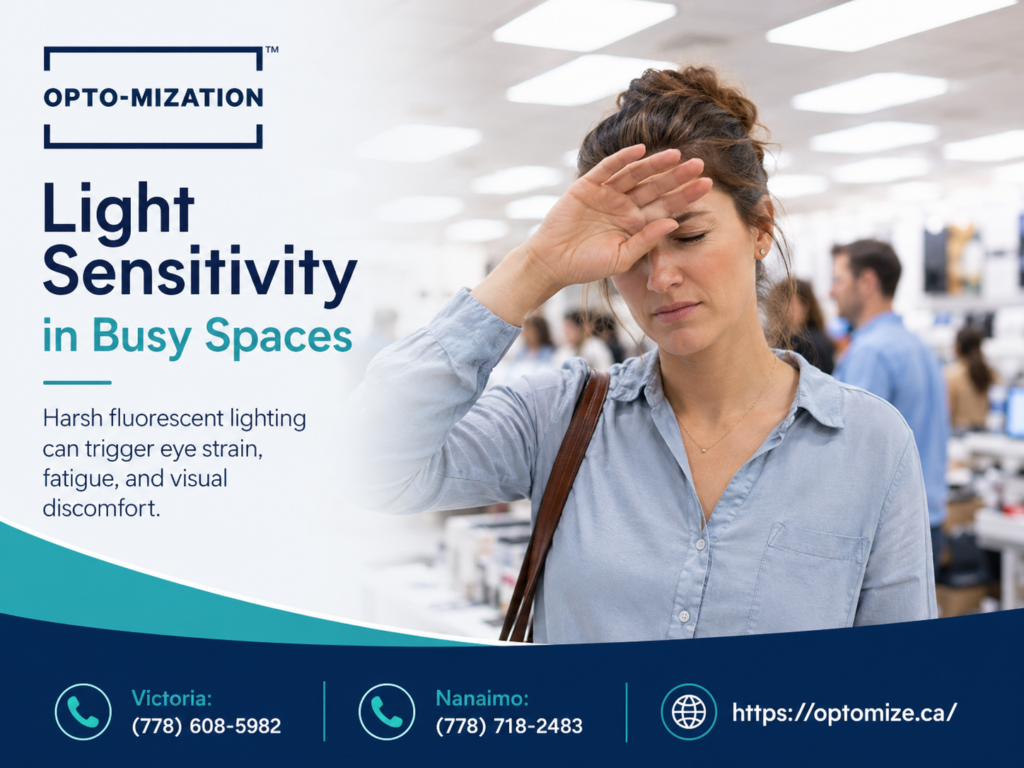
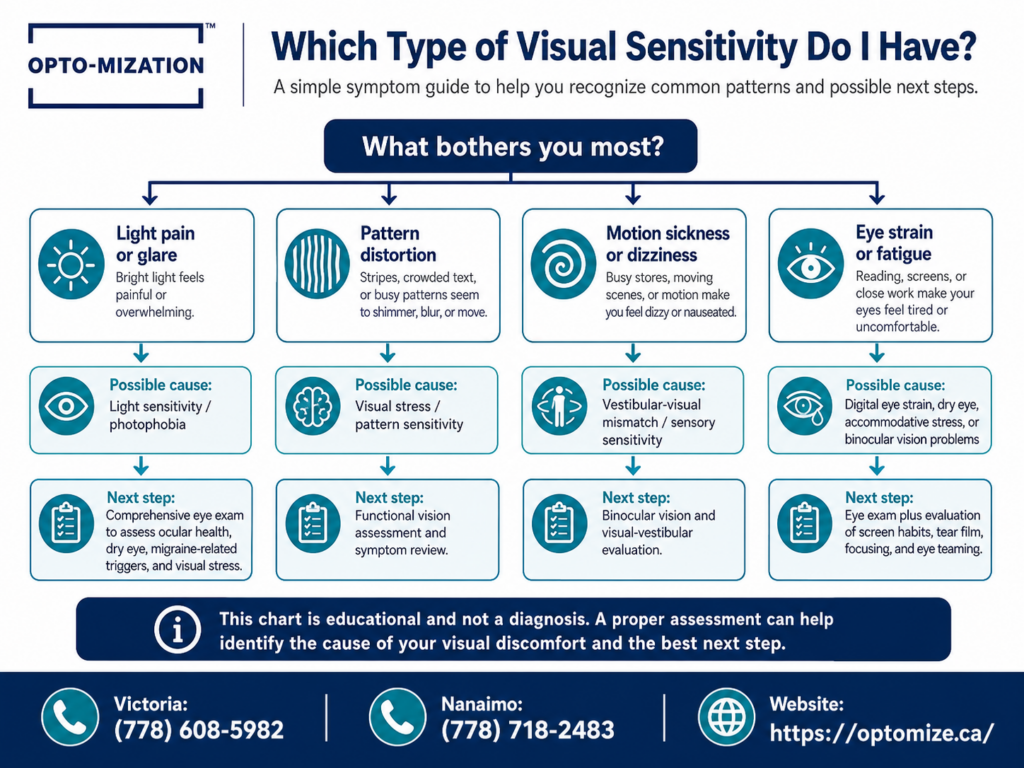
Bright lights, high-contrast patterns, and fast movement are all examples of high-load visual input. They demand significant processing resources. For people with visual stress or heightened sensory sensitivity, the visual cortex can struggle to keep up. The result is a range of symptoms: headaches, eye strain, dizziness, nausea, and a strong urge to look away or close your eyes entirely.
If you have ever noticed that certain stripe patterns seem to shimmer or move even though they are perfectly still, that is an example of how a taxed visual cortex can generate perceptual distortions. This phenomenon is sometimes called pattern glare, and it is well-documented in optometric and neuroscience research. You can read more about how this connects to distorted vision in our overview of why straight lines can look distorted or warped.
Common Causes of Visual Overwhelm
Several distinct conditions can produce these kinds of symptoms. They sometimes overlap, which is why a thorough evaluation matters more than guessing at the cause on your own.
Visual Stress (Meares-Irlen Syndrome)
Visual stress is a neurological condition in which the brain responds poorly to certain wavelengths of light or types of visual contrast. Reading black text on white paper, looking at striped floors, or sitting under certain lighting can trigger headaches, eye strain, and perceptual distortions. It is more common in people with dyslexia but can occur independently of any reading difficulty.
Photophobia and Light Sensitivity
Photophobia refers to an uncomfortable or painful sensitivity to light. It is often associated with migraines, concussions, and various neurological conditions, but it can also appear without an obvious triggering diagnosis. Understanding why lights look too bright is a useful starting point for anyone whose main complaint is about lighting intensity rather than patterns or motion.
Vestibulo-Ocular Dysfunction
The vestibular system (your inner ear balance system) and your visual system work together constantly. When their signals do not align, the mismatch creates dizziness, nausea, and a feeling of spatial disorientation. This is why moving visuals like scrolling screens, passing cars, or busy crowds can feel nauseating even when you are standing still. For anyone who gets sick scrolling through social media or reading on a phone, this is often part of the picture. Our article on why scrolling on your phone causes nausea covers this in more detail.
Anxiety and the Nervous System
When the nervous system is in a heightened state, sensory thresholds drop. Sounds feel louder, lights feel brighter, and visual stimulation that was manageable before becomes genuinely overwhelming. Anxiety does not create the visual processing issue, but it can amplify symptoms significantly and make recovery slower.
Sensory Processing Differences
People who are autistic, have ADHD, or experience sensory processing disorder often report a lower threshold for visual stimulation. Their nervous systems register sensory input more intensely, and the filtering that most people do automatically requires much more conscious effort. This is not a character trait. It reflects real differences in how the brain handles incoming information.
Which Environments and Triggers Are Most Common?
Studies on visual stress suggest that a significant proportion of people who experience persistent headaches or reading difficulties have some degree of light or pattern sensitivity. Estimates vary, but research from optometric institutions has placed the figure between 15% and 20% of the general population, with higher rates among those with migraines or dyslexia.
Some triggers come up repeatedly across different conditions. The table below outlines common visual triggers and the conditions they are most frequently associated with.
| Trigger | Most Common Associated Condition(s) | Typical Symptoms Triggered |
| Fluorescent lighting | Visual stress, photophobia, migraine | Headache, eye strain, fatigue |
| Striped or high-contrast patterns | Visual stress (Meares-Irlen), anxiety | Visual distortion, dizziness, nausea |
| Scrolling screens or moving visuals | Vestibulo-ocular dysfunction, sensory sensitivity | Nausea, disorientation, headache |
| Bright sunlight or glare | Photophobia, post-concussion syndrome | Pain, squinting, avoidance behavior |
| Crowded or visually busy spaces | Sensory processing differences, anxiety | Overwhelm, panic, cognitive fatigue |
| Driving at night | Photophobia, visual processing issues | Halos, glare sensitivity, discomfort |
How Is This Kind of Sensitivity Assessed?
A thorough evaluation typically involves more than a standard eye chart test. Standard vision assessments check acuity (sharpness of vision) but do not always evaluate how the brain processes visual information, how the eyes track and coordinate, or how the vestibular system integrates with vision.
A comprehensive assessment for visual processing and sensory sensitivity may include:
- Detailed case history: Understanding which environments trigger symptoms, how long they last, and whether any related conditions are present.
- Binocular vision testing: Checking how well the two eyes work together, since poor coordination can create significant visual stress.
- Eye tracking assessment: Evaluating smooth pursuit and saccadic movement to see whether the eyes are moving efficiently or working harder than they should.
- Contrast sensitivity testing: Looking at how well the visual system handles differences between light and dark, which is relevant to pattern sensitivity.
- Tint or overlay screening: Determining whether coloured overlays or precision tinted lenses reduce symptoms, which can help confirm visual stress as a contributing factor.
- Review of vestibular and balance symptoms: Noting whether dizziness and nausea are part of the picture, which may point to vestibulo-visual mismatch.
What Can Actually Help?
Research into precision tinted lenses (developed through work by Professor Arnold Wilkins and colleagues) has shown measurable reductions in pattern glare and visual stress symptoms in both children and adults. The specific tint that helps varies significantly between individuals, which is why self-selecting sunglasses from a pharmacy rarely provides the same benefit as a professionally prescribed tint.
Treatment depends entirely on the underlying cause, which reinforces why a proper assessment comes first. That said, several approaches have good evidence behind them.
| Approach | Best Suited For | Notes |
| Precision tinted lenses | Visual stress, pattern sensitivity, migraine | Tint must be individualized to be effective |
| Vision therapy | Binocular vision issues, tracking problems | Supervised program, results take time |
| Vestibular rehabilitation | Motion sickness, vestibulo-visual mismatch | Often involves a multidisciplinary team |
| Environmental modifications | Sensory processing differences, workplace discomfort | Adjusting lighting, screen settings, workspace layout |
| Screen and device adjustments | Digital eye strain, scroll-triggered nausea | Reducing brightness, contrast, refresh rate changes |
Common Mistakes People Make When Dealing With These Symptoms
- Assuming it is just stress or tiredness. While stress makes symptoms worse, it rarely explains the full picture. Getting an assessment rather than waiting it out leads to better outcomes.
- Using generic tinted sunglasses as a fix. Off-the-shelf tints are not calibrated to the specific wavelength sensitivities driving your symptoms. They may provide minor relief but miss the real issue.
- Only addressing one system. If both visual processing and vestibular function are involved, treating only one rarely resolves symptoms fully.
- Avoiding all stimulation as a long-term coping strategy. Withdrawing from screens, lights, or crowds may reduce symptoms short-term but can reinforce avoidance patterns that limit daily life.
- Accepting symptoms as permanent. Many people live with significant visual discomfort for years without knowing that effective, targeted support exists.
Visual stress and sensory sensitivity are underdiagnosed in both children and adults. A portion of individuals who experience chronic headaches, reading difficulties, or unexplained dizziness may have an unidentified visual processing component that standard eye exams do not detect.
Frequently Asked Questions
What is sensory overload?
Sensory overload happens when the nervous system receives more sensory input than it can efficiently process at once. In a visual context, this means the brain is working overtime to interpret bright light, busy patterns, or rapid movement, and it begins to signal distress through headaches, dizziness, nausea, or a strong urge to close your eyes. It is not an emotional response. It is a physiological one, and it is common in people with visual stress, sensory processing differences, anxiety, or vestibular dysfunction.
Why do patterns and movement make me dizzy?
Dizziness triggered by patterns or movement often involves the vestibular system, which governs balance and spatial orientation. When your eyes register strong movement signals (like a spinning pattern or a rapidly scrolling screen) but your body is not actually moving, the mismatch between what your eyes see and what your inner ear feels can produce dizziness and nausea. High-contrast patterns can also overstimulate the visual cortex directly, generating discomfort without any actual motion involved.
Is light sensitivity a sign of anxiety?
It can be related to anxiety, but anxiety alone rarely explains it fully. Anxiety lowers sensory thresholds, making the nervous system more reactive to all kinds of input, including light. However, light sensitivity also occurs independently as a symptom of visual stress, migraine, post-concussion syndrome, and other conditions. If anxiety is present alongside light sensitivity, addressing both together tends to produce better results than treating only one.
Are these sensations linked to neurodivergence?
Yes, quite commonly. Many autistic people, and those with ADHD or sensory processing disorder, experience heightened sensitivity to visual stimuli as part of how their nervous systems are wired. This is not a universal experience across all neurodivergent individuals, but it is well-documented and recognized in clinical practice. For people in this group, strategies that reduce environmental visual load alongside targeted visual support tend to be the most helpful combination.
How can I stop feeling overwhelmed by visual stimulation?
The most effective path starts with understanding what is driving your specific symptoms. Short-term adjustments like reducing screen brightness, using matte surfaces instead of glossy ones, switching to warmer lighting, and taking regular breaks from high-stimulus environments can reduce day-to-day discomfort. For lasting improvement, a professional assessment can identify whether precision tinted lenses, vision therapy, or another targeted approach is appropriate for your situation. Trying to manage without understanding the cause often leads to partial relief at best.
When to Seek a Professional Assessment
If visual overwhelm is affecting your ability to work, read, drive, or spend time in normal environments, it is worth getting a proper evaluation. The same applies if symptoms have been present for more than a few weeks, if they are getting worse over time, or if they are accompanied by headaches, nausea, or concentration difficulties on a regular basis.
General optometry appointments cover a lot of ground, but they do not always include the specific assessments needed to identify visual stress, binocular vision dysfunction, or vestibulo-visual mismatch. Seeking out a practitioner with specific expertise in visual processing and sensory sensitivity makes a real difference in whether the root cause gets identified.
Research into binocular vision therapy has shown positive outcomes for individuals with convergence insufficiency and other binocular dysfunction conditions, including reductions in headache frequency, improved reading comfort, and decreased visual fatigue. Results depend on the nature and severity of the condition as well as consistency with the therapeutic program.
Ready to Understand What Your Visual System Is Telling You?
Feeling overwhelmed by bright lights, patterns, or movement is not something you should simply push through or accept as part of your daily life. These symptoms point to something real happening in your visual system, and with the right assessment, there is a good chance that real solutions exist for you.
Opto-Mization specializes in visual processing and sensory sensitivity. The team understands that standard eye exams do not always tell the full story, and they take a thorough approach to identifying exactly what is contributing to your discomfort.
To schedule an assessment or ask questions about your symptoms, contact Opto-Mization at (778) 608-5982. Getting clarity on what is happening is the first step toward actually feeling better.