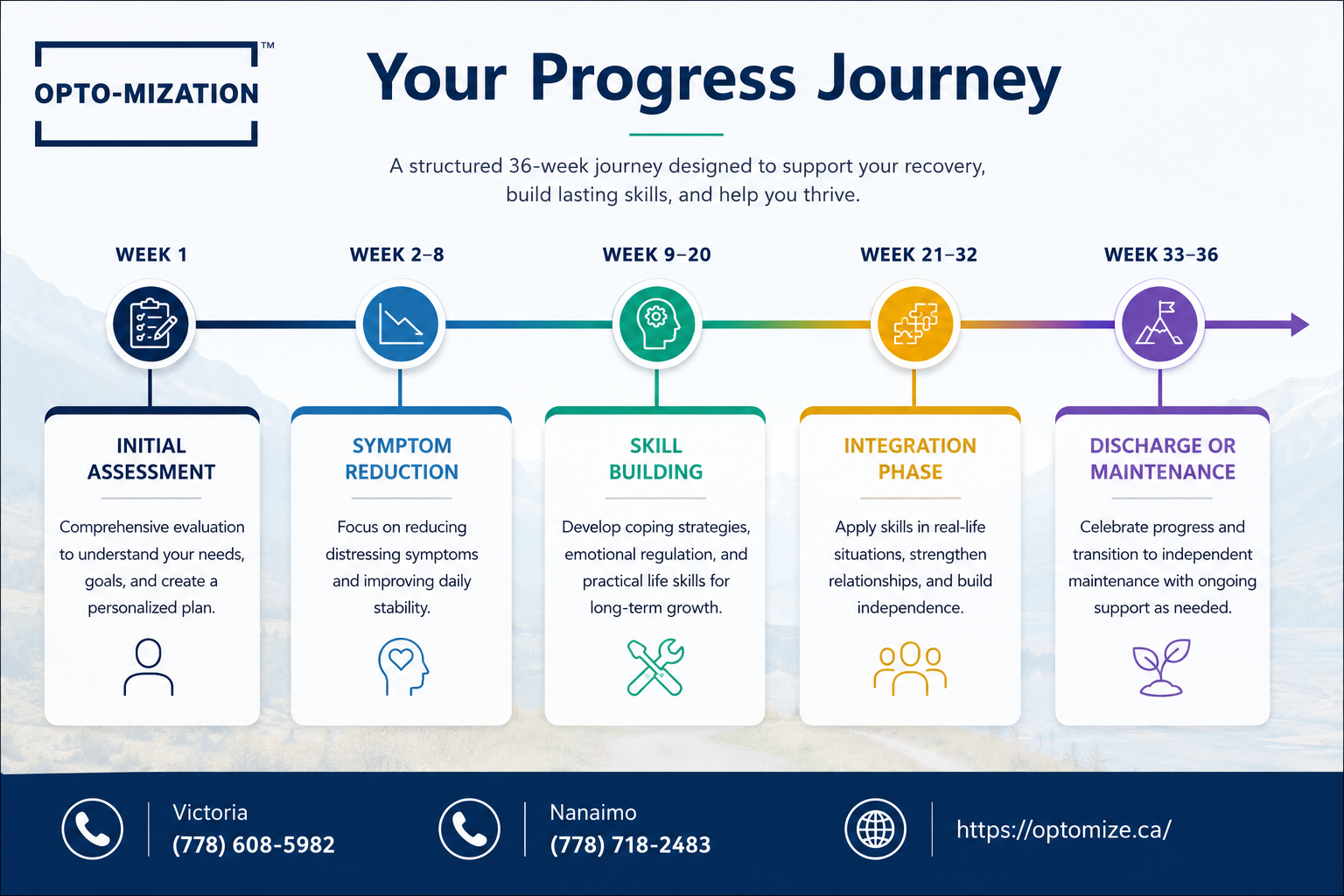
Vision therapy typically takes 12 to 36 weeks, though complex cases can extend to a year or longer. Progress depends on the condition being treated, patient age, frequency of sessions, and consistency with home exercises. Most patients notice meaningful functional improvements within the first 6 to 10 weeks when following a structured program.
If you’ve just been told vision therapy might help you or your child, one of the first questions you’re probably asking is: how long is this actually going to take? It’s a fair question. The answer isn’t a single number — but it’s far more predictable than most people expect, once you understand what drives progress and what slows it down.
Key Takeaways
- Most vision therapy programs run 12 to 36 weeks, with weekly in-office sessions plus daily home exercises.
- Simpler binocular vision issues often resolve in 3 to 6 months; convergence insufficiency and amblyopia can take longer.
- Age affects how quickly the brain adapts — children typically respond faster, but adults can and do achieve significant results.
- Missing home exercises is the single most common reason progress stalls; they aren’t optional reinforcement, they’re active treatment.
- Progress is usually tracked in stages: symptom relief first, then functional skill building, then automatic integration into everyday tasks.
- A functional eye exam is the essential first step in understanding which conditions are present and how intensive the program needs to be.
What Does a Typical Vision Therapy Timeline Actually Look Like?
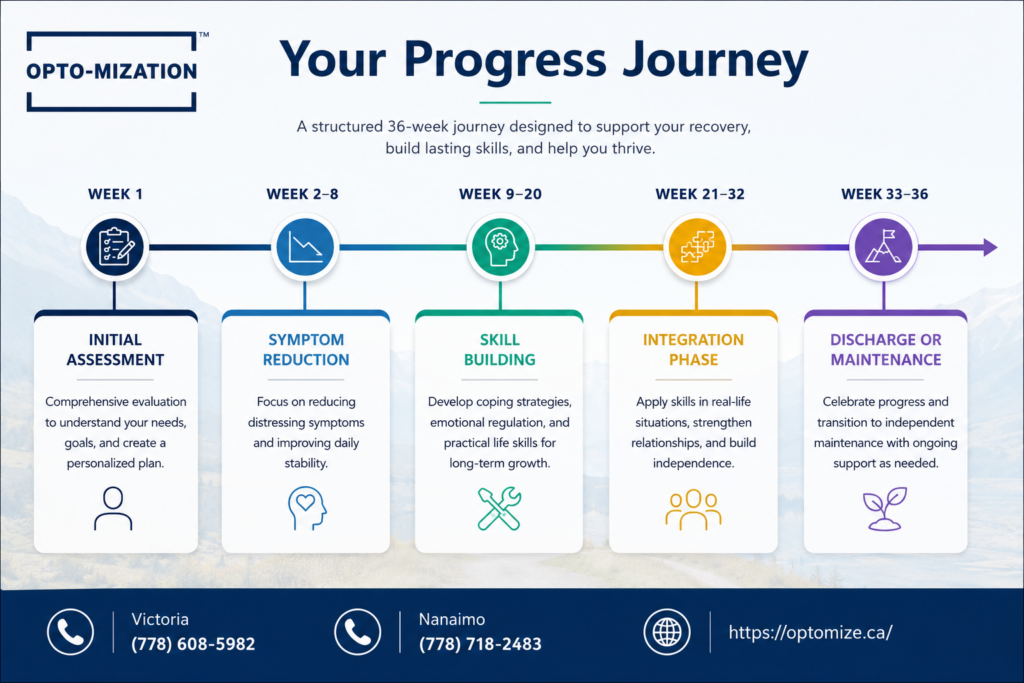
Most structured vision therapy programs are divided into phases rather than a flat duration. Understanding these phases helps set realistic expectations and gives patients something concrete to measure against during treatment.
| Phase | Typical Timeframe | What’s Happening |
| Assessment & Baseline | Weeks 1–2 | Functional testing, custom program design |
| Symptom Reduction | Weeks 3–10 | Headaches, eye strain, and double vision begin to ease |
| Skill Building | Weeks 6–20 | Eyes learn to work together, tracking and focusing improve |
| Integration | Weeks 16–36 | New skills become automatic during reading, driving, and sports |
| Discharge or Maintenance | Week 24–52+ | Program ends or transitions to occasional check-ins |
Research into convergence insufficiency — one of the most common conditions treated with vision therapy — shows that structured in-office programs produce clinically significant improvement in roughly 75% of patients who complete a full course of treatment. Programs typically ran 12 to 16 weeks in major clinical trials, with sessions held once per week and daily home exercises assigned between appointments.
Notice that the phases overlap. Skill building doesn’t wait for symptoms to fully disappear, and integration begins before the skill-building phase is complete. This layered progression is intentional: the brain needs repetition at gradually increasing challenge levels, not a sequential on-off process.
Which Conditions Take Longer, and Why?
Not all vision therapy cases are equal in complexity. The underlying diagnosis is probably the single biggest variable affecting how long treatment takes.
Convergence insufficiency typically resolves in 12 to 16 weeks with a compliant patient. Amblyopia (lazy eye) often requires 6 to 12 months because it involves retraining neural pathways that were suppressed during a critical developmental window. Strabismus cases that don’t require surgery can take anywhere from 6 months to over a year depending on the angle of deviation and how long the misalignment has been present.
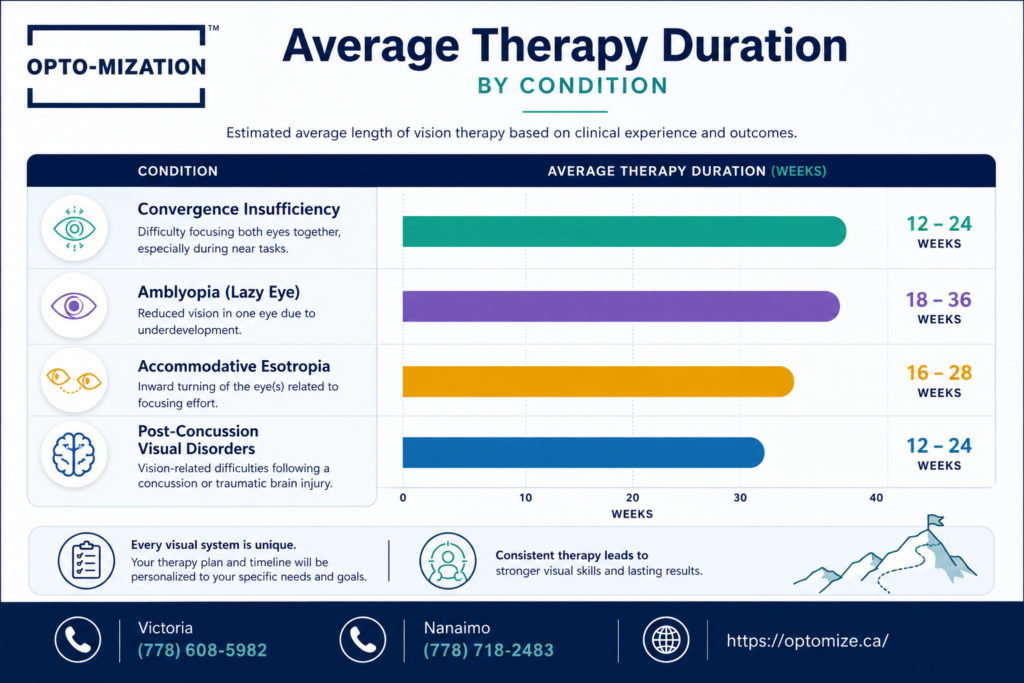
Post-concussion visual rehabilitation sits in its own category. Patients dealing with visual symptoms after a traumatic brain injury often experience eye pain, light sensitivity, and tracking problems simultaneously. These cases are more complex because the neurological and visual systems need to heal together, and timelines of 6 to 18 months are not uncommon.
What Factors Speed Up or Slow Down Results?
Two patients with the same diagnosis can have very different timelines. Here’s what actually determines how fast progress happens in practice.
- Age: Younger children benefit from higher neuroplasticity, meaning the brain rewires more readily. That said, adults absolutely respond to vision therapy — the process just tends to require more sessions to achieve the same level of automaticity.
- Severity of the condition: Mild convergence insufficiency caught early responds much faster than a severe case that went undiagnosed for years.
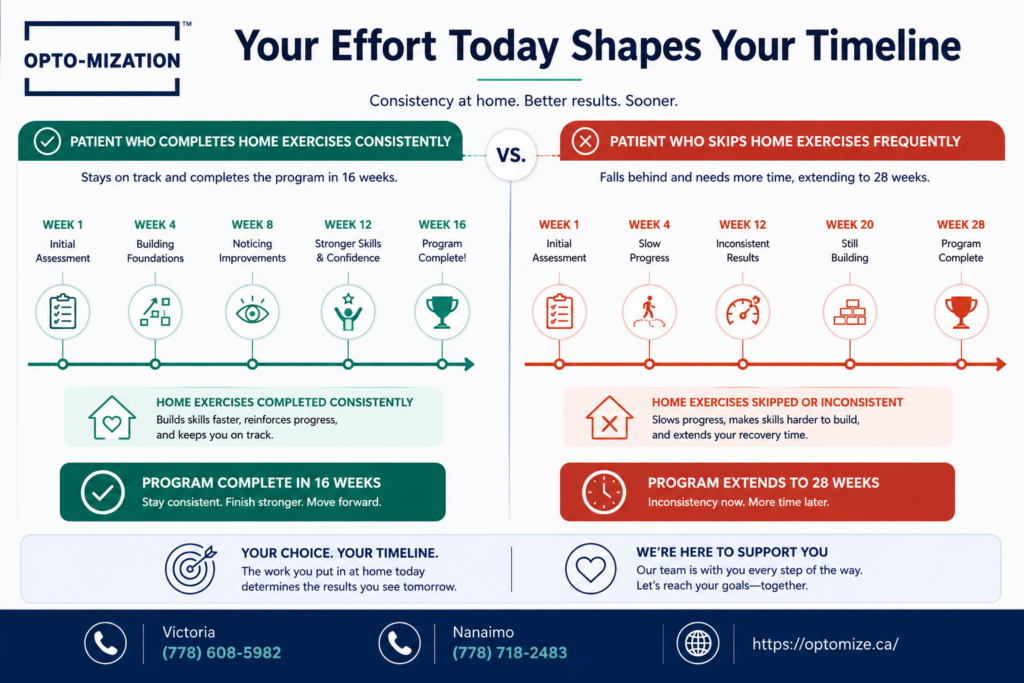
- Consistency of home exercises: In-office sessions are typically once per week. Home exercises, done daily for 15 to 20 minutes, account for the majority of practice hours over any program. Patients who skip them routinely extend their programs significantly.
- Co-existing conditions: Attention difficulties, learning disabilities, or sensory processing differences can slow the rate of skill acquisition, not because progress isn’t possible, but because the brain is managing more variables simultaneously.
- Patient motivation and self-awareness: Older children and adults who understand why they’re doing each exercise tend to engage more effectively and transfer skills faster to real-world tasks.
Studies examining compliance in pediatric vision therapy programs found that children who completed more than 80% of assigned home exercises achieved their target outcomes in roughly 30% fewer sessions compared to those with lower compliance rates. This gap is significant enough that many clinics now track home exercise completion as a formal outcome variable.
Step-by-Step: What Happens During a Vision Therapy Program
- Initial functional assessment: Your optometrist performs a detailed evaluation beyond a standard eye exam, measuring how your eyes team together, focus, track, and process visual information. This shapes the entire program.
- Custom program design: Based on the assessment results, a sequence of activities is built specifically around your deficits. No two programs are identical, even for the same diagnosis.
- Weekly in-office sessions: Sessions typically run 45 to 60 minutes. A therapist guides you through increasingly challenging activities using lenses, prisms, filters, and technology-assisted tools.
- Daily home exercise sets: Between sessions, you practice shorter versions of the in-office work. These reinforce neural pathways while the brain is still consolidating the previous session’s input.
- Progress evaluations: Every 6 to 8 weeks, your optometrist re-tests your visual skills against your baseline. This is where objective data replaces “I think I’m getting better.”
- Integration tasks: Later in the program, exercises shift toward real-world applications — reading at speed, tracking moving objects, or maintaining focus during demanding visual tasks.
- Discharge planning: When objective scores reach target thresholds and skills are automatic, the formal program ends. Some patients transition to occasional maintenance visits; others are fully discharged.
When Should You Expect to Notice a Difference?
Symptom relief and skill improvement don’t always arrive at the same time. Most patients report that headaches after reading and general eye fatigue begin to decrease within the first 4 to 6 weeks — often before measurable gains show up in formal testing.
Functional improvements like reading fluency, reduced double vision, or better hand-eye coordination tend to show up in testing around weeks 8 to 12. The gap between “I feel better” and “the numbers confirm improvement” is normal and worth understanding, because it keeps patients from stopping too early when they feel relief but before the gains have fully stabilized.
If symptoms like distorted sight or warped spatial perception are part of the presenting complaint, these often take longer to resolve because they involve higher-level visual processing rather than basic muscle coordination.
Common Mistakes That Extend Vision Therapy Timelines
- Stopping when symptoms improve: Feeling better is not the same as being done. Skills that feel better but haven’t been tested objectively often regress within weeks of stopping.
- Treating home exercises as optional: Patients who do in-office sessions faithfully but skip home exercises are essentially compressing a week’s worth of progress into a single hour. The math doesn’t work.
- Inconsistent session attendance: Missing two or three consecutive weeks forces the program to partially retrace steps rather than continue building.
- Not communicating setbacks: If exercises feel too hard or too easy, that’s important clinical information. Therapists adjust difficulty progressively — but only if they know what’s happening at home.
- Expecting vision therapy to work like glasses: Glasses correct optical errors passively. Vision therapy trains the brain and visual system actively, which takes time and repetition — the same way learning any physical skill does.
- Delaying treatment in children: The visual system is most plastic during childhood. Waiting for a child to “grow out of it” is one of the most common reasons cases that could have resolved in 4 months end up requiring much longer programs.
Does Insurance or Cost Affect How Long People Stay in Treatment?
Vision therapy costs in Canada typically range from $100 to $200 per session, with full programs running between $1,500 and $5,000 depending on the number of sessions required. Coverage varies widely by province and plan; most extended health benefits in Canada do not cover vision therapy as a standalone service, though some plans cover a portion under optometry or rehabilitative care categories.
This is a real-world factor that rarely gets acknowledged directly: some patients stop prematurely because of financial pressure rather than clinical readiness. The consequence is often regression, which is frustrating and ultimately more expensive when treatment restarts. Discussing the full anticipated program length and cost upfront — before therapy begins — allows for better planning and avoids incomplete treatment cycles.
| Condition | Typical Program Length | Sessions (Estimate) | Key Compliance Factor |
| Convergence Insufficiency | 12–16 weeks | 12–16 | Daily home exercises critical |
| Amblyopia (Lazy Eye) | 6–12 months | 24–48+ | Early intervention improves speed |
| Accommodative Dysfunction | 12–24 weeks | 12–24 | Screen habits between sessions matter |
| Post-Concussion Visual Rehab | 6–18 months | 24–72+ | Pacing and symptom management essential |
| Strabismus (non-surgical) | 6–12+ months | 24–52+ | Severity and deviation angle are key |
Frequently Asked Questions
Do I have to do vision therapy forever?
No. Vision therapy is a finite treatment program with a defined endpoint. Once objective testing confirms that visual skills meet target thresholds and those skills are functioning automatically in daily life, the formal program ends. Some patients with certain conditions return for brief maintenance sessions if symptoms recur — similar to how someone might revisit physical therapy after a setback — but this is not the norm for most diagnoses.
Is vision therapy just eye exercises?
It’s a common misconception. Vision therapy is a clinically supervised program that uses lenses, prisms, filters, balance boards, digital technology, and guided activities to retrain how the brain and visual system process information together. The exercises themselves are tools within a structured neurological rehabilitation framework, not a set of repetitive movements done in isolation. The sequencing, progression, and clinical oversight are what make it effective.
When will I see results?
Most patients notice symptom relief within the first 4 to 6 weeks — reduced eye strain, fewer headaches after reading, or less fatigue during screen use. Measurable improvements in visual skill testing typically emerge around weeks 8 to 12. Real-world functional gains, like reading faster or tracking a ball more accurately, often solidify during the integration phase, which usually begins around weeks 16 to 20 of a full program.
What happens if I miss home exercises?
Skipping home exercises slows progress more than most patients expect. The in-office session introduces and challenges a skill; the home exercises consolidate it before the next session. Without that consolidation window, each in-office session spends time re-establishing what was lost rather than building on it. Patients who consistently miss home exercises typically need significantly more total sessions to achieve the same outcomes as those who complete them regularly.
Can adults do vision therapy?
Yes, and this is one of the most persistent myths worth addressing directly. The idea that vision therapy only works for children stems from older assumptions about neuroplasticity having a hard cutoff at adolescence. Current research shows that adult brains retain meaningful capacity for visual system retraining. Adults may take longer to achieve the same level of automaticity, but they achieve it. Many adults who struggled with reading fatigue or binocular vision problems for decades find significant relief through a properly structured program.
Final Thoughts: Vision Therapy Takes Time, But the Timeline Is Predictable
The honest answer to “how long does vision therapy take?” is somewhere between 12 weeks and 12 months — and knowing where you fall in that range comes down to your diagnosis, your consistency, and how early you start.
What separates successful outcomes from prolonged ones usually isn’t the severity of the condition. It’s whether patients understand the phases they’re moving through, commit to the home exercise component, and stay in communication with their care team when something isn’t working.
If you’re considering vision therapy or have already been referred and want to understand what your specific situation might look like, the team at Opto-Mization can walk you through the expected timeline based on your functional assessment results. Call (778) 608-5982 to ask questions or book a consultation.