The best eye doctor for your situation is not necessarily the one closest to you or the one with the shortest wait list. For Nanaimo residents dealing with chronic headaches, reading difficulties, dizziness, or a child who keeps struggling in school despite a “normal” eye exam result, the right provider is one who evaluates how your eyes and brain work together, not just how sharp your vision is. Opto-Mization serves Nanaimo and surrounding communities with comprehensive functional vision assessments designed to find what standard exams routinely miss.
Key Takeaways
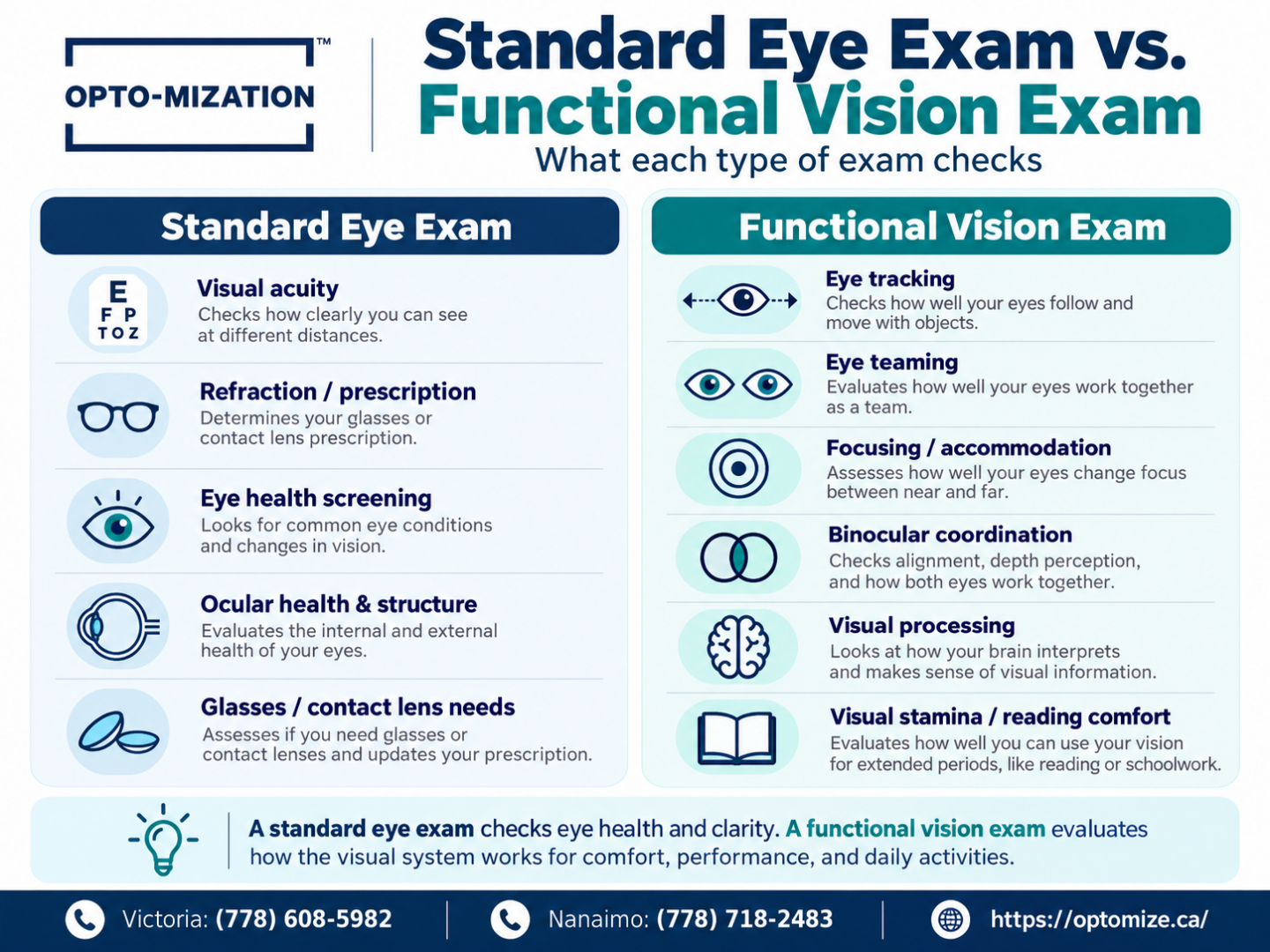
- Standard eye exams measure visual acuity. Functional vision exams assess eye tracking, focusing, binocular coordination, and visual processing — skills that directly affect reading, attention, balance, and daily comfort.
- Many patients in Nanaimo have spent years treating symptoms like headaches, dizziness, or learning struggles without knowing the root cause was a functional vision problem.
- Children who avoid reading, lose their place on the page, or show ADHD-like behaviors may have an undetected binocular vision issue rather than an attention disorder.
- Opto-Mization serves Nanaimo, Lantzville, Parksville, Qualicum Beach, and surrounding communities. No referral is needed to book a functional vision assessment.
- The clinic offers a satisfaction guarantee, which reduces the risk of booking a more comprehensive evaluation if you have been skeptical about what it might reveal.
Things You Must Know
1. Passing a Standard Eye Exam Does Not Rule Out a Vision Problem
A typical eye exam confirms whether you can read the letters on a chart at a set distance. It does not measure how well your eyes track moving text, sustain focus during reading, or work together as a coordinated pair. These functional skills are entirely separate from sharpness, and when they break down, the symptoms can look like fatigue, inattention, headaches, or motion sensitivity rather than blurry vision. Many patients at Opto-Mization arrive after being told their eyes are “fine” — and then a functional assessment identifies the actual problem within the first evaluation.
2. The Type of Exam Matters as Much as the Provider
Choosing the right eye doctor in Nanaimo is partly about credentials and experience, but it is also about choosing the right type of examination for your symptoms. If your concern is a routine prescription update, most optometrists can help. If your concern involves chronic symptoms that have not responded to standard treatment, you need a provider who offers functional and neuro-optometric assessments. Opto-Mization is built specifically around that second category, which is why patients travel from Parksville, Qualicum Beach, and Lantzville to be seen there.
3. Vision Therapy Is Not the Same as Eye Exercises You Find Online
Structured vision therapy in Nanaimo through a qualified functional optometry clinic is a clinical, progressive program built around your specific deficits as identified by a detailed assessment. The exercises change as your visual system improves, and the program is monitored throughout. Generic eye exercise routines available online are not equivalent and are not designed around individual diagnosis.
What Separates a Functional Eye Doctor from a Conventional Optometrist?
Most optometry clinics focus on two things: measuring refractive error (how well you see at distance and near) and checking for eye disease. Both are important. A comprehensive functional eye exam goes significantly further by evaluating the visual skills that determine how efficiently your eyes process information under real-world conditions.
Those skills include eye tracking accuracy, binocular vision (how well both eyes work as a team), convergence and divergence ability, accommodative flexibility (how quickly the eyes shift focus), and visual processing speed. When any of these systems are underdeveloped or misaligned, the brain works harder to compensate — and the result is often symptoms that have nothing to do with how clear your vision appears on a chart.
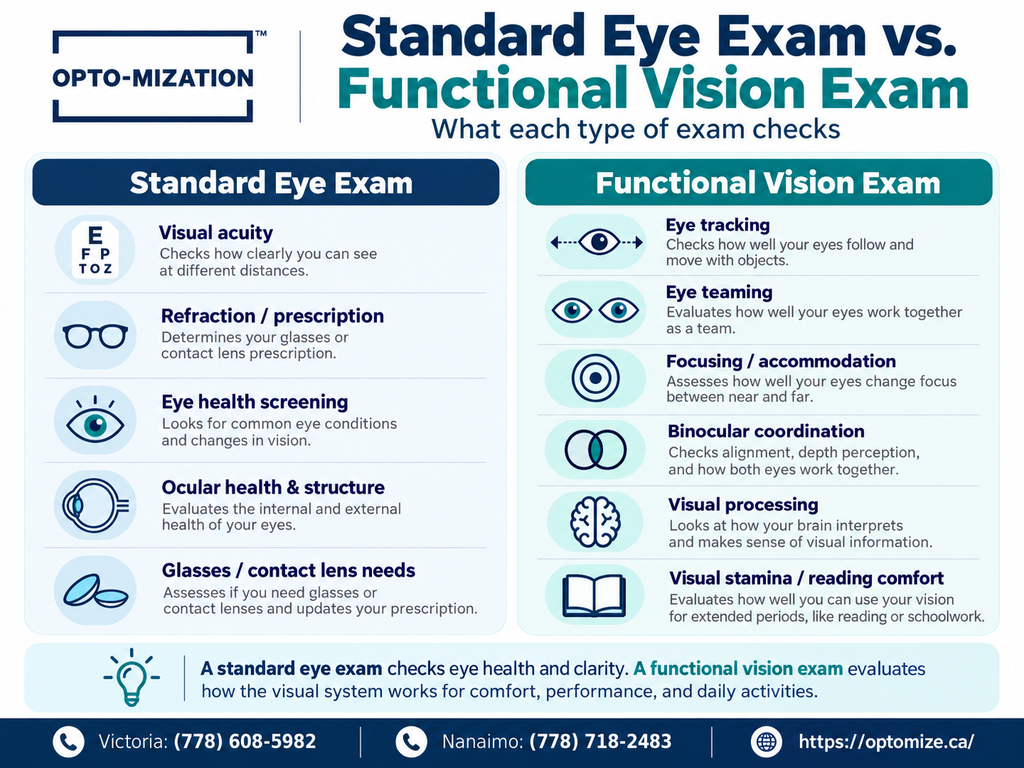
| What a Standard Eye Exam Assesses | What a Functional Vision Exam Adds |
| Distance and near visual acuity | Eye tracking accuracy and control |
| Basic eye health screening | Binocular vision coordination |
| Prescription for glasses or contacts | Convergence and divergence ranges |
| Color vision check | Accommodative flexibility under load |
| Peripheral field screening | Visual processing speed and accuracy |
| Pressure check (glaucoma) | Neuro-optometric evaluation for neurological symptoms |
Who Benefits Most from Seeing a Functional Eye Doctor in Nanaimo?
Opto-Mization sees patients across several distinct groups, each of whom arrives with a different presenting concern. Understanding which profile fits your situation helps clarify whether a functional assessment is the right next step.
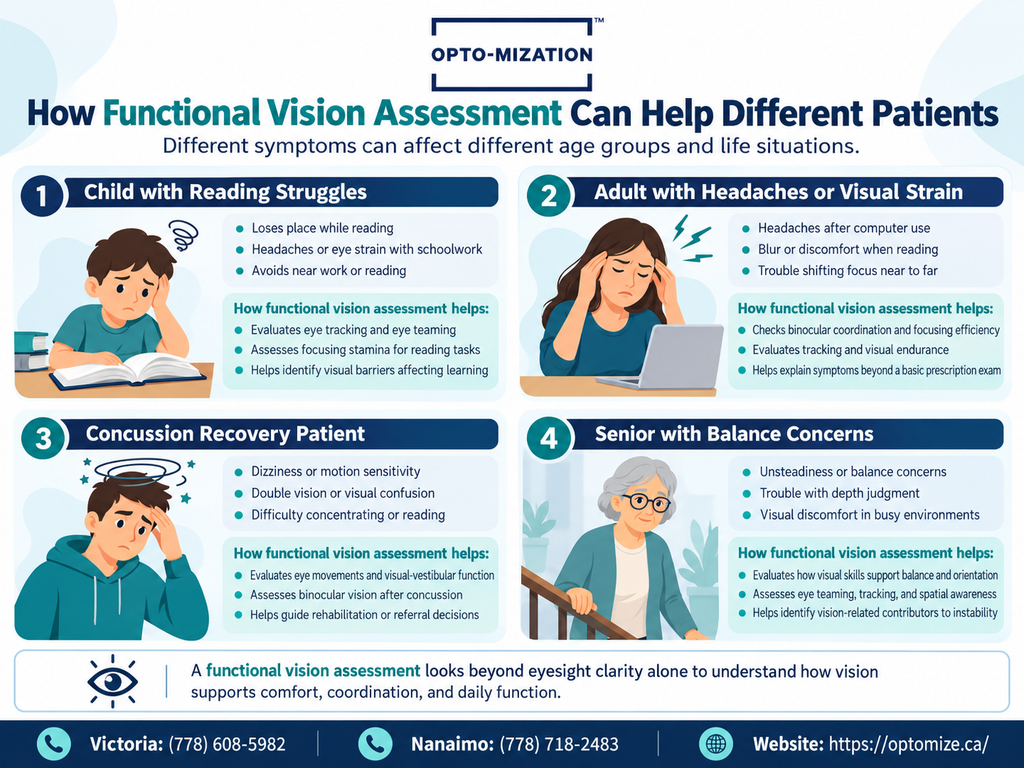
Children Struggling with Reading or School Performance
If your child avoids reading, frequently loses their place, reverses letters beyond the expected age, complains that words move on the page, or has been flagged for possible ADHD or dyslexia, a functional vision evaluation is worth prioritizing. Many of these behaviors map closely to children losing their place while reading due to eye tracking problems rather than attention deficits. The distinction matters because the treatment path is entirely different.
Research indicates that convergence insufficiency, one of the most common binocular vision disorders, affects between 2 and 13 percent of school-age children according to prevalence data reviewed by the Edge Foundation, and children with the condition are frequently mislabeled as having ADHD or dyslexia prior to a proper functional vision evaluation.
Adults with Chronic Headaches, Eye Strain, or Screen Fatigue
Adults who spend most of their workday on screens and experience daily headaches, end-of-day visual fatigue, or difficulty sustaining focus during reading often have a functional vision component driving those symptoms. A standard prescription update rarely resolves these complaints because the problem is not refractive — it is how the visual system performs under sustained demand. Opto-Mization’s assessments are built to identify exactly where that breakdown is occurring.
Patients Recovering from Concussion or Neurological Events
Post-concussion vision problems, including light sensitivity, double vision, difficulty reading, and balance disruption, are reported in a significant proportion of concussion cases. A peer-reviewed review published in 2025 found that vision symptoms occur in 69 to 82 percent of patients with persisting concussion symptoms and can persist without targeted neuro-optometric rehabilitation.
Opto-Mization’s neuro-optometric services address this directly. For patients whose concussion recovery has stalled, a visual rehabilitation assessment can determine whether the lingering symptoms have a treatable visual component.
Seniors with Balance Concerns or Dizziness
Unexplained dizziness, difficulty with crowded environments, or reduced confidence while driving are common concerns among older adults in Nanaimo. Visual dysfunction is a frequently overlooked contributor to balance problems in seniors, and a functional assessment can clarify whether vision is playing a role.
Common Mistakes People Make When Choosing an Eye Doctor for Persistent Symptoms
- Accepting “your eyes are fine” as a final answer. If your symptoms are real and ongoing, a result from a standard exam that finds nothing is a signal to seek a more specialized assessment, not confirmation that vision is not involved.
- Prioritizing convenience or price over specialization. For routine prescriptions, proximity makes sense. For complex or persistent symptoms, the type of exam matters far more than the location or the cost of the appointment.
- Assuming vision therapy is only for children. Adults with binocular vision dysfunction, post-concussion symptoms, or long-standing reading difficulties respond well to vision therapy when the treatment is matched to a proper assessment.
- Waiting years before seeking a second opinion. Many patients at Opto-Mization have spent three to five years managing symptoms with medications, behavioral strategies, or tutoring before a functional vision evaluation identified a treatable cause.
- Confusing eye health with visual function. Healthy eyes and efficiently functioning eyes are not the same thing. You can have no eye disease and still have a significant functional vision deficit driving daily symptoms.
How a Functional Vision Assessment Works at Opto-Mization
- Initial intake and symptom review: The assessment begins with a thorough history covering symptoms, previous diagnoses, academic performance (for children), and any treatments already tried. This context shapes how the evaluation is structured.
- Standard vision measurements: Visual acuity, eye health, and basic refractive error are confirmed as a baseline.
- Binocular vision testing: The optometrist evaluates how well both eyes work together, measuring convergence, divergence, and alignment under various conditions.
- Eye tracking assessment: Eye movement control during reading-like tasks is measured to identify tracking deficits that interfere with reading efficiency.
- Accommodative testing: Focusing flexibility and endurance are measured, particularly relevant for patients with screen fatigue or difficulty shifting focus.
- Visual processing evaluation: Where indicated, testing covers how the brain interprets visual information, including processing speed, visual memory, and spatial reasoning.
- Results and recommendations: The optometrist explains findings in plain language and outlines whether treatment such as vision therapy results or specialized lens prescribing is likely to help, along with realistic timelines.
| Patient Concern | Likely Assessment Focus | Potential Treatment Path |
| Child avoiding reading | Eye tracking, binocular vision | Pediatric vision therapy |
| Daily headaches | Convergence, accommodative load | Prism lenses, vision therapy |
| Post-concussion symptoms | Neuro-optometric evaluation | Neuro vision rehabilitation |
| Senior dizziness or falls | Visual-vestibular integration | Vestibular vision therapy |
| Screen fatigue at work | Accommodative flexibility | Functional glasses, therapy |
Frequently Asked Questions
What makes Opto-Mization different from other eye doctors in Nanaimo?
Most eye clinics in Nanaimo focus primarily on measuring visual acuity and prescribing corrective lenses. Opto-Mization specializes in functional vision care, evaluating how the eyes and brain work together rather than just how clearly you see. Their assessments examine eye tracking, focusing ability, binocular vision, and visual processing. Conditions that go undetected at a traditional eye exam, such as convergence insufficiency or visual processing disorders contributing to reading struggles, headaches, or balance problems, can be identified and treated here. For patients who have been told their eyes are “fine” but are still experiencing symptoms, that distinction is the whole point.
My child passed a standard eye exam but is still struggling in school. Could a functional assessment help?
A standard eye exam confirms that a child can see clearly at a distance, but it does not measure how well the eyes track across a page, maintain focus while reading, or work together as a team. When these visual skills are underdeveloped, children often avoid reading, lose their place frequently, reverse letters, or tire quickly during schoolwork — symptoms frequently misattributed to ADHD or dyslexia. A functional vision assessment at Opto-Mization is specifically designed to uncover these hidden issues and determine whether vision-based treatment could meaningfully improve a child’s learning and school performance.
Is vision therapy a legitimate, evidence-based treatment?
Vision therapy is a recognized area of optometric care with a growing body of clinical research, particularly for conditions such as convergence insufficiency, which is one of the most studied causes of reading-related difficulties in children and adults. It involves structured, progressive exercises designed to retrain the visual system and improve the brain-eye connection rather than simply compensating for a problem with lenses. At Opto-Mization, vision therapy programs are built around a detailed functional assessment so treatment is targeted to each patient’s specific deficits. Patients who are strong candidates for vision therapy often notice measurable improvements in reading comfort, concentration, headache frequency, and daily performance.
Can vision problems actually cause headaches, dizziness, or balance issues in adults?
Binocular vision dysfunction and other functional vision problems are a frequently overlooked cause of chronic headaches, migraines, dizziness, motion sensitivity, and balance difficulties in adults. When the eyes do not work together efficiently, the brain works harder to compensate, which can produce significant neurological symptoms over time. This is especially relevant for adults recovering from concussions, people with screen-heavy jobs, and seniors dealing with unexplained balance concerns. Opto-Mization’s neuro-optometric evaluations are designed to identify whether these symptoms have a visual root cause and, if so, to build a targeted treatment plan around that finding.
Do I need a referral to book at Opto-Mization’s Nanaimo location?
No referral is required. Patients from Nanaimo, Parksville, Qualicum Beach, Lantzville, and surrounding communities can contact the clinic directly to schedule a comprehensive evaluation. Because many patients arrive after years of unsuccessful treatments for symptoms like chronic headaches, reading difficulties, or post-concussion issues, Opto-Mization is well-practiced at working with individuals who are seeking answers rather than a routine check-up. The assessment process is thorough and designed to give patients a clear picture of whether their symptoms have a functional vision component before any treatment is recommended.
Ready to Find Out What Your Standard Eye Exam Missed?
If you or your child have been managing symptoms without a clear explanation, a functional vision assessment with Opto-Mization is a concrete next step. The clinic serves Nanaimo and the surrounding region, including Parksville, Qualicum Beach, and Lantzville, with no referral required to book.
Opto-Mization also offers a satisfaction guarantee, so you can approach the evaluation without the concern that it will leave you with more questions than answers.
Contact Opto-Mization directly to schedule your assessment: (778) 718-2483
Your eyes and brain work as a team. If that team is struggling, the right evaluation will show it — and the right treatment can change far more than just your vision.