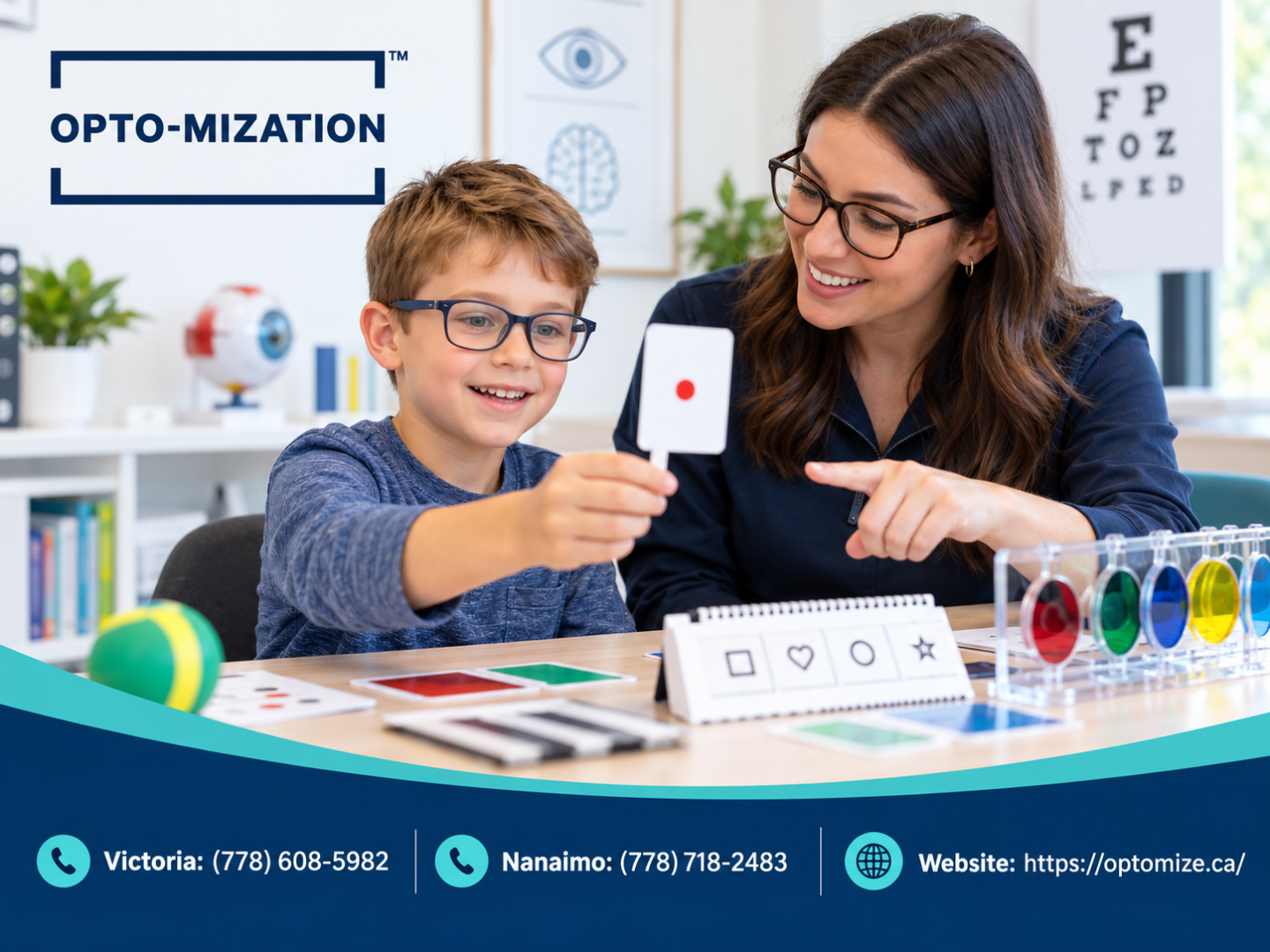
Vision therapy in Nanaimo is available through Opto-Mization, a specialized clinic focused on how the eyes and brain work together rather than simply measuring whether you can read a chart. Many patients in Nanaimo and surrounding communities — including Lantzville, Parksville, and Qualicum Beach — discover for the first time that persistent headaches, reading struggles, dizziness, or attention difficulties have a treatable visual root cause. The difference between a routine eye exam and a functional eye exam is substantial, and for many families and adults, that difference changes everything.
Key Takeaways
- Opto-Mization serves Nanaimo, Lantzville, Parksville, and Qualicum Beach with specialized functional vision assessments and vision therapy programs.
- A functional vision exam evaluates eye tracking, binocular coordination, focusing stamina, and visual processing — skills a standard eye exam does not test.
- Children who struggle in school despite normal intelligence, and adults dealing with chronic headaches or dizziness, are the most common candidates for vision therapy.
- Vision therapy at Opto-Mization follows a comprehensive assessment, so treatment is targeted to the specific dysfunction found, not a generic program.
- The clinic offers a satisfaction guarantee, reducing the risk of getting started for families and adults who are uncertain about committing to a program.
Things You Must Know
1. A Clear Prescription Does Not Rule Out a Functional Vision Problem
Many patients who come to Opto-Mization have already passed multiple standard eye exams and still experience daily symptoms. Standard exams measure sharpness at a distance, but they do not evaluate whether the two eyes coordinate efficiently, whether the focusing system holds up under sustained reading, or whether the brain processes visual information accurately. A child can have 20/20 sight and still struggle with eye tracking or convergence in ways that make reading exhausting. Getting a functional assessment is the only way to know whether those issues exist.
2. Vision Therapy Is a Process, Not a Quick Fix
Patients who see the strongest results typically complete a structured program over several months. The timeline depends on the specific dysfunction, its severity, and how consistently the patient engages with in-office and home-based exercises. Opto-Mization builds individualized programs rather than applying a one-size approach, which means the length and intensity of therapy varies from person to person. A thorough assessment at the start sets realistic expectations and gives patients a clear picture of what the process involves.
3. Many Overlapping Diagnoses Have a Visual Component That Gets Missed
Children already assessed for ADHD, dyslexia, or anxiety — and adults managing chronic migraines or post-concussion symptoms — frequently have an undetected functional vision problem running alongside those conditions. This is not because other assessments were wrong, but because standard evaluations rarely test the visual skills that functional optometrists examine. Treating both the confirmed condition and the vision component together tends to produce better outcomes than addressing each in isolation.
What Functional Vision Care Actually Involves
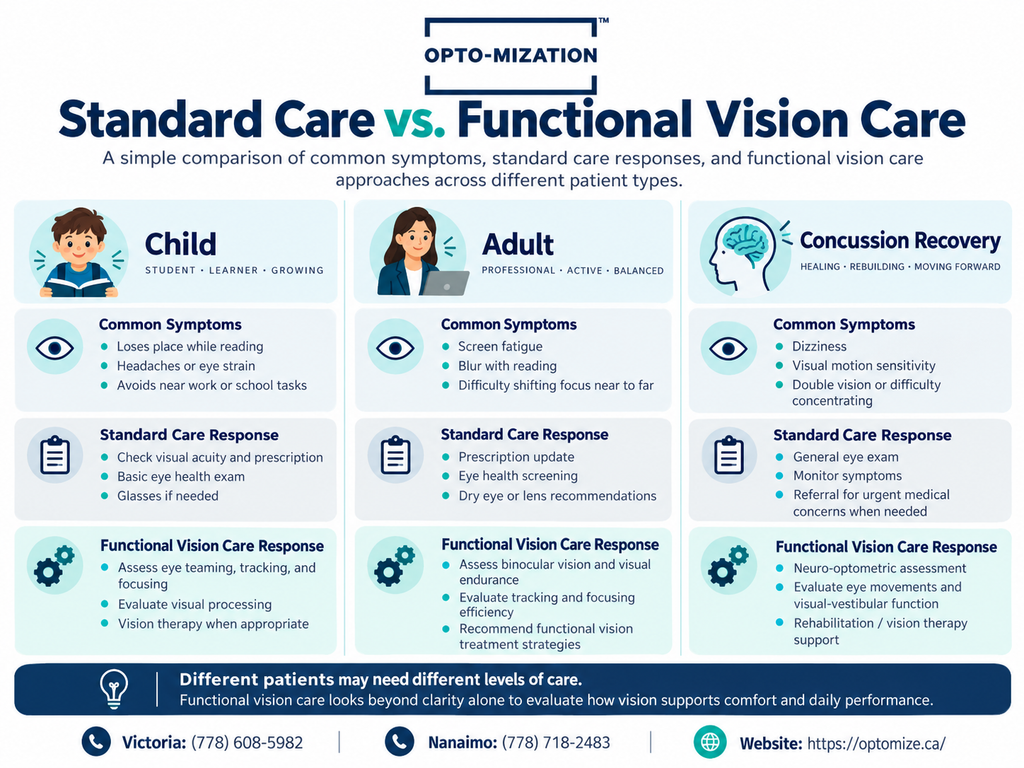
Traditional optometry answers one question well: can you see clearly? Functional vision care answers a different set of questions entirely. How well do your eyes track a moving target? Do they work as a coordinated team under sustained demand? Does your focusing system shift quickly between near and far distances? Does your brain interpret what your eyes send it accurately and efficiently?
Opto-Mization was founded by Dr. Cameron McCrodan, who transitioned from an engineering background into optometry after his sister’s life was transformed through functional vision treatment. That engineering mindset shapes how the clinic approaches diagnosis: identify the specific dysfunction, measure it precisely, and build a targeted solution rather than offering a generic response to vague symptoms.
Research in developmental and behavioral optometry consistently shows that functional vision problems, including convergence insufficiency, are among the most common yet least diagnosed causes of reading difficulty and academic underperformance in school-age children, with one clinical study finding that 18.2% of children assessed for reading difficulties demonstrated convergence insufficiency.
Who Benefits From Vision Therapy in Nanaimo?
Opto-Mization sees three primary groups of patients across their Nanaimo service area.
Children Struggling in School
Parents often arrive at Opto-Mization after exhausting other explanations. Their child is clearly intelligent, tested thoroughly, working with a tutor — and still falling behind. When the eyes do not track smoothly across a line of text, or when the two eyes fail to converge properly at reading distance, the brain expends enormous energy just trying to hold the words still. Reading becomes physically draining. Attention breaks down. The symptoms look almost identical to ADHD or a processing disorder.
A pediatric functional vision assessment examines these skills in depth, looking at eye tracking, binocular coordination, convergence, and visual processing in ways that school screenings and standard eye exams never reach.
Adults With Chronic Headaches, Eye Strain, or Dizziness
Professionals spending long hours on screens, adults dealing with migraines that have not responded to other treatments, and people who feel overwhelmed in visually busy environments like grocery stores or crowded spaces are all strong candidates for a functional vision assessment. Dizziness and balance problems in particular are frequently tied to how the visual system communicates with the vestibular system, and that connection gets missed in a standard medical workup.
A peer-reviewed review published in Survey of Ophthalmology found that visual symptoms affect 69–82% of concussion patients with persisting post-concussion symptoms — including double vision, difficulty with eye movements, and light sensitivity — and that these symptoms can persist for months or years, yet visual rehabilitation is rarely included in standard concussion protocols.
Concussion and Brain Injury Recovery
The visual system is highly vulnerable to traumatic brain injury. Patients recovering from concussion often find that headaches, sensitivity to light, difficulty reading, and balance problems linger for months. Neuro-optometric rehabilitation at Opto-Mization addresses the visual component of concussion recovery through structured therapy targeting the specific pathways disrupted by the injury.
How Opto-Mization Compares to Standard Eye Care
| What Gets Tested | Standard Eye Exam | Opto-Mization Functional Exam |
| Distance visual acuity | Yes | Yes |
| Eye health screening | Yes | Yes |
| Eye tracking assessment | Rarely | Yes, in depth |
| Binocular coordination | Basic screening only | Comprehensive evaluation |
| Visual processing | No | Yes |
| Focusing stamina (near demand) | No | Yes |
| Vestibular-visual integration | No | Yes, for qualifying patients |
What to Expect When You Start the Process
- Initial contact: Reach out to Opto-Mization by phone or through their website to describe your symptoms or your child’s situation. The team will confirm whether a functional vision assessment is the right starting point.
- Comprehensive functional vision assessment: This is the diagnostic foundation. The exam evaluates eye tracking, binocular vision, convergence, focusing, visual processing, and in relevant cases, vestibular-visual integration. It takes significantly longer than a standard eye exam.
- Results review: Dr. McCrodan or a clinic clinician walks through the findings in detail, explaining what was found, what it means for daily life, and whether vision therapy or specialized prescribing is recommended.
- Individualized therapy program: If therapy is the right path, a structured program is designed around the specific dysfunctions identified. Programs typically combine weekly in-office sessions with daily home exercises.
- Progress tracking: Patients are reassessed at intervals throughout the program. Measurable improvements in the clinical markers guide decisions about adjusting the program or concluding therapy.
Common Mistakes Patients Make Before Finding Opto-Mization
- Assuming a passed eye exam means vision is not the problem, when standard exams simply do not test the relevant skills.
- Pursuing only ADHD medication or tutoring for a child whose core issue is a visual dysfunction that makes reading physically difficult.
- Treating migraines symptomatically for years without anyone investigating whether a binocular vision dysfunction is driving them.
- Accepting post-concussion symptoms as permanent when neuro-optometric rehabilitation specifically targets the visual pathways disrupted by head injury.
- Waiting until a child is significantly behind in school before seeking a functional vision evaluation, when earlier assessment leads to faster recovery.
Research published in Optometry and Vision Science found that children with symptomatic convergence insufficiency — even those without a parent-reported ADHD diagnosis — scored significantly higher on academic behavior surveys measuring inattention, avoidance of near work, and difficulty completing schoolwork than children with normal binocular vision, according to this peer-reviewed CITT-linked study.
What Patients in the Nanaimo Region Actually Notice Over Time
Outcomes vary depending on the diagnosis and the individual, but Opto-Mization’s patient base consistently reports improvements that extend well beyond the visual. Parents describe children who begin reading voluntarily for the first time. Adults report that morning headaches they had accepted as normal have stopped. Patients recovering from concussion describe the return of their ability to drive confidently at night or work on a screen without needing to stop every twenty minutes.
The landmark Convergence Insufficiency Treatment Trial (CITT), funded by the National Eye Institute, found that office-based vision therapy produced statistically significant symptom reduction in approximately 75% of children treated, compared to roughly 35% in the placebo group and substantially lower rates in pencil push-up therapy alone — a difference that was clinically and statistically significant.
For families in Nanaimo who have spent months or years searching for answers, this kind of specificity matters. The clinic’s approach focuses on finding the root cause rather than managing symptoms, and the vision therapy results in Nanaimo reflect that focus directly.
| Patient Type | Common Presenting Symptoms | Typical Areas of Improvement |
| School-age child | Avoids reading, loses place, reverses letters, suspected ADHD | Reading fluency, focus, confidence in class |
| Working adult | Screen fatigue, afternoon headaches, motion sensitivity | Sustained screen comfort, headache frequency, productivity |
| Concussion patient | Persistent light sensitivity, reading difficulty, balance problems | Driving confidence, reading tolerance, dizziness reduction |
| Senior | Dizziness, falls, reduced driving confidence | Balance, spatial orientation, confidence in daily activities |
Frequently Asked Questions
Is vision therapy available in Nanaimo, or do I have to travel to Victoria?
Opto-Mization serves patients in Nanaimo and surrounding communities including Lantzville, Parksville, and Qualicum Beach, in addition to their Greater Victoria locations. If you are in the Nanaimo region and looking for a functional vision specialist or vision therapy program, Opto-Mization is the clinic in BC focused specifically on how the eyes and brain work together rather than simply measuring eyesight. Contacting the clinic directly to confirm current availability and scheduling options for your area is the best first step.
How is a functional vision exam at Opto-Mization different from a regular eye exam anywhere in Nanaimo?
A standard eye exam measures whether you can see clearly at a distance, but it typically does not evaluate how well your eyes track, team, focus, or communicate with your brain. Opto-Mization performs comprehensive functional vision assessments that test skills like eye tracking, binocular coordination, visual processing, and focusing stamina — skills that directly affect reading, attention, balance, and daily performance. Many patients who have passed routine eye exams for years discover through a functional assessment that an underlying visual dysfunction has been contributing to their headaches, learning struggles, or dizziness all along. Treating the root cause leads to lasting improvement, not just a new lens prescription.
My child has been assessed for ADHD and dyslexia but is still struggling in school. Could vision therapy help?
Children who have already been assessed for ADHD or dyslexia and are still struggling more commonly than most families expect have an undetected functional vision problem running alongside or mimicking those conditions. When a child’s eyes do not track smoothly, team efficiently, or maintain focus across a page, reading becomes exhausting and attention breaks down — symptoms that look nearly identical to ADHD or a processing disorder. Opto-Mization’s pediatric functional assessment examines eye tracking, convergence, visual processing, and binocular vision in ways a school screening or standard exam never would. Many families report meaningful improvements in reading, focus, and school performance once the visual root cause is addressed directly.
What conditions and symptoms are typically treated with vision therapy at Opto-Mization?
Vision therapy at Opto-Mization addresses functional vision problems that standard eye care often misses, including convergence insufficiency, eye tracking disorders, binocular vision dysfunction, and visual processing difficulties. Patients commonly seek care because of headaches, migraines, eye strain, dizziness, motion sensitivity, balance issues, reading difficulties, and difficulty sustaining focus. The clinic also provides neuro-optometric rehabilitation for patients recovering from concussion or brain injury, where visual symptoms frequently persist after other symptoms resolve. Because these symptoms overlap with other health conditions, Opto-Mization begins with a thorough functional vision assessment to confirm whether a visual root cause is present before recommending any therapy program.
Is vision therapy worth the investment, and how do I know it will work for my situation?
Vision therapy produces the strongest results when it follows a precise diagnosis, which is why Opto-Mization starts every patient relationship with a comprehensive functional vision assessment rather than moving straight to treatment. The assessment determines whether a functional vision problem exists, how significant it is, and whether therapy is the right path forward — giving you a clear, evidence-based answer before committing to a full program. The clinic competes on outcomes and expertise rather than price, and their approach centers on measurable improvements in real-life performance, from reading and school success to headache reduction and concussion recovery. Opto-Mization also offers a satisfaction guarantee, so families and adults can move forward with confidence rather than uncertainty.
Taking the Next Step Toward Better Visual Performance
For parents in Nanaimo whose children are struggling in school despite intelligence and effort, for adults managing headaches or dizziness that have not responded to other care, and for anyone recovering from a concussion whose symptoms persist, a functional vision assessment is often the piece that has been missing from the picture.
Opto-Mization is not a general optometry clinic. The practice was built specifically to find and treat the visual dysfunctions that standard care overlooks, and every treatment program starts with a precise diagnosis rather than a generic protocol.
If you are ready to find out whether a functional vision problem is behind the symptoms you or your child has been living with, contact Opto-Mization directly to book a comprehensive functional vision assessment.
Opto-Mization Optometry & Vision Therapy
Phone: (778) 718-2483
Serving Nanaimo, Lantzville, Parksville, Qualicum Beach, and Greater Victoria.