
Vision therapy produces measurable, lasting improvements for children who struggle with reading, adults dealing with chronic headaches or screen fatigue, and patients recovering from concussion. At Opto-Mization, those results come from treating how the eyes and brain work together, not just what the eye chart shows. The improvements patients report span reading fluency, attention, balance, headache frequency, and overall quality of daily life — and they tend to build progressively over the course of a structured program.
Key Takeaways
- Vision therapy at Opto-Mization targets the brain-eye connection, which means results often extend well beyond clearer eyesight into reading, attention, balance, and headache relief.
- Children with normal eye exams can still have significant functional vision problems that interfere with learning — and those problems respond well to structured vision therapy.
- Adults, including those recovering from concussion, benefit from vision therapy because the brain retains the ability to be retrained throughout life.
- Results are grounded in objective, measurable findings from a comprehensive functional vision assessment, not guesswork.
- Opto-Mization backs its programs with a satisfaction guarantee, reducing financial risk for families and individuals considering care.
Things You Must Know
1. A Normal Eye Exam Does Not Rule Out a Functional Vision Problem
Standard eye exams measure whether you can see the letters on a chart. They do not evaluate eye tracking accuracy, focusing stamina, binocular coordination, or how the visual system processes what it sees. A child or adult can have 20/20 acuity and still have a functional vision deficit significant enough to cause daily symptoms. If previous exams came back clear but the problems persist, a functional eye exam specifically evaluates the skills a routine test skips entirely.
2. Vision Therapy Is a Structured Clinical Program, Not a Set of Online Exercises
Generic eye exercises found online are not built around a specific patient’s deficits and are not supervised by a clinician trained in functional and neuro-optometric care. At Opto-Mization, every program is designed from the findings of a detailed assessment, meaning the activities target the exact visual skills that are underperforming for that individual. Without that diagnostic foundation, unsupervised exercises rarely produce the lasting changes a structured clinical program achieves.
3. Results Take Time and Build Progressively
Vision therapy is not a quick fix. Most patients notice early changes within several weeks, but the full program typically spans months, depending on the complexity of the dysfunction. Families and patients who commit to the process and complete their home practice components consistently tend to see the strongest outcomes. Understanding this timeline before starting helps set realistic expectations and keeps motivation steady through the program.
What Do Real Vision Therapy Results Look Like for Children?
Parents in Greater Victoria and Nanaimo often bring their children to Opto-Mization after years of being told everything looks fine, while the child continues to avoid reading, reverse letters, lose their place on the page, or struggle to concentrate in school. The assumption is often that the child has ADHD, dyslexia, or simply needs more support. In many of those cases, the root cause turns out to be a functional vision problem.

After completing a structured vision therapy program, children commonly show improvements in reading fluency, sustained attention, handwriting control, and willingness to engage with books. Teachers and parents frequently notice the shift before the child can articulate it themselves. The child stops avoiding homework, sits through longer reading sessions, and stops skipping lines or rereading the same sentence repeatedly.
Research into vision therapy for convergence insufficiency and other binocular vision disorders consistently shows statistically significant improvements in convergence symptoms and clinical signs — including near point of convergence and positive fusional vergence — in children who complete supervised office-based programs compared to those who receive home-based or no treatment.
Children who avoid reading despite knowing the words are often experiencing a system that physically fatigues under the demands of close-up work. Once the underlying dysfunction is addressed, the avoidance typically resolves on its own, because reading no longer feels exhausting.
What Results Do Adults Notice After Vision Therapy?
Adults are often surprised to learn that vision therapy applies to them at all. The common assumption is that these programs are for children with learning problems. In practice, many of Opto-Mization’s adult patients are professionals in their 30s, 40s, and 50s who have spent years managing symptoms they never connected to their visual system.
| Symptom Before Therapy | What Patients Commonly Report After |
| Chronic headaches after screen work | Reduced frequency and intensity; longer comfortable work sessions |
| Dizziness in busy environments | Greater stability in grocery stores, crowds, and moving traffic |
| Eye fatigue by mid-afternoon | Extended visual comfort throughout the workday |
| Motion sensitivity while driving or as a passenger | Reduced nausea and improved driving confidence |
| Difficulty concentrating on sustained reading | Improved focus and reading stamina |
A peer-reviewed review published in Neuroscience & Biobehavioral Reviews confirms that the adult visual system retains residual plasticity well after the critical period, meaning visual pathways can be retrained at any age — which forms the neurological basis for why structured vision therapy programs produce meaningful improvements in adults.
Vision Therapy Results After Concussion: A Specific and Common Case
Post-concussion patients represent one of the clearest examples of how vision therapy produces results that other treatments cannot replicate. After a head injury, the visual system frequently loses its coordination, causing double vision, sensitivity to light, balance problems, and difficulty reading or focusing. These symptoms are often attributed to general concussion recovery, but many persist because the underlying visual dysfunction goes untreated.
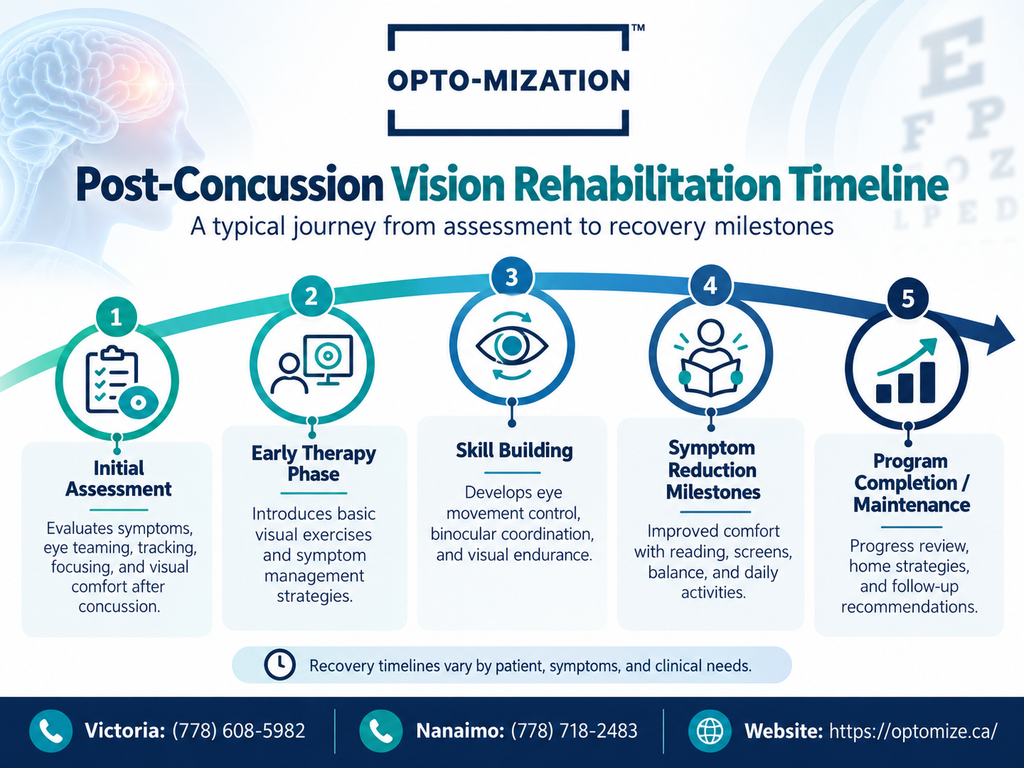
Clinical research on post-concussion vision rehabilitation shows that convergence insufficiency and other oculomotor disorders are among the most frequently identified visual problems following head injury, and that targeted office-based vergence therapy significantly improves near point of convergence, positive fusional vergence, and symptom resolution — while recovery through watchful waiting alone is rare.
Patients who work with Opto-Mization after a concussion often describe a turning point in their recovery: the moment their visual system starts responding consistently again. Screens become manageable. Reading stops triggering headaches. Balance in everyday situations improves. For many, this is the first meaningful progress they have seen after months of other treatments failing to move the needle.
How the Assessment Process Shapes the Results
One reason results at a specialized clinic differ from what general exercises produce is the depth of the diagnostic work that comes first. Opto-Mization’s functional vision assessment evaluates dozens of visual skills that a standard eye exam does not touch, including eye tracking precision, focusing flexibility, binocular alignment under load, and visual processing speed.
- Comprehensive intake: The clinician reviews symptoms, history, previous diagnoses, and what situations trigger problems, building a full picture before any testing begins.
- Functional vision assessment: Objective measurements of eye teaming, tracking, focusing, and visual processing identify exactly which systems are underperforming and by how much.
- Program design: A personalized vision therapy plan is built directly from the assessment findings, with specific goals and measurable benchmarks tied to the patient’s symptoms.
- Supervised therapy sessions: In-clinic sessions combine with home practice, both guided by the clinician’s findings, not generic protocols.
- Progress tracking: The same functional measures used at the start are re-evaluated throughout the program, so patients and families can see the changes in objective terms, not just subjective feeling.
This structure is what allows Opto-Mization to connect specific pre-therapy deficits to specific post-therapy improvements. The results are not anecdotal — they are grounded in measurable changes to the functional skills that were tested at the start.
Common Mistakes That Delay or Prevent Real Results
- Skipping the functional assessment: Starting exercises without knowing which specific skills need retraining produces inconsistent outcomes. The assessment is where the real work begins.
- Stopping the program early: Many patients notice early improvements and reduce their engagement before the visual system has fully consolidated the new patterns. The gains become unstable without completing the program.
- Relying on vision therapy alone when lenses are also needed: Some functional vision conditions respond best to a combination of specialized prescription lenses and therapy. Addressing only one factor limits the result.
- Assuming a clean standard exam means no vision problem exists: Functional vision problems are invisible to routine testing. A clear chart result does not confirm that the visual system is working well under the demands of reading, screens, or movement.
- Waiting too long after a concussion: Early intervention for post-concussion vision problems tends to produce faster and more complete recovery. Long-delayed treatment can mean more sessions are needed to achieve the same result.
How Vision Therapy Results Compare Across Patient Groups
| Patient Group | Primary Concerns Coming In | Typical Outcomes After Therapy |
| Children (ages 5-18) | Reading struggles, skipped lines, suspected ADHD, avoidance behaviors | Improved reading fluency, attention, and academic confidence |
| Working adults | Screen fatigue, headaches, dizziness, concentration difficulty | Reduced headache frequency, longer comfortable work periods |
| Post-concussion patients | Prolonged recovery, balance issues, light sensitivity, reading pain | Faster return to daily function, reduced visual symptoms |
| Seniors | Balance concerns, dizziness, falls, reduced driving confidence | Improved stability, greater confidence in daily movement |
A narrative review published in Clinical and Experimental Optometry found that visual deficits — including impaired eye movement control and loss of binocular single vision — are closely linked to increased postural instability and fall risk in older adults, underscoring why addressing the visual-vestibular connection is a meaningful target for rehabilitation programs aimed at improving balance and daily mobility confidence.
Frequently Asked Questions
What kinds of real results do patients actually see from vision therapy at Opto-Mization?
Patients at Opto-Mization often report improvements that go well beyond clearer eyesight. Children who struggled with reading, skipped lines, or were flagged for ADHD frequently show measurable gains in attention, reading fluency, and school confidence after completing a vision therapy program. Adults dealing with chronic headaches, screen fatigue, or dizziness often find those symptoms significantly reduced once the underlying visual dysfunction is identified and treated. Because the program targets how the eyes and brain work together rather than visual acuity alone, the changes tend to affect daily life in meaningful, practical ways.
My child had a normal eye exam but is still struggling in school. Could vision therapy actually help?
A standard eye exam measures whether your child can see clearly at a distance, but it does not evaluate the functional visual skills required for reading and learning — things like eye tracking accuracy, focusing stamina, binocular coordination, and visual processing speed. A child can have perfect acuity and still have a significant functional vision problem that makes sustained reading exhausting or nearly impossible. Opto-Mization’s comprehensive functional vision assessment is specifically designed to find the problems routine exams miss. Many families in Greater Victoria and Nanaimo have discovered that what appeared to be a learning disability or attention disorder was a treatable visual dysfunction.
How do I know vision therapy will work before committing to a full program?
This concern is one of the most common and reasonable questions families bring to the clinic. Opto-Mization addresses it by starting with a comprehensive functional vision assessment that identifies exactly which visual skills are contributing to the symptoms, giving you a clear, objective picture of the problem before any treatment begins. The clinic also offers a satisfaction guarantee, which is designed to reduce the financial risk of committing to care. That combination of thorough diagnosis, defined goals, and a guarantee gives families a much stronger foundation for deciding whether to move forward. You can also review how long vision therapy takes to set timeline expectations before your first appointment.
Is vision therapy from a specialized clinic different from eye exercises I can find online?
The difference is significant. Generic online exercises are not designed around an individual’s specific visual deficits and are not supervised by a clinician trained in functional vision. At Opto-Mization, every therapy program is built from the results of a detailed assessment, so the activities directly target the particular skills that are underperforming for that patient. The program also draws on neuro-optometric principles, addressing how the brain and eyes communicate rather than targeting muscle strength or movement in isolation. Without that diagnostic foundation, unsupervised exercises rarely produce the kind of measurable, durable improvements that a structured clinical program achieves.
Can adults actually benefit from vision therapy, or is it mainly for children?
Vision therapy is highly effective for adults, and many of Opto-Mization’s patients are professionals managing headaches, migraines, screen fatigue, dizziness, motion sensitivity, or difficulty concentrating. Adults who experienced a concussion are also strong candidates, since post-concussion visual dysfunction is a common and frequently overlooked cause of prolonged recovery. The brain retains neuroplasticity into adulthood, meaning it can still be retrained to coordinate with the eyes more efficiently. Whether the symptoms have persisted for years or appeared after a head injury, a functional assessment for adults is the appropriate starting point to determine whether vision therapy can help.
Ready to Find Out What Is Actually Causing Your Symptoms?
If you or your child have been struggling with reading difficulties, chronic headaches, dizziness, attention problems, or prolonged concussion symptoms, the visual system may be where the answers are. A comprehensive functional vision assessment at Opto-Mization identifies the specific deficits driving those symptoms, so any treatment that follows is built on objective findings rather than assumptions.
Opto-Mization serves patients across Greater Victoria and Nanaimo, BC. The clinic offers a satisfaction guarantee and begins every program with a thorough diagnostic assessment before any treatment is recommended. Contact Opto-Mization to book your functional vision assessment and find out whether vision therapy is the right path forward for you or your child.
Sources
- https://pmc.ncbi.nlm.nih.gov/articles/PMC5423373/
- https://www.sciencedirect.com/science/article/pii/S0149763419303288
- https://www.aoa.org/news/clinical-eye-care/diseases-and-conditions/vision-therapy-yields-faster-recovery-from-concussion-related-eye-condition
- https://pmc.ncbi.nlm.nih.gov/articles/PMC11913239/