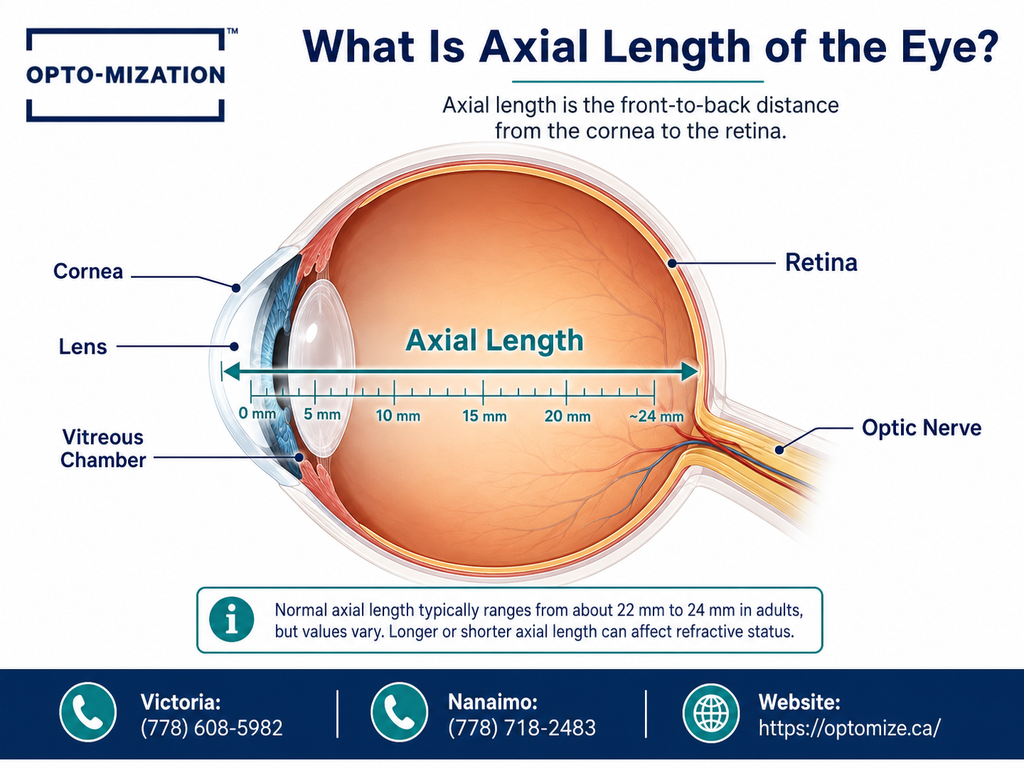
The axial length of the eye is the distance from the front of the cornea to the back of the retina, measured in millimetres. In adults, the average falls between 22 and 24.5 mm, and even a difference of half a millimetre changes how clearly light focuses on the retina. For patients managing myopia or monitoring a child’s eye development, this single measurement carries more clinical weight than most people realize.
Key Takeaways
- Axial length is the front-to-back measurement of the eyeball, typically ranging from 22 to 24.5 mm in adults with normal vision.
- Eyes longer than 26 mm are associated with high myopia and a meaningfully higher risk of retinal complications over time.
- Axial length is measured with optical biometry or ultrasound, neither of which requires touching the eye directly.
- In children, tracking how fast axial length grows matters as much as the length itself — rapid growth signals active myopia progression.
- Myopia management strategies can slow axial elongation, but no current treatment reverses it once it has occurred.
- A standard vision test does not measure axial length; a dedicated functional or myopia management exam is required.
Things You Must Know
1. A Standard Eye Exam Will Not Give You This Number
Routine vision testing checks how well you see at various distances and confirms your prescription. It does not measure the physical length of the eye. If you or your child has progressing myopia, ask specifically whether axial length measurement is part of the exam. Many practices now offer optical biometry as a dedicated step, particularly in myopia management programs.
2. Growth Rate in Children Is the Real Warning Signal
A single axial length reading tells you where a child stands today. Comparing measurements over six to twelve months tells you where they are heading. An eye that grows more than 0.3 mm per year is considered fast-progressing by most clinical guidelines, and earlier intervention consistently produces better outcomes than waiting until the prescription climbs substantially.
3. Longer Eyes Carry Structural Risks Beyond Blurry Vision
Myopia is not just an inconvenience corrected by glasses. As the eye elongates, the retina, choroid, and sclera stretch thinner. This raises the statistical risk of retinal detachment, glaucoma, macular degeneration, and myopic maculopathy later in life. Understanding axial length reframes myopia from a prescription issue into a long-term eye health issue.
What Does Axial Length Actually Measure?
Think of the eye as a camera. The cornea and lens work together as the optical system, and the retina acts as the film. For a sharp image, the point where light converges must land exactly on the retina. Axial length determines how far back that film sits.
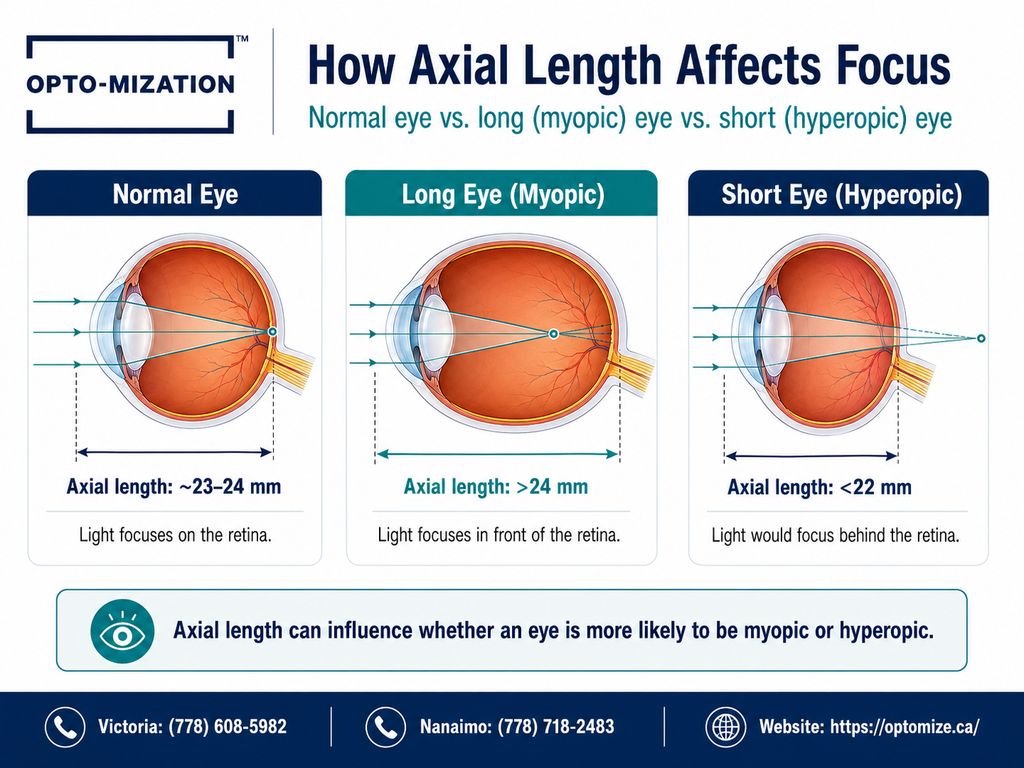
When the eye is too long, light from a distant object converges in front of the retina rather than on it, producing myopia (nearsightedness). When the eye is too short, light would focus behind the retina, producing hyperopia (farsightedness). The relationship is direct: a one-millimetre increase in axial length shifts the prescription by roughly 2.5 to 3.00 dioptres toward myopia.
What Is the Normal Axial Length Range?
In emmetropic adults (those with clear distance vision without correction), axial length typically falls between 22.0 and 24.5 mm, with a population mean close to 23.5 mm. Eyes shorter than 22 mm are more likely to present with hyperopia or a higher risk of angle-closure glaucoma. Eyes longer than 25 mm fall into the clinically significant myopia range, and those exceeding 26 mm are associated with high myopia.
| Axial Length Range | Clinical Category | Typical Prescription Range |
| Less than 22.0 mm | Hyperopia (farsighted) | +2.00 D or more |
| 22.0 – 24.5 mm | Emmetropia (normal) | Plano to mild correction |
| 24.5 – 26.0 mm | Moderate myopia | Approx. -1.00 to -6.00 D |
| Greater than 26.0 mm | High myopia | -6.00 D and beyond |
These ranges are population averages. Individual anatomy, corneal curvature, and lens power all influence where light focuses, which is why two patients with identical axial lengths can have different prescriptions.
How Is Axial Length Measured?
Two main methods are used in clinical practice. Optical biometry uses low-coherence interferometry, a laser-based technique that calculates length by analyzing light reflections within the eye. It is fast, non-contact, and highly precise (accurate to within 0.01 mm in most cases). It is the preferred method in most modern practices.
Immersion ultrasound biometry uses high-frequency sound waves. A probe sits in a saline bath placed over the closed eyelid or rests gently on the eye with a coupling gel. It remains the standard when optical biometry cannot achieve a reliable reading, such as in eyes with dense cataracts.
Step-by-Step: What Happens During Axial Length Measurement
- You sit in front of the optical biometer and rest your chin on a support.
- You focus on a small internal fixation target to align the eye correctly.
- The device fires a low-power laser through the pupil and records the reflected signal.
- Multiple readings are taken automatically over a few seconds and averaged for accuracy.
- The result (in millimetres) is recorded and, if a previous measurement exists, compared to track change over time.
Optical biometry has become the gold standard for pre-cataract-surgery planning and myopia management monitoring. A peer-reviewed optimization study notes that optical biometry, especially using swept-source devices with an accuracy of 0.01–0.02 mm, has become the state-of-the-art method in biometry, with superior repeatability and reproducibility compared with ultrasound in cooperative patients.
Why Axial Length Matters for Children
Children’s eyes are not static. From birth through the mid-teenage years, the eye grows to reach its adult size, a process called emmetropization. Most of this growth is complete by age eight to ten, but in children developing myopia, growth continues longer and faster than it should.
Tracking axial length over time allows clinicians to measure whether a child’s eye is stabilizing or still elongating. This matters because the goal of myopia management is not just to reduce how much a child squints. It is to slow the rate of elongation itself, keeping the eye within a safer structural range over their lifetime.
Research published in major ophthalmology journals indicates that slowing myopia by 1 dioptre (equivalent to approximately 0.4 mm less axial length) can cut a patient’s risk of myopic maculopathy by approximately 40%, according to clinical evidence reviewed in Optometry Times. This finding is one of the primary arguments for early myopia management intervention rather than a “wait and see” approach.
If your child sits very close to screens or books, it may be worth investigating whether progressing myopia is a factor. Understanding the reasons a child holds reading material close can help you decide whether a myopia management consultation is the right next step.
Axial Length and High Myopia Risk
High myopia is defined as a prescription of -6.00 dioptres or more, which typically corresponds to an axial length exceeding 26 mm. At this length, the structural stress on the retina becomes clinically significant.
| Structural Risk | Connection to Axial Length |
| Retinal detachment | Thinning and stretching of peripheral retina increases tear risk |
| Myopic maculopathy | Central retinal changes linked to elongation over 26 mm |
| Glaucoma | Elevated intraocular pressure risk correlates with longer eyes |
| Posterior staphyloma | Outward bulging of the posterior eye wall in very long eyes |
A landmark study published in the journal Ophthalmology projected that by 2050, roughly half the global population will have some degree of myopia, with approximately 10% reaching high myopia, according to global prevalence research on PubMed. Given the direct relationship between axial length and structural complications, monitoring strategies are becoming a routine part of paediatric eye care in many regions.
Common Mistakes Patients and Parents Make
- Treating myopia as purely a prescription problem. Glasses and contacts correct blurry vision but do not slow axial elongation. Myopia management strategies such as orthokeratology, atropine drops, or peripheral defocus contact lenses address the elongation process directly.
- Waiting for prescription to stabilize before acting. In children, stable prescription does not always mean stable axial length. Axial growth can continue even when the prescription plateaus temporarily.
- Assuming a “mild” prescription carries no structural risk. Moderate myopia in childhood can become high myopia in adulthood if growth continues unchecked. The earlier intervention begins, the more elongation can realistically be limited.
- Skipping serial measurements. A single axial length reading establishes a baseline. Without follow-up measurements, there is no way to know whether the eye is growing at a concerning rate.
- Not mentioning family history. Children with two myopic parents have a substantially higher risk of developing progressive myopia. Informing your optometrist at the start of an exam shapes how the results are interpreted.
Axial Length and Contact Lens Fitting
For patients interested in contact lenses, axial length data provides useful context during the fitting process, particularly for specialty lenses designed to slow myopia progression. Orthokeratology lenses, worn overnight to temporarily reshape the cornea, are fitted with attention to both corneal curvature and overall eye dimensions. Understanding your contact lens options for myopia is easier when you already have a current axial length measurement on file.
Frequently Asked Questions
What is the normal axial length of the eye?
For adults with normal, uncorrected vision, axial length typically falls between 22.0 and 24.5 mm, with a mean close to 23.5 mm. Values outside this range suggest refractive error. Eyes shorter than 22 mm tend toward hyperopia, while eyes longer than 24.5 mm are increasingly associated with myopia. These figures describe population averages and individual results always need to be interpreted alongside other clinical findings such as corneal curvature and lens power.
What do you mean by axial length?
Axial length refers to the total distance from the front surface of the cornea to the retina at the back of the eye, measured along the central visual axis. The term “axial” indicates this is measured along the optical axis of the eye, not at an angle. It is the most clinically relevant dimensional measurement of the eyeball because it directly determines where the focal point of incoming light lands relative to the retina.
How is axial length calculated?
In most clinical settings, axial length is calculated using optical biometry. The instrument emits a low-coherence infrared laser beam into the eye and analyzes how the beam reflects back from different ocular structures, including the cornea, lens, and retina. The time delay between reflections is converted into a precise distance measurement. Multiple readings are averaged to reduce variability. In cases where optical biometry cannot obtain a reliable result (such as with a dense cataract), immersion ultrasound biometry is used instead.
What axial length is considered high myopia?
An axial length greater than 26.0 mm is generally associated with high myopia, typically defined as a prescription of -6.00 dioptres or stronger. Some researchers use 26.5 mm as the threshold for classifying an eye as pathologically myopic, where structural complications become significantly more probable. Eyes exceeding 30 mm are rare and carry a substantially elevated risk of retinal and macular changes. Regular monitoring of patients in the high myopia range is considered standard of care in most eye health guidelines.
What happens if the axial length is too long?
As the eye elongates beyond its normal range, the tissue layers at the back stretch and thin. This increases the risk of retinal tears or detachment, glaucoma, myopic maculopathy (damage to the central retina affecting detailed vision), and a structural deformation called posterior staphyloma. Longer eyes also tend to develop cataracts earlier. For children, unchecked elongation during development can compound these risks significantly by the time they reach adulthood, which is the primary reason early myopia management is recommended rather than waiting until the prescription is “bad enough.”
Taking Axial Length Seriously in Your Eye Care Routine
Most people assume their prescription number tells the whole story of their eye health. Axial length adds a dimension to that picture that a prescription number alone cannot. For children with progressing myopia, it is arguably the most important number being tracked. For adults with high myopia, it provides context for understanding their structural risk and knowing which symptoms deserve prompt attention, such as sudden floaters or flashes, which can indicate retinal stress.
Whether you are managing an existing prescription or trying to get ahead of a child’s developing myopia, axial length measurement gives your care team the data they need to make decisions grounded in structural evidence rather than prescription estimates alone.
At Opto-Mization, axial length measurement is part of how we approach myopia management and comprehensive eye health assessment. If you would like to know where your eyes stand or whether your child’s eyes are growing at a concerning rate, book an appointment with our team. We offer dedicated exams that go well beyond standard vision testing, so you leave with answers, not just a new prescription.
Visit optomize.ca to learn more about what a thorough eye health assessment includes, or contact our Nanaimo location directly to schedule a consultation.