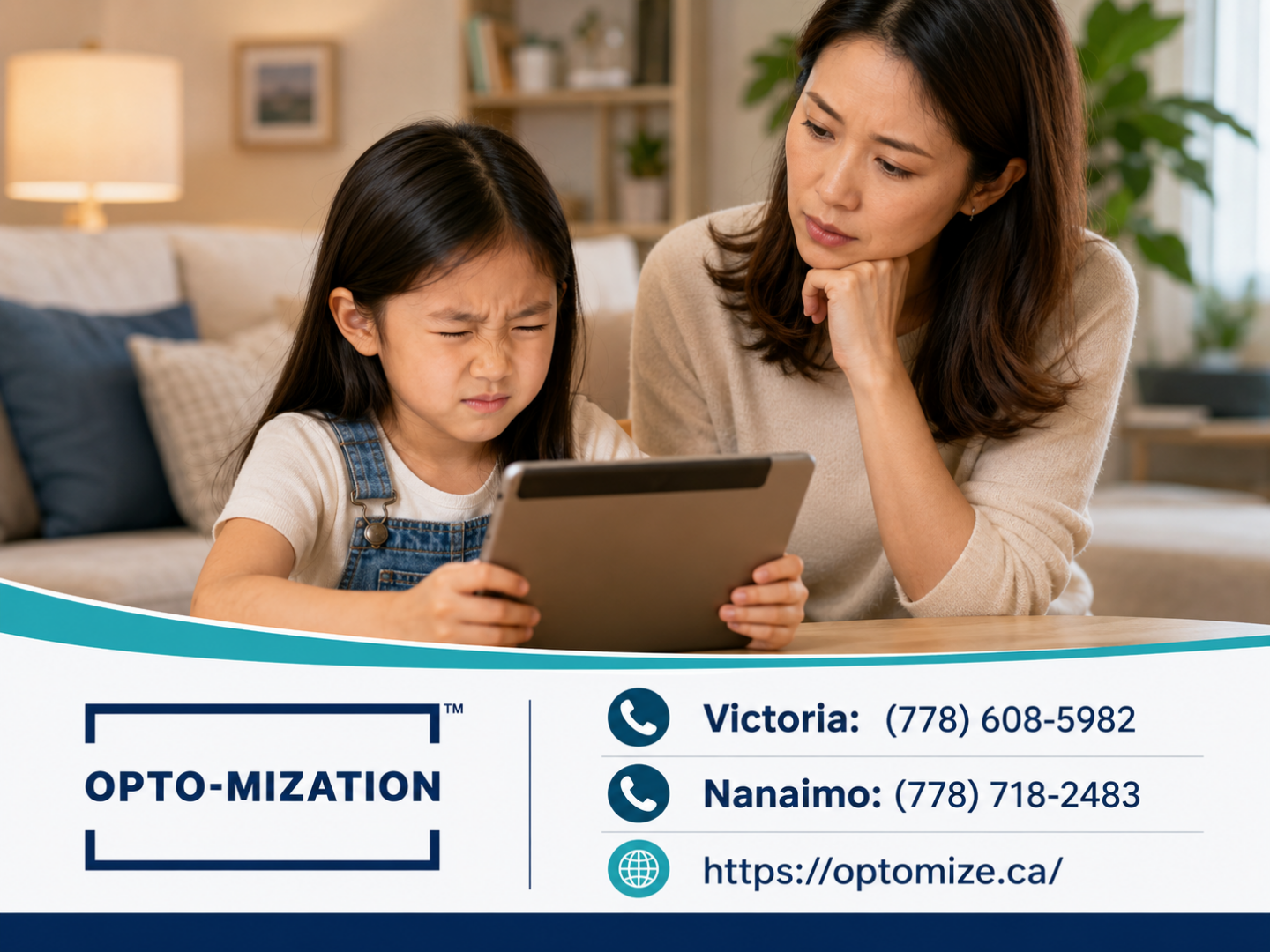
When a child consistently moves close to a screen or pulls a book uncomfortably near their face, it usually signals an underlying vision problem rather than a habit. Conditions like myopia (nearsightedness), convergence insufficiency, or accommodative difficulties make close proximity feel necessary for clarity. A comprehensive pediatric eye exam can identify the cause and point toward the right support.
Key Takeaways
- Sitting too close to screens or holding books near the face is rarely just a habit — it often reflects a vision issue worth investigating.
- Myopia is one of the most common explanations, but it is not the only one; focusing and eye teaming problems can produce the same behavior.
- Children rarely complain about blurry vision because they assume everyone sees the same way they do.
- Early detection makes a meaningful difference — many vision conditions are more effectively managed when caught in childhood.
- A standard school vision screening does not catch all vision problems; a full eye exam provides a more complete picture.
- Behavioral signs like avoiding reading, losing their place, or rubbing their eyes often accompany the physical proximity habit.
Things You Must Know
1. School Screenings Are Not Comprehensive Eye Exams
Many parents feel reassured when their child passes a school vision screening, but these tests typically check distance acuity only. They are not designed to detect focusing problems, eye teaming difficulties, or early myopia progression. A child can pass a school screening and still have a clinically significant vision issue driving the behavior you are noticing at home.
2. Children Do Not Know What “Normal” Vision Looks Like
A child who has always seen the world slightly blurry or experienced eye strain during reading has no reference point for comparison. They adapt without realizing it, moving closer to see better without connecting that behavior to a vision problem. This is why parent observation matters so much — you are often the first person to notice something is off, even before your child can articulate discomfort.
3. Vision and Learning Are Deeply Linked
When a child struggles to see clearly or comfortably, reading becomes tiring and schoolwork suffers. The proximity habit is sometimes mistaken for inattentiveness or disinterest when the real issue is that the child simply cannot see well enough to engage from a normal distance. Addressing the underlying vision cause often produces noticeable improvements in focus and academic engagement.
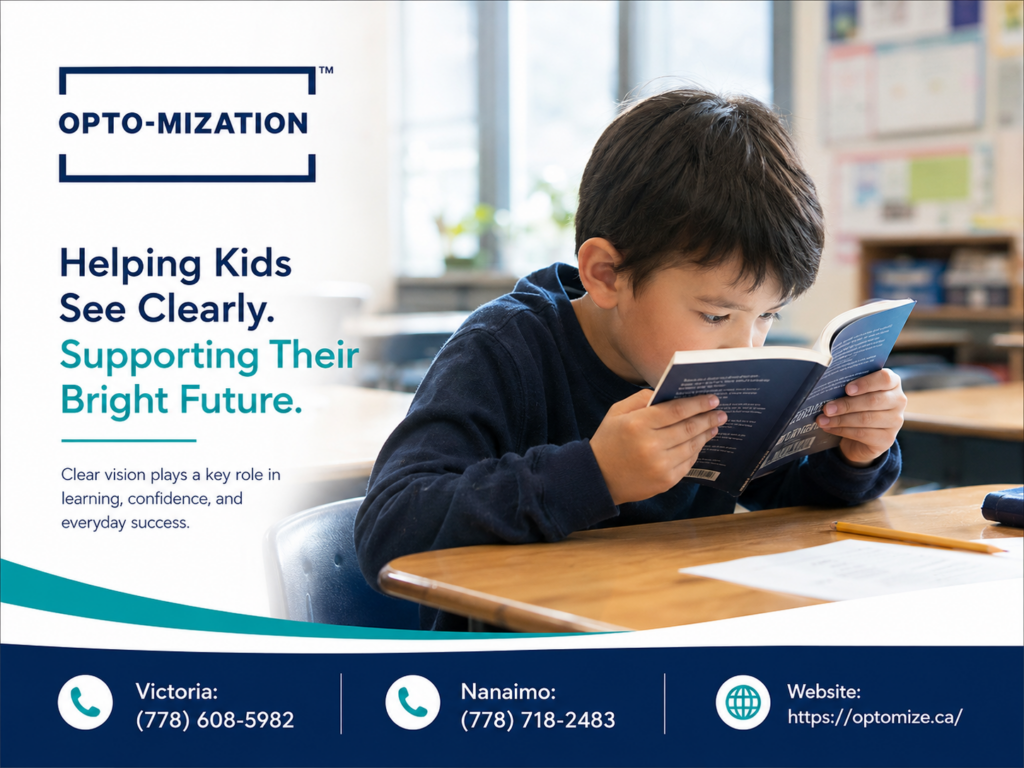
What Does It Actually Mean When a Child Sits Too Close?
The short answer is that your child is doing what they need to do to see clearly. Moving closer to a screen or a page is a coping strategy, not a choice. When the image is too small or too blurry at a normal distance, bringing it closer increases the angular size of what they are looking at, which temporarily compensates for the visual difficulty.
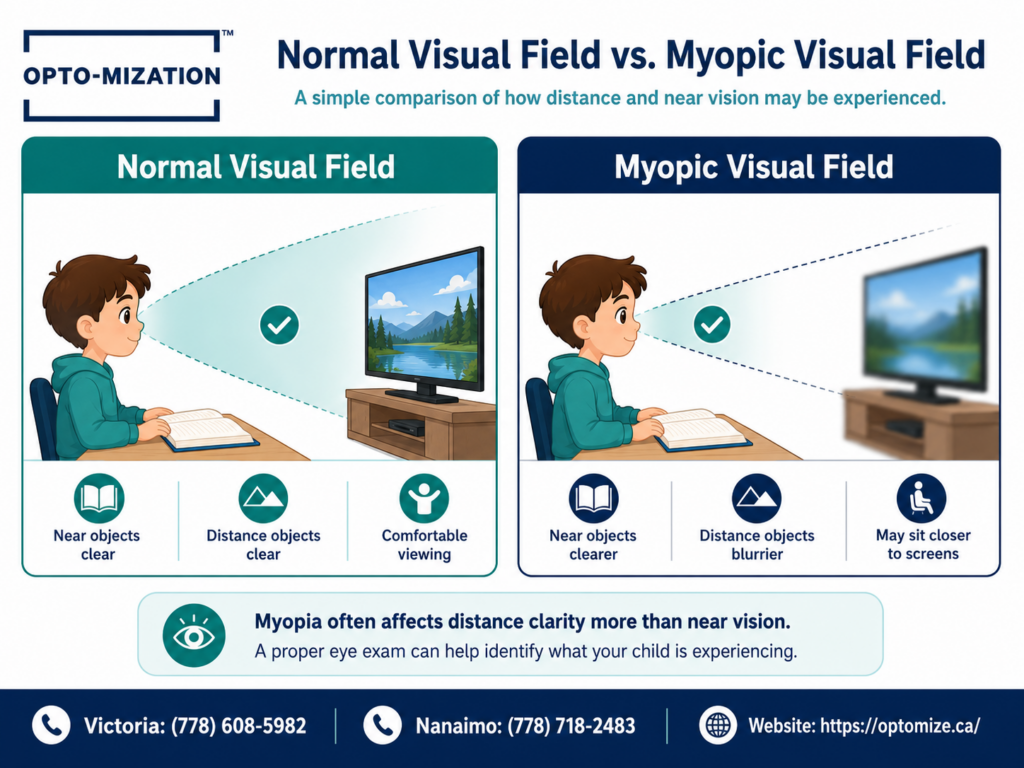
This behavior shows up differently depending on the underlying cause. A child with myopia may sit within inches of the TV but read a book at a normal distance. A child with a focusing problem (accommodative dysfunction) may struggle at both distances but find close work particularly tiring. A child with convergence insufficiency might manage distance tasks fine but drift their book closer and closer as reading fatigue sets in.
Understanding which category applies to your child requires more than observation — it requires a proper assessment.
What Vision Conditions Cause This Behavior?
Myopia (Nearsightedness)
Myopia is the most frequently identified cause. A myopic child can see clearly up close but struggles with anything at a distance. The TV across the room looks blurry, so they move toward it. Street signs are unclear, distant faces are vague, and the classroom whiteboard becomes a source of frustration.
Myopia rates among children have been rising steadily over recent decades, with researchers pointing to reduced outdoor time and increased near-work demands from screens and academic workloads as contributing factors. Some estimates suggest that a significant portion of the global population will be myopic by 2050.
Accommodative Dysfunction
The eye’s ability to shift focus between distances is called accommodation. When this system is sluggish or unstable, the child may find that moving closer reduces the effort required to see clearly. Close proximity narrows the focal range the eye needs to manage, making the task feel more manageable even if it looks awkward from the outside.
Convergence Insufficiency
Convergence insufficiency means the eyes struggle to work as a coordinated team during near tasks. The effort of keeping both eyes aimed at the same point on a page can become tiring quickly. Some children compensate by holding material very close, which reduces the convergence angle the eyes need to maintain. This condition is often associated with reading difficulties and is commonly missed on standard screenings. You can read more about eye teaming and depth perception in children’s reading success to understand how this affects learning.
Astigmatism
Uncorrected astigmatism creates blur at multiple distances, not just far away. A child with significant astigmatism may find that reducing the viewing distance softens the distortion enough to function, even though their overall vision remains compromised. This is a less obvious cause and often goes undetected without a dilated eye exam.
How to Tell the Difference Between a Habit and a Vision Problem
| Behavior | Likely Just a Habit | Possible Vision Concern |
| Sitting close to TV | Does it occasionally, corrects when reminded, no other signs | Consistent, returns immediately after moving back, squinting |
| Holding books near face | Only when very tired or lying down casually | Happens every reading session, worsens over time, avoids reading |
| Squinting at screens | Glare or bright sunlight only | Squints indoors, at normal light levels, regardless of screen brightness |
| Losing place while reading | Rare, mostly when distracted | Frequent, uses finger to track, re-reads the same line repeatedly |
| Eye rubbing | After waking, seasonal allergies | During or after reading, screen use, homework, or drawing |
What Other Signs Appear Alongside This Behavior?
The proximity habit rarely appears in isolation. Most children with an underlying vision issue show a cluster of signs that, taken together, paint a clearer picture. Knowing what to look for beyond just how close they sit can help you have a more productive conversation with a vision care provider.
- Tilting the head when looking at screens or during reading
- Covering or closing one eye to see more clearly
- Complaining of headaches after school or during homework time
- Avoiding activities that require reading or sustained near-work
- Difficulty copying from a board or a page at arm’s length
- Losing their place frequently while reading aloud
- Becoming tired or irritable after visual tasks that should not be exhausting
Children with attention challenges may also exhibit some of these signs, which is why vision is worth ruling out before assuming the cause is purely behavioral. Hidden vision problems in children with dyslexia and ADHD is a topic that often surprises parents who assumed those diagnoses explained everything.
Research suggests that a meaningful percentage of children identified with reading difficulties or attention issues have co-existing, undiagnosed vision problems that contribute significantly to their symptoms. Treating those vision problems has, in some cases, reduced behavioral and academic concerns without any other intervention.
What Is the Process for Getting a Child’s Vision Assessed?
- Schedule a comprehensive pediatric eye exam, not just a vision screening. Request an exam that evaluates visual acuity, focusing ability, eye teaming, tracking, and depth perception.
- Prepare a list of observed behaviors before the appointment: when the proximity habit appears, how long it has been happening, whether it is getting worse, and any accompanying symptoms like headaches or avoidance.
- Ask about a dilated fundus exam if the provider does not mention it. Dilation allows for a more thorough view of the eye’s internal structures and provides a clearer measure of refractive error.
- Discuss all relevant contexts, including school performance, reading habits, screen time, outdoor time, and any family history of myopia or other eye conditions.
- Follow through on recommended follow-up. Some conditions, particularly myopia in children, benefit from active management rather than a wait-and-see approach. Ask what the recommended monitoring schedule looks like.
Does Screen Time Cause This, or Does It Make It Worse?
Extended near-work, including screen use, has been associated with myopia progression in children, particularly when combined with limited time spent outdoors. Outdoor light exposure appears to have a protective effect on eye development, though the exact mechanisms are still being studied. Current guidance from many vision health organizations recommends regular breaks from near-work and adequate daily outdoor time as part of a healthy visual environment for children.
The honest answer is that excessive screen time does not directly cause the sitting-close behavior in a child with healthy vision. However, in a child who is already myopic or has a focusing problem, prolonged near-work can accelerate myopia progression and worsen visual fatigue. The proximity habit may become more noticeable as a result.
Managing screen time sensibly is reasonable, but it should not replace a proper eye exam. Reducing screen time in a child who actually needs glasses will not resolve the underlying issue.
Common Mistakes Parents Make When They Notice This Behavior
- Attributing it entirely to screen addiction without investigating whether vision is a factor. Proximity to screens can reflect visual need, not just habit or preference.
- Relying on a school screening result as the final word. School screenings were not designed to catch all vision problems, and passing one does not rule out the conditions most commonly associated with this behavior.
- Waiting to see if the child grows out of it. Some vision conditions do not resolve on their own, and early management is generally more effective than delayed intervention.
- Assuming the child would say something if their vision were truly a problem. Most children with uncorrected vision issues do not complain because they have no concept of what clearer vision would feel like.
- Focusing only on the screen behavior and missing the reading behavior. A child who holds books close is showing the same sign as one who sits close to the TV, but parents often notice only one and not the other.
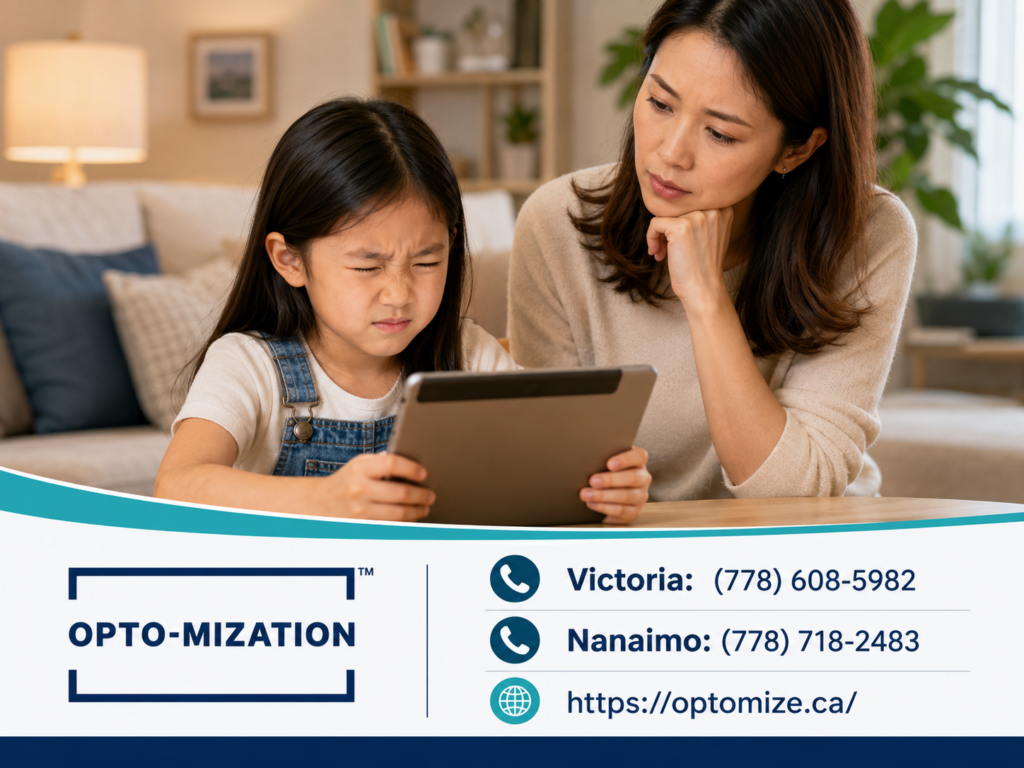
How Visual Skills Connect to Reading and Focus
Vision is not just about how sharp the letters look. It also involves how efficiently the eyes move across a line of text, how well they track a moving target, and how consistently they maintain focus over time. When any part of this system is working harder than it should, children often compensate in ways that look like behavioral issues: short attention span during reading, fidgeting, refusing to sit for homework, or appearing disengaged in class.
Understanding how visual skills affect focus and concentration in children can help parents see that what looks like an attitude problem or a learning difficulty might have a sensory foundation worth addressing first.
| Visual Skill | What It Does | What Happens When It Is Weak |
| Accommodation | Shifts focus between distances | Blurry vision after switching from board to book; fatigue |
| Convergence | Aims both eyes at the same near point | Double vision, headaches, avoidance of reading |
| Tracking (Saccades) | Moves eyes smoothly along a line of text | Losing place, skipping words, slow reading pace |
| Visual acuity | Resolves fine detail at a given distance | Blurry text or images; squinting; sitting closer |
Children who skip words frequently while reading sometimes do so because of eye tracking difficulties rather than phonics gaps. You can explore the vision link behind why some children skip words when reading to understand how this connects to the broader picture.
Frequently Asked Questions
Do children with ADHD sit close to the TV?
Some children with ADHD do sit close to screens, but the reasons vary. In some cases, proximity is driven by the same vision issues that affect any child. In other cases, attentional differences affect how children position themselves during screen use. Because ADHD and vision problems can co-exist and produce overlapping behaviors, it is worth having a vision assessment done separately rather than assuming ADHD explains everything. A comprehensive eye exam can clarify whether vision is contributing to the behavior.
Does sitting close to a screen affect eyesight?
There is no strong evidence that sitting close to a screen directly damages a child’s eyes. However, extended near-work, including screen use at close range, is associated with visual fatigue and may be a contributing factor in myopia progression in children who are already predisposed. The behavior itself is more of a symptom than a cause. If your child is consistently drawn very close to screens, the more useful question is why they feel the need to sit that close, which usually points back to an underlying vision issue.
What are the symptoms of too much screen time for kids?
Excessive screen time can cause symptoms of digital eye strain, including eye redness, dryness, fatigue, headaches, blurred vision, and difficulty refocusing after looking away from the screen. These symptoms typically ease with rest and reduced screen use. If symptoms persist despite reduced screen time or if they accompany behaviors like squinting and sitting very close, the underlying cause is likely a refractive or binocular vision issue rather than screen overuse alone. A 20-20-20 rule (every 20 minutes, look at something 20 feet away for 20 seconds) is commonly recommended as a practical break strategy.
What is Streff syndrome in children?
Streff syndrome, sometimes called non-malingering syndrome, is a functional vision condition typically seen in children under significant emotional or academic stress. It presents as a reduction in visual acuity that cannot be explained by structural eye disease or standard refractive error. Children with Streff syndrome may hold reading material very close and show reduced visual performance on testing. The condition responds well to supportive care, vision therapy, and addressing the underlying stressors. It is relatively uncommon and is best identified through a thorough functional vision evaluation by an experienced provider.
How do I know if my child has vision problems?
Beyond the proximity behavior, look for patterns: headaches during or after schoolwork, complaints that reading is tiring or boring, avoidance of activities that require sustained near vision, squinting at distances, tilting the head to see, covering one eye, or declining academic performance without a clear explanation. Because children rarely self-report vision difficulties, parent observation is often the trigger that leads to a diagnosis. If you notice two or more of these signs consistently, scheduling a comprehensive pediatric eye exam is a reasonable next step regardless of when their last screening occurred.
Conclusion
When a child consistently moves within inches of a screen or pulls a book practically to their nose, the behavior is telling you something. It is rarely stubbornness or screen addiction. More often, it is a child doing what they need to do to compensate for a vision system that is not yet working as well as it should. The good news is that most of the conditions behind this behavior respond well to early, appropriate care.
If you have noticed this pattern in your child and want answers rather than guesswork, a comprehensive eye exam is the right starting point. The team at Opto-mization works with children to assess the full range of visual skills, not just how sharp their vision is at a set distance. Call (778) 608-5982 to book an appointment and find out what is really going on with your child’s vision.