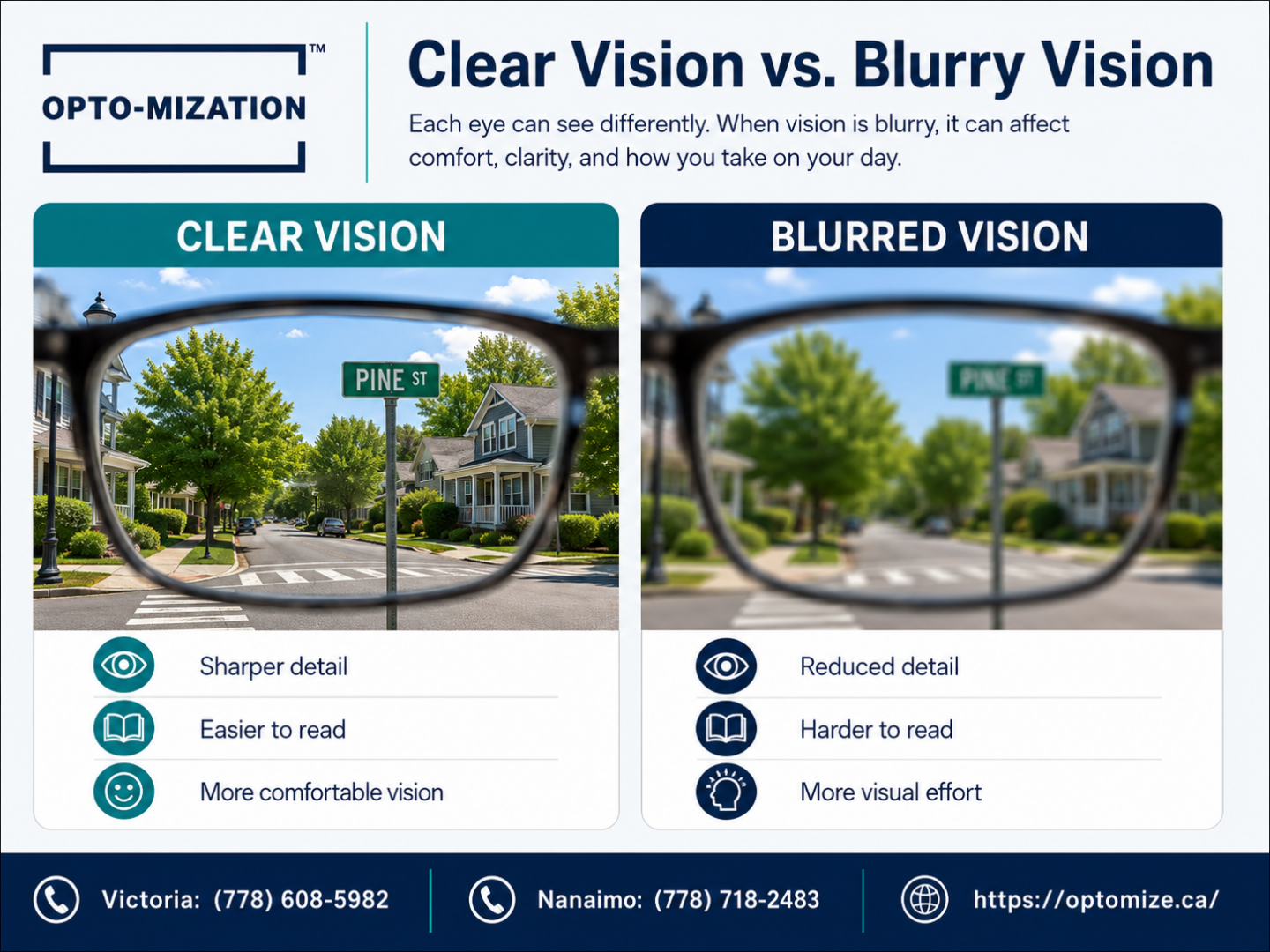
When one eye is noticeably blurrier than the other, it usually points to a refractive difference between the two eyes, a condition called anisometropia, though causes also include dry eye, early cataracts, amblyopia, or underlying health conditions. Many of these are correctable with updated lenses or targeted treatment, but some require a more thorough functional assessment to catch accurately.
If you’ve covered one eye and noticed a sharp difference in clarity, you’re not imagining it. Unequal vision between the two eyes is surprisingly common, yet it often goes unaddressed because people assume it’s just a sign of aging or a minor quirk in their prescription. Sometimes it is. Other times, it’s a signal worth taking seriously.
Key Takeaways
- One eye being blurrier than the other is often caused by a refractive imbalance, meaning each eye has a different prescription need.
- Conditions like dry eye, cataracts, and amblyopia (lazy eye) can all affect one eye more than the other.
- Sudden blurriness in one eye, especially with other symptoms, can indicate a medical emergency requiring prompt attention.
- A standard eye exam doesn’t always catch functional vision problems; a more in-depth evaluation may be needed.
- Correcting the imbalance early typically leads to better outcomes, especially in children and younger adults.
- Opto-mization specializes in identifying vision issues that standard screenings frequently miss.
Things You Must Know
1. Glasses or Contacts Don’t Always Fix the Underlying Problem
An updated prescription can mask the symptom without addressing the cause. If your blur comes from a muscle imbalance, focusing dysfunction, or early neurological issue, corrective lenses may improve clarity partially but won’t resolve what’s driving it. A functional eye evaluation looks beyond refractive error to understand how the two eyes are working together.
2. Children Often Don’t Report One Blurry Eye
Kids adapt to vision differences faster than adults do. The brain can suppress the weaker eye so effectively that a child never complains about blurry vision, even when amblyopia is developing. This is why relying on a child’s self-report isn’t enough. Routine exams that test each eye individually are essential, particularly before age 8 when the visual system is still developing.
3. Sudden Onset Is a Different Situation Entirely
Blurriness that has been slowly worsening over months is a very different concern from blur that appeared in hours or days. Sudden blurry vision in one eye can be a warning sign for retinal detachment, a vascular event, or optic nerve inflammation. In those cases, waiting for a routine appointment is not the right move.
What Causes One Eye to Be Blurrier Than the Other?
The most common explanation is anisometropia, a condition where each eye has a different refractive error. One eye might be nearsighted while the other is farsighted, or the degree of astigmatism differs significantly between the two. This creates an imbalance the brain has to constantly manage, which can also cause headaches and eye strain beyond the blur itself.
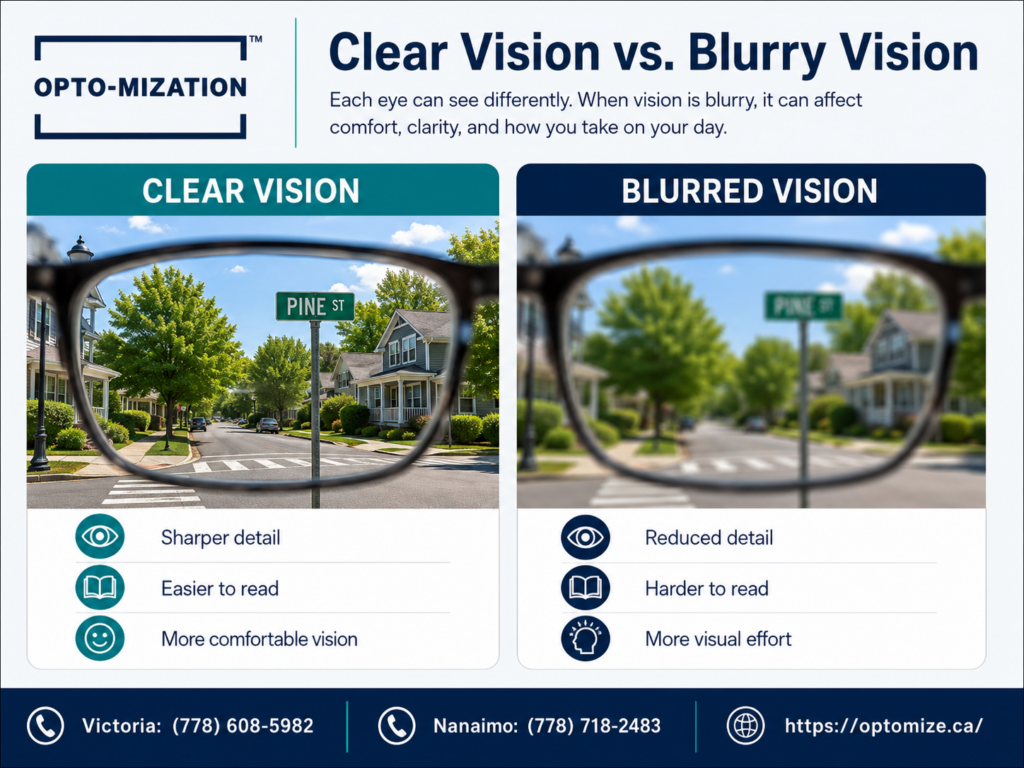
Other causes fall into a few distinct categories worth understanding on their own terms.
Refractive Errors and Prescription Changes
Myopia (nearsightedness), hyperopia (farsightedness), and astigmatism can develop or progress at different rates in each eye. Someone who had relatively equal vision at 25 might find noticeable asymmetry by 35 or 40. This is especially true during periods of hormonal change, extended screen use, or after certain medications.
Studies suggest that myopia progression often differs between the two eyes, with the dominant eye sometimes maintaining better acuity for longer periods. This asymmetrical development is one of the more frequently overlooked reasons people notice one eye underperforming even with a recent prescription.
Dry Eye Syndrome
Dry eye doesn’t always affect both eyes equally. One eye may have a less stable tear film, causing intermittent blur that clears temporarily when you blink. This type of blur fluctuates throughout the day and tends to worsen with screen time, air conditioning, or wind exposure. If you notice the blur is inconsistent rather than constant, dry eye is worth exploring.
You can read more about how eyes feeling worse as the day goes on relates to tear film instability and visual fatigue.
Cataracts
Cataracts typically develop at different rates in each eye. It’s common for one eye to cloud earlier or more significantly than the other, creating exactly the kind of unequal clarity you might notice when you cover each eye alternately. Early-stage cataracts often produce a slightly hazed or washed-out quality rather than outright blur.
Cataract progression is commonly asymmetrical, with one eye advancing faster than the other in a significant portion of bilateral cataract cases. This uneven development is often the first noticeable sign that prompts people to seek an evaluation.
Amblyopia (Lazy Eye)
Amblyopia develops when the brain begins to favor one eye over the other, usually starting in childhood. The suppressed eye gradually loses sharpness because the neural pathways for that eye aren’t being used fully. Many adults have mild amblyopia they were never diagnosed with, often because it wasn’t severe enough to be caught in a brief school screening.
Keratoconus and Corneal Irregularities
Keratoconus, a progressive thinning and reshaping of the cornea, often affects one eye more prominently in its early stages. It produces a distorted, smeared quality to vision that glasses don’t fully correct. This is a case where a standard refraction may not give the full picture.
How Do Doctors Diagnose Why One Eye Is Blurrier?
Diagnosis starts with isolating each eye separately, which a basic vision screening doesn’t always do properly. A comprehensive evaluation includes refraction for each eye independently, a slit-lamp examination of the cornea and lens, assessment of the retina and optic nerve, and in many cases a binocular vision assessment to understand how both eyes work as a team.
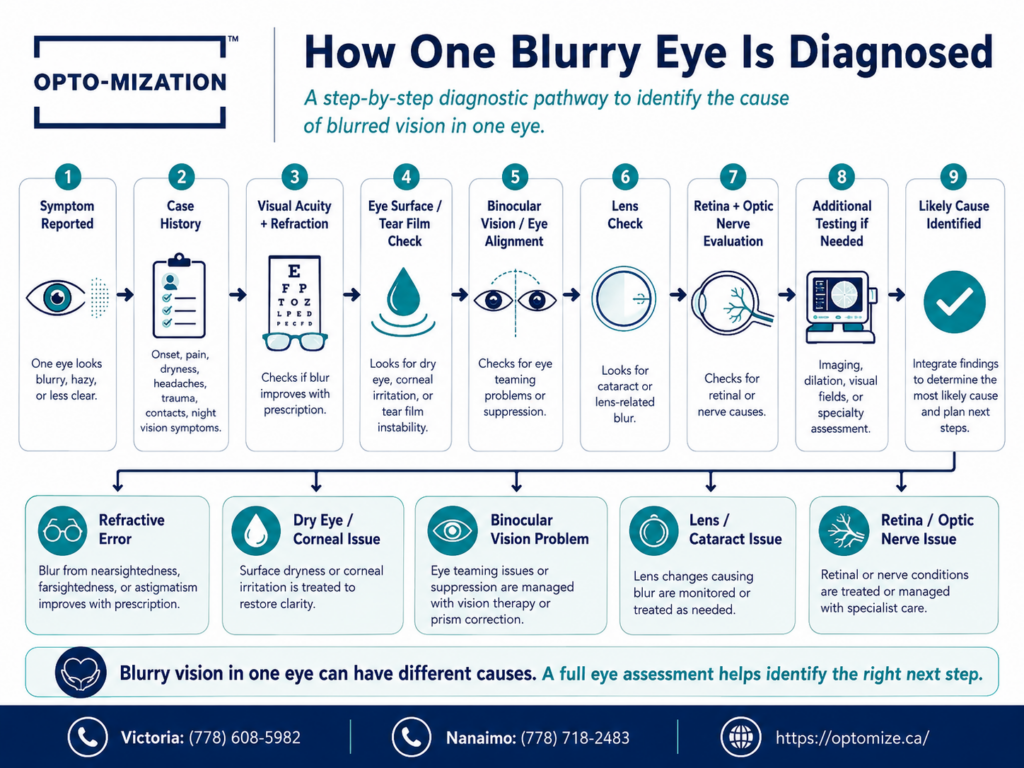
For people whose blur doesn’t resolve with a standard prescription update, a functional eye exam offers a more detailed look at how the visual system is processing information. This type of exam assesses eye teaming, tracking, and focusing in ways a conventional exam doesn’t.
Step-by-Step: What to Expect at an Evaluation for Unequal Vision
- Initial history review: The provider will ask when you noticed the difference, whether it’s constant or intermittent, and whether there are associated symptoms like headaches, double vision, or light sensitivity.
- Monocular visual acuity testing: Each eye is tested separately using a standard acuity chart to establish the baseline difference in clarity.
- Refraction: The exact prescription for each eye is measured to identify any refractive imbalance.
- Anterior segment examination: The cornea and lens of each eye are examined for structural causes like keratoconus or cataract formation.
- Posterior segment examination: The retina and optic nerve are examined to rule out more serious underlying causes.
- Binocular vision assessment (if indicated): Testing how the two eyes coordinate and whether suppression is occurring in the weaker eye.
Comparing the Most Common Causes at a Glance
| Cause | Who It Affects | Blur Quality | Correctable? |
| Anisometropia | Any age | Consistent, distance or near | Yes, with lenses or surgery |
| Dry Eye | Adults, common over 40 | Fluctuating, clears with blink | Yes, with treatment |
| Cataracts | Adults over 50 primarily | Hazy, washed out | Yes, with surgery |
| Amblyopia | Children and some adults | Reduced acuity, often subtle | Partially, better when caught early |
| Keratoconus | Young adults primarily | Distorted, ghosting | Manageable with specialty lenses or crosslinking |
| Retinal Issue / Vascular | Any age | Sudden, may include distortion | Depends on cause and timing |
When Should You Be Concerned About One Blurry Eye?
Gradual, stable blurriness in one eye is usually not an emergency. It still warrants a proper evaluation, but there’s generally time to schedule one through normal channels.
Seek urgent care if you experience any of these alongside sudden blurry vision in one eye:
- Sudden loss of a portion of your visual field
- Flashes of light or a sudden increase in floaters
- Eye pain, redness, or sensitivity to light
- Double vision or drooping eyelid on the same side
- Headache, facial numbness, or difficulty speaking
Sudden unilateral vision changes are among the recognized warning signs for retinal artery occlusion and transient ischemic attack (TIA). In both cases, timely intervention significantly affects outcomes. Ophthalmology and neurology guidelines widely recommend treating sudden monocular vision loss as an urgent clinical situation.
Common Mistakes People Make With Unequal Vision
- Ignoring it because it doesn’t seem “that bad”: Mild blur in one eye can mask a developing condition for years before it becomes significant. Early identification changes the outcome in many cases.
- Assuming a recent prescription means the problem has been addressed: A standard refraction doesn’t evaluate the retina, optic nerve, or binocular function in detail. Getting a new prescription is not the same as getting a thorough eye health evaluation.
- Self-diagnosing with online information: Symptoms overlap considerably across very different conditions. A blurry right eye might be dry eye in one person and early macular degeneration in another. Self-diagnosis delays proper care.
- Not testing each eye separately during at-home checks: Many people don’t notice a difference because both eyes are always open. Covering one eye and checking clarity individually is a simple first step worth doing.
- Delaying care in children because the child doesn’t complain: As noted earlier, children suppress and adapt. The absence of complaints is not reassurance that vision is equal in both eyes.
If you’ve noticed that words sometimes seem unclear or inconsistent, it may be worth reading about how vision problems get missed in standard eye exams and what a more complete assessment looks like.
How Prescription Imbalance Affects Daily Life
| Daily Activity | How Unequal Vision Affects It |
| Reading | One eye may dominate; the other creates visual noise that slows processing |
| Driving | Depth perception is affected when both eyes aren’t contributing equally |
| Screen use | Eye strain accumulates faster when one eye is working harder to compensate |
| Sports / Spatial tasks | Judging distance, speed, and trajectory becomes less reliable |
| Headaches and fatigue | The brain works harder to merge two unequal images, contributing to end-of-day fatigue |
Research into binocular vision dysfunction has linked uncorrected anisometropia with increased rates of reading difficulties and visually-induced headache, as the brain’s effort to reconcile two differently focused images creates measurable strain over sustained visual tasks.
Frequently Asked Questions
How do you fix one blurry eye?
Treatment depends entirely on the cause. Refractive differences are typically corrected with prescription glasses or contact lenses, sometimes including specialty lenses for conditions like keratoconus. Dry eye responds to lubricating drops, lifestyle adjustments, or prescription treatments. Cataracts are addressed surgically when they reach a stage where they impact quality of life. For amblyopia, vision therapy or patching may be recommended, particularly in younger patients. The first step is identifying the specific cause through a proper examination.
When should you worry about blurry vision in one eye?
Concern is warranted when blur appears suddenly rather than gradually, when it accompanies other symptoms such as pain, flashes, floaters, or neurological signs like facial drooping or speech difficulty, or when it represents a significant and unexpected change from your normal baseline. Any of these combinations should be evaluated promptly rather than monitored over time.
Why is eyesight getting blurrier overall?
Gradual worsening in one or both eyes over time is often driven by natural refractive change, presbyopia (age-related near vision loss), cataract development, or conditions like macular degeneration. Systemic health conditions, including diabetes and hypertension, can also affect the clarity of vision over time. Regular eye exams help track progression and catch these changes before they become more disruptive.
What causes cloudiness in one eye?
Cloudiness specifically, as opposed to general blur, is most commonly associated with cataracts, corneal scarring, or certain types of retinal changes. A posterior capsule opacification (a common post-cataract-surgery development) can also produce haziness in one eye. Each of these has a distinct appearance that a slit-lamp examination can identify relatively quickly.
How do you fix cloudiness in the eye?
The approach depends on what’s causing it. Cataract-related cloudiness is treated with surgery to replace the natural lens with a clear artificial one. Posterior capsule opacification is addressed with a brief laser procedure. Corneal cloudiness may require medicated drops, therapeutic contact lenses, or in some cases a corneal transplant. Early evaluation makes a meaningful difference in how many treatment options remain available.
Take the Next Step With Opto-mization
One eye being blurrier than the other is rarely something to ignore indefinitely. Whether it’s a straightforward refractive imbalance, an early sign of something more involved, or a visual efficiency problem that’s been quietly affecting your daily life, the answer starts with the right kind of evaluation.
Opto-mization specializes in thorough vision assessments that go beyond what a standard screening covers. If you’ve had your eyes checked and still feel like something isn’t quite right, it may be worth exploring what a more complete functional evaluation can reveal.
To book an assessment or ask about what an evaluation involves, contact Opto-mization directly at (778) 608-5982. Clear, accurate vision in both eyes is worth the conversation.