
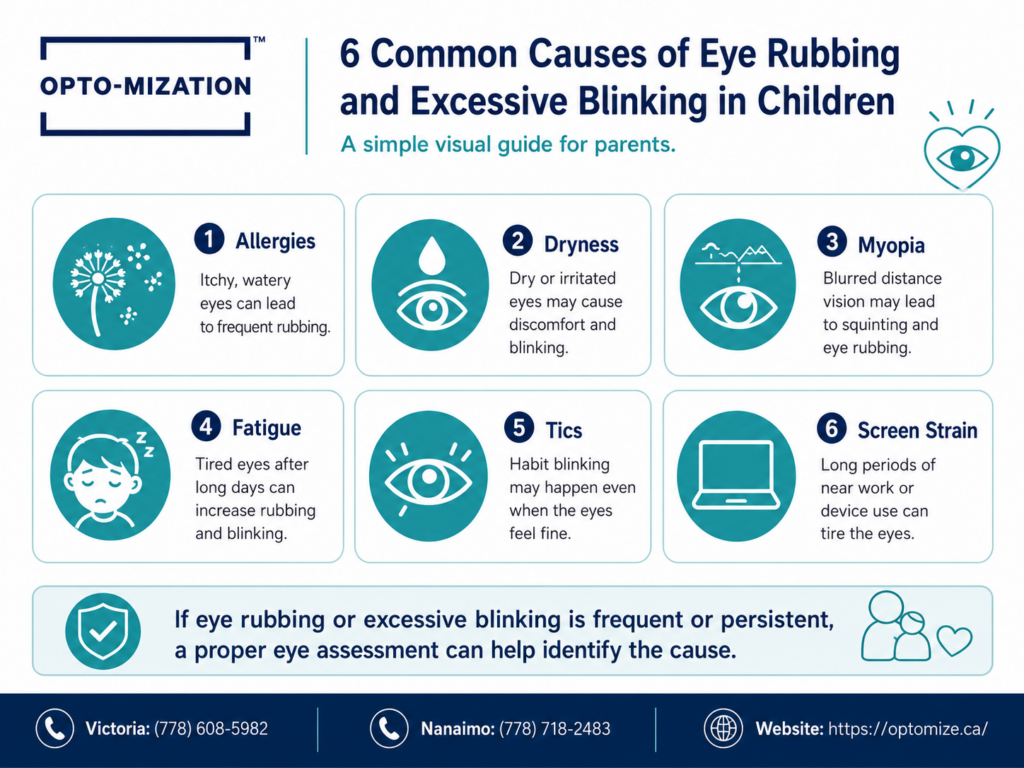
Frequent eye rubbing, blinking, and squinting in children can signal anything from simple tiredness or dryness to uncorrected vision problems, allergies, or a neurological reflex. Many causes are easy to address once identified. A comprehensive children’s eye exam is the most reliable way to find out what’s driving the behaviour and whether vision care or another form of treatment is needed.
Introduction
If you’ve noticed your child constantly rubbing their eyes, blinking hard, or squinting at the TV, you’re not alone. These habits are one of the most common reasons parents start wondering whether something is wrong. Sometimes the answer is simple. Other times, it points to a vision issue that’s been quietly affecting how your child sees the world.
Key Takeaways
- Occasional blinking and eye rubbing is normal, but frequent or persistent habits deserve attention.
- The most common causes include dry eyes, allergies, refractive errors (like nearsightedness), and eye strain from screens.
- Squinting is often a child’s instinctive way of trying to see more clearly when their vision is blurry.
- Some blinking patterns can be linked to tics, ADHD, or sensory processing differences rather than the eyes themselves.
- A comprehensive children’s eye exam can rule out or confirm most causes quickly.
- Early detection of vision problems in children leads to better outcomes, especially before age 8 when visual development is still active.
Things You Must Know
1. Squinting Is Often a Vision Red Flag, Not Just a Habit
When children squint, they’re usually doing it because it helps them see better. Squinting reduces the amount of light entering the eye and temporarily sharpens a blurry image. If your child squints regularly at the whiteboard, the TV, or anything at a distance, it’s worth having their distance vision tested. This reflex is one of the clearest early signs of myopia (nearsightedness) in school-age kids.
2. Eye Rubbing Can Make Some Conditions Worse
Rubbing the eyes feels soothing when they’re itchy or tired, but frequent rubbing can cause problems over time. In children with a condition called keratoconus, repeated eye rubbing is considered a contributing risk factor for corneal thinning. Even in kids without that condition, hard rubbing can irritate the surface of the eye further. If your child rubs often and vigorously, it’s worth mentioning to an eye care provider rather than assuming it’s harmless.
3. Vision Problems in Children Don’t Always Come With Complaints
Many children don’t know their vision is blurry because they’ve never experienced it any other way. They may not say “I can’t see” but instead show signs like moving closer to screens, losing interest in reading, or rubbing and blinking repeatedly. Relying on a child to self-report vision trouble means many problems go undetected for months or longer. Routine eye exams catch what complaints don’t.

What Are the Most Common Reasons Children Rub or Blink Their Eyes?
There’s rarely one single explanation. The behaviour tends to fall into a few broad categories, and sometimes more than one is happening at once.
Tiredness and Overuse
The most straightforward cause is simply tired eyes. Like adults, children’s eyes get fatigued after long periods of reading, screen time, or concentration. Blinking and rubbing are the body’s natural response to that fatigue. If it mainly happens in the evening or after extended close work, tiredness is likely a big factor.
Dry Eye
Children can develop dry eyes, especially in environments with dry air, low humidity, or high screen use. When the eyes aren’t producing enough quality tears, they feel scratchy or uncomfortable, which triggers rubbing. Screen use significantly reduces blink rate, which makes dry eye symptoms worse over time. If your child blinks hard or rubs their eyes during or after screen time, dryness is worth exploring.
Research suggests that children who use screens for two or more hours per day blink significantly less often than children with lower screen exposure, contributing to increased dry eye symptoms and eye discomfort.
Allergies
Seasonal or environmental allergies are a very common cause of itchy, watery eyes in children. Pollen, pet dander, dust, and mold spores can all trigger ocular allergies, which cause intense itching that makes rubbing almost impossible to resist. Allergic eye symptoms often come with other signs like a runny nose, sneezing, or dark circles under the eyes. If symptoms are seasonal or spike in certain environments, allergies are likely involved.
Refractive Errors
Nearsightedness, farsightedness, and astigmatism are collectively called refractive errors, and they’re among the most frequently missed causes of eye-related habits in children. A nearsighted child squints at distant objects. A farsighted child may rub their eyes after reading because close-up work strains their visual system harder than it should. Astigmatism can cause blurring at all distances, leading to squinting, head tilting, or constant blinking as the child tries to compensate.
Myopia prevalence among school-age children has been rising significantly over recent decades, with some estimates suggesting that nearly 30% of children in North America are affected, a rate that continues to climb.
Eye Strain from Screens and Close Work
Extended near-work, including reading, drawing, and device use, puts sustained demand on the muscles that focus the eyes. This is called accommodative eye strain, and it leads to blinking, rubbing, and squinting as the visual system tries to reset. Children engaged in heavy homework loads or long screen sessions are particularly susceptible, and the habits often worsen as the school year progresses.
If your child also complains of headaches after reading or says their eyes feel “heavy,” you may find some useful context in this overview of why pressure behind the eyes develops and what it can indicate.
Could It Be a Tic or a Neurological Reflex?
Not all repetitive blinking is vision-related. Some children develop motor tics, which are sudden, repetitive, involuntary movements. Eye blinking is one of the most common tic presentations in childhood, often appearing between ages 5 and 10. Transient tic disorder is surprisingly common and usually resolves on its own within a year.
Tic-related blinking tends to look different from vision-related blinking. It may involve other facial movements, happen regardless of visual demand (including when the child isn’t focused on anything), and may briefly worsen when the child is anxious, excited, or tired. If you suspect a tic, a paediatrician or developmental specialist is the right starting point alongside any vision evaluation.
Comparing the Most Common Causes at a Glance
| Cause | Main Symptom Pattern | When It Tends to Occur | Who to See |
| Dry Eye | Rubbing, scratchy feeling | During/after screen time | Optometrist |
| Allergies | Itching, watering, redness | Seasonal, or around triggers | Optometrist or allergist |
| Myopia | Squinting at distance | TV, boards, outdoors | Optometrist |
| Eye Strain | Rubbing, blinking, headaches | After reading or close work | Optometrist |
| Tic Disorder | Rapid repetitive blinking | Random, not task-dependent | Paediatrician |
| Tiredness | Heavy lids, rubbing | Evening, after long days | Usually no action needed |
What Signs Should Prompt an Eye Exam Sooner Rather Than Later?
Some patterns of eye rubbing, blinking, or squinting are more urgent than others. If your child shows any of the following, booking a comprehensive eye exam soon makes sense.
- Squinting consistently at the TV, whiteboard, or objects across the room
- Holding books or devices very close to their face
- Tilting or turning their head to look at things
- One eye that appears to turn in or out (strabismus)
- Complaints of double vision, headaches, or blurry sight
- Rubbing so hard that the eye area becomes red or swollen
- Sensitivity to bright lights alongside the blinking habit (read more about why lights can look too bright and what that sensitivity may indicate)
Vision problems that are left uncorrected during the early developmental years, particularly before age 8, can result in amblyopia (lazy eye), a condition in which the brain suppresses input from one eye, leading to permanent visual impairment if not caught in time.
What Happens During a Children’s Eye Exam?
Many parents aren’t sure what to expect from a paediatric eye assessment, especially for younger children who can’t yet read a letter chart. Here’s how a typical exam at a children’s optometry practice tends to unfold.
- Case history: The optometrist will ask about your child’s habits, any complaints, family history of vision problems, and the specific behaviours you’ve noticed at home or school.
- Visual acuity testing: This tests how clearly your child can see at various distances. For pre-readers, child-friendly symbols or matching games are used instead of letters.
- Refraction: The optometrist measures whether glasses or contact lenses would improve your child’s clarity. This can be done objectively with instruments, so it doesn’t require perfect cooperation from a young child.
- Eye alignment and movement testing: This checks whether both eyes are working together correctly, including screening for strabismus and convergence issues.
- Eye health evaluation: The front and back of each eye are examined to look for signs of allergies, inflammation, or other structural concerns.
- Discussion of findings and next steps: You’ll receive a clear summary of what was found and what, if anything, is recommended.
Common Mistakes Parents Make When Dealing with Eye-Rubbing Habits
- Assuming it’s just tiredness and waiting it out. Fatigue is sometimes the cause, but persistent habits that don’t resolve with rest deserve a closer look.
- Relying on school vision screenings as a complete assessment. School screenings check basic distance acuity but miss many issues, including farsightedness, binocular vision problems, and early astigmatism.
- Treating the symptom instead of the cause. Antihistamine drops may soothe allergy symptoms, but if the root cause is uncorrected vision, the rubbing and squinting won’t stop.
- Waiting for the child to complain. Children often adapt to blurry or uncomfortable vision without realising it’s abnormal. Their silence doesn’t mean nothing is wrong.
- Assuming all blinking is neurological without ruling out vision first. Tics and ADHD-related blinking are real, but an eye exam should come first to eliminate treatable vision causes.
Studies on paediatric vision care have found that a significant proportion of children who fail school-based vision screenings are never followed up with a comprehensive eye exam, leaving correctable problems unaddressed throughout critical learning years.
How Screen Time Habits at Home Can Make Things Worse
Digital device use doesn’t cause all of these habits, but it frequently makes existing ones harder to ignore. When children use screens, their blink rate drops considerably, their eyes hold a fixed focal distance for extended periods, and the blue light exposure can affect visual comfort for some children.
Practical steps that help include enforcing regular breaks (the 20-20-20 rule: every 20 minutes, look at something 20 feet away for 20 seconds), ensuring screens are at a comfortable viewing distance, and keeping device use in well-lit rooms rather than dark ones. These habits support eye comfort but don’t replace a professional evaluation if symptoms persist.
Average daily recreational screen time for children aged 8 to 12 has been reported at over four hours per day in multiple national surveys, a figure that has increased substantially since 2020.
Frequently Asked Questions
Why does my child keep blinking and squinting?
The most likely causes are an uncorrected refractive error (such as nearsightedness or astigmatism), eye strain from screens or close work, dry eyes, or allergies. Squinting in particular is the eye’s way of trying to sharpen a blurry image, so it’s one of the clearest signs that a vision assessment is due. A comprehensive eye exam can identify what’s driving the behaviour.
Why is my child rubbing his eyes a lot?
Frequent eye rubbing usually points to discomfort. The most common culprits are itchiness from allergies, dryness, fatigue, or irritation. In some cases, children with farsightedness rub their eyes because close work puts significant strain on the eye muscles. If rubbing is persistent or vigorous, it’s worth getting both the eyes and the possible allergy component assessed.
Why does my toddler keep blinking and rubbing his eyes?
In toddlers, blinking and rubbing can simply mean they’re tired. But if the behaviour is frequent regardless of sleep, it may indicate early refractive errors, blocked tear ducts, or mild eye irritation. Toddlers can’t articulate visual discomfort, so these physical habits are often the only signal parents have. Paediatric eye exams are recommended starting at age 1 in many clinical guidelines, with follow-ups as the child grows.
Do kids with ADHD blink a lot?
Increased blinking in children with ADHD can occur for a few reasons. First, attention and eye movement control are closely connected, and some children with ADHD have underlying binocular vision difficulties that contribute to blinking and eye strain. Second, motor tics are more common in children with ADHD than in the general paediatric population. An eye exam helps determine whether a vision component is involved, which is a treatable factor even if ADHD is also present.
Is blinking a lot a sign of autism?
Repetitive blinking isn’t a core diagnostic feature of autism spectrum disorder, but some autistic children do show repetitive motor behaviours that can include facial movements like blinking. If repetitive blinking is present alongside other developmental concerns, it’s best evaluated as part of a broader developmental assessment. That said, vision problems in autistic children are common and frequently missed, so an eye exam remains a useful first step regardless of any neurodevelopmental diagnosis.
Conclusion
Frequent eye rubbing, blinking, and squinting in children rarely have one simple explanation, but they almost always have an explanation worth finding. Some causes are easy to address once identified. Others, like uncorrected myopia or early amblyopia, become harder to manage the longer they go undetected. The best approach is to treat these habits as useful signals rather than minor quirks, and to get a clear picture through a proper examination rather than guessing.
If you’ve been watching your child blink, squint, or rub their eyes and wondering what’s behind it, Opto-mization is here to help. Our team provides comprehensive children’s eye exams designed to identify the full picture, from refractive errors to eye health concerns, in an environment that’s welcoming for kids of all ages.
Call us at (778) 608-5982 to book your child’s eye exam with Opto-mization. The sooner you know, the sooner they can see clearly.