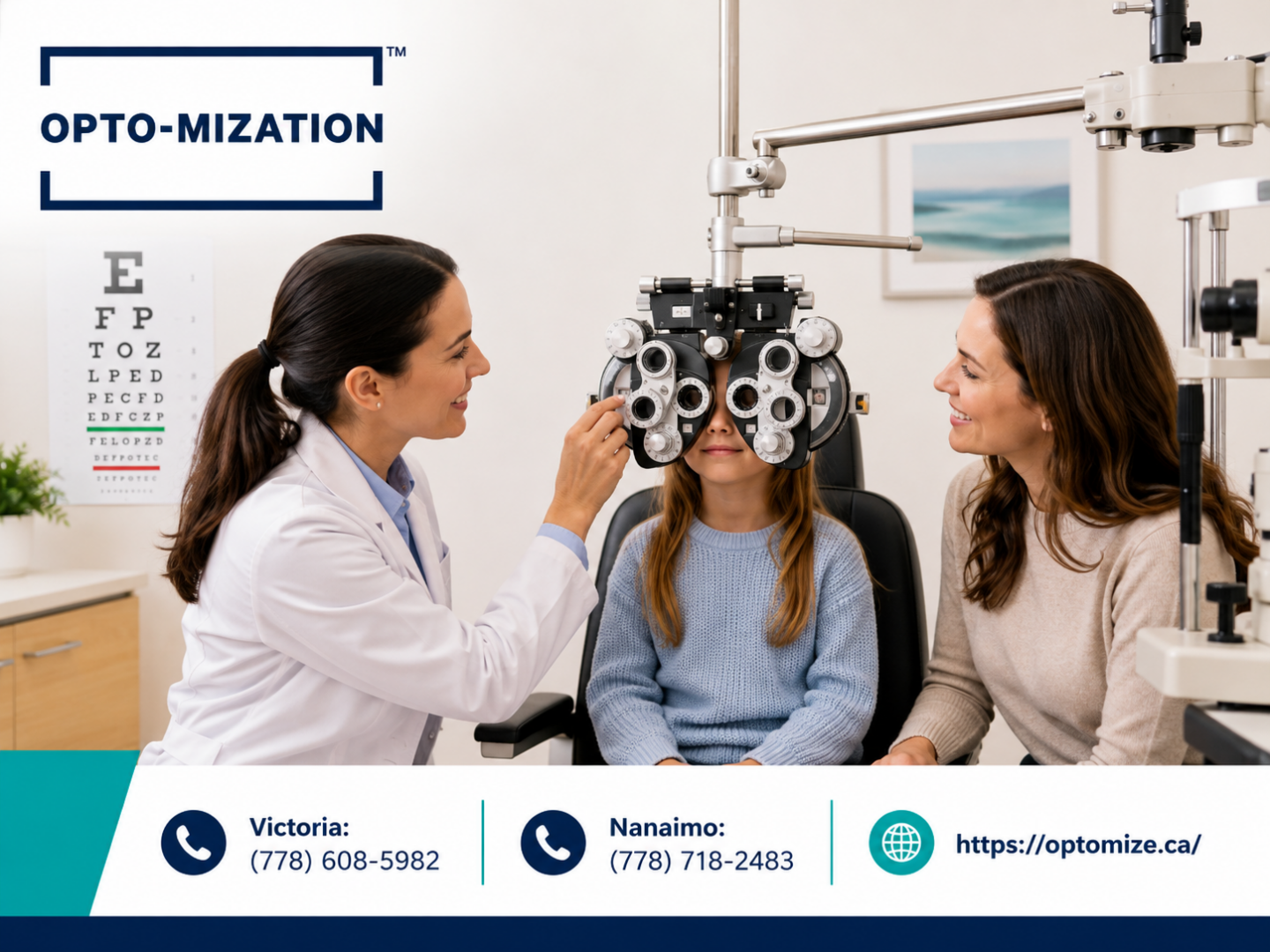
When children cover one eye, tilt their head, or pull back from reading and close-up tasks, it often signals an underlying vision problem rather than a behavioral issue. These habits are the child’s way of compensating for blurred, doubled, or uncomfortable vision. A functional vision assessment can identify conditions like amblyopia, strabismus, or convergence insufficiency before they affect learning and development.
Introduction
Most parents notice these little habits and chalk them up to quirks or restlessness. A child who squints at the TV, tilts their chin down during homework, or suddenly refuses to read might just seem distracted. But these patterns are worth paying close attention to, because the eyes often send signals long before a child can explain what they’re seeing.
Key Takeaways
- Covering one eye is a common self-correction strategy when the brain is receiving two conflicting images.
- Head tilting can indicate a misalignment in eye muscle coordination, not just a posture habit.
- Avoiding close-up work often points to focusing strain or convergence problems, not laziness or learning difficulties.
- Many functional vision problems are missed in standard school screenings, which test clarity but not visual processing.
- Early detection significantly improves outcomes, especially for amblyopia (lazy eye) and convergence insufficiency.
- A developmental or behavioral optometrist assesses how the eyes work together, not just how sharp the vision is.
Things You Must Know
1. Standard Vision Screenings Often Miss These Problems
The eye chart at a school screening checks distance clarity, which is only one part of vision. It does not evaluate how well the eyes team together, focus at near distances, or track across a line of text. A child can pass a 20/20 screening and still have a significant functional vision problem that affects reading and learning. A comprehensive exam with a developmental optometrist covers these areas in detail.
2. These Behaviors Are Compensation Strategies, Not Bad Habits
When a child covers one eye or tilts their head, they are not being stubborn or inattentive. They have discovered that a specific posture or action makes the visual discomfort more manageable. Correcting the posture without addressing the underlying vision issue will not solve anything, and in some cases may make the child more frustrated because their self-coping strategy has been removed.
3. The Window for Effective Treatment Is Time-Sensitive for Some Conditions
Amblyopia (commonly called lazy eye) responds best to treatment during the years when the visual system is still developing, typically before age 8 to 10. After that window, the brain’s ability to adapt and improve becomes more limited. This does not mean treatment is impossible after that age, but early identification gives children the best possible outcome. Waiting to “see if they grow out of it” is a risk worth discussing with a specialist.
Why Do Children Cover One Eye?
Covering one eye is one of the clearest signs that the two eyes are not working as a coordinated pair. When the brain receives two images that do not align properly, it can feel disruptive or confusing. Blocking one eye removes the conflict and makes vision temporarily clearer or more comfortable.
Convergence insufficiency, a condition where the eyes struggle to turn inward together for near tasks, is estimated to affect approximately 5 to 10 percent of school-age children. It is one of the most common causes of eye-covering behavior, particularly during reading or screen time.
Strabismus (eye turn) is another common cause. One eye may drift inward, outward, upward, or downward, and covering the misaligned eye allows the child to use their stronger eye without the interference of a competing image. This pattern is something a parent may notice consistently, or it may only appear when the child is tired or concentrating hard.
If you have noticed your child losing their place while reading, covering one eye during that task is a strong signal that eye teaming may be the root cause rather than attention or literacy issues.
What Does Head Tilting Actually Mean?
A persistent head tilt is not always a neck or posture issue. The visual system and vestibular system are tightly connected, and the head often adjusts to compensate for a misalignment in how the eyes are positioned or working.
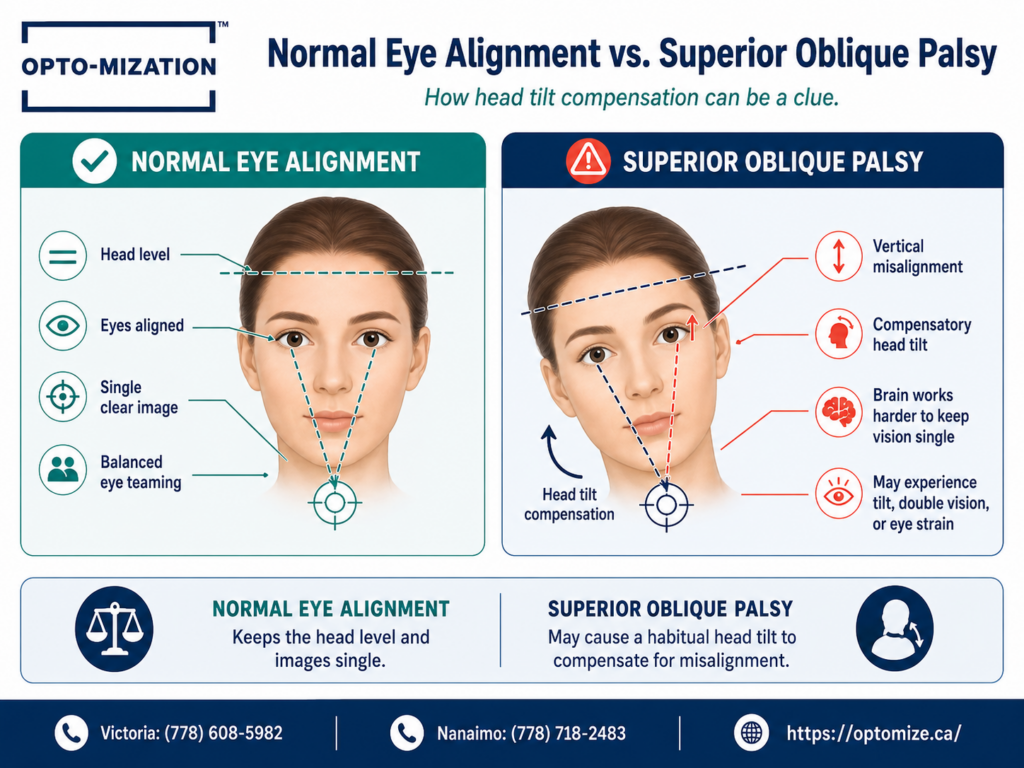
One of the most common reasons for head tilting is a condition called superior oblique palsy, where one of the small muscles controlling vertical eye movement is weakened. Tilting the head effectively rotates the visual field slightly, which can reduce or eliminate the double vision caused by the imbalance.
In children with vertical strabismus, head tilting is reported as a compensatory posture in a significant portion of cases. Left untreated, the habitual tilt can sometimes contribute to neck muscle imbalances over time.
Head tilting can also reflect nystagmus (involuntary eye movement), where a specific head position happens to be the “null point” at which the movement settles and vision becomes clearest. Children often discover this position naturally and adopt it without understanding why.
Why Would a Child Avoid Reading and Close-Up Tasks?
Reading requires a specific set of visual skills that go far beyond seeing clearly at a distance. The eyes must converge (turn inward toward the text), maintain focus at close range for sustained periods, and track smoothly across each line without losing position. When any of these functions is strained or inefficient, reading becomes physically uncomfortable.
Children rarely say “my eyes hurt when I read.” Instead, they say the book is boring, they have a headache, the words are blurry, or they just get up and walk away after a few minutes. These are not attention problems. They are descriptions of visual fatigue.
Research into the relationship between reading difficulties and vision has found that convergence insufficiency, in particular, is significantly associated with reading avoidance, reduced comprehension, and academic performance gaps. Some studies suggest it may be misidentified as ADHD in a portion of affected children.
Understanding the role of eye teaming and depth perception in children’s reading success is essential context here. When the two eyes are not cooperating efficiently, every line of text demands extra neurological effort, and children burn through their concentration reserves quickly.
Accommodative dysfunction is another factor to consider. This refers to the eye’s ability to adjust its focus for near objects. If that focusing system is sluggish, unstable, or overworking to compensate, close-up tasks feel strenuous even with otherwise good visual acuity.
Common Conditions Behind These Behaviors
| Condition | What It Affects | Common Behavior Signal |
| Amblyopia (Lazy Eye) | One eye has reduced vision; brain suppresses it | Covers stronger eye; difficulty with depth tasks |
| Strabismus (Eye Turn) | Eyes point in different directions | Covers one eye; visible eye drift |
| Convergence Insufficiency | Eyes can’t sustain inward focus for near tasks | Avoids reading; words blur after short periods |
| Superior Oblique Palsy | Vertical eye muscle weakness | Persistent head tilt; double vision |
| Accommodative Dysfunction | Difficulty sustaining near focus | Headaches after reading; avoidance of close work |
| Nystagmus | Involuntary eye movement | Head tilt to find null point; sensitive to motion |
How a Functional Vision Assessment Works
A functional vision exam goes significantly further than a standard eye chart test. It looks at how effectively the visual system performs under the conditions a child faces every day, especially during reading and learning tasks. Here is what a thorough assessment typically covers:
- Visual acuity at distance and near: Checking clarity at both ranges, not just the 20-foot standard.
- Eye alignment and muscle balance: Assessing whether the eyes point in the same direction under various conditions.
- Convergence and divergence: Measuring how well the eyes can move inward and outward as needed for different distances.
- Accommodative function: Testing the ability to shift focus between near and far and sustain it over time.
- Eye tracking: Evaluating smooth pursuit and saccadic movement (the jumps the eyes make when reading).
- Binocular integration: Checking how well the brain fuses the two images from each eye into a single, stable picture.
- Visual processing (when indicated): Assessing how the brain interprets what the eyes send, particularly for reading-related tasks.
Children who skip words when reading often have tracking or binocular integration issues that only become visible through this kind of detailed evaluation.
Common Mistakes Parents Make When Noticing These Signs
- Assuming it is behavioral: Avoidance of reading or homework is frequently treated as a motivation problem when it may be a physical discomfort issue.
- Relying solely on school screenings: A pass on the school vision check does not mean functional vision is healthy. These screenings were never designed to catch binocular or tracking problems.
- Waiting it out: Some conditions, particularly amblyopia, have a time-sensitive treatment window. Delayed assessment can mean a harder road to improvement later.
- Correcting the head tilt directly: Reminding a child to sit up straight without understanding why they tilt can remove their only comfortable viewing strategy without replacing it with anything helpful.
- Assuming glasses will fix everything: Glasses correct refractive error (blur), but they do not treat binocular dysfunction, convergence problems, or tracking issues. Those require a different type of intervention.
How Visual Discomfort Connects to Classroom Struggles
When visual tasks are effortful, children prioritize survival over engagement. They disengage from reading, lose their place frequently, skip lines, reverse letters, or read the same sentence repeatedly because the tracking system cannot hold position reliably.
Studies examining children with reading difficulties have found vision-based factors present in a notable subset of cases, with binocular vision dysfunction appearing alongside reading challenges at rates that suggest systematic screening could identify children who would benefit from vision therapy before educational interventions alone are attempted.
Busy or crowded visual environments can make these difficulties worse. Children who struggle with visual processing often find busy patterns, crowded text, and bright classrooms overwhelming in ways that are directly tied to how their visual system handles competing stimuli.
| What You See | What It May Indicate | Next Step |
| Child covers one eye to read or watch TV | Binocular dysfunction, strabismus | Book a functional vision exam |
| Persistent head tilt in photos and daily life | Eye muscle imbalance, nystagmus | Rule out vision before physio referral |
| Refuses or avoids reading after a few minutes | Convergence insufficiency, accommodative strain | Assess near vision function specifically |
| Complaints of headaches during homework | Visual fatigue from sustained focusing effort | Track when headaches occur; mention to optometrist |
Frequently Asked Questions
Why do kids cover one eye during reading or screen time?
Covering one eye is a self-correction strategy. When the two eyes are not working together efficiently, the brain receives two slightly different or misaligned images. Blocking one eye removes that conflict and makes vision feel more stable and comfortable. It is one of the clearest behavioral signals that the binocular vision system needs to be assessed. It does not mean the child has poor vision in one eye necessarily; it means the eyes are not cooperating as a team.
Why does my child tilt their head all the time?
A consistent head tilt often means the child has found a position where their vision is clearest or least doubled. This is common with vertical eye muscle imbalances (such as superior oblique palsy) and with nystagmus. The tilt is not a posture problem to be corrected through reminders. It is a compensatory reflex that should prompt a vision assessment to identify what the head position is compensating for.
Why does my child avoid reading and close-up work?
Close-up tasks demand that the eyes converge, focus, and track simultaneously over sustained periods. If any of those systems are strained or inefficient, reading becomes physically uncomfortable long before a child has the vocabulary to describe what they are experiencing. Avoidance is the child’s natural response to discomfort. Convergence insufficiency and accommodative dysfunction are two of the most common causes and both respond well to appropriate treatment when identified early.
What conditions are usually behind these behaviors?
The most common underlying causes include amblyopia (lazy eye), strabismus (eye turn), convergence insufficiency, accommodative dysfunction, superior oblique palsy, and nystagmus. These are not rare or exotic diagnoses. Several affect a meaningful percentage of school-age children and are routinely missed by standard screenings because those screenings only measure distance clarity, not functional visual performance.
When should I see a specialist about my child’s vision behaviors?
If you notice any of these behaviors, including covering one eye, tilting the head consistently, squinting, avoiding reading, complaining of headaches during close work, or losing their place frequently while reading, it is worth booking a comprehensive functional vision assessment rather than waiting. These signs do not resolve on their own if the underlying vision issue remains unaddressed. For conditions like amblyopia, earlier assessment leads to better treatment outcomes.
What to Do Next
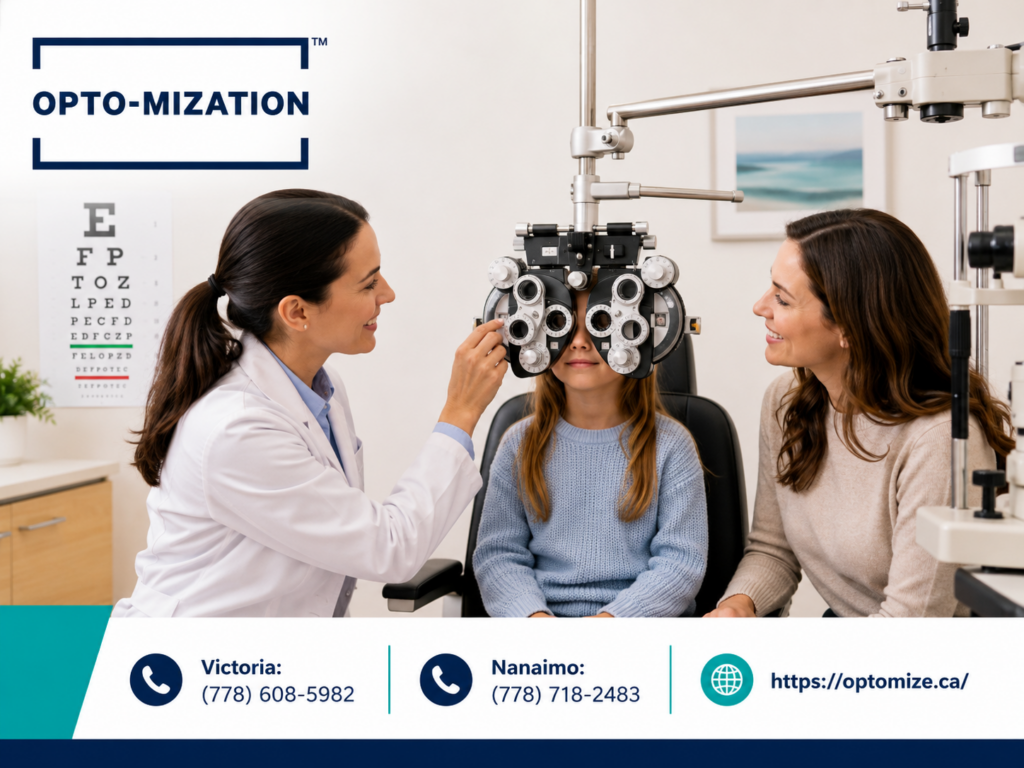
If any of the patterns in this article sound familiar, the most useful step is a comprehensive functional vision assessment with a developmental optometrist. A standard eye test at a school or walk-in clinic will not evaluate the binocular and functional skills that these behaviors reflect.
The behaviors themselves are not the problem. They are the signal. And the earlier that signal is properly read, the more options exist for supporting your child’s visual development and learning.
Opto-Mization offers thorough vision assessments designed to evaluate how the eyes work together, not just how clearly they see at a distance. If you have questions about your child’s visual behaviors or want to understand what a functional assessment involves, reach out at (778) 608-5982.