
When a child repeatedly loses their place while reading, it often points to a functional vision problem rather than a learning or attention disorder. Skills like eye tracking, eye teaming, and visual focus can all interfere with smooth reading even when a child passes a standard vision screening. A developmental vision assessment can identify these issues early and guide the right support.
Introduction
You watch your child sound out every word correctly, yet somehow they still lose their spot mid-sentence. They re-read the same line twice, skip lines entirely, or use their finger just to stay on track. It’s easy to assume they’re not trying hard enough, but the real explanation is often sitting in how their eyes are working together, not how hard they’re concentrating.
Key Takeaways
- Losing your place while reading is frequently linked to visual tracking or eye teaming problems, not reading ability or intelligence.
- A child can pass a standard 20/20 vision test and still have a functional vision problem that disrupts reading.
- Signs like skipping lines, re-reading sentences, or needing a finger to track are worth investigating with a vision professional.
- Developmental vision assessments test skills that standard screenings do not, including how eyes move and coordinate.
- Early identification gives children a much better chance of catching up without lasting academic impact.
- Vision-based reading struggles are treatable, and many children show meaningful improvement with the right care.
Things You Must Know
1. A “Passed” Eye Exam Does Not Rule Out Vision-Related Reading Problems
Standard school or pediatric vision screenings check whether a child can see clearly at a distance, which is a 20/20 test. They do not evaluate whether the eyes move accurately across a page, stay aligned while focusing up close, or converge and diverge correctly. A child can score perfectly on that screening and still have a functional vision problem that makes reading exhausting and unreliable.
2. The Symptoms Can Look Exactly Like ADHD or Dyslexia
Children with tracking and teaming problems often fidget, avoid reading, lose focus quickly, or act out during reading tasks. These behaviors closely mirror attention and language-processing disorders. Without a developmental vision evaluation, many children are assessed or treated for the wrong issue for months or even years. Ruling out vision as a root cause should be an early step in any reading difficulty investigation.
3. The Right Type of Assessment Matters
Not every eye care provider tests functional vision skills. A developmental or behavioral optometrist evaluates the full range of visual processing skills relevant to reading, including saccades (the small jumping movements eyes make across a line of text), vergence (how eyes converge toward close objects), and visual memory. Asking specifically for a comprehensive functional vision assessment ensures nothing is missed.

What Actually Happens in the Eyes When a Child Reads
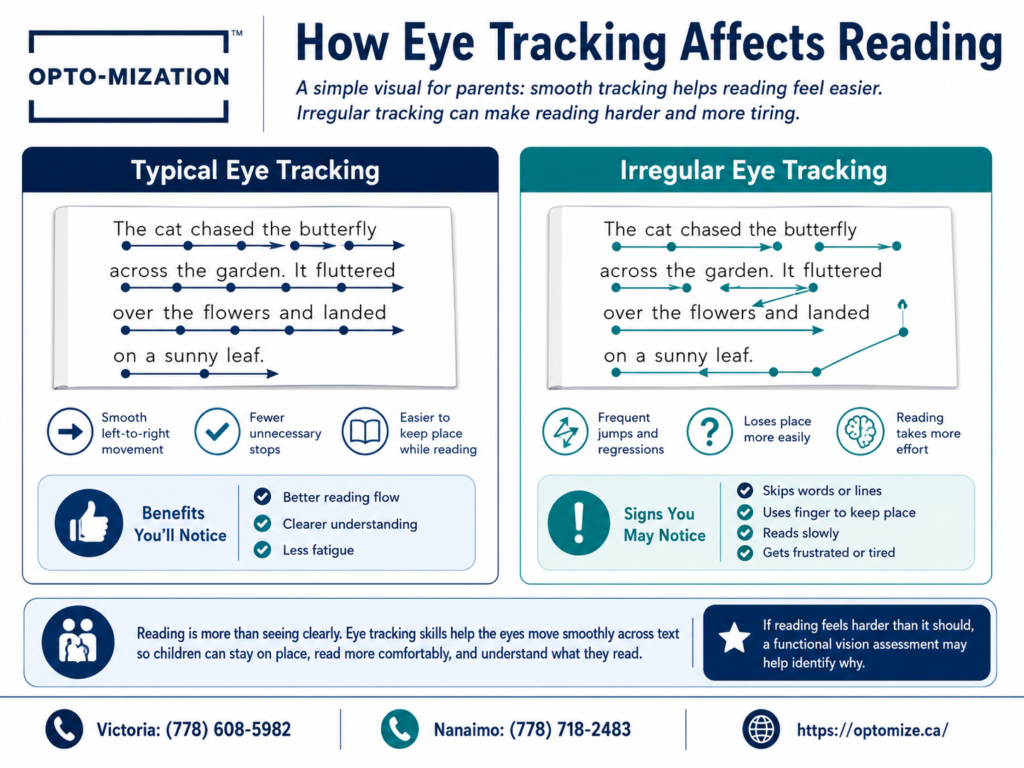
Reading is one of the most demanding visual tasks the human brain performs. The eyes don’t glide smoothly across a line of text. They make a rapid series of small, precise jumps called saccades, pausing briefly at each word or cluster of words. Between lines, both eyes must coordinate to return accurately to the start of the next line.
For this system to work, several visual skills need to function in sync. If any one of them is underdeveloped or inconsistent, reading becomes unpredictable and tiring. The child may not be able to explain what’s wrong. From their perspective, reading just feels hard.
The Three Visual Skills Most Linked to Losing Your Place
| Visual Skill | What It Does | What Happens When It’s Weak |
| Saccadic Eye Movement | Controls precise jumping movement across text | Child skips words, loses their place, or re-reads lines |
| Convergence / Eye Teaming | Keeps both eyes aimed at the same point up close | Words appear to blur, move, or double; child loses focus quickly |
| Visual Accommodation | Adjusts focus as eyes move from word to word | Text becomes temporarily blurry; child slows down or stops |
Understanding how eye teaming and depth perception affect reading success is one of the most important things parents can do before concluding that a reading struggle is purely academic.
Common Signs Your Child May Have a Tracking or Teaming Problem
Children rarely say “my eyes aren’t working together.” They describe their experience in much simpler terms, or they don’t describe it at all. They just stop wanting to read.
- Loses their place frequently, even mid-sentence
- Uses a finger, pencil, or ruler to stay on the line
- Skips lines or re-reads the same line without realizing it
- Reads slowly despite knowing all the words
- Complains of headaches or tired eyes after short reading sessions
- Covers one eye or tilts their head when reading
- Avoids reading or becomes frustrated quickly
- Performs better when text is larger or lines are wider apart
Any combination of these signs is worth taking seriously. This is especially true if the child reads well orally when someone else points to the words, but struggles independently.
Could It Be Something Other Than Vision?
Vision is one of the most common and most overlooked causes, but it isn’t the only possible explanation. A thorough approach means considering a few overlapping factors.
| Possible Cause | Overlapping Signs | Key Distinction |
| Functional Vision Problem | Loses place, avoids reading, inattentive during reading tasks | Passes 20/20 test; symptoms worsen with longer reading sessions |
| ADHD | Difficulty sustaining focus, restlessness, impulsivity | Attention difficulties appear across many tasks, not just reading |
| Dyslexia | Letter reversals, slow decoding, struggles with phonics | Difficulty sounding out words even when tracking is supported |
| Anxiety or Avoidance | Refuses to read aloud, cries or shuts down, emotional responses | Often secondary to an unresolved underlying difficulty |
Vision problems and other learning differences can and do co-exist. Identifying a functional vision issue doesn’t rule out dyslexia or ADHD. It does mean that one piece of the puzzle can be treated directly, which sometimes changes the entire picture.
If your child avoids reading even though they know the words, the avoidance itself is often a signal that reading is physically uncomfortable, not just difficult.
What a Developmental Vision Assessment Looks At
A standard optometry exam answers one question: can your child see clearly? A developmental vision assessment goes significantly further.
- Visual Acuity: Confirms whether distance and near vision are clear at both ranges.
- Eye Tracking (Saccades): Tests how accurately and efficiently the eyes move across a line of text in both directions.
- Eye Teaming (Vergence): Evaluates whether both eyes converge and diverge consistently at reading distance.
- Accommodation: Checks whether the eyes can sustain focus and shift it quickly without blurring.
- Visual Perception: Assesses how the brain processes and makes sense of what the eyes see.
- Visual Memory and Processing Speed: Looks at how efficiently visual information is stored and retrieved during reading tasks.
This kind of evaluation gives parents a clear and specific picture of what’s working, what isn’t, and what kind of support would actually help.
Research suggests that a significant percentage of children with reading difficulties have an underlying functional vision problem that was not identified during routine school screenings. Many of these children are referred to reading specialists or assessed for learning disabilities before vision is evaluated as a contributing factor.
Common Mistakes Parents Make When This Problem Shows Up
- Assuming the school eye screening was thorough enough. School screenings are valuable but limited. They are not designed to catch tracking or teaming problems.
- Increasing reading practice without investigating the cause. Pushing a child to read more when the underlying problem is visual can increase frustration and avoidance without producing improvement.
- Waiting to see if they grow out of it. Functional vision problems generally don’t resolve on their own. Early intervention tends to produce better outcomes than delayed treatment.
- Attributing all symptoms to ADHD or laziness. Behavioral symptoms during reading tasks often have a physical origin. It’s worth ruling out vision before assuming motivation or attention is the primary issue.
- Skipping the specialist and going straight to tutoring. Academic tutoring helps children learn strategies to cope, but it doesn’t address the visual system that makes reading difficult in the first place.
There’s a useful deeper look at why some children skip words when reading and the vision link parents often miss, which explains how these patterns connect directly to eye movement control.
Studies on convergence insufficiency, one of the most common functional vision conditions in school-age children, indicate that it affects a notable proportion of the school-age population and is associated with reduced reading fluency, comprehension difficulties, and increased symptom load during near-vision tasks.
What Parents Can Do at Home in the Meantime
Home strategies won’t correct a functional vision problem, but they can reduce frustration while a proper assessment is arranged.
- Allow your child to use a finger, bookmark, or reading strip as a tracking aid without discouragement.
- Use larger font sizes or increase line spacing when possible, particularly for homework or independent reading.
- Break reading sessions into shorter intervals with visual rest breaks (looking out a window at a distant point for 20 to 30 seconds).
- Read aloud together, alternating sentences, so your child has regular visual rest while still engaging with the text.
- Reduce visual clutter on the page by covering content below the line being read.
These are supportive measures, not solutions. If the signs described above match your child’s experience, a professional evaluation is the most useful next step.
The 20-20-20 rule, widely recommended by optometrists, suggests that for every 20 minutes of near-vision work, children should look at something at least 20 feet away for 20 seconds to reduce visual fatigue. Consistent application of this approach has been associated with reduced eye strain symptoms in school-age children.

Frequently Asked Questions
Is losing their place a sign of a vision problem even if they have 20/20 eyesight?
Yes. 20/20 eyesight measures sharpness at a distance and tells you nothing about how the eyes move, track, or coordinate during close-up tasks like reading. Children with perfect visual acuity can still have weak saccadic control, convergence insufficiency, or accommodative dysfunction, all of which interfere directly with staying on a line of text. A developmental vision evaluation tests these skills specifically.
Could losing their place be linked to dyslexia or ADHD?
It’s possible, but vision problems can produce nearly identical symptoms and are often missed first. Dyslexia primarily affects phonological processing and decoding, while ADHD affects sustained attention across multiple settings. A child whose difficulty is largely vision-based typically struggles most during reading tasks and reading-adjacent activities, with symptoms that ease when tracking is supported. A proper vision evaluation is a practical early step before or alongside assessments for other conditions.
Why does my child get frustrated or avoid reading aloud?
Reading aloud adds a performance layer to an already difficult task. If a child’s eyes are working inconsistently, they are already managing a high cognitive load just to stay on the line. Adding the pressure of speaking out loud while tracking, decoding, and maintaining comprehension becomes genuinely overwhelming. Avoidance in this context is often a self-protective response to repeated failure or discomfort, not a lack of effort or motivation.
Should I let my child use their finger or a ruler to track words?
Yes, in the short term. Using a physical guide helps a child compensate for weak eye tracking and can reduce frustration significantly. It is not a long-term solution, and it won’t strengthen the underlying visual skill, but it makes reading more manageable while the root cause is being investigated. Some children naturally stop needing it once the underlying problem is addressed; others may continue to find it helpful regardless.
What steps can I take at home to improve their tracking?
Simple activities like following a moving object with the eyes, practicing smooth pursuit by tracking a finger moved slowly across their visual field, or doing near-far focusing exercises (shifting focus between a close object and a distant one) can support the visual system in a gentle way. These are general wellness activities, not clinical treatments. If the problem is significant, vision therapy guided by a developmental optometrist is the appropriate route, not home exercises alone.
Helping Your Child Move Forward
Losing their place while reading isn’t a character flaw, and it’s not always a sign of a learning disability. For many children, it’s a functional vision problem that can be assessed, understood, and treated. The earlier you identify what’s actually happening, the sooner your child gets the right kind of support.
If the signs in this article sound familiar, the most helpful next step is a comprehensive developmental vision assessment with a qualified provider who looks beyond the 20/20 test.
Opto-Mization offers developmental vision assessments designed specifically to evaluate the visual skills that affect learning and reading. To book an assessment or ask questions about your child’s reading challenges, call (778) 608-5982 today. Getting clarity on what’s happening visually can change everything about how your child experiences school and reading.