When an image lingers in your vision after you stop looking at it, you’re experiencing what’s known as a visual afterimage. Most afterimages are a normal result of how photoreceptors in your eyes process light, but persistent or unusual afterimages can point to underlying issues with how your eyes and brain work together, and those deserve a closer look.
You glance at a bright lamp, look away, and there it is, a ghost of the light floating in front of you. Or you stare at a logo, close your eyes, and see its outline in a completely different colour. That experience has a name, it has an explanation, and in most cases it’s completely harmless. But sometimes it’s a signal worth paying attention to.
Key Takeaways
- Afterimages occur when photoreceptors in your eyes become temporarily fatigued from prolonged exposure to a stimulus.
- Short-lived afterimages after looking at bright lights or high-contrast images are a normal part of how vision works.
- Persistent, frequent, or distressing afterimages may indicate a visual processing issue, binocular vision dysfunction, or a neurological concern.
- Afterimages that accompany headaches, dizziness, light sensitivity, or reading difficulty are worth having evaluated by a functional vision specialist.
- A comprehensive functional vision assessment can identify whether your visual system is processing information efficiently or struggling in ways a standard eye exam would miss.
Things You Must Know
1. A Normal Eye Exam Won’t Always Catch This
Standard optometry appointments measure how clearly you see letters on a chart. They don’t assess how your visual system processes, sustains, or recovers from visual stimuli over time. If afterimages are frequent or paired with symptoms like eye strain or headaches, a functional vision evaluation looks at the parts of your visual system that routine testing skips entirely.
2. Afterimages and Palinopsia Are Not the Same Thing
Most people experience brief, normal afterimages. Palinopsia is a different and less common condition where images genuinely persist or recur in a way that is involuntary and disruptive. Palinopsia can be linked to migraines, certain medications, or neurological conditions, and is worth discussing with a healthcare provider. Knowing the difference matters before drawing any conclusions about what you’re experiencing.
3. The Visual System Is More Complex Than Most People Realize
Your brain does an enormous amount of work to interpret, stabilize, and update your visual experience moment to moment. When the eyes and brain aren’t coordinating efficiently, the result can be symptoms that seem unrelated to vision, including difficulty reading, fatigue, motion sensitivity, and yes, unusual visual experiences like lingering images. These functional issues are often entirely treatable.
What Actually Causes an Afterimage?
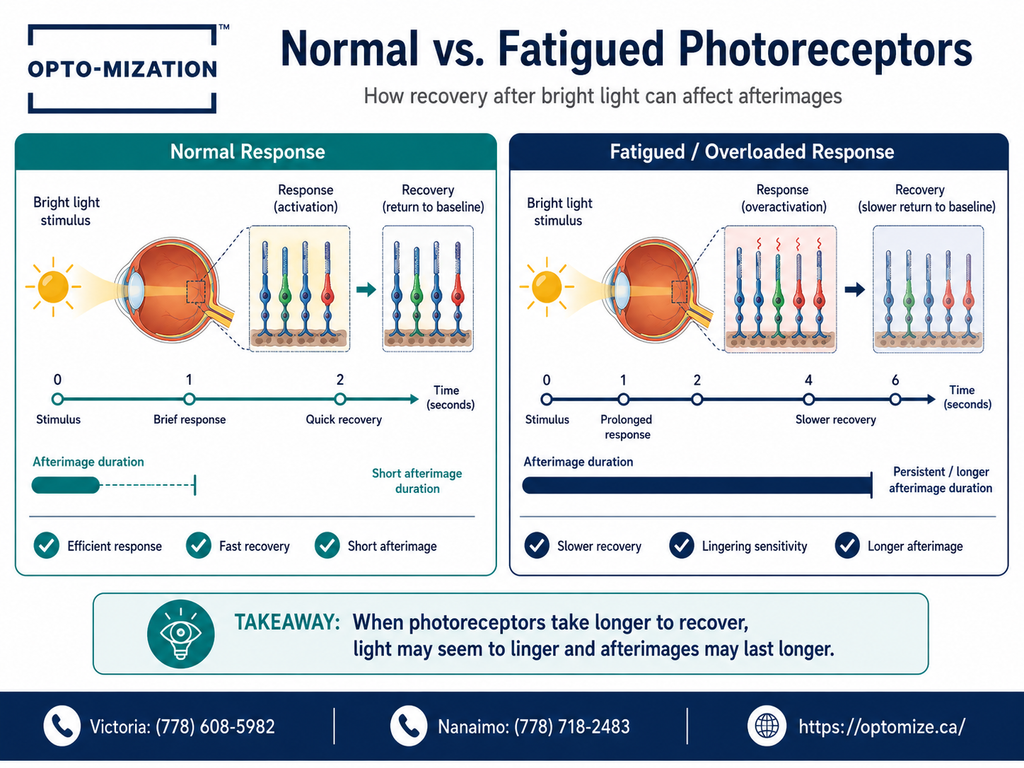
Your retina contains two types of photoreceptors: rods, which handle low-light vision, and cones, which process colour and fine detail. When you stare at something for a sustained period, the cones responding to that particular colour or brightness become fatigued. When you look away, those tired cones temporarily send a weaker signal than the surrounding cones, creating the impression of a reversed or complementary image in your field of view.
This is called a negative afterimage, and it’s the most common type. A bright white light might leave a dark afterimage. A red object might leave a green ghost. These are normal physiological responses and typically fade within seconds.
Positive afterimages, which appear in the same colours as the original stimulus, happen when the visual pathways continue firing briefly after the stimulus is removed. These also fade quickly and are generally harmless.
When Are Afterimages Considered Normal?
Brief afterimages after looking at bright lights, high-contrast images, or vivid colours are a completely expected part of how vision works. You’ve probably noticed them after glancing at the sun, looking at a camera flash, or staring at a bold graphic for too long.
The key word is “brief.” Normal afterimages last a few seconds, sometimes up to a minute if the original exposure was intense. They don’t interfere with your regular vision and they don’t repeat once you’ve looked away from the source.
| Type of Afterimage | Appearance | Typical Duration | Usually a Concern? |
| Negative afterimage | Inverted colours or brightness | Seconds to 1 minute | No (normal) |
| Positive afterimage | Same colours as original | Seconds | No (normal) |
| Persistent afterimage | Any; doesn’t fade quickly | Minutes to hours | Worth evaluating |
| Recurring afterimage | Returns without new stimulus | Variable | Yes, see a specialist |
What If the Afterimage Stays Longer Than It Should?
Persistent afterimages, ones that linger for minutes, reappear without a new visual trigger, or feel intrusive, can have several causes worth taking seriously. These range from visual system inefficiencies to neurological factors.
Visual Fatigue and Screen Exposure
The average person now spends more than seven hours per day looking at screens, and extended screen use has been associated with increased visual fatigue, reduced blink rate, and heightened sensitivity to visual aftereffects. When the visual system is under chronic strain, even normal stimulus recovery can take longer than it should.
If screens regularly leave you with lingering visual impressions or general visual “noise,” it’s a sign your eyes may be working harder than they need to. You can explore more about why screens cause eye discomfort even with regular breaks and what that pattern often signals about visual function.
Binocular Vision Dysfunction
When the two eyes don’t coordinate smoothly, the brain receives slightly misaligned signals and has to work constantly to reconcile them. This added cognitive and visual load can affect how quickly your visual system recovers from stimulation, making afterimages more noticeable or persistent. People with binocular vision issues often also experience headaches, double vision, words moving on a page, and difficulty concentrating.
Light Sensitivity and Visual Stress
Some people have a heightened sensitivity to high-contrast patterns, bright environments, or busy visual scenes. For them, afterimages can feel more intense and last longer than they do for others. If you’ve ever felt overwhelmed by bright lights, patterns, or movement, that experience and persistent afterimages may share a common root in how your visual system processes sensory input.
Post-Concussion and Neurological Factors
Visual processing difficulties are among the most commonly reported and underdiagnosed symptoms following concussion and traumatic brain injury. Changes in how the brain handles visual information after head trauma can make afterimages more frequent, more vivid, or slower to resolve, sometimes months or years after the original injury.
If your visual symptoms appeared or worsened after a head injury, a neuro-optometric evaluation is an appropriate next step rather than waiting to see if things improve on their own.
Symptoms That Suggest This Is More Than a Normal Afterimage
- Most people dismiss afterimages as a minor quirk. These symptoms, however, suggest that something more worth evaluating is going on:
- Afterimages lasting more than a few minutes without an obvious cause like sun exposure
- Visual “echoes” that repeat or return without a new trigger
- Afterimages accompanied by headaches or a sense of visual overwhelm
- Increased difficulty recovering visually after transitioning between light and dark environments
- Afterimages that make reading, screen use, or driving uncomfortable
- Symptoms that have worsened over time or appeared after a head injury
Research into visual processing disorders suggests that symptoms like persistent afterimages, light sensitivity, and visual fatigue often coexist, and that addressing the underlying coordination and processing deficits through structured intervention can reduce all three simultaneously.
How Is This Kind of Visual Problem Assessed?
A standard eye exam is designed to measure visual acuity, check for refractive error, and screen for eye disease. It isn’t designed to evaluate how quickly your visual system recovers from stimulation, how well your eyes coordinate under sustained demand, or how your brain integrates visual information.
A functional vision assessment goes further. At a clinic like Opto-mization in Greater Victoria and Nanaimo, this type of evaluation examines skills including binocular coordination, eye tracking, focusing flexibility, visual processing speed, and how the visual system responds under real-world conditions. If afterimages are a recurring issue for you, this is the level of evaluation most likely to identify why.
| What a Standard Eye Exam Checks | What a Functional Vision Assessment Also Evaluates |
| Visual acuity (20/20) | Binocular coordination and teaming |
| Lens and prescription needs | Eye tracking accuracy and stamina |
| Eye health and disease screening | Visual processing speed and efficiency |
| Basic colour and contrast sensitivity | Recovery from visual fatigue and stimulus |
| Peripheral field screening | Focusing flexibility and convergence |
Common Mistakes People Make When Dealing With Visual Afterimages
- Assuming it’s just tiredness: Fatigue can amplify visual symptoms, but persistent afterimages are usually a signal from the visual system itself, not just the body needing sleep.
- Waiting it out indefinitely: Visual system issues that go unaddressed often worsen over time or lead to compensatory habits that create new problems like headaches, posture changes, or reading avoidance.
- Treating the symptom instead of the cause: Reducing screen brightness or avoiding bright environments manages discomfort but doesn’t address the underlying processing inefficiency.
- Assuming a clear eye exam means there’s no problem: Many functional vision issues produce real, disruptive symptoms despite perfect visual acuity scores. The exam measures sharpness, not how the system coordinates and sustains itself.
- Ignoring the connection to other symptoms: Afterimages that come alongside headaches, dizziness, or reading difficulty aren’t coincidental. These symptoms often share a root cause in how the eyes and brain work together.
If you also notice that your eyes feel like they’re pulling or fighting each other, that sensation and your afterimage experiences may be pointing to the same underlying coordination issue.
What Can Actually Help?
Once the underlying cause is identified, the options are much more targeted. For many people, the path forward involves one or more of the following:
- Functional vision assessment: Establishes a baseline and identifies which specific visual skills are contributing to the problem.
- Precision lens prescribing: In some cases, specialized lenses designed around functional visual needs reduce the demand on the visual system and help recovery happen faster.
- Vision therapy: A structured, personalized program of exercises designed to retrain how the visual system coordinates, tracks, and sustains itself. Opto-mization offers vision therapy programs built specifically around each patient’s functional profile.
- Neuro-optometric rehabilitation: For patients with post-concussion symptoms or neurological involvement, a targeted rehabilitation approach addresses the brain-vision connection directly.
- Environmental and lifestyle adjustments: Specific guidance on lighting, screen habits, and activity modifications can complement treatment and reduce symptom frequency in the meantime.
Studies on vision therapy outcomes for binocular vision dysfunction report meaningful reductions in symptoms including visual fatigue, light sensitivity, and sustained discomfort with reading and screen use, with many patients experiencing significant improvement within a structured treatment period.
Frequently Asked Questions
What could be causing me to see images after looking away?
The most common cause is photoreceptor fatigue, where the cone cells in your retina become temporarily overstimulated by a colour or brightness level and send a weaker signal when you shift your gaze. This produces a brief, complementary afterimage. When afterimages are persistent, frequent, or more intense than expected, contributing factors can include binocular vision dysfunction, visual processing inefficiency, light sensitivity, post-concussion visual changes, or prolonged screen exposure that has overworked the visual system.
Why do I see an afterimage when I close my eyes?
Closing your eyes removes external visual input, which actually makes afterimages easier to notice because there’s no competing visual scene to mask them. The photoreceptors that were stimulated continue sending residual signals for a short time after the stimulus is gone, and those signals are interpreted by your brain as a faint image. This is normal for brief periods. If you regularly see distinct images or patterns when you close your eyes that don’t quickly fade, that’s worth mentioning to a vision specialist.
How long do afterimages last?
Normal afterimages from everyday visual exposure typically fade within a few seconds. Afterimages from very bright or intense stimuli, like a camera flash or direct sun exposure, can last up to a minute or slightly longer. Afterimages that persist beyond a few minutes without an obvious intense stimulus, or that return without a new trigger, fall outside the expected range and are worth having evaluated. Duration on its own doesn’t diagnose a problem, but it’s a useful indicator of how efficiently your visual system is recovering.
How do you get rid of an afterimage?
For normal afterimages, the most effective approach is simply to look around at a varied, moderately lit scene rather than staring at a blank surface, which can actually prolong the effect. Blinking helps reset the visual signal. For afterimages linked to an underlying visual processing issue, reducing symptoms in the moment is less meaningful than addressing the root cause. A functional vision assessment can determine whether there’s a treatable reason your visual system is producing afterimages more intensely or frequently than it should.
Why won’t my afterimage go away?
An afterimage that doesn’t resolve in a reasonable timeframe can reflect a few different things: the original stimulus was unusually intense (like prolonged sun exposure), your visual system is under significant fatigue, or there’s an underlying issue with how your visual cortex or binocular system is processing and clearing the signal. Conditions like palinopsia, which involves genuinely persistent or recurring image traces, can be associated with migraines, certain medications, or neurological changes. If this is happening regularly, a thorough functional vision evaluation and, if appropriate, a referral for neurological assessment is the right path forward.
The Visual System Does More Than See Clearly
Afterimages are a window into something most people never think about: the visual system is an active, dynamic process, not just a camera. The way your eyes and brain recover from stimulation, coordinate with each other, and sustain performance over time directly affects how comfortable and functional your daily visual experience is.
When that system is running well, you don’t notice it. When it’s struggling, the signals can show up as symptoms that seem minor until they start affecting your reading, your work, your driving, or your sense of wellbeing.
If you’re in Greater Victoria or Nanaimo and you’ve been brushing off visual experiences like persistent afterimages, frequent eye strain, or light sensitivity as “just how my eyes are,” it’s worth getting a proper picture of what’s actually going on. Opto-mization offers comprehensive functional vision assessments that go well beyond what a standard eye exam covers. The goal isn’t just to confirm your eyes are healthy. It’s to understand whether your visual system is performing the way it should, and to do something about it if it isn’t.
Book a functional vision assessment at Opto-mization and find out what your visual system is actually capable of. Visit Opto-mization’s functional eye exam page to learn what the evaluation involves and how to get started.