
Missing things in your side vision, also called peripheral vision loss, can result from eye health conditions like glaucoma, but it can also stem from how your eyes and brain work together. Functional vision problems affecting eye tracking, binocular coordination, and visual processing are often missed by standard eye exams and may be the root cause of symptoms you’ve been living with for years.
You reach for something just outside your direct line of sight and miss it. You bump into doorframes. You don’t notice a car pulling out from a side street until it’s almost too late. Your peripheral vision, the vision you rely on constantly without thinking about it, feels unreliable.
For many people in Victoria and Nanaimo, this experience gets dismissed as clumsiness or aging. But peripheral vision issues often point to something more specific, and sometimes more treatable, than most people realize.
Key Takeaways
- Peripheral vision loss has multiple causes, ranging from eye health conditions to how the eyes and brain communicate.
- Functional vision problems (not just eyesight problems) are a common and frequently missed cause of side vision difficulties.
- Standard eye exams measure visual clarity but don’t always assess how the eyes coordinate, track, or process visual information.
- Children who miss things while reading, skip lines, or seem inattentive may have a functional peripheral vision issue, not an attention disorder.
- A comprehensive functional vision assessment can identify problems that traditional optometry often overlooks.
- Many functional peripheral vision problems respond well to vision therapy and specialized lens prescribing.
Things You Must Know
1. Passing a Standard Eye Exam Doesn’t Rule Out a Vision Problem
Many people who struggle with peripheral awareness have 20/20 visual acuity on a standard eye chart. Traditional eye exams are excellent at measuring how clearly you see straight ahead, but they rarely evaluate eye tracking, binocular coordination, or visual processing, all of which directly affect how well your visual system handles peripheral information. If you’ve been told your eyes are “fine” but you’re still missing things in your side vision, a functional vision evaluation is the appropriate next step.
2. Peripheral Vision Problems Affect More Than Driving and Sports
Most people associate peripheral vision with driving or catching a ball. But your visual periphery is also active while reading (your eyes use it to track where the next word is), while walking through a crowd, while navigating a busy classroom, and even while maintaining balance. Children who seem clumsy, skip lines while reading, or appear distracted may be struggling with how their visual system processes peripheral input, not necessarily with their eyesight.
3. Not Every Cause Is an Emergency, but Some Are
Sudden peripheral vision loss, flashing lights, or a shadow appearing at the edge of your vision can indicate a retinal detachment or other urgent medical condition that requires immediate attention. However, gradual, long-standing difficulty noticing things in your side vision is more often related to functional vision issues that develop slowly and are easy to miss. When in doubt, a professional assessment can help determine which category your symptoms fall into.
What Is Peripheral Vision, and Why Does It Matter?
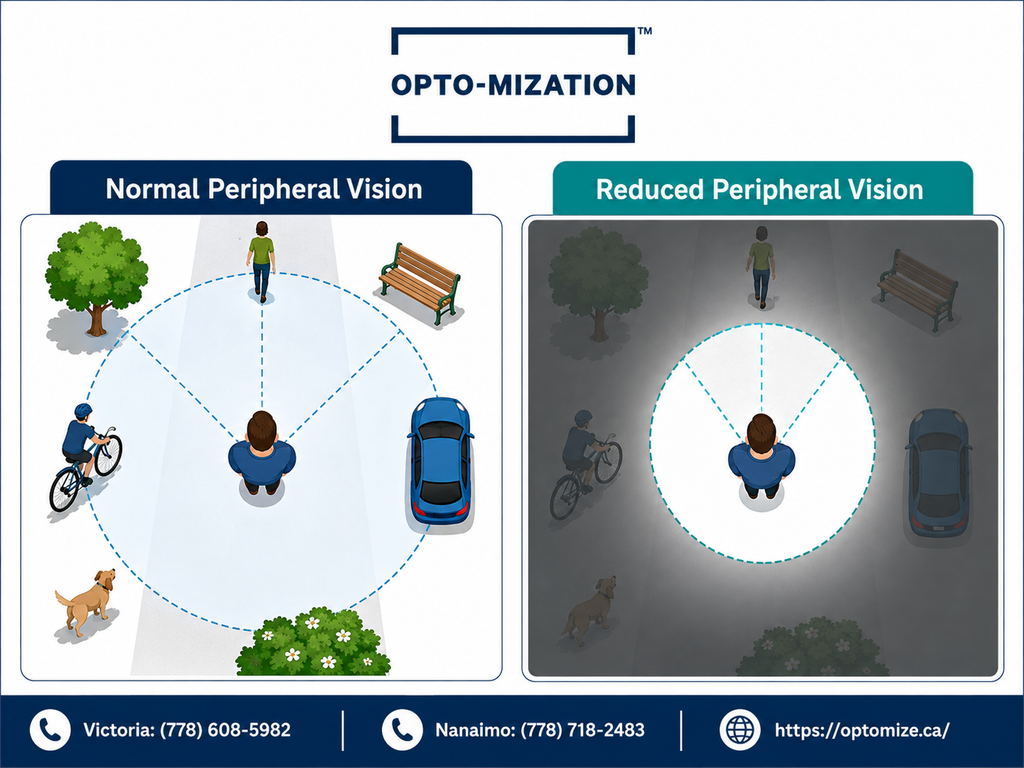
Peripheral vision is everything you can see outside your direct point of focus. It spans roughly 180 degrees in healthy vision and handles a surprising range of tasks: detecting movement, maintaining spatial awareness, guiding balance, and giving the visual system context for what you’re looking at directly.
Unlike central vision, which is high-resolution and color-sensitive, peripheral vision is more motion-sensitive and lower in fine detail. Your brain relies on it constantly, often without you noticing, until it starts failing.
When the peripheral system breaks down, the effects show up in unexpected places: difficulty reading a full line of text, missing items on a shelf just to the left or right, failing to see a pedestrian stepping off the curb, or feeling visually overwhelmed in busy environments.
What Causes Peripheral Vision Loss?
There are two broad categories worth understanding: structural eye health conditions and functional vision problems. Both can produce similar symptoms, and both deserve proper evaluation.
Structural Eye Health Causes
Glaucoma is one of the most common causes of gradual peripheral vision loss. It damages the optic nerve over time, often without pain or noticeable symptoms in the early stages, and is estimated to affect over 80 million people worldwide. Regular eye pressure checks and optic nerve assessments are the standard screening tools.
Retinal conditions, including retinal detachment and retinal artery occlusion, can also reduce peripheral visual field, sometimes acutely. Neurological events like stroke or traumatic brain injury can damage the visual pathways between the eye and brain, creating predictable patterns of field loss depending on where the injury occurred.
Functional Vision Causes
This is where many people’s symptoms fall, and where they most often go undiagnosed. Functional vision problems don’t involve damage to eye structures. Instead, they reflect how the eyes and brain work together to process visual information. The eyes may be healthy, but the system isn’t functioning as it should.
Common functional causes of peripheral awareness problems include:
- Binocular vision dysfunction: When the two eyes don’t coordinate properly, the brain may suppress information from one eye, effectively narrowing the usable visual field.
- Reduced visual attention span: The visual system processes a narrower slice of information than it should, making peripheral details easy to miss even when the peripheral retina is structurally intact.
- Poor peripheral awareness from underdeveloped visual processing: Some individuals, particularly children, never fully develop the visual processing skills needed to integrate peripheral input effectively.
- Post-concussion visual changes: Brain injuries can disrupt how the brain processes signals from the eyes, often producing narrowed or unreliable peripheral awareness that standard eye exams don’t capture.
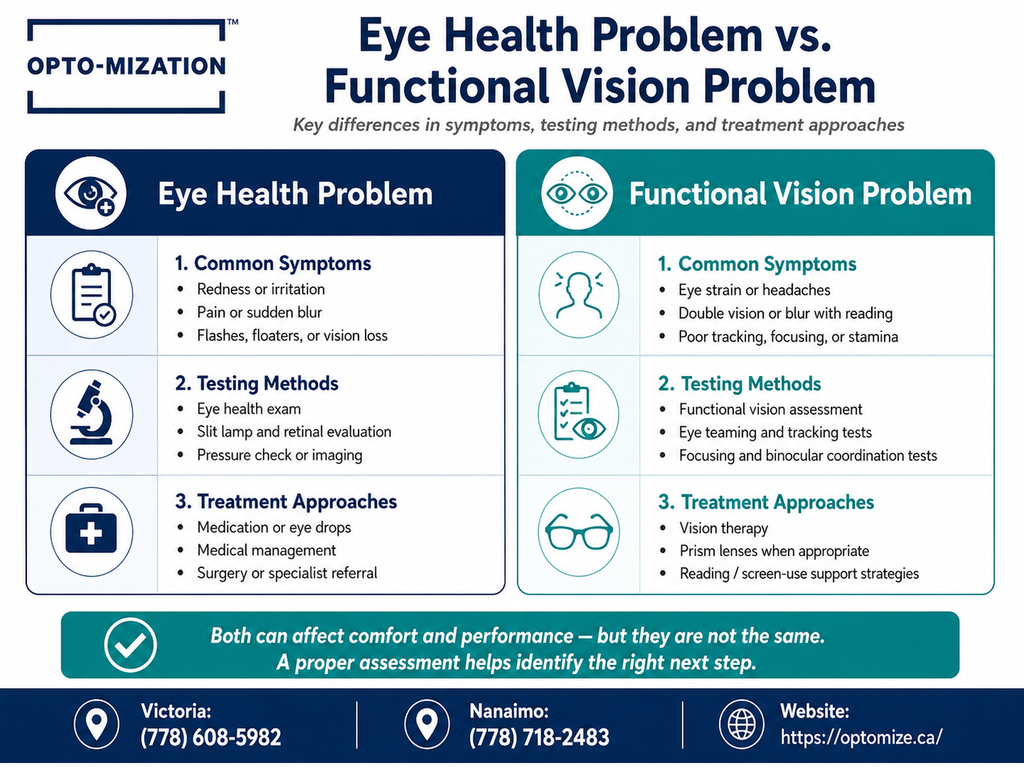
How Structural and Functional Problems Compare
| Feature | Structural Eye Condition | Functional Vision Problem |
| Detected by standard exam? | Often yes | Rarely |
| Affects visual clarity? | Sometimes | Not always |
| May cause headaches or fatigue? | Less common | Very common |
| Treatable with vision therapy? | No | Often yes |
| Linked to learning or attention issues? | Rarely | Frequently |
| Improves with glasses alone? | Depends on condition | Sometimes, with specialized lenses |
Who Is Most Likely to Experience This?
Peripheral vision problems show up across all age groups, but the causes and contexts differ.
Children and Students
Research suggests that a significant percentage of children diagnosed with attention difficulties also have undetected vision problems affecting how they process visual input. A child who loses their place while reading, skips words, or misses things on the left or right side of their visual field during schoolwork may have a functional peripheral vision issue rather than, or in addition to, an attention disorder.
These children are often bright and capable. They’re not struggling because they’re not trying. Their visual system simply isn’t giving the brain what it needs to work efficiently.
Adults with Demanding Visual Workloads
Professionals who spend extended hours at screens, in visually complex environments, or doing precision work are more likely to notice peripheral vision fatigue. This can show up as missing things at the edges of computer monitors, feeling overwhelmed in busy spaces, or becoming noticeably worse at spatial tasks as the day progresses.
Seniors
As the visual system ages, peripheral processing naturally slows. But there’s a difference between age-related change and functional deterioration that can be addressed. Seniors experiencing falls, reduced confidence while driving, or difficulty in busy environments may benefit from a full functional assessment rather than a prescription update alone.
Concussion Survivors
Post-concussion vision problems, including reduced peripheral awareness, are among the most commonly reported and least-treated symptoms following a head injury. Studies indicate that visual dysfunction affects a majority of concussion patients, yet many are discharged from care without any vision-specific evaluation.

What the Assessment Process Looks Like
Understanding what to expect from a functional vision evaluation makes the process less intimidating and helps you prepare for a more productive appointment.
- Case history review: The clinician gathers information about your symptoms, medical history, and how your vision difficulties affect daily life. This context shapes which tests are prioritized.
- Standard visual acuity testing: Baseline clarity measurements establish whether there’s a refractive issue (nearsightedness, farsightedness, or astigmatism) contributing to your symptoms.
- Visual field testing: Specific tests map the full extent of your peripheral vision and identify any areas of loss or suppression.
- Binocular vision assessment: The examiner evaluates how well your two eyes work as a team, including eye alignment, convergence, and whether one eye’s input is being suppressed by the brain.
- Eye tracking evaluation: Tests measure how accurately and efficiently your eyes move across a visual scene, including in the periphery.
- Visual processing assessment: Higher-level tests evaluate how the brain interprets the information the eyes are sending, including peripheral spatial awareness.
- Findings review and treatment planning: Results are discussed with you directly, and a personalized plan is developed based on what the evaluation revealed.
For a detailed overview of what’s involved, the guide to how to prepare for a functional eye exam walks through what patients can expect before and during the appointment.
What Treatment Options Are Available?
Treatment depends entirely on what the assessment identifies. There is no single fix for peripheral vision problems because the causes vary significantly.
| Treatment Type | Best For | How It Helps |
| Vision Therapy | Functional vision problems, binocular issues, post-concussion | Retrains visual processing and eye coordination through structured exercises |
| Prism Lenses | Binocular vision dysfunction, misalignment | Adjusts how light enters the eye to reduce the strain of compensation |
| Functional Prescription Update | Refractive errors contributing to visual fatigue | Reduces the effort required to maintain clear vision across the visual field |
| Neuro Vision Rehabilitation | Concussion, brain injury, neurological conditions | Rebuilds the visual-neurological pathways disrupted by injury |
If vision therapy is recommended, a common follow-up question is how long the process takes. The answer depends on the severity and type of dysfunction, and the article on how long vision therapy takes provides practical context for setting expectations.
Common Mistakes People Make When Dealing with Peripheral Vision Problems
- Waiting too long: Many people adapt to reduced peripheral awareness over time, not realizing it’s affecting their safety, performance, or quality of life. The longer a functional problem goes unaddressed, the more ingrained the compensations become.
- Assuming glasses will fix it: Standard glasses correct refractive errors. They don’t address how the eyes coordinate or how the brain processes peripheral visual input. A prescription update may not touch the underlying problem.
- Attributing symptoms to aging or stress: While both can affect vision, peripheral awareness problems are not a normal or inevitable part of getting older. Many are highly treatable with the right assessment and plan.
- Dismissing a child’s symptoms as behavioral: Children rarely say “my peripheral vision isn’t working.” They act out, avoid reading, seem clumsy, or get labelled inattentive. A functional vision problem is worth ruling out before, or alongside, other evaluations.
- Skipping the evaluation because standard tests came back normal: Normal visual acuity does not mean normal visual function. The two things measure very different aspects of how the visual system works.
Some estimates suggest that up to 80% of learning in a classroom environment is visually mediated. Children with undetected functional vision problems, including those affecting peripheral processing, may be operating at a significant disadvantage despite having eyesight that tests within the normal range on a standard school screening.
Frequently Asked Questions
Why do I keep seeing things in my peripheral vision that aren’t there?
Seeing movement, shadows, or flashes in the peripheral field that aren’t there can have several causes. Photopsia (flashes of light) may result from vitreous pulling on the retina and should be evaluated promptly, as it can precede retinal detachment. Persistent peripheral movement sensations that aren’t flashes are more often connected to visual processing irregularities or binocular vision instability, where the brain is receiving slightly inconsistent signals from the two eyes and interpreting them as movement. A functional vision assessment can help determine which type of issue is driving the experience.
Why do objects disappear from your vision?
Objects can seem to disappear from peripheral vision for two primary reasons. First, if there is a visual field defect (from glaucoma, retinal damage, or a neurological cause), that area of the visual field simply isn’t being received by the brain. Second, with binocular suppression, the brain actively ignores input from one eye to resolve conflicting signals, creating a functional “blind zone” even though the eye itself is healthy. Both can be identified through proper visual field and binocular vision testing.
Why am I losing my side vision?
Gradual peripheral vision loss is most commonly associated with glaucoma, which damages the optic nerve progressively and is often painless in its early stages. Other causes include retinal disease, neurological conditions, and certain medications. However, what many people describe as “losing” side vision can also reflect a gradual decline in functional visual awareness, particularly in people experiencing concussion effects, binocular vision deterioration, or visual processing fatigue. The distinction matters because the treatment paths are very different. Getting a thorough comprehensive eye exam is the right starting point for understanding what’s happening.
Why am I seeing spots in my peripheral vision?
Floaters, which appear as spots, threads, or cobweb-like shapes drifting in peripheral vision, are usually the result of changes in the vitreous gel inside the eye and are common, especially after age 40. A sudden increase in floaters, particularly when accompanied by flashes of light or a shadow in the visual field, warrants urgent assessment as it may signal a retinal tear or detachment. Spots that appear more as visual disturbances or flickering, rather than floating debris, can be associated with ocular migraines or visual processing irregularities.
What are the first signs of an eye stroke?
An eye stroke (retinal artery or vein occlusion) typically presents as a sudden, painless loss of vision in one eye. This may appear as a dark curtain, shadow, or complete blackout affecting part or all of the visual field. Unlike migraines, which often involve flickering or zigzag patterns that resolve within 20 to 60 minutes, an eye stroke causes persistent vision loss that does not recover on its own. This is a medical emergency. Anyone experiencing sudden, unexplained vision loss should seek urgent care immediately, not wait for a scheduled appointment.
Conclusion
Peripheral vision problems are easy to overlook, largely because they develop gradually and because the most obvious explanation, “my eyes must be getting worse,” doesn’t always point people in the right direction.
If you’ve been missing things at the edges of your vision, bumping into objects, losing your place while reading, or feeling visually overwhelmed in busy environments, the answer may not be a stronger prescription. It may be a more thorough look at how your eyes and brain work together.
That’s exactly what a functional vision assessment is designed to uncover. At Opto-mization, serving Greater Victoria and Nanaimo, the evaluation process goes well beyond visual acuity to examine eye tracking, binocular coordination, visual processing, and peripheral awareness, identifying the root cause rather than just adjusting the prescription. The practice also offers a satisfaction guarantee, so you can invest in the process knowing the commitment to your outcome is genuine.
If you’re ready to find out what’s actually happening with your side vision, book a functional vision assessment at Opto-mization. The first step is getting a clear picture of what’s going on.
Visit optomize.ca to book your functional vision assessment in Victoria or Nanaimo.