
Many adults dealing with chronic dizziness or poor balance spend months seeing specialists, ruling out inner ear problems and blood pressure issues, without ever getting a clear answer. A surprisingly common but frequently overlooked cause sits in the visual system: when the eyes and brain struggle to coordinate properly, the result can be persistent dizziness, unsteadiness, and a feeling that something is always slightly “off.” Addressing the visual component of balance can change outcomes for people who have not responded to other treatments.
Key Takeaways
- The visual system contributes directly to balance, working alongside the inner ear and body’s sense of position to keep you steady.
- Binocular vision dysfunction, poor eye tracking, and visual processing problems can all trigger dizziness and balance issues in adults.
- Standard eye exams typically check visual acuity, not the functional visual skills responsible for balance and spatial awareness.
- Symptoms like dizziness in grocery stores, motion sensitivity, and feeling overwhelmed by busy visual environments are often linked to the eyes.
- A functional vision assessment can identify visual causes that routine medical workups miss, offering a path to treatment.
- Vision therapy and specialized lens prescriptions can reduce or resolve vision-driven dizziness in many adults.
Things You Must Know
1. A Normal Eye Exam Does Not Rule Out a Visual Cause
Standard optometry appointments measure how clearly you see letters on a chart, which says nothing about how well your two eyes coordinate, track moving objects, or orient your body in space. Adults with 20/20 acuity can still have significant binocular vision dysfunction that produces daily dizziness. If a doctor has told you your eyes are “fine” but dizziness persists, a functional vision assessment covers the skills a routine exam does not reach.
2. Vestibular and Visual Systems Share the Job of Balance
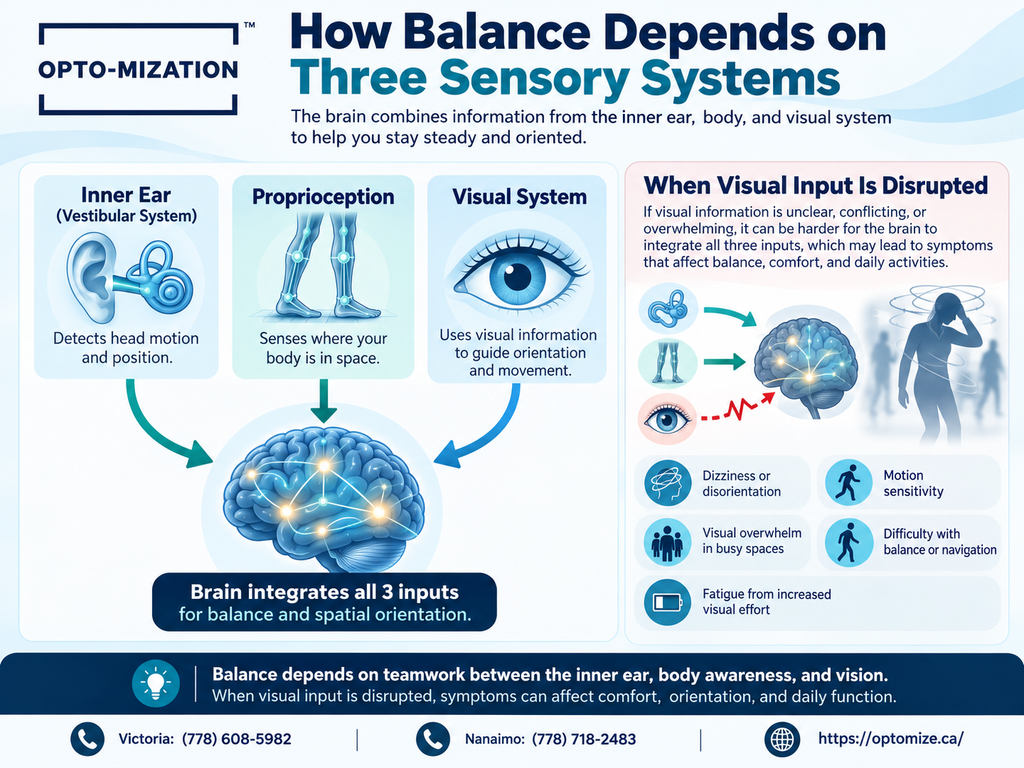
Your brain triangulates your position in space using three inputs: the inner ear (vestibular), proprioception from joints and muscles, and visual information from the eyes. When the visual input is unreliable or conflicting, the brain cannot reconcile all three signals and dizziness follows. This is why treating only the inner ear often produces partial results for people whose visual system is also contributing to the problem.
3. Symptoms Often Appear in Specific Environments
Vision-related dizziness tends to worsen in visually demanding situations: busy grocery stores, scrolling on a phone, driving on highways with passing traffic, or walking through patterned flooring. If your dizziness follows this pattern rather than occurring randomly, visual dysfunction is worth investigating. This symptom profile is distinct enough that functional vision specialists recognize it as a common presentation.

How the Visual System Affects Balance
Balance is not a single system working alone. The brain constantly receives signals from the inner ear, from stretch receptors in muscles and joints, and from the eyes. Each system feeds the brain real-time data about where the body is in space and how it is moving relative to its environment.
The visual system carries a significant share of that load. When both eyes point at the same location accurately and the brain fuses those two images into one stable picture, the result is reliable spatial information. When one eye drifts, when the two eyes struggle to converge or diverge properly, or when tracking breaks down, the spatial picture becomes inconsistent. The brain registers that inconsistency as instability and produces the sensation of dizziness or unsteadiness.
Binocular Vision Dysfunction and Dizziness
Binocular vision dysfunction (BVD) is a condition in which the two eyes do not align precisely enough to give the brain a single, stable image. The misalignment can be subtle, far smaller than what produces visible eye turns, but the brain’s effort to compensate for even minor misalignment creates significant strain.
Common symptoms of BVD-related dizziness include a persistent sensation of tilting or swaying, difficulty walking in low-light conditions, and feeling unsteady when turning the head. These overlap heavily with vestibular disorders, which is part of why BVD frequently goes undiagnosed for years. If you frequently feel dizzy in grocery stores or other visually busy spaces, binocular vision dysfunction is a likely contributor.
Visual Sensitivity and Environmental Overwhelm
Some adults with dizziness and balance problems describe a specific trigger: environments with a great deal of movement, patterned surfaces, or visual clutter. Scrolling through social media, walking through a parking garage, or watching traffic from the passenger seat all provoke symptoms.
This pattern is associated with visual motion sensitivity, a condition in which, according to published research on motion sensitivity, the symptoms are due to a misinterpretation of, or overreliance on, visual cues for orientation in space. When the environment itself is in motion, the brain receives conflicting data and produces dizziness as a result.
This is distinct from inner ear dizziness, which tends to correlate more strongly with head position changes. Recognizing the difference is clinically useful because it points toward the appropriate assessment. You can also explore the related question of why scrolling on a phone causes nausea, which shares the same underlying mechanism.
Common Visual Causes of Dizziness and Balance Problems in Adults
| Visual Condition | How It Affects Balance | Common Symptom Triggers |
| Binocular Vision Dysfunction | Misaligned images create unstable spatial mapping | Head turns, low light, walking on uneven surfaces |
| Convergence Insufficiency | Eyes struggle to hold a single image at near distance | Reading, screen use, close-up tasks |
| Poor Eye Tracking | Unstable gaze control disrupts visual-vestibular matching | Moving traffic, scrolling, busy public spaces |
| Visual Motion Sensitivity | Over-reliance on visual cues produces conflict in moving environments | Grocery stores, escalators, highways, patterned floors |
| Post-Concussion Visual Dysfunction | Brain injury disrupts visual processing and integration | Bright lights, screen use, crowds, any visual demand |
What a Functional Vision Assessment Looks For
A functional eye exam goes considerably further than checking letter clarity. At Opto-mization, the assessment evaluates how the two eyes align under different demands, how smoothly they track moving targets, how quickly they shift focus between near and far distances, and how well the brain integrates visual information with the body’s other balance inputs.
For adults with dizziness and balance complaints, the exam specifically looks at oculomotor control, vergence ranges, and visual-vestibular integration. These measurements require specialized testing protocols and equipment that are not part of a standard annual eye exam. The findings give a clinician a clear picture of whether the visual system is contributing to symptoms and, if so, which specific skills need treatment.
- Binocular alignment testing: Measures how well the two eyes point at the same target across different gaze positions and distances, detecting subtle misalignment that standard cover tests can miss.
- Vergence assessment: Evaluates the eyes’ ability to converge inward for near tasks and diverge for distance, identifying insufficiency or excess that creates visual conflict.
- Eye tracking evaluation: Assesses smooth pursuit (following a moving target) and saccadic accuracy (jumping between fixed targets), both of which affect visual stability in motion.
- Visual processing review: Examines how the brain interprets and makes sense of incoming visual data, including spatial orientation and figure-ground discrimination.
- Visual-vestibular integration screen: Looks at how the visual system coordinates with balance inputs, particularly in dynamic or visually complex environments.
Treatment Options for Vision-Related Dizziness
Treatment depends entirely on what the functional assessment finds. There is no single protocol because the underlying cause varies from person to person. The most common approaches include vision therapy, specialized lens prescriptions, and prism lenses.
| Treatment Approach | Best Suited For | Expected Outcome |
| Vision Therapy | Eye tracking, convergence, visual-vestibular issues | Retrained visual skills; reduced dizziness over weeks to months |
| Prism Lenses | Binocular alignment problems, vertical misalignment | Immediate or near-immediate reduction in symptoms for many patients |
| Functional Prescription Lenses | Visual stress contributing to motion sensitivity | Reduced visual strain and improved spatial comfort |
| Neuro-Optometric Rehabilitation | Post-concussion, acquired brain injury | Gradual restoration of visual processing and balance integration |
Prism lens correction has shown measurable improvements in dizziness for patients with vertical heterophoria. A University of Michigan Health System study found that prismatic eyeglass lenses led to a 71.8 percent reduction of symptoms in patients with vertical heterophoria and traumatic brain injury. Vision therapy programs targeting convergence insufficiency have also demonstrated improvements in binocular function and related symptoms in adults, with office-based therapy consistently outperforming home therapy alone in clinical trials.
Common Mistakes Adults Make When Dealing With Dizziness
- Stopping after one specialist: Dizziness has multiple possible causes, and vestibular specialists, neurologists, and cardiologists rarely assess the visual system. Ruling out their areas of concern does not mean the problem is psychological or untreatable.
- Accepting “your eyes are fine” as a complete answer: Visual acuity and functional vision are different things. Passing a standard eye chart test leaves dozens of visual skills unexamined.
- Attributing all symptoms to anxiety: Visual dizziness can elevate anxiety, and anxiety can worsen visual sensitivity, creating a cycle. Treating only anxiety without addressing a physical visual cause produces limited results.
- Waiting it out for years: Without treatment, the brain often compensates in ways that cause additional problems, including neck tension, poor posture, avoidance of certain environments, and worsening balance over time.
- Overlooking the post-concussion timeline: Visual dysfunction after a concussion can persist for months or years without targeted rehabilitation. Many patients do not realize vision was affected until a functional assessment reveals the full picture.
Frequently Asked Questions
What could be causing my bad balance?
Balance problems in adults can stem from several systems: the inner ear, the nervous system, blood pressure regulation, muscle and joint proprioception, and the visual system. When the visual system fails to send accurate spatial information to the brain, the result is unsteadiness even when the other systems are functioning normally. A functional vision assessment can determine whether your eyes are contributing to the problem, which is a question standard medical workups typically do not address.
How do you treat an off-balance feeling?
Treatment depends on the underlying cause. If vestibular rehab or medication has not resolved the problem, a functional vision evaluation is a logical next step. Visually driven imbalance can respond well to prism lenses, vision therapy, or both, depending on what the assessment finds. For adults with post-concussion symptoms, neuro-optometric rehabilitation is often part of a broader recovery plan. No single treatment covers all causes, which is why accurate diagnosis matters more than starting with any particular intervention.
Is there any medication for balance problems?
Some medications address specific underlying causes, such as vestibular suppressants for acute inner ear episodes or treatments for blood pressure-related dizziness. For functional visual causes of balance problems, medication does not correct the misalignment or processing issues driving the symptoms. Corrective lenses and structured visual rehabilitation address the mechanism directly rather than suppressing the sensation. Consult your physician about any medication questions specific to your situation.
What are possible causes of balance issues when standing still?
Feeling unsteady while stationary is often linked to the visual system because standing still removes movement cues and places greater demand on visual and proprioceptive input. Vertical binocular misalignment is a well-documented cause, where the eyes are not horizontally level and the brain receives conflicting spatial data. Neurological conditions and inner ear issues also contribute, but in many adults with no clear vestibular or neurological finding, visual dysfunction is the remaining explanation worth pursuing.
What vitamins help with balance?
Vitamin D deficiency has been associated with increased fall risk and balance difficulties in older adults, with a systematic review and network meta-analysis finding that vitamin D supplementation at 800–1000 IU per day is associated with a lower risk of falls among older adults with deficiency. Some research also links low B12 levels to neurological symptoms including dizziness and unsteadiness. Magnesium plays a role in nerve function and may support vestibular health in some individuals. That said, supplementation addresses nutritional deficiencies rather than structural or functional causes. If your balance problems persist despite adequate nutrition, the cause is unlikely to be resolved through vitamins alone.
When Vision Is the Answer You Have Not Found Yet
Adults living with chronic dizziness and balance problems deserve a thorough explanation, not a referral loop that circles back to “we can’t find anything wrong.” For a meaningful portion of these patients, the visual system is the missing piece: a functional skill that nobody has measured, contributing to symptoms that affect every part of daily life.
Opto-mization serves adults throughout Greater Victoria and Nanaimo with comprehensive functional vision assessments designed to find exactly this kind of problem. The evaluation goes well beyond a standard exam to assess the visual skills that drive balance, spatial orientation, and comfort in complex environments. If dizziness or unsteadiness is limiting your confidence, your mobility, or your quality of life, a functional eye exam for adults is the right place to start.
Book a functional vision assessment with Opto-mization today. Many patients describe the experience as the first time someone looked for the right thing.