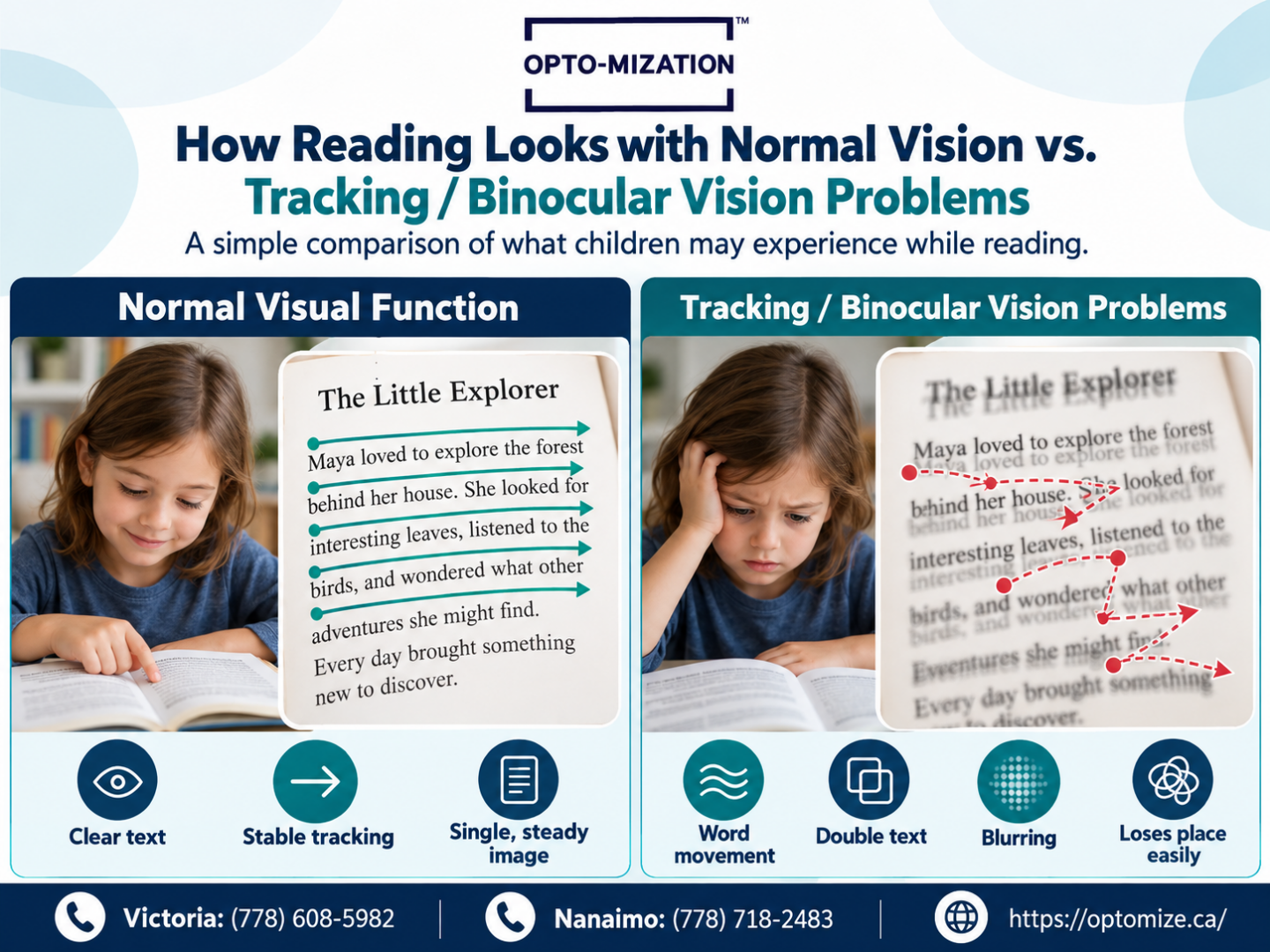
A child can have 20/20 eyesight and still struggle to read, focus, or sit through a school day without headaches. Pediatric eye exams in Victoria cover far more than whether your child needs glasses — a thorough evaluation looks at how the eyes and brain coordinate, process, and sustain visual attention. For parents noticing signs like avoidance of reading, skipped lines, or complaints about blurry words, a standard vision screening at school or a walk-in clinic often won’t catch the underlying issue.
Key Takeaways
- Children should have their first comprehensive eye exam at 6 months, again at age 3, and then annually from age 5 onward.
- School vision screenings only test visual acuity — they do not assess eye teaming, tracking, or focusing stamina.
- In BC, children under 19 are covered for annual eye exams through BC MSP.
- Many learning difficulties, attention struggles, and reading problems trace back to functional vision issues that a standard exam misses.
- Signs like head tilting, skipping lines, avoiding books, or messy handwriting can all indicate a vision problem worth investigating.
- A functional vision assessment evaluates how the eyes and brain work together, not just how clearly a child can see a chart.
Things You Must Know
1. Passing a School Screening Is Not the Same as a Clear Eye Exam
School vision screenings check whether a child can read letters from a set distance. They do not test how well the eyes move across a page, how the brain interprets visual information, or whether both eyes coordinate effectively. A child can pass every school screening and still have a vision-based learning difficulty that goes undetected for years. If your child struggles academically or avoids reading despite appearing capable, an in-office pediatric eye exam is the appropriate next step.
2. Functional Vision Problems Often Look Like Attention or Learning Disorders
Symptoms of binocular vision dysfunction and eye tracking problems overlap significantly with ADHD and dyslexia. Children who lose their place while reading, reverse letters frequently, or fatigue quickly during close work are sometimes referred for learning support before anyone checks their visual function. Getting a comprehensive functional vision assessment early can either confirm or rule out vision as a contributing factor, which shapes the entire treatment plan.
3. Age Matters More Than Most Parents Realize
The visual system develops most rapidly between birth and age 8. Problems identified and treated during this window tend to respond better because the brain retains greater neuroplasticity. Amblyopia (lazy eye) and binocular vision problems are significantly easier to correct before age 10. Waiting until a child “seems old enough to sit through an exam” means missing the period when intervention is most effective.
What Does a Pediatric Eye Exam Actually Cover?
A standard pediatric eye exam checks visual acuity, eye health, and basic refractive error (nearsightedness, farsightedness, astigmatism). These are important baseline measures. A functional pediatric eye exam goes several steps further and evaluates the skills the visual system needs for learning and sustained attention.
| Area Tested | Standard Exam | Functional Exam |
| Visual Acuity (clarity) | Yes | Yes |
| Eye Health | Yes | Yes |
| Refractive Error | Yes | Yes |
| Eye Teaming (binocular vision) | Partial | Comprehensive |
| Eye Tracking | Rarely | Yes |
| Focusing Stamina | Rarely | Yes |
| Visual Processing | No | Yes |
| Reading Vision Assessment | No | Yes |
The difference between exam types is substantial for children whose symptoms relate to sustained close work, reading endurance, or classroom attention.
Warning Signs Parents in Victoria Commonly Overlook
Children rarely say their vision hurts. They don’t have a reference point for what comfortable reading feels like, so they tend to avoid the activity rather than report the discomfort. The behavioral signs are usually the first thing parents and teachers notice.
According to the American Optometric Association, approximately 1 in 4 children has a vision problem significant enough to interfere with learning, yet the majority go undetected through standard screening alone.
Watch for these patterns across different settings:
- Avoiding books or asking to stop reading after a short period
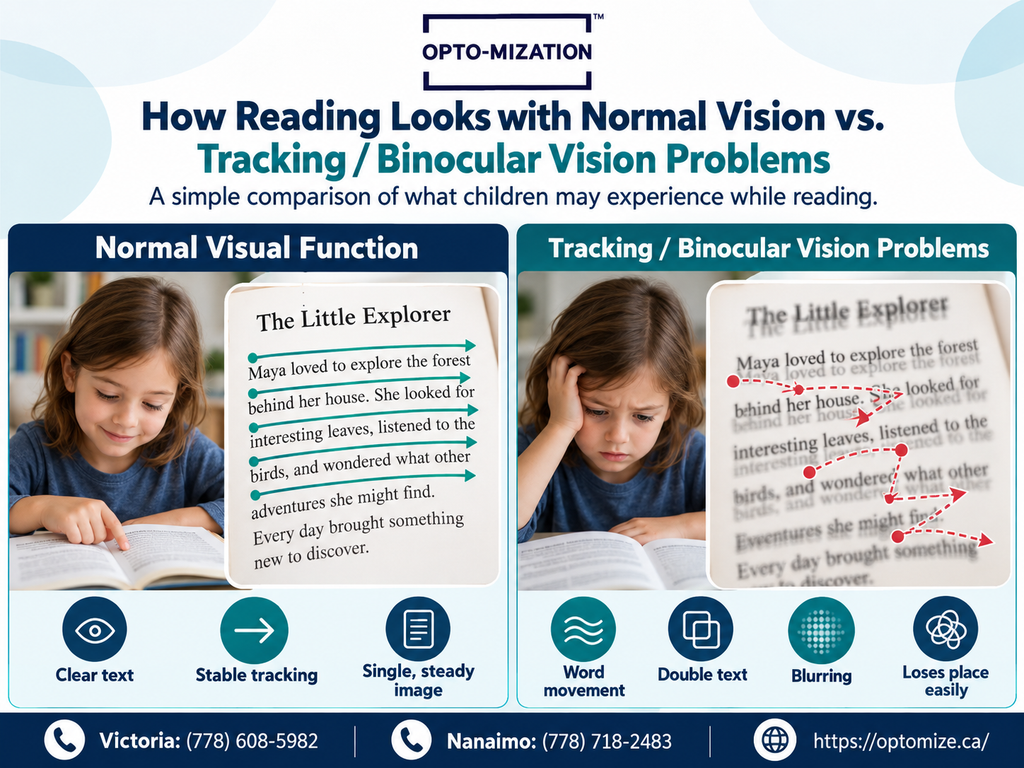
- Skipping lines, losing place, or rereading the same sentence
- Reversing letters beyond the age when this is developmentally expected
- Tilting the head or covering one eye when focusing on close work
- Messy handwriting or difficulty staying on lined paper
- Complaining of headaches, tired eyes, or blurry text after school
- Poor attention during close tasks but no difficulty on screens or outdoors
If several of these patterns sound familiar, the connection between reading struggles and eye tracking is worth understanding before assuming the issue is behavioral or attention-based.
How Vision Affects Learning More Than Most Expect
Reading requires a child’s eyes to move smoothly left to right, hold focus at close range, and maintain that coordination across an entire page — repeatedly. These are learned motor and neurological skills, not passive abilities. When the eye teaming system is weak, the brain receives slightly misaligned input from each eye, which makes sustained reading exhausting rather than automatic.
Research on convergence insufficiency, one of the most common binocular vision problems in school-age children, shows that children with symptomatic CI report significantly more symptoms when reading, have more behaviors that lead to academic difficulties, and score worse on parent ratings of attention compared to children with normal binocular vision, even when their visual acuity tests as normal.
The role of eye teaming in reading success is a factor many families don’t hear about until they’ve already been through reading tutors and ADHD assessments without resolution.
What to Expect During a Pediatric Eye Exam at Opto-mization
A functional pediatric exam at Opto-mization is more thorough than a routine optometry appointment and is structured to get useful clinical data from children who may not sit still for long or articulate what they see clearly. Here’s what the process looks like:
- Health and developmental history: The clinician reviews academic performance, any ADHD or learning assessments already completed, and specific symptoms the parent has noticed at home or school.
- Standard acuity and refractive testing: Clarity at distance and near, with objective measurements that don’t rely entirely on the child’s verbal responses.
- Eye health examination: Assessment of the retina, optic nerve, and internal eye structures using appropriate pediatric tools.
- Binocular vision testing: How well the two eyes coordinate, align, and maintain comfortable fusion while shifting focus across a range of distances.
- Eye tracking assessment: Measurement of smooth pursuit and saccadic eye movements — the specific skills required for reading across a page.
- Focusing and stamina testing: How well the child can sustain and shift focus, and how quickly that system fatigues.
- Visual processing evaluation (where indicated): How the brain interprets and organizes visual information, relevant for children with suspected reading or learning difficulties.
Functional pediatric vision exams typically run 60 to 90 minutes, significantly longer than a general optometry appointment, because measuring visual processing and binocular function accurately requires additional time and specialized testing protocols, as outlined by established functional vision assessment guidelines.
Common Mistakes Parents Make Before and During a Pediatric Eye Exam
- Relying only on school screenings as confirmation of healthy vision. A passed screening means a child can see a projected letter at 20 feet. It says nothing about close-range reading function.
- Waiting for a child to “grow out” of reading struggles. Some issues do resolve, but functional vision problems rarely improve without targeted treatment. Earlier assessment leads to faster resolution.
- Assuming glasses solve the whole problem. Refractive correction helps clarity, but children with eye teaming or tracking problems often continue to struggle even with an accurate prescription.
- Not mentioning school performance or behavioral concerns to the optometrist. These details directly shape which tests are run and how results are interpreted.
- Skipping the exam because the child doesn’t complain. Children adapt to visual discomfort by avoiding the activity that causes it — which often looks like disinterest, not vision trouble.
Frequently Asked Questions
When is the best age to get a first eye test for a child?
The Canadian Association of Optometrists recommends the first comprehensive eye exam at 6 months of age, a second exam at age 3, and then annual exams from age 5 onward. These early exams are possible even with pre-verbal children because optometrists use objective testing methods that don’t require a child to read letters or respond verbally. Catching conditions like amblyopia (lazy eye) or strabismus early significantly improves treatment outcomes.
Are eye exams covered for kids in BC?
BC MSP covers one annual comprehensive eye exam for children under 19. This means there is no out-of-pocket cost for the basic exam itself. Additional functional testing, specialized assessments, or vision therapy programs may involve separate fees. Parents should confirm what is included when booking, particularly at clinics offering comprehensive functional evaluations.
Is there anything I shouldn’t do before an eye exam?
If dilation drops are expected, it helps to bring sunglasses for your child and plan for some light sensitivity afterward. Avoid scheduling the exam immediately after a long school day if possible — a fatigued child gives less reliable responses during subjective testing. Bring any previous prescription records, school assessments, or reports from teachers or psychologists, as this context helps the clinician direct the exam appropriately.
What are the most common eye abnormalities in children?
The most frequently diagnosed conditions in pediatric patients include myopia (nearsightedness), hyperopia (farsightedness), astigmatism, amblyopia, and strabismus. Beyond these, functional vision problems such as convergence insufficiency, accommodative dysfunction, and eye tracking deficits are common in children who struggle with reading and learning but are rarely detected in a standard school screening or brief general exam.
At what age is a child’s vision fully developed?
The visual system develops most rapidly from birth to around age 8 or 9, though refinement continues into the early teenage years. The period up to age 8 is considered critical because the brain retains the greatest capacity to rewire visual pathways during this window. Problems identified and treated before age 10 generally respond more quickly and more completely than those addressed in adolescence or adulthood.
The critical period for visual development in humans is generally considered to close between ages 8 and 9, after which neuroplasticity in the visual cortex decreases substantially — with peer-reviewed research on critical periods noting little effect of intervention after age 9, making early detection and intervention a significant clinical priority in pediatric optometry.
Vision Therapy as a Follow-Up Option
When a pediatric eye exam identifies a functional vision problem, the most common treatment path is vision therapy — a structured program of exercises and activities designed to retrain how the eyes and brain work together. This is different from patching or simply wearing glasses. Programs are typically conducted in-office and supported by home practice, with measurable progress tracked at each stage.
The original Convergence Insufficiency Treatment Trial (CITT), funded by the National Eye Institute, found that office-based vision therapy resulted in significantly greater symptom improvement than home-based pencil push-ups or placebo therapy alone, with approximately 75 percent of children who received in-office treatment reporting fewer and less severe symptoms related to reading and near work.
Families often ask how long a program takes. The answer depends on the severity of the problem and how consistently the child engages with the program. A realistic overview of vision therapy timelines can help parents plan ahead before committing.
Book a Pediatric Eye Exam in Victoria
If your child is struggling at school, avoiding reading, or showing any of the signs covered here, a pediatric functional vision exam is the clearest way to find out whether vision is contributing. Opto-mization serves families across Greater Victoria — including Saanich, Langford, Colwood, Sidney, and surrounding areas — with comprehensive evaluations that go well beyond standard optometry.
To book an appointment or ask a question about what to expect, contact Opto-mization directly at (778) 608-5982. The exam is covered annually for children under 19 through BC MSP, so there’s no reason to wait for clarity on what your child’s visual system is actually doing.
Sources
- https://www.optometrists.org/vision-therapy/guide-vision-and-learning-difficulties/vision-and-learning-difficulties/
- https://childrenslearninginstitute.org/research/convergence-insufficiency-treatment-trial-attention-and-reading-trial-citt-art/
- https://www.thevisiontherapycenter.com/what-is-vision-therapy/diagnosis-functional-vision-test
- http://www.scholarpedia.org/article/Critical_period
- https://www.nei.nih.gov/research-and-training/research-news/more-effective-treatment-identified-common-childhood-vision-disorder