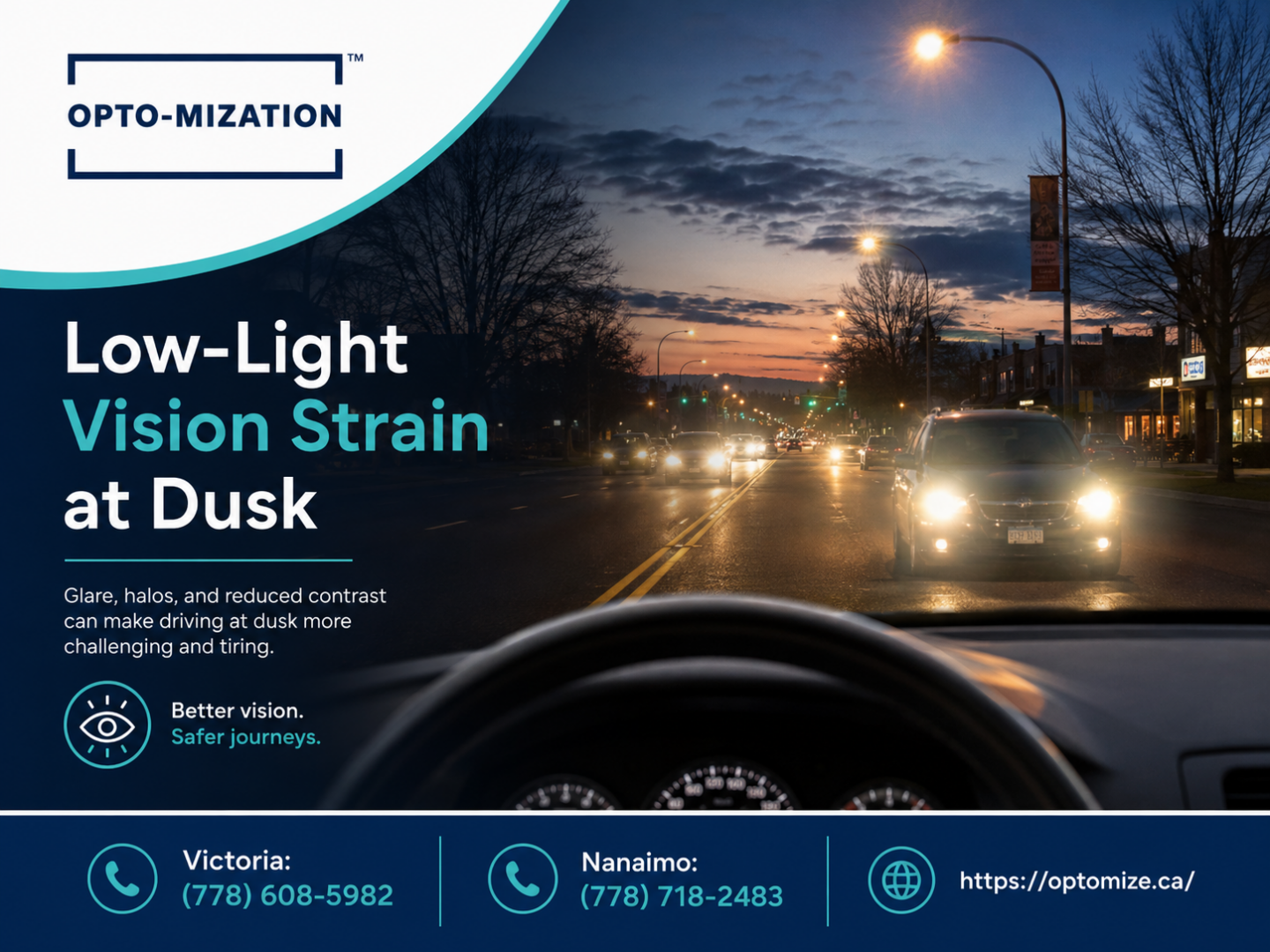
Difficulty seeing clearly at dusk or in dim lighting is a normal part of how the human visual system works, but when that struggle feels excessive, it may point to more than simple low-light adaptation. Conditions like uncorrected refractive error, astigmatism, and binocular vision dysfunction can all make dim-light vision significantly harder. A functional vision assessment can identify whether what you’re experiencing goes beyond normal night vision challenges.
Key Takeaways
- Your eyes rely on two types of photoreceptors (rods and cones), and the shift between them at dusk is what makes that in-between light the hardest to navigate.
- Dusk is harder to see in than full darkness because your visual system is caught mid-transition, not yet fully switched to night-vision mode.
- Conditions like astigmatism, vitamin A deficiency, and binocular vision dysfunction can all amplify low-light vision problems beyond the normal range.
- If dim-light difficulty is affecting your driving confidence, reading comfort, or daily performance, a functional vision evaluation can uncover whether something treatable is contributing.
- Not all vision problems show up on a standard eye chart. Many low-light and contrast issues involve how the eyes and brain process visual information together.
The Real Reason Dusk Is So Hard on Your Eyes
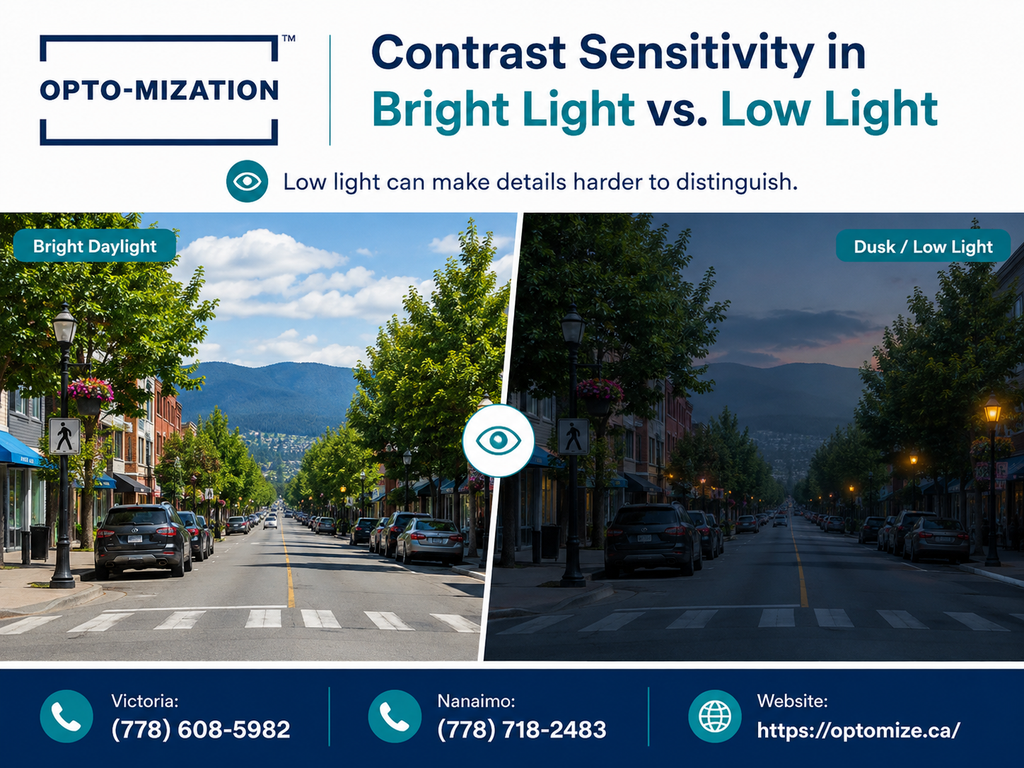
There’s a reason that golden hour feels beautiful to photographers but uncomfortable for drivers. Dusk sits in a visual no-man’s land where your eyes haven’t yet committed to either their daytime or nighttime operating mode.
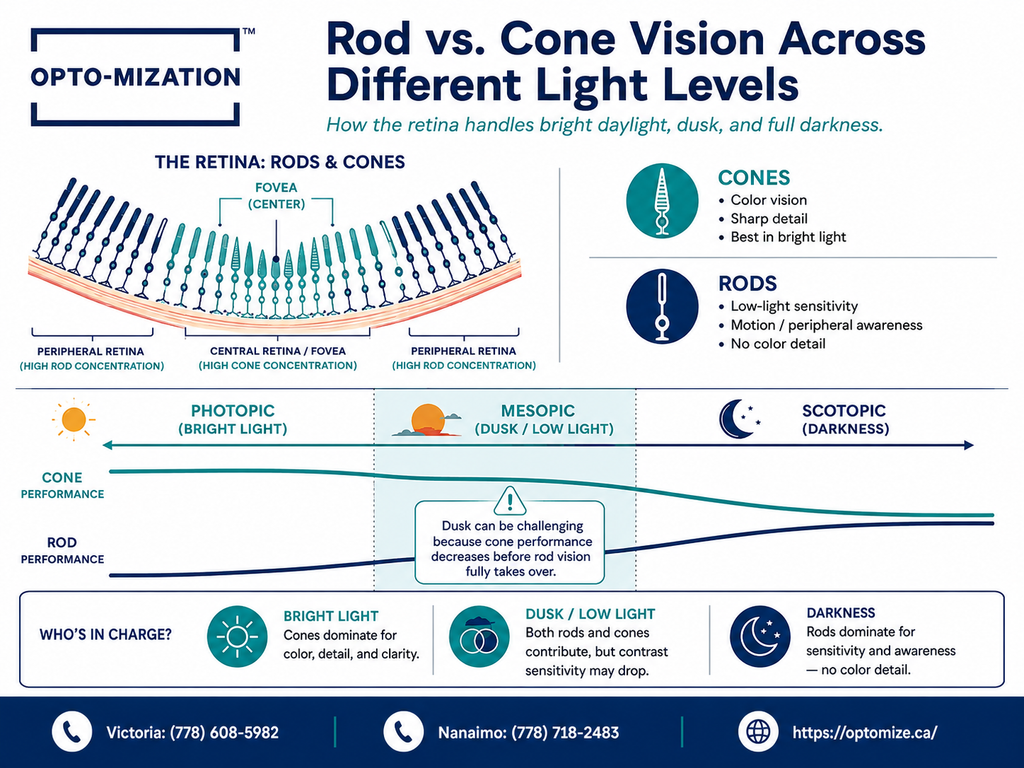
Your retina contains two types of light-sensitive cells. Cones handle color and sharp detail in bright conditions. Rods take over in low light, trading color accuracy for sensitivity to dim, diffuse light. The problem at dusk is that the light level has dropped too low for cones to work well, but it hasn’t dropped far enough to fully activate your rod system. Your visual system is caught mid-switch.
This transition period is called mesopic vision, and it’s genuinely the most challenging lighting condition the human eye faces. It’s not a flaw in your vision. It’s basic biology. But for some people, the struggle goes well beyond what’s typical, and that’s worth paying attention to.
Things You Must Know
1. Dusk Is Harder Than Darkness for a Biological Reason
Most people assume that full darkness is harder to see in than dim light. The opposite is often true. In complete darkness, your rod system fully activates and your eyes adapt. At dusk, the competing signals from both rod and cone systems create a visual processing conflict that results in reduced contrast sensitivity, slower reaction times, and a washed-out quality to your surroundings. This is why driving at dusk often feels more disorienting than driving at night under streetlights.
2. “Normal” Low-Light Struggle and “Treatable” Low-Light Struggle Are Not the Same Thing
Some difficulty at dusk is expected for everyone. But if you find yourself squinting significantly more than others, losing confidence while driving after 4pm, or noticing that headlights create halos or starbursts, those experiences can reflect uncorrected astigmatism, binocular vision dysfunction, or other measurable conditions. A standard eye exam may not catch everything involved. A functional vision assessment evaluates not just what you can see, but how efficiently your visual system processes what it receives.
3. Fatigue and Screen Exposure During the Day Can Make Dusk Vision Worse
If your eyes have been working hard all day on screens, documents, or detailed close-up tasks, the visual fatigue that builds up can make the transition into dim lighting feel sharper and more disorienting. This isn’t just tiredness. It reflects real strain on the focusing and coordination systems of your eyes. If you regularly experience eye discomfort after screen use during the day, the effect often compounds once the light drops in the evening.
What Is Actually Happening Inside Your Eye at Dusk?
When light levels drop, your pupils dilate to let in more light. This sounds helpful, but larger pupils also reduce the eye’s depth of field and allow more light to enter through the edges of the lens, where optical imperfections are greater. For someone with uncorrected or under-corrected refractive error, this means their vision can noticeably worsen as the day fades, even if they see fine in bright conditions.
At the same time, rod cells take time to fully activate. Dark adaptation, the process of the eyes adjusting to reduced light, can take up to 20 to 30 minutes for full sensitivity. During that window, your contrast sensitivity is reduced, edges look less defined, and depth perception becomes less reliable.
Why Astigmatism Makes This Much Worse
Astigmatism means the cornea or lens is slightly irregular in shape, causing light to focus at multiple points rather than one. In bright light, pupils are small, limiting how much of the cornea participates in focusing. At dusk, as pupils dilate, more of the imperfect corneal surface comes into play. The result is ghosting, halos, and a streaky or blurred quality to lights and edges that can be quite disorienting.
Astigmatism is estimated to affect more than 30% of the population to some degree, and even mild uncorrected astigmatism can produce noticeable visual disturbances in low-light and nighttime conditions due to pupil dilation effects.
How Binocular Vision Dysfunction Fits In
Your two eyes need to work as a coordinated team to produce a single, clear image. When they don’t align perfectly, your brain works overtime to merge the signals. In good lighting with strong visual cues, this compensation often goes unnoticed. In dim conditions, those cues fade, the visual system loses reference points, and the strain of forcing the two eyes to cooperate becomes more noticeable.
People with eyes that feel like they are pulling or fighting each other often report that this sensation intensifies significantly at dusk or in low-contrast environments. That’s a meaningful signal, not something to dismiss as normal tiredness.
Common Conditions That Amplify Low-Light Vision Difficulty
| Condition | How It Affects Dim-Light Vision | Detectable by Standard Eye Exam? |
| Astigmatism | Halos, starbursts, and blur worsen as pupils dilate | Yes, if measured carefully |
| Binocular Vision Dysfunction | Eye teaming breaks down without strong visual anchors | Often missed |
| Vitamin A Deficiency | Reduces rhodopsin production, limiting rod sensitivity | No (requires blood work) |
| Uncorrected Myopia | Distance objects blur more as contrast drops | Yes |
| Contrast Sensitivity Loss | Reduced ability to distinguish edges and depth cues | Only with specialized testing |
| Visual Processing Dysfunction | Brain struggles to interpret incomplete or ambiguous visual signals | No (requires functional evaluation) |
Why Does Night Driving Feel So Much More Stressful Than It Used To?
This is one of the most common concerns that brings people in for evaluation, and it’s often dismissed as “just getting older.” While it’s true that dark adaptation slows with age and the lens becomes less clear over time, attributing everything to aging can cause treatable conditions to go unaddressed for years.
Research suggests that contrast sensitivity, which is the ability to distinguish edges and detail against a similar background, declines measurably beginning in the fourth decade of life. However, uncorrected refractive error and binocular vision dysfunction are also significant contributing factors that can be present at any age.
Glare from oncoming headlights, halos around streetlights, and a sense of visual overwhelm on busy roads are often symptoms of contrast sensitivity loss, uncorrected astigmatism, or the visual system struggling to maintain stable binocular alignment under demanding conditions. These are not things you simply have to accept.
Vitamin A and Nutrition: A Real but Often Overlooked Factor
Rhodopsin, the photopigment that enables rod cells to detect dim light, is synthesized from vitamin A. When vitamin A levels are low, rhodopsin production drops, and the rods become less sensitive. This is actually one of the oldest known nutritional vision disorders, and in its early stages it presents as increased difficulty seeing at dusk before progressing to more serious night blindness.
Vitamin A deficiency is among the most common nutritional deficiencies worldwide and is a recognized cause of night blindness (nyctalopia). Early-stage deficiency can reduce rod sensitivity before any other symptoms appear.
Good dietary sources of vitamin A include liver, eggs, dairy products, and beta-carotene-rich vegetables like carrots, sweet potatoes, and leafy greens. If you have dietary restrictions or suspect nutritional gaps, discussing this with a healthcare provider is worthwhile before assuming your low-light vision issues are purely optical.
How a Functional Vision Assessment Differs from a Standard Eye Exam
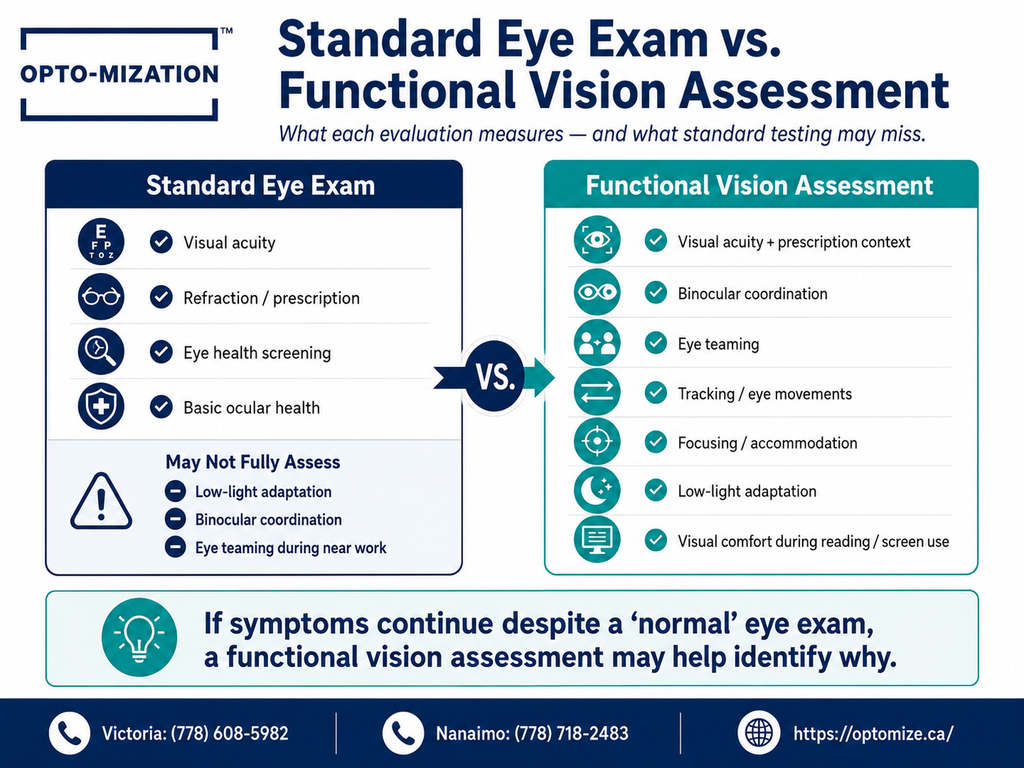
A standard eye exam measures visual acuity, which is essentially how clearly you can read letters on a chart under controlled bright lighting. It’s a valuable baseline, but it doesn’t replicate the conditions your eyes actually face throughout your day, including reduced contrast, changing light levels, or sustained visual demands.
A functional vision assessment evaluates the full range of how your eyes and brain work together. This includes how well your eyes converge and diverge, how accurately they track moving targets, how quickly they shift focus, how your visual system processes contrast and motion, and whether both eyes are genuinely cooperating at a neurological level.
For someone struggling with low-light vision beyond the normal range, this type of assessment can identify whether astigmatism correction needs refinement, whether binocular vision dysfunction is adding to the strain, or whether contrast sensitivity testing reveals a specific deficit that wouldn’t show up on an acuity chart.
Common Mistakes People Make About Low-Light Vision Problems
- Assuming it’s just age. While dark adaptation does slow with age, age alone doesn’t explain significant halos, glare sensitivity, or sudden changes in dusk visibility. Treating it as inevitable delays diagnosis of correctable conditions.
- Relying only on a standard prescription check. Standard refraction testing is done in bright, high-contrast conditions. Your glasses prescription may not be optimized for the low-contrast, dilated-pupil conditions of dusk driving.
- Wearing sunglasses too late in the day. Wearing dark lenses in the late afternoon slows the early stages of dark adaptation. Removing them earlier than feels comfortable can give your visual system more time to begin adjusting.
- Ignoring the brain’s role. Low-light vision difficulty isn’t only a hardware problem in the eye. Visual processing happens in the brain, and how efficiently your brain interprets reduced or ambiguous visual signals matters enormously.
- Not connecting daytime eye strain to evening difficulty. If your eyes are already strained from a full day of close work, the transition to dim lighting will feel harder. Addressing the root causes of daytime eye strain can improve your evening visual comfort as well.
Low-Light Vision Across Different Life Stages
| Life Stage | Common Low-Light Concern | What to Investigate |
| Children | Avoiding activities at dusk, clumsiness in dim spaces | Functional vision, binocular coordination |
| Working Adults | Dusk driving stress, headlights causing glare | Astigmatism correction, contrast sensitivity |
| Seniors | Reduced driving confidence after dark, balance issues at dusk | Contrast sensitivity, binocular vision, lens clarity |
Among older adults, reduced contrast sensitivity and dark adaptation are associated with increased fall risk and reduced driving performance. These changes often precede significant visual acuity loss and may be detectable through specialized testing before they become functionally disabling.
Frequently Asked Questions
Why is it harder to see at dusk than at night?
At dusk, your visual system is caught mid-transition between its daytime mode (cone-driven, color-accurate, detail-focused) and its nighttime mode (rod-driven, motion-sensitive, low-contrast). Neither system is fully active, and this overlap creates the worst possible conditions for contrast sensitivity and depth perception. Once full darkness arrives and your eyes have had time to adapt, rod vision takes over more completely and many people actually find it easier to see than in that uncertain in-between light.
Why is my eyesight worse in dim light?
Several factors can make dim-light vision noticeably worse than your daytime vision. Pupil dilation in low light exposes more of the optical imperfections in your lens and cornea, making uncorrected astigmatism and refractive error more apparent. Reduced contrast sensitivity makes it harder to separate edges and depth cues. And if binocular vision dysfunction is present, the reduced visual anchors in dim environments make it harder for your eyes to maintain stable coordination.
Are dim lights better for eyes?
Dim lighting is not inherently harmful to your eyes, but it does require them to work harder, especially for close-up or detailed tasks. Reading or doing close work in dim light doesn’t damage your eyes permanently, but it does increase visual fatigue and can accelerate the eye strain that builds over a long day. For general activities, moderate consistent lighting reduces the contrast demands on your visual system and tends to be more comfortable than frequently shifting between very bright and very dim environments.
Why is my vision blurry at dusk?
Blurry vision specifically at dusk is often connected to how pupil dilation affects your refractive error. As your pupils widen in lower light, any uncorrected or partially corrected astigmatism, myopia, or other refractive condition becomes more optically significant. Your current glasses prescription may have been measured under bright conditions and may not be optimized for the low-light, dilated-pupil state. A careful functional refraction can evaluate whether your prescription needs adjustment for these conditions.
Can astigmatism cause blurry vision at dusk and in low light?
Yes, and it’s one of the most common explanations for low-light visual disturbance. Astigmatism means your cornea focuses light unevenly, and this effect becomes more pronounced as your pupil enlarges in dim conditions. Many people with mild astigmatism have acceptable daytime vision but experience halos, starbursts around lights, ghosting, or a general blurriness at night that they don’t notice during the day. In some cases, even a slight refinement of the astigmatism correction in a prescription can make a meaningful difference to night driving comfort.
Your Low-Light Vision Struggles May Have a Treatable Cause
Difficulty seeing at dusk is something most people quietly accept, assuming it’s just a normal part of vision or aging. For many, some degree of struggle in that transitional light is genuinely normal. But if dusk driving has become stressful, if oncoming headlights feel blinding, or if dim rooms feel harder to navigate than they should, that experience may reflect something measurable and addressable.
At Opto-Mization, the approach to vision care goes beyond the standard eye chart. A functional vision assessment evaluates how your eyes and brain work together across a range of conditions, including the kinds of low-light and contrast demands that a typical exam doesn’t replicate. Whether the root cause turns out to be astigmatism, binocular vision dysfunction, contrast sensitivity loss, or something else entirely, finding that answer is the starting point for real improvement.
If you’re in Greater Victoria or the Nanaimo area and your low-light vision has been affecting your driving confidence, your comfort, or your daily performance, a functional vision evaluation at Opto-Mization can help identify exactly what’s going on and what, if anything, can be done about it.
Book a functional vision assessment at Opto-Mization and find out what your standard eye exam may have missed. Visit optomize.ca to learn more and schedule your evaluation.