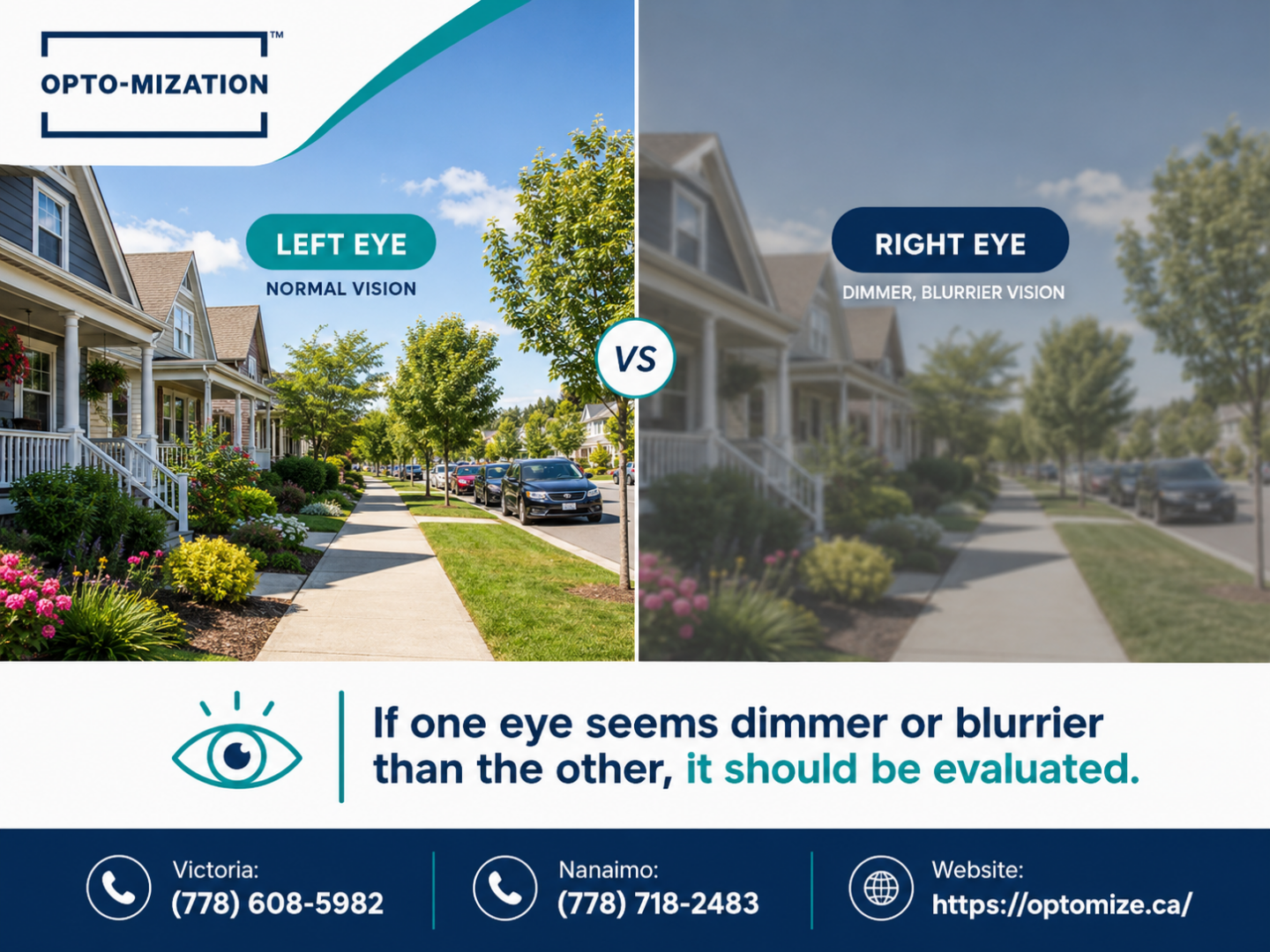
Dimmer or less clear vision in one eye can stem from a range of causes, from dry eye and cataracts to more serious conditions like optic neuritis, macular degeneration, or binocular vision dysfunction. Some causes are manageable with early care; others require urgent attention. A thorough functional vision assessment is often the most reliable way to identify the true source of the problem.
Introduction
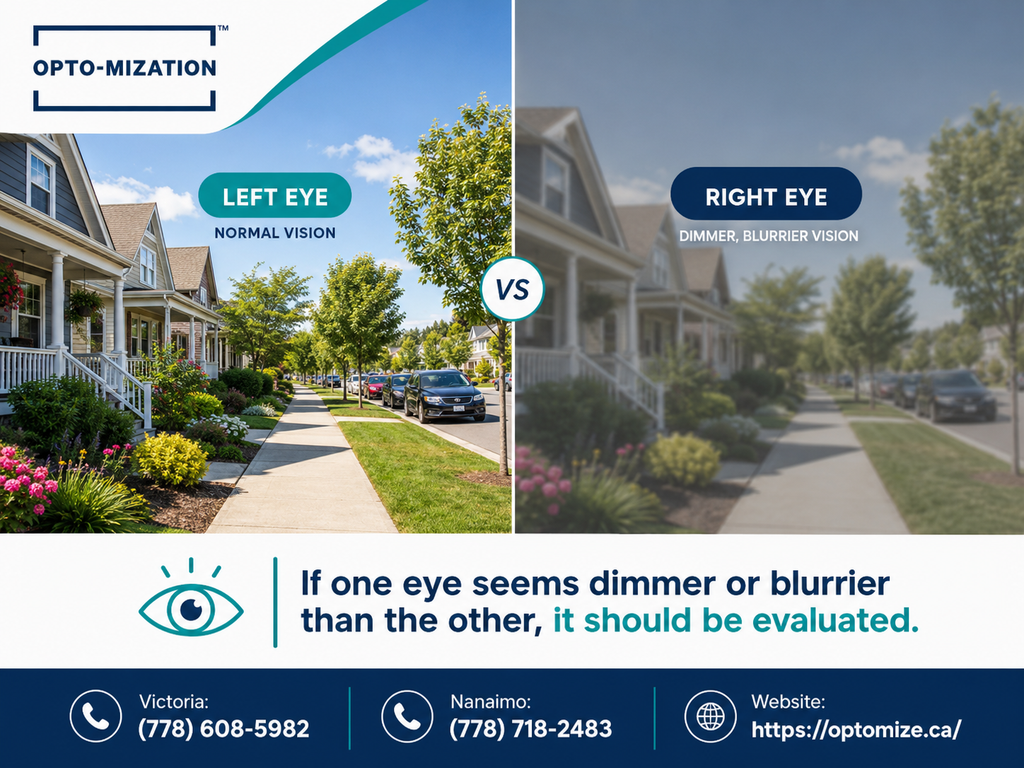
You close one eye and the world looks normal. You close the other and everything seems a little darker, a little softer, or just slightly off. It’s easy to dismiss that difference as tiredness or screen fatigue, but a consistent gap in visual clarity between your two eyes is worth taking seriously.
This isn’t always a simple prescription problem. The eye and brain work together as a system, and when something disrupts that system on one side, the effects can be subtle but significant. Understanding what’s happening is the first step toward fixing it.
Key Takeaways
- Dimness or reduced clarity in one eye can indicate anything from a refractive error to a neurological condition affecting the optic nerve or visual cortex.
- Many people live with this for months before getting assessed, assuming it will resolve on its own. In some cases, delay makes treatment harder.
- Standard eye exams measure visual acuity but don’t always evaluate how the eyes and brain coordinate, which is often where the real problem lies.
- Conditions like amblyopia (lazy eye), optic neuritis, and binocular vision dysfunction can all cause one eye to perceive the world as dimmer or less sharp.
- A functional vision assessment looks beyond the lens and tests the entire visual system, including tracking, focusing, and neurological integration.
Things You Must Know
1. “Normal” on a Standard Eye Chart Doesn’t Mean Your Vision Is Fine
A conventional eye exam measures how well you can read letters at a fixed distance. It does not evaluate how your eyes work together, how your brain processes what each eye sees, or whether one eye is being suppressed by your visual system. Many people with significant binocular vision problems test at 20/20 on a basic acuity chart and still experience daily visual discomfort, dimness, or blurring that no one has been able to explain.
2. Sudden Dimness in One Eye Is a Medical Warning Sign
If the change happened quickly, with no obvious cause like a contact lens issue or allergies, that’s a different situation than gradual, long-standing dullness. Sudden vision loss or dimness in one eye can indicate a vascular event, optic nerve inflammation, or retinal problem that needs same-day medical evaluation. Do not wait and see if it improves. Seek urgent care first, then follow up with a comprehensive functional assessment once any acute cause has been ruled out.
3. The Brain Can “Turn Off” an Eye Without You Realizing It
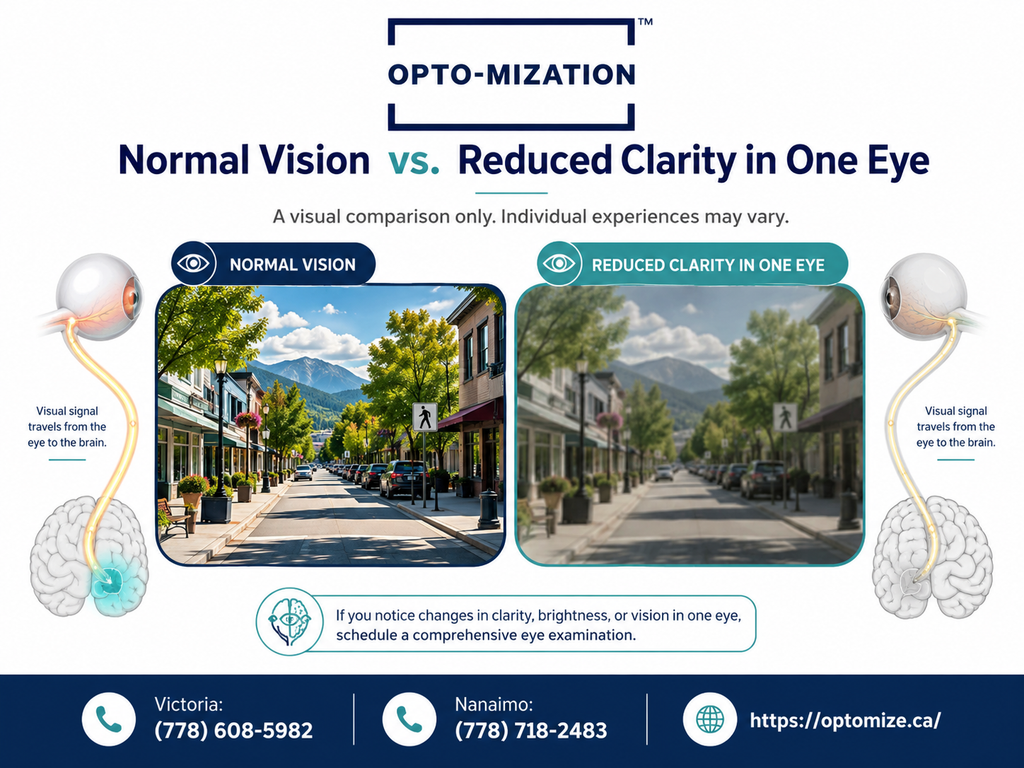
In cases of amblyopia or suppression, the brain learns to ignore or reduce the signal from one eye to avoid confusion. This can make that eye seem dimmer even when the eye itself is structurally healthy. This is a neurological adaptation, not a hardware failure, and it often responds well to vision therapy when addressed properly.
What Are the Most Common Reasons One Eye Appears Dimmer?
There’s no single answer to this, because the visual system has many moving parts. The cause could be in the eye itself, in the optic nerve, or in how the brain processes and balances input from both eyes. Below are the most common categories.
Refractive Errors and Prescription Asymmetry
If one eye has a significantly different prescription than the other, the brain may receive a noticeably blurrier or less detailed image from that eye. This is called anisometropia, and it can make one eye feel dimmer by comparison. Correcting the underlying prescription helps, though in some cases the brain has already learned to suppress that eye’s input and may need more targeted intervention.
Amblyopia (Lazy Eye)
Amblyopia affects an estimated 2 to 3 percent of the general population and is one of the most common causes of reduced vision in one eye in children and adults alike. In amblyopia, the brain does not fully develop the neural connections from one eye, often because that eye had a different refractive error, turned inward or outward during childhood, or was obstructed. The affected eye doesn’t appear damaged but produces a dimmer, less sharp image because the brain isn’t fully processing its signal.
The good news is that amblyopia is not a life sentence. vision therapy programs can retrain the brain to process input from the weaker eye more effectively, even in adults, though outcomes are generally better when treatment begins earlier.
Cataracts
Cataracts develop when the lens inside the eye becomes cloudy over time. They typically progress slowly and can affect one eye more than the other, causing that eye to produce a dimmer, yellowed, or hazy image. Cataracts are the leading cause of correctable vision loss globally and are managed surgically once they significantly affect daily function.
Optic Neuritis
Optic neuritis is inflammation of the optic nerve and is often associated with multiple sclerosis or other demyelinating conditions. It typically presents as a sudden reduction in vision in one eye, sometimes accompanied by pain when moving the eye, reduced colour saturation, or a visual field defect. It often resolves partially or fully on its own but warrants urgent neurological evaluation, particularly if it’s the first occurrence.
Macular Degeneration and Retinal Conditions
The macula is the central part of the retina responsible for sharp, detailed vision. When it’s affected by disease or age-related changes, central vision in that eye becomes blurry, distorted, or dim, while peripheral vision may remain relatively intact. Early detection through a comprehensive eye exam is essential because some forms of macular degeneration can be slowed with timely treatment.
Binocular Vision Dysfunction
This is a category of conditions that standard eye exams frequently miss. When the two eyes don’t align, coordinate, or focus in perfect sync, the brain can perceive one eye’s image as weaker or less clear, even if both eyes are healthy. Binocular vision dysfunction can also cause one eye to feel more strained, leading to the perception of dimness after visual effort like reading or screen use. A functional assessment specifically designed to evaluate how the two eyes work together is often the only way to identify this accurately.
How Do Clinicians Tell These Conditions Apart?
The diagnostic path depends heavily on how the problem presents. Here’s a general overview of how different clinical settings approach the evaluation:
| Condition | Primary Symptom | Standard Exam Finds It? | Functional Exam Adds Value? |
| Refractive error | Blurry, soft image in one eye | Usually yes | Yes, if suppression is present |
| Amblyopia | Reduced acuity or dimness in one eye | Sometimes | Yes, critical for treatment planning |
| Cataracts | Hazy, yellowed vision | Yes | Less so |
| Optic neuritis | Sudden dimness, often with pain | Partially | Requires urgent medical referral first |
| Binocular vision dysfunction | Eye fatigue, suppression, dimness after effort | Rarely | Yes, essential for diagnosis |
| Macular degeneration | Central blurring or distortion | Yes | Supplementary benefit |
When Should You Take Action?
Some causes of one-sided dimness are gradual and manageable with scheduled care. Others need same-day attention. Here’s how to think about urgency:
- Sudden vision change with no clear cause: Go to an emergency department or urgent care immediately. This is not the time for watchful waiting.
- Pain behind or around the eye alongside dimness: Seek medical evaluation the same day. This combination can indicate optic neuritis or acute glaucoma.
- Gradual dimness over weeks or months: Book a comprehensive eye exam soon. Don’t assume it will stabilize on its own.
- Dimness that appears only after reading or screen use: This pattern often points to a functional or binocular vision issue. A standard exam may not catch it; request a comprehensive functional vision exam that evaluates how your eyes coordinate under sustained effort.
- Persistent dimness that previous exams haven’t explained: Ask specifically for a binocular vision and visual processing assessment. Many patients with this presentation have been told their eyes are “fine” but have never had their visual system evaluated beyond basic acuity.
Can Dimness in One Eye Affect More Than Just Sight?
Yes, and this is something most people don’t expect. When the brain receives unequal input from the two eyes over a long period, it works harder to compensate. That extra effort can show up as chronic headaches, eye strain, fatigue, difficulty concentrating, or balance issues, especially in visually demanding environments.
Research in neuro-optometry has shown that binocular vision imbalances, where one eye underperforms relative to the other, can contribute to symptoms including dizziness, motion sensitivity, reading difficulty, and even disrupted sleep, because the visual system remains in a state of low-level neurological stress throughout the day.
For patients who’ve been experiencing fatigue, reading difficulties, or headaches without a clear explanation, vision often turns out to be part of the picture. You can learn more about how unresolved visual stress may be affecting sleep and rest quality in this related overview of how vision problems can affect sleep.
What Does a Functional Vision Assessment Look For?
A functional vision assessment goes significantly beyond the letter chart. At a clinic like Opto-Mization, the evaluation is designed to measure how the two eyes work together as a system, not just how each eye performs in isolation.
| What Gets Tested | What It Reveals |
| Visual acuity (each eye) | Refractive errors, prescription imbalances |
| Binocular vision alignment | Convergence insufficiency, phoria, suppression |
| Eye tracking and fixation | Reading difficulties, attention-related visual issues |
| Focusing flexibility (accommodation) | Near-far transitions, screen fatigue |
| Ocular health | Retinal, optic nerve, and lens integrity |
| Visual processing | How the brain interprets and integrates visual information |
Common Mistakes People Make When One Eye Seems Dimmer
- Assuming it’s just fatigue. Tired eyes are a real thing, but visual fatigue should recover after rest. If the dimness is still there the next morning, something else is going on.
- Self-diagnosing based on screen time alone. Screen use can worsen symptoms, but it rarely causes persistent one-sided dimness. It’s usually a contributing factor, not the root cause.
- Getting a basic prescription check and stopping there. If the optometrist doesn’t specifically test binocular function, suppression, or visual processing, critical causes can be missed entirely.
- Waiting for the problem to get worse before acting. Some conditions, especially those involving neurological adaptation or suppression, become harder to treat the longer they’re left unaddressed.
- Treating each symptom separately. Headaches, dimness in one eye, reading difficulty, and trouble concentrating might all be expressions of the same underlying visual system imbalance. Addressing them in isolation rarely resolves the bigger picture.
Studies in optometric research suggest that a significant proportion of patients who present with unexplained visual symptoms, including asymmetric clarity, headaches, or reading fatigue, have underlying binocular vision conditions that were not identified in their previous standard eye examinations.
Frequently Asked Questions
Why do I see dimmer in one eye?
Dimness in one eye can result from a number of causes: a refractive error that’s more significant in that eye, a cataract developing on the lens, inflammation of the optic nerve (optic neuritis), or the brain actively suppressing input from one eye as it does in amblyopia or binocular vision dysfunction. A sudden onset warrants urgent care; gradual dimness calls for a thorough eye health and functional vision assessment to determine the cause accurately.
Why is my vision slightly blurry in one eye?
Mild blurriness in one eye that doesn’t correct fully with glasses or contacts may indicate something beyond a simple refractive error. It can reflect amblyopia, where the brain underuses one eye; early changes in the retina or lens; or a binocular vision problem where the two eyes aren’t coordinating properly. If the blurriness has been present for a while or wasn’t identified in a past exam, a functional vision assessment is worth pursuing.
Why does my eyesight seem dimmer overall?
If overall dimness has developed gradually rather than in just one eye, possibilities include developing cataracts, conditions affecting the optic nerve, or changes in the retina. It can also reflect medication side effects or systemic health changes. Noticing whether the dimness is equal in both eyes or more pronounced in one is a useful starting point for your clinician. Either way, a comprehensive exam is the right first step.
Why is my vision shimmering in one eye?
Shimmering, flickering, or sparkling sensations in one eye are often described as visual phenomena related to migraine aura, posterior vitreous detachment (a common age-related change in the gel inside the eye), or, less commonly, retinal conditions. If shimmer is accompanied by a sudden increase in floaters, flashes of light, or a shadow in your vision, seek emergency eye care promptly, as these can indicate a retinal tear or detachment.
Why is my vision blurry and wavy in one eye?
Wavy or distorted vision in one eye, especially in the centre of your visual field, is a classic symptom of macular conditions including wet age-related macular degeneration or central serous chorioretinopathy. This symptom should be evaluated without delay. A simple self-monitoring tool called the Amsler grid can help you notice distortion changes between appointments, but it doesn’t replace clinical assessment.
What to Do If You’re in Greater Victoria or Nanaimo
If you’ve been experiencing dimness, reduced clarity, or visual asymmetry between your eyes and haven’t found an explanation, a functional vision assessment may uncover what previous exams have missed.
Opto-Mization serves patients across Greater Victoria, including Victoria, Saanich, Langford, Sidney, and surrounding communities, as well as the Nanaimo region. Their assessments evaluate not just how clearly each eye sees, but how the eyes and brain work together as a coordinated system. That distinction often makes all the difference for patients who’ve had normal acuity results but still don’t feel like their vision is right.
If you’re unsure whether a functional assessment is right for your situation, it’s also worth revisiting how often comprehensive evaluations are recommended and what they actually cover. This overview of whether annual eye exams are truly necessary offers useful context for making that decision.
Taking the Next Step
Dimmer or less clear vision in one eye is your visual system signalling that something has shifted. Whether the cause is structural, neurological, or a coordination problem between your eyes and brain, the path forward starts with the right kind of evaluation.
A standard prescription check is a starting point, not a finish line. If your symptoms haven’t been explained, a functional vision assessment at Opto-Mization gives you a much more complete picture of what’s actually happening and what can be done about it.
Book a functional vision assessment at Opto-Mization and find out what your eyes and brain have been trying to tell you. Visit optomize.ca to get started.