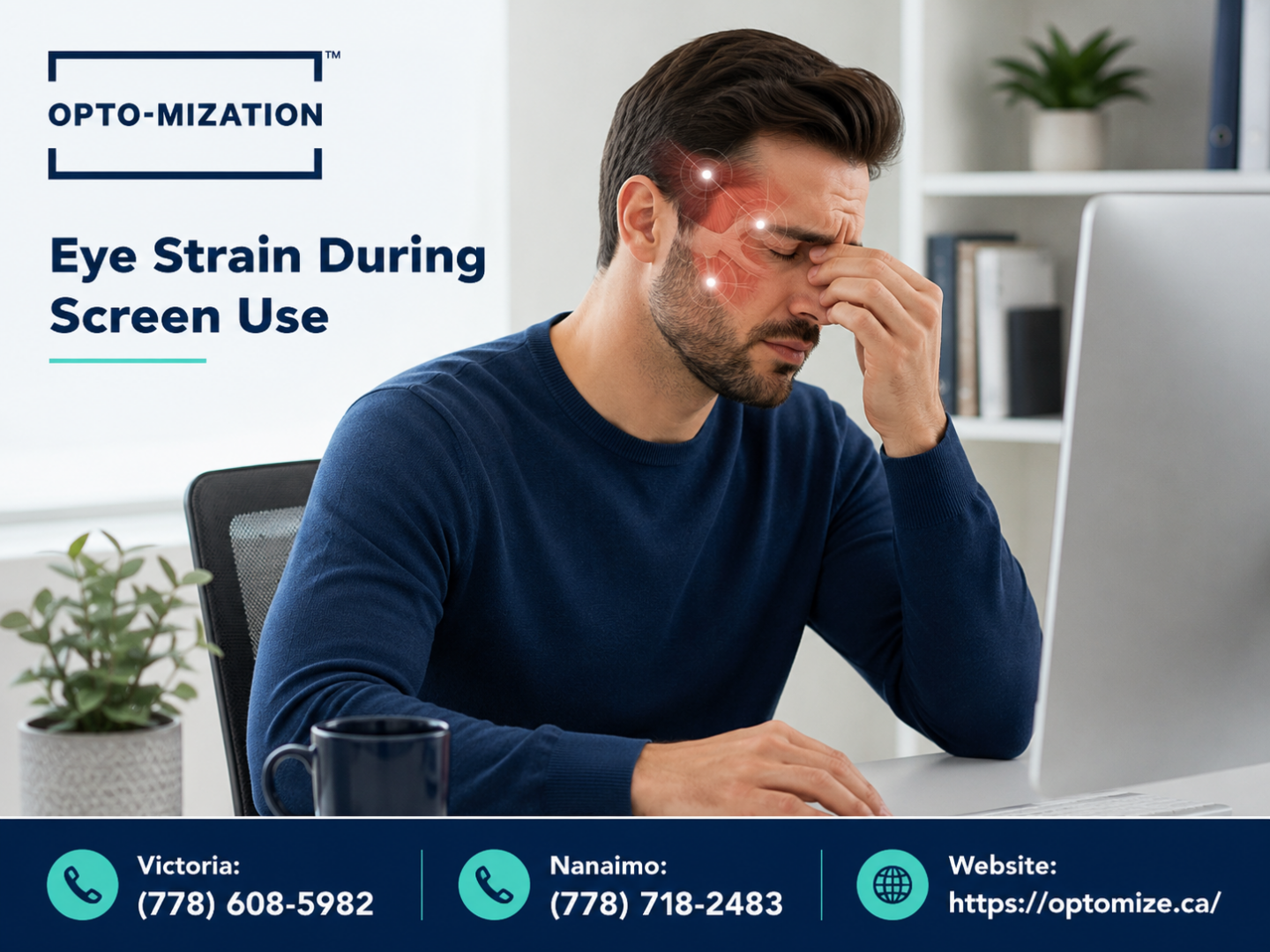
Eyelid twitching (myokymia) is most often caused by fatigue, caffeine, or stress and resolves on its own within days. However, persistent or frequent twitching can sometimes indicate underlying visual strain, binocular vision dysfunction, or neurological issues that a standard eye exam won’t catch. If your eyelid keeps fluttering despite rest and lifestyle changes, a functional vision assessment may help identify the root cause.
Introduction
That involuntary flutter. You’re midway through a meeting, a book, or your third hour of screen time, and suddenly your eyelid starts twitching on its own. It’s harmless enough to ignore, but annoying enough that you notice it every time it happens.
For most people, eyelid twitching is short-lived and tied to something obvious like poor sleep or too much coffee. But when it keeps coming back, or when it shows up alongside headaches, eye strain, or reading fatigue, it’s worth looking a little deeper at what’s actually going on.
Key Takeaways
- Eyelid twitching is usually harmless and caused by lifestyle factors like fatigue, stress, or caffeine.
- Persistent twitching that returns frequently may signal visual strain or binocular vision dysfunction, not just tiredness.
- Twitching accompanied by headaches, blurred vision, or difficulty focusing warrants a functional vision evaluation.
- Standard eye exams measure sharpness but often don’t assess how the eyes and brain coordinate, which can be a hidden driver of symptoms.
- Rarely, eyelid twitching can be associated with neurological conditions and should be evaluated if it spreads to other facial muscles.
Things You Must Know
1. “Normal” Twitching vs. a Pattern Worth Investigating
A twitch that lasts a day or two after a bad night’s sleep is almost always benign. The concern arises when twitching recurs over weeks, shows up predictably during or after near work like reading or screen use, or travels beyond the eyelid to the cheek or mouth. These patterns deserve attention from a professional who evaluates more than visual acuity.
2. Visual Strain Is a Common and Overlooked Trigger
When the eyes struggle to maintain focus or work together properly, the muscles around the eye can become overworked. This overexertion often shows up as eyelid twitching, fatigue, or that “gritty” sensation at the end of the day. Many people with this pattern pass a standard vision test with 20/20 results, which makes the connection easy to miss. A comprehensive functional eye exam looks at coordination, focusing endurance, and teaming, not just sharpness.
3. Lifestyle Changes Help, But They’re Not Always Enough
Cutting caffeine, getting more sleep, and reducing screen time are reasonable first steps and often effective for situational twitching. When those changes don’t resolve it, the underlying issue may be structural rather than behavioural. A functional vision assessment can determine whether the eyes are working efficiently or whether there’s an undiagnosed coordination problem driving the symptom.
What Actually Causes Eyelid Twitching?
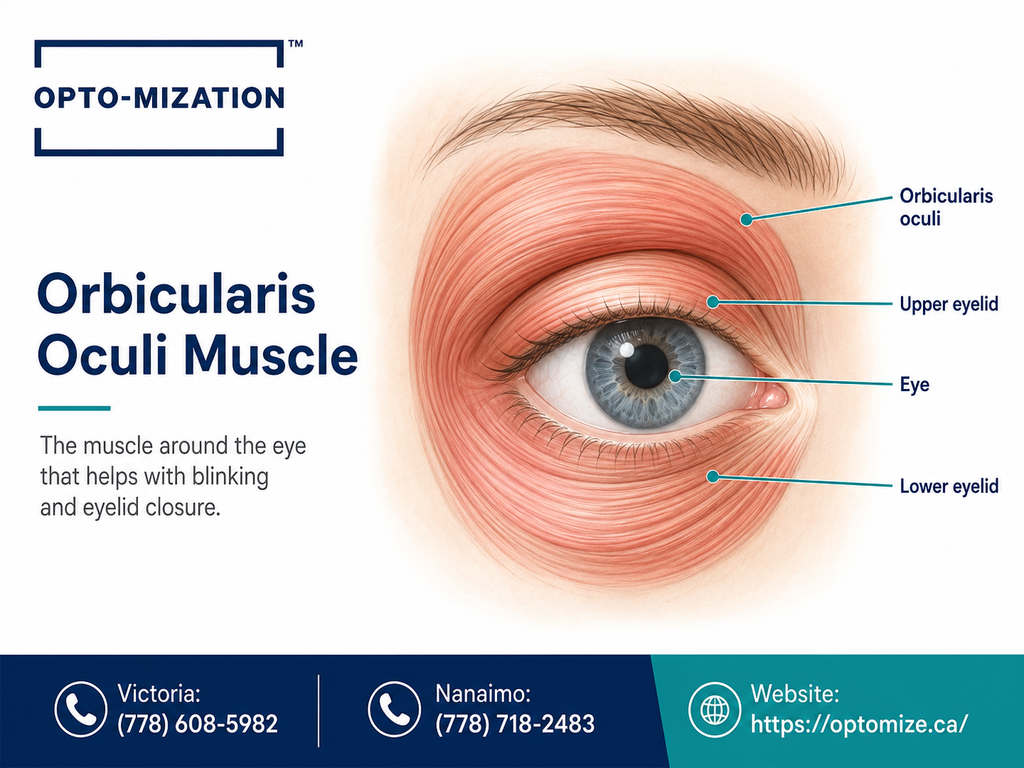
The medical term for the common eyelid twitch is myokymia. It refers to an involuntary, repetitive spasm of the orbicularis oculi, the muscle that surrounds the eye. The trigger is almost always one of a handful of well-established causes.
| Cause | Why It Triggers Twitching | Typical Duration |
| Sleep deprivation | Fatigued nerves fire inconsistently | Resolves with rest |
| Caffeine excess | Stimulates nerve activity and muscle irritability | Resolves after reducing intake |
| Stress and anxiety | Heightens neuromuscular sensitivity | Varies with stress levels |
| Dry eyes | Ocular surface irritation triggers reflex muscle activity | Ongoing until treated |
| Eye strain / visual fatigue | Overworked focusing and teaming muscles | Recurs with near work |
| Binocular vision dysfunction | Misaligned eye coordination creates compensatory muscle tension | Chronic without treatment |
| Nutritional deficiencies | Low magnesium may affect nerve-muscle signalling | Varies |
| Neurological conditions | Blepharospasm, hemifacial spasm (less common) | Persistent, requires evaluation |
When Is Eyelid Twitching Just Annoying, and When Is It a Warning Sign?
The vast majority of eyelid twitches fall into the benign, temporary category. They’re frustrating but harmless, and they stop when the underlying trigger goes away. The situations that warrant closer attention are different in character.
You should consider a professional evaluation if the twitching:
- Persists for more than two to three weeks without an obvious cause
- Spreads beyond the eyelid to the cheek, jaw, or other facial muscles
- Causes the eyelid to fully close involuntarily (this may indicate blepharospasm)
- Occurs alongside double vision, blurred vision, or headaches
- Consistently appears during or after reading, screen use, or close-up tasks
- Affects both eyes simultaneously in an unusual way
That last pattern, twitching that reliably follows near work, is particularly worth noting from a functional vision standpoint. It often reflects the eyes working harder than they should to maintain focus or alignment.
The Connection Between Visual Strain and Eyelid Twitching
This is where things get more nuanced than most general health articles acknowledge. Vision isn’t purely about how sharp the letters look on a chart. The visual system involves a complex coordination between both eyes, the brain, and a network of muscles that control focus, alignment, and movement.
When that coordination is off, even subtly, the system compensates. The eyes work harder. The muscles around the eye stay in a near-constant state of low-level tension. Over hours of reading or screen use, that tension can manifest as twitching, fatigue, or the sensation of the eyes “giving up” at the end of the day.
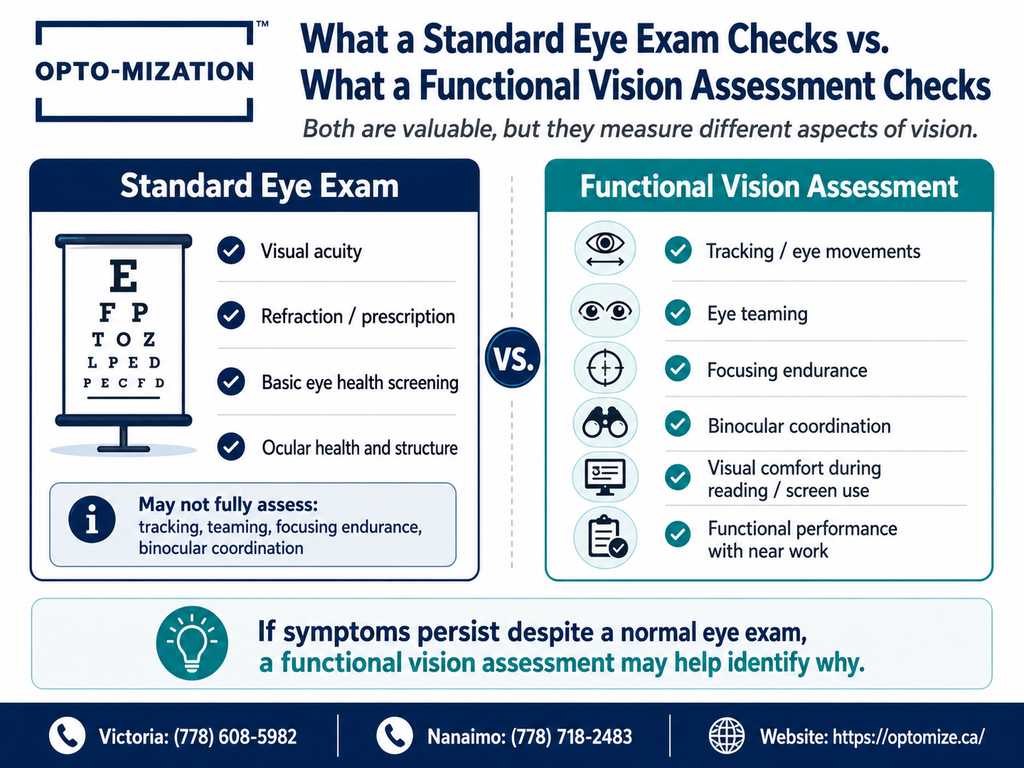
Binocular vision dysfunction is thought to affect a meaningful portion of the population, yet it frequently goes undetected in routine vision screenings because standard tests don’t assess how the two eyes work as a coordinated team. Many people with 20/20 acuity still experience significant visual strain because of how their eyes converge, diverge, or maintain focus under sustained demand.
If you find yourself wondering why your eyes still feel tired even with the right prescription, the underlying issue may be coordination rather than clarity. Twitching in that context is often one symptom among several, accompanying headaches, difficulty concentrating, or text that seems to blur after extended reading.
Lifestyle Factors That Make Twitching Worse
Before assuming anything structural, it’s worth ruling out the most common lifestyle contributors. These are genuinely effective for situational twitching and should be the first things you try.
- Reduce caffeine intake. Coffee, energy drinks, and certain teas can increase neuromuscular irritability. A short trial of reduced intake often clarifies whether caffeine is a factor.
- Prioritize sleep. Even one or two nights of poor sleep can trigger twitching in people who don’t usually experience it. Consistency matters more than total hours in a single night.
- Apply the 20-20-20 rule during screen use. Every 20 minutes, look at something 20 feet away for 20 seconds. This reduces the sustained focusing demand that builds up with extended near work.
- Address dry eyes. If your eyes feel gritty or uncomfortable during the day, lubricating drops may reduce the surface irritation that contributes to twitching.
- Manage stress actively. High cortisol levels affect neuromuscular function. Exercise, sleep, and deliberate rest all play a role.
- Check your magnesium levels. Some evidence suggests low magnesium can affect nerve-muscle signalling. A conversation with your family physician can help determine whether supplementation is appropriate for you.
Screen time in North America has increased substantially over the past decade, with many adults spending six or more hours daily on digital devices. Extended near focus at screen distances places significant demand on the visual system’s convergence and accommodation mechanisms, which are often undertested in routine eye care settings.
What Happens in a Functional Vision Assessment?
If lifestyle changes haven’t resolved the twitching, or if the twitching is accompanied by other visual symptoms, a functional vision assessment looks at factors that a standard eye exam doesn’t evaluate.
| Standard Eye Exam | Functional Vision Assessment |
| Visual acuity (sharpness) | Visual acuity plus binocular coordination |
| Prescription measurement | Focusing flexibility and endurance |
| Eye health check | Eye tracking accuracy and control |
| Basic colour vision | Convergence and divergence range |
| Intraocular pressure | Visual processing and brain-eye coordination |
At Opto-Mization, assessments are designed around how the eyes and brain work together, not just what each eye can see in isolation. For patients in Greater Victoria and Nanaimo, this kind of evaluation can be a turning point for those who’ve been told their eyes are “fine” but continue experiencing symptoms that interfere with daily life.
Common Mistakes People Make With Eyelid Twitching
- Assuming it will always resolve on its own. Situational twitching usually does. Twitching rooted in binocular vision dysfunction or chronic strain won’t improve without addressing the underlying cause.
- Treating twitching as a sleep problem when it’s actually a vision problem. Sleep deprivation and visual strain produce similar symptoms. Many people focus entirely on sleep without considering whether their eyes are overworking during the day.
- Ignoring associated symptoms. Twitching on its own is rarely serious. Twitching alongside headaches, double vision, or concentration difficulties points toward something worth evaluating.
- Relying on a standard eye exam to rule out visual causes. A 20/20 result doesn’t mean the visual system is functioning efficiently under sustained demand. Many functional vision issues only appear during tasks that require prolonged focus or precise eye coordination.
- Dismissing it as stress without investigating further. Stress can be a genuine contributor, but it can also be a convenient explanation that delays identifying a treatable problem.
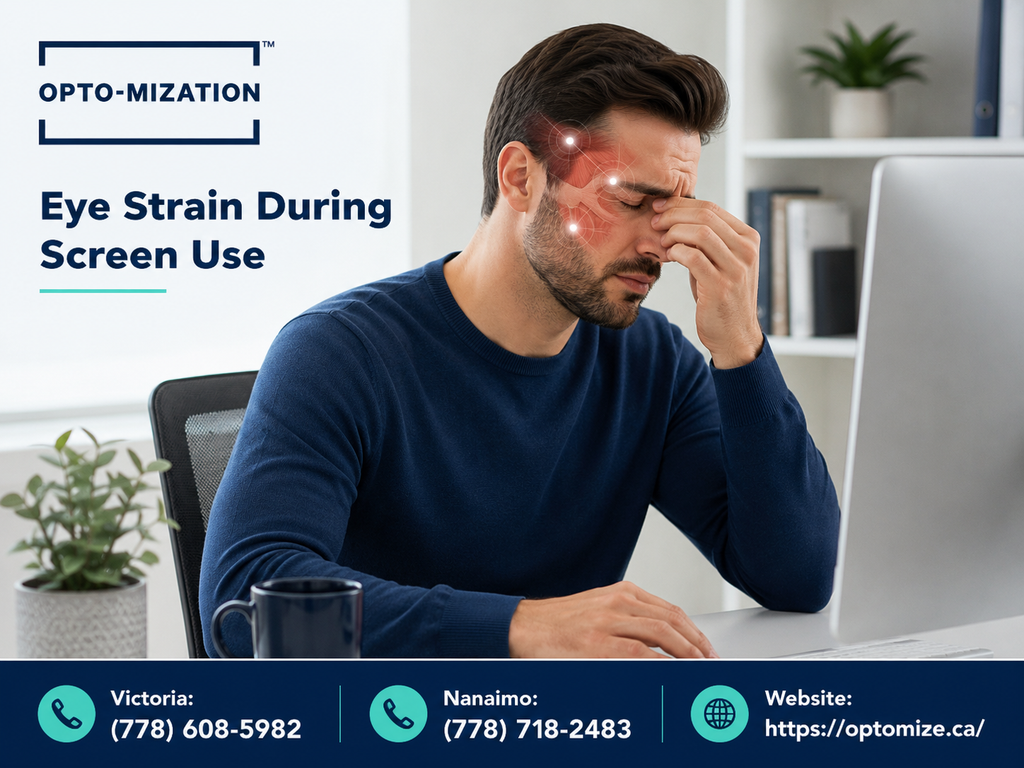
Research on convergence insufficiency, one of the more common binocular vision disorders, suggests it affects a notable percentage of school-age children and adults. Despite its prevalence, it is frequently missed in standard vision screenings because the tests used don’t assess near-range binocular coordination under sustained effort.
Could Eyelid Twitching Be Related to a More Serious Condition?
In rare cases, persistent eyelid twitching is associated with neurological conditions. Blepharospasm involves involuntary, forceful closure of the eyelid and is different in character from common myokymia. Hemifacial spasm involves twitching that spreads across one side of the face and typically has a vascular or nerve-compression cause. These conditions are uncommon, but they do require medical evaluation and should not be managed by waiting them out.
For patients who have experienced a concussion or other neurological event, visual symptoms including twitching, light sensitivity, and difficulty tracking can be part of post-concussion syndrome. Vision therapy following neurological conditions has shown meaningful benefit for many patients who experience these kinds of persistent visual disruptions.
Post-concussion vision problems are reported in a significant proportion of patients who sustain mild traumatic brain injuries. Symptoms can include eye movement difficulties, focusing problems, light sensitivity, and in some cases, eyelid sensitivity or involuntary muscle activity around the eye. These symptoms often persist well beyond the acute recovery phase and respond to targeted rehabilitation approaches.
Frequently Asked Questions
When should I be worried about my eyelid twitching?
Most eyelid twitching is benign and resolves on its own within a few days. You should seek a professional evaluation if the twitching persists beyond two to three weeks, spreads to other parts of your face, causes the eyelid to close completely, or accompanies visual symptoms like double vision, blurred vision, or headaches. Twitching that consistently occurs during reading or screen use may also indicate a functional vision issue worth investigating.
Why is only one eye constantly twitching?
Single-eye twitching is actually quite typical for benign myokymia. The orbicularis oculi muscle in one eye may be more fatigued or irritated than the other, especially if you have a dominant eye that carries more of the visual workload. Persistent one-sided twitching that doesn’t resolve, or that spreads across one side of the face, could indicate hemifacial spasm and should be assessed by a medical professional.
Does eyelid twitching mean high blood pressure?
Eyelid twitching is not a reliable indicator of high blood pressure. There’s no strong clinical link between the two. High blood pressure is often asymptomatic, which is why it’s sometimes called the “silent condition.” If you’re concerned about blood pressure, speak with your family physician directly. Eyelid twitching is far more commonly related to fatigue, stress, or visual strain than to cardiovascular issues.
What does it mean if a woman’s left eyelid twitches?
From a medical standpoint, the left eyelid twitching in women has the same potential causes as twitching in any other eyelid in any person: fatigue, stress, caffeine, dry eyes, or visual strain. Cultural and folkloric interpretations of eyelid twitching vary widely across different traditions, but there is no physiological distinction between left and right eyelid twitching, or between men and women, in terms of cause or clinical significance.
Is eye twitching a mini stroke?
Eyelid twitching by itself is not a sign of a stroke or TIA (transient ischemic attack). Stroke symptoms typically include sudden weakness or numbness on one side of the body, facial drooping, slurred speech, vision loss, or severe headache. A twitch in the eyelid muscle does not fit that profile. However, if you experience sudden vision changes, weakness, or any of the classic stroke warning signs alongside facial muscle changes, seek emergency care immediately.
Conclusion
An eyelid twitch is easy to dismiss, and most of the time that’s completely reasonable. A few bad nights, too much coffee, a stressful week, and it resolves. But when it keeps coming back, or when it shows up reliably alongside reading fatigue, headaches, or difficulty concentrating, it’s telling you something about how hard your visual system is working.
Vision problems aren’t always about sharpness. Sometimes they’re about how efficiently the eyes and brain coordinate, especially under sustained near demand. That’s a dimension of vision that most standard exams don’t evaluate, which is why so many people with functional vision issues are told their eyes are fine when the underlying problem is still very much present.
If your eyelid keeps fluttering and lifestyle changes haven’t made a lasting difference, a functional vision assessment at Opto-Mization can help identify whether visual strain or binocular vision dysfunction is part of the picture. The clinic serves patients across Greater Victoria and Nanaimo, BC, and focuses specifically on the kind of visual assessment that goes beyond the eye chart.
Book a functional vision assessment at Opto-Mization and find out what your standard eye exam may have missed. Visit optomize.ca to learn more or request an appointment.