Many children on the autism spectrum have vision problems that go undetected for years, not because their eyesight is poor, but because the way their eyes and brain work together is disrupted in ways a standard eye chart cannot measure. These functional vision issues can intensify sensory sensitivities, interfere with learning, and contribute to the behavioral patterns that families and teachers often attribute entirely to autism itself. Understanding this connection can open doors to support that many families in Victoria, BC have never been offered.
Key Takeaways
- Children with autism have higher rates of functional vision problems, including difficulty with eye teaming, eye tracking, and visual processing, compared to the general pediatric population.
- A standard eye exam measures visual acuity but does not assess how the eyes coordinate, focus under load, or process visual information, meaning these problems are routinely missed.
- Visual dysfunction can look like sensory overload, attention problems, or avoidance behaviors, making it easy to attribute everything to autism when a treatable vision issue is also present.
- Vision therapy is an evidence-supported treatment option that can reduce visual symptoms and improve a child’s comfort, focus, and daily functioning.
- A functional vision assessment is the starting point for identifying whether a child’s struggles have a visual component that can be addressed.
Things You Must Know
1. Passing a standard eye exam does not rule out a vision problem.
Most school vision screenings and routine optometry appointments test whether a child can see the letters on a chart at 20 feet. They do not measure how well the eyes team together, whether the focusing system holds steady during near work, or how efficiently the brain processes what the eyes send. A child can score 20/20 and still have a significant functional vision problem. If your child has already “passed” an eye exam and is still struggling, that result does not close the door on vision as a contributing factor.
2. Visual symptoms in autistic children often look like behavioral symptoms.
A child who avoids reading, melts down in brightly lit stores, covers one eye during close tasks, or seems easily overwhelmed in busy visual environments may be responding to genuine visual discomfort. These reactions are often interpreted as purely sensory or behavioral in origin. In many cases, there is a functional vision component driving or amplifying those responses. Identifying it does not replace autism support strategies; it adds a layer of understanding that can make those strategies more effective.
3. Functional vision assessments require a specialist, not a general optometrist.
Not every eye care provider is trained to evaluate binocular vision, visual processing, eye tracking, or how the visual system performs under the specific demands placed on it during reading and learning. A comprehensive functional vision assessment measures these skills in depth. For families in Victoria, BC and surrounding areas, finding a provider who specializes in pediatric functional vision is worth the effort, particularly if a child has already gone through multiple evaluations without a clear explanation for their difficulties.
Why Do So Many Autistic Children Have Vision Problems?
The connection between autism spectrum disorder (ASD) and visual dysfunction is not coincidental. Both involve the way the brain processes incoming information, and the visual system is one of the most neurologically demanding sensory systems a child has.
Research consistently shows that children with autism experience higher rates of strabismus, convergence insufficiency, and visual processing disorders compared to neurotypical children. A peer-reviewed study on ophthalmologic manifestations in ASD found strabismus present in 15.4% of patients and convergence altered in more than 25% — figures substantially higher than those seen in the general pediatric population, and likely an undercount given how rarely these issues are screened for in this population.
The challenge is that autism already affects sensory processing, communication, and behavior, so when a vision problem adds to that load, its contribution is invisible. Parents see a child who struggles. Clinicians often see autism. The visual system goes unexamined.
What Functional Vision Problems Look Like in Kids on the Spectrum
The signs of a functional vision problem in an autistic child can be subtle or can closely resemble other autism-related traits. The table below outlines common visual symptoms and how they tend to present in this population.
| Visual Problem | What It Can Look Like | Often Attributed To |
| Convergence insufficiency | Avoiding close work, covering one eye, losing place while reading | Inattention, task avoidance, ADHD |
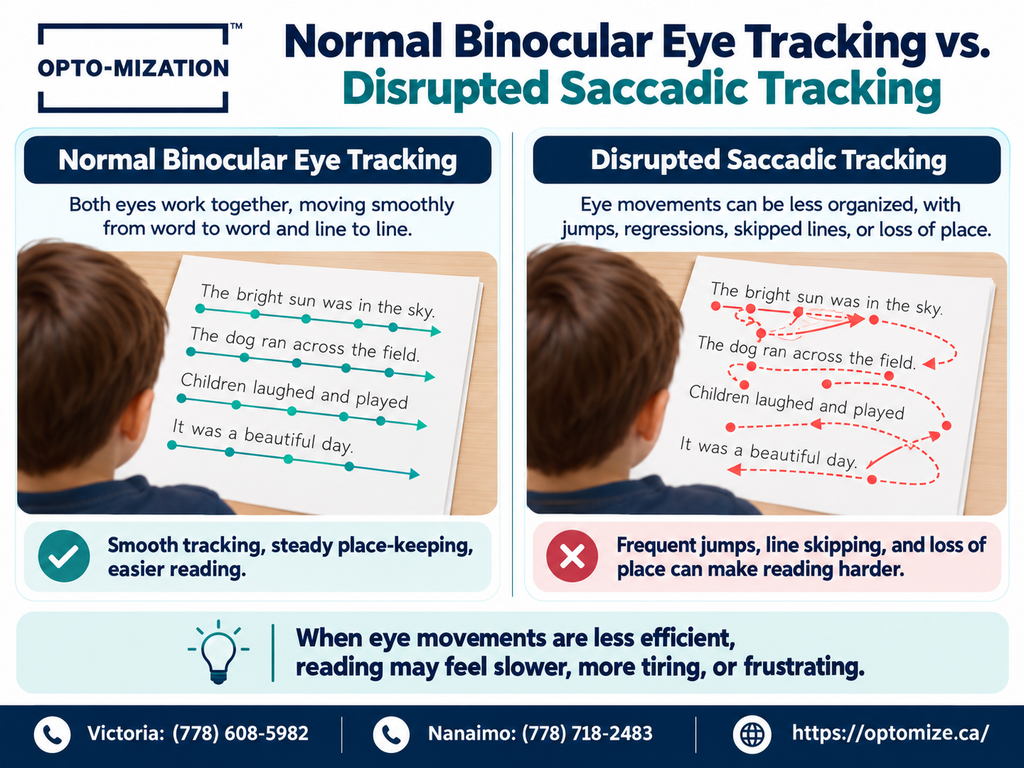
| Poor eye tracking | Skipping words or lines, re-reading, slow reading pace | Dyslexia, reading disability |
| Visual processing disorder | Difficulty copying from a board, poor handwriting, confusion with similar letters | Learning disability, fine motor issues |
| Light sensitivity | Distress in fluorescent lighting, sunlight, or busy visual environments | Sensory processing disorder |
| Strabismus or eye turn | Reduced eye contact, head tilting, avoidance of face-to-face interaction | Social communication differences |
None of these presentations are exclusive to vision problems, and autism is a genuine explanation for many of them. The issue is that a co-occurring vision problem is treatable, and leaving it unaddressed means a child carries two burdens when intervention could reduce one of them.
How Light Sensitivity and Visual Overload Affect Autistic Children
Sensory overload is a well-documented experience for many autistic individuals, and the visual system is a significant contributor. Fluorescent lighting, crowded visual environments, and high-contrast patterns can trigger distress responses that disrupt learning and daily life.
Some researchers have proposed that heightened visual sensitivity in autism may stem from atypical magnocellular pathway function, a neural processing route involved in motion detection and peripheral vision. A 7-Tesla fMRI study of the visual sensory thalamus found diminished magnocellular responses in autistic individuals compared to controls, supporting the long-standing hypothesis that magnocellular visual system alterations are part of autism’s sensory profile. Disruption in this pathway can cause visual environments to feel unpredictable or overwhelming, contributing to avoidance behaviors and anxiety.
For children in busy classroom settings, such as many schools across Victoria, these responses are not simply behavioral choices. The visual system is genuinely struggling to manage input. A functional vision assessment can clarify how much of that overload has a manageable visual component, and whether tinted lenses, visual supports, or vision therapy could reduce the burden.
For a closer look at how overwhelming visual environments affect children’s eyes, the article on busy classrooms and visual overload covers the mechanisms in more depth.
The Strabismus and Autism Connection
Strabismus, where one eye turns inward or outward rather than aligning with the other, occurs at higher rates in children with autism than in the general population. A meta-analysis of strabismus prevalence across over 100,000 autistic individuals found rates 3 to 10 times that of the general population. An eye turn disrupts binocular vision, makes depth perception unreliable, and can cause suppression where the brain essentially ignores input from one eye to avoid double vision.
For an autistic child already navigating a world that can feel visually overwhelming, strabismus adds another layer of visual confusion. It can also affect social interaction in ways that compound autism-related social differences. When eye contact is uncomfortable or visually disorienting, a child avoids it, and that avoidance tends to be attributed entirely to autism rather than to a correctable eye condition.
There is more context on why a child’s eye turns and what that means for their visual system.
What a Functional Vision Assessment Actually Measures
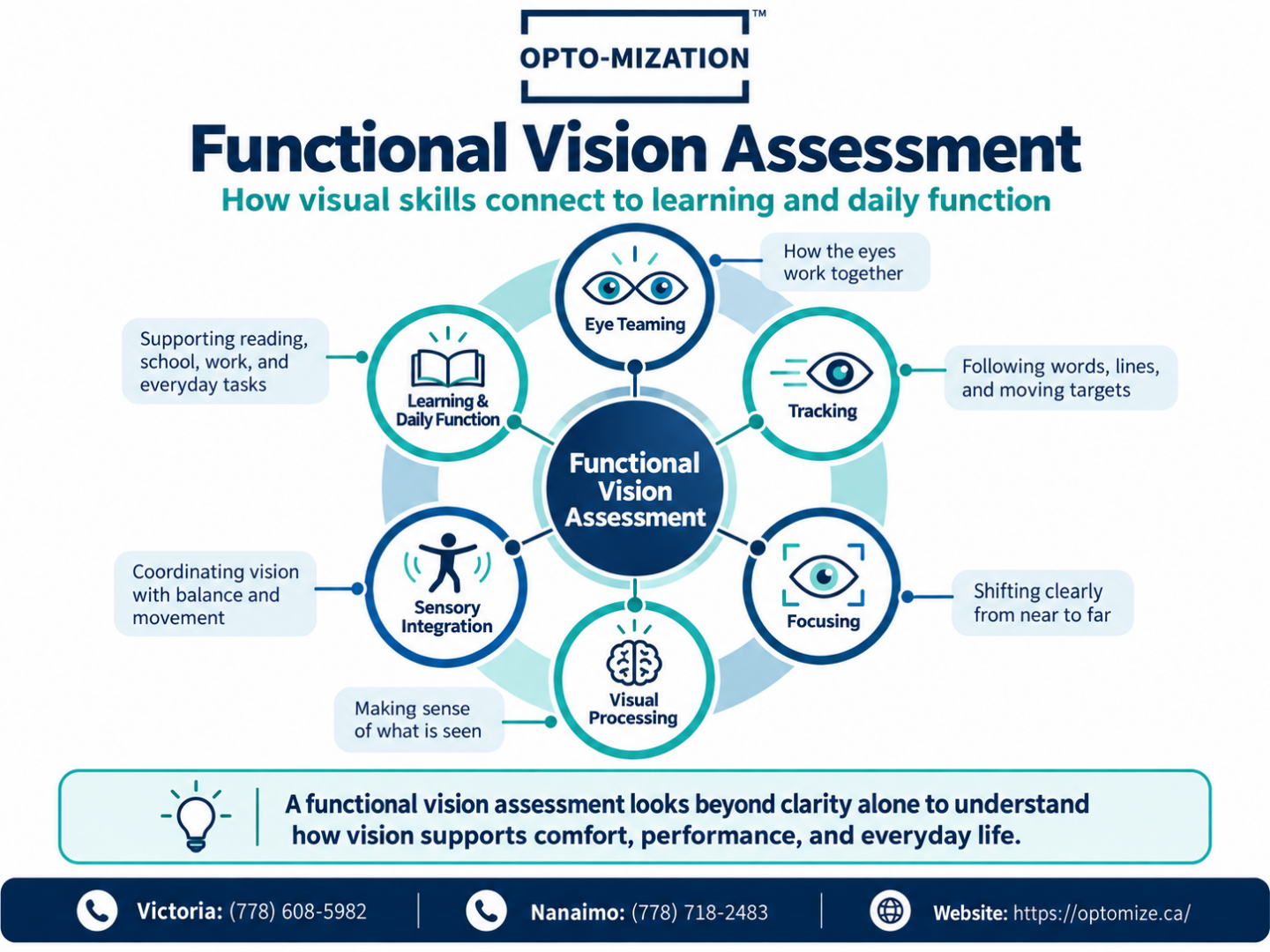
A functional vision assessment goes far beyond checking whether a child can read the bottom line of a chart. The evaluation looks at how the visual system performs under real-world demands, which is where problems in autistic children most often show up.
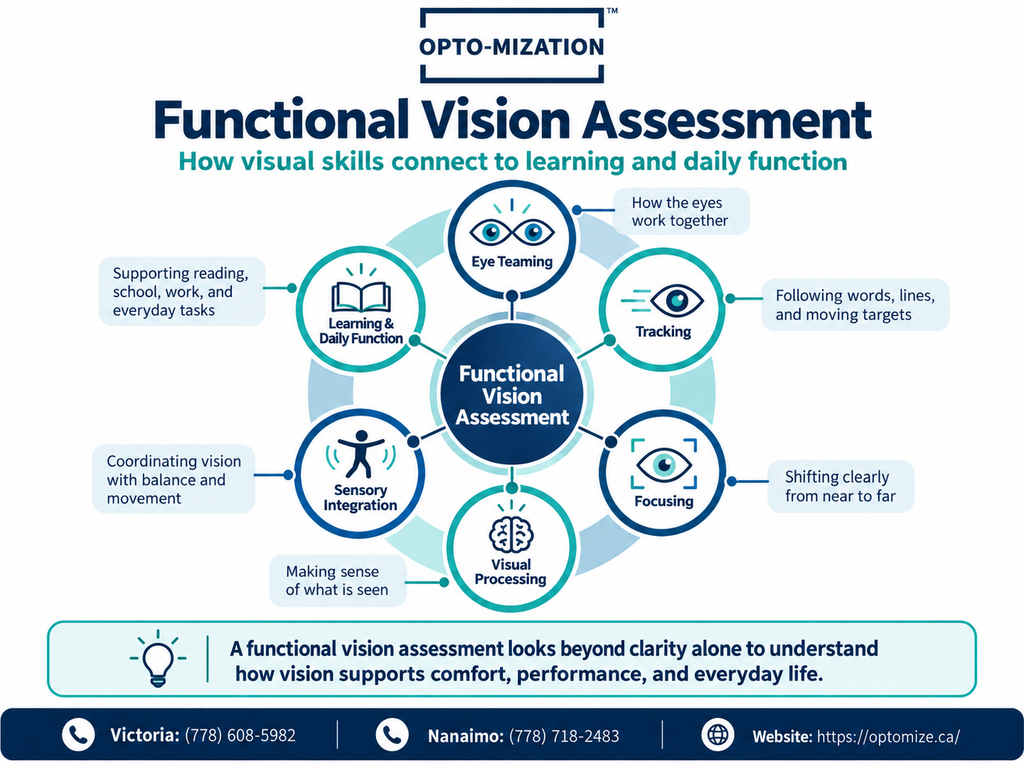
- Eye teaming (binocular vision): Whether both eyes coordinate accurately during near and distance tasks, including convergence and divergence under load.
- Eye tracking (saccades and pursuits): Whether the eyes move smoothly and accurately across a line of text or follow a moving target without losing position.
- Focusing (accommodation): Whether the focusing system adjusts quickly and holds steadily between near and far targets, and whether it fatigues under sustained near work.
- Visual processing: How the brain interprets, organizes, and acts on what the eyes send, including spatial processing, visual memory, and figure-ground discrimination.
- Sensory integration: How visual input interacts with vestibular and proprioceptive input, which is often disrupted in autism and can affect balance, coordination, and comfort in busy environments.
For autistic children, the assessment process may be adapted to accommodate communication differences, sensory sensitivities, and attention spans. An experienced clinician understands that the examination itself needs to be structured in a way the child can participate in meaningfully.
Can Vision Therapy Help Children on the Autism Spectrum?
Vision therapy for autistic children focuses on the specific functional deficits identified during assessment, such as convergence insufficiency, poor saccadic control, or visual processing difficulties. A prospective study on vision therapy outcomes in children with ASD found significant post-therapy improvements in visual perceptual skills and oculomotor functions, with children completing the program showing large effect sizes. Outcomes vary depending on the child, the severity of the problem, and the consistency of the therapy program.
Vision therapy does not treat autism. It addresses a co-occurring visual dysfunction that may be adding to a child’s difficulties. For families who have already invested heavily in OT, speech therapy, and behavioral support, adding vision therapy to the picture can feel like yet another appointment. The more useful frame is this: if a correctable visual problem is making every other challenge harder, treating it gives the other supports more room to work.
Reading about eye teaming and reading success in children can help parents understand why this matters for academic function specifically.
Common Mistakes Parents and Clinicians Make
- Assuming a passed school screening rules out vision problems. Screenings test acuity only. They are not designed to catch functional vision deficits.
- Attributing all avoidance and discomfort to autism alone. Autism is real, and so are co-occurring conditions. Both deserve investigation.
- Waiting until a child is older to assess vision. Earlier identification allows earlier intervention, and the visual system is more adaptable in younger children.
- Choosing vision therapy based on proximity rather than specialization. Not all optometry practices offer or specialize in functional vision therapy. The provider’s training and approach matters significantly.
- Expecting a quick fix. Vision therapy is a structured program over weeks or months, not a single visit. Realistic expectations from the start make it easier for families to stay consistent.
Frequently Asked Questions
Is strabismus common in autism?
Strabismus occurs more frequently in children with autism than in the general pediatric population. The exact rate varies across studies, but the association is well-documented. An eye turn in an autistic child warrants evaluation by a specialist in functional vision, not just a general optometrist, because the management approach and its interaction with the child’s broader visual processing needs are more complex than in a neurotypical child.
Can vision therapy help people with autism?
Vision therapy can help address specific functional vision problems that co-occur with autism, such as convergence insufficiency, poor eye tracking, or visual processing difficulties. It does not treat autism itself. For children where a functional vision problem is identified and confirmed, a tailored vision therapy program can reduce visual symptoms, improve reading and learning performance, and lower the sensory load the child experiences daily. Results depend on the specific deficits present and the child’s ability to engage with the program.
Is there a way to prevent autism spectrum disorder?
Current research does not support any proven method of preventing autism spectrum disorder. Autism is a neurodevelopmental condition shaped by a complex mix of genetic and environmental factors that are not yet fully understood. The focus in most evidence-based clinical settings is on early identification and support, not prevention. If your concern is helping an autistic child thrive, identifying and addressing co-occurring conditions, including functional vision problems, is a practical and meaningful place to invest energy.
How to reduce visual stimming in autism?
Visual stimming, such as hand-flapping near the eyes, staring at lights, or side-glancing, often serves a regulatory function for autistic individuals. Reducing it without understanding its purpose is rarely productive. That said, some visual stimming may be intensified by underlying visual discomfort or dysfunction. A functional vision assessment can clarify whether a treatable visual problem is contributing. Occupational therapists with sensory integration training are also well-positioned to support families working on this question.
How to improve eye contact in autism?
Reduced eye contact in autism is often tied to sensory discomfort, social processing differences, or both. Forcing eye contact is not recommended and can increase distress. If a child also has strabismus or binocular vision dysfunction, eye contact may be physically uncomfortable as well as socially challenging. Addressing any visual component through a functional vision assessment is a reasonable first step. Behavioral and social communication supports, typically through speech-language therapy or ABA, address the social processing dimension.
What Families in Victoria, BC Can Do Next
If your child is on the autism spectrum and you have noticed reading avoidance, sensitivity to light or busy environments, poor handwriting, or difficulty with near tasks, their visual system deserves a closer look. A standard eye exam is not enough to rule out functional vision problems in this population.
Opto-mization in Victoria, BC offers comprehensive functional vision assessments specifically designed to identify the visual problems that standard exams miss. The clinic’s approach evaluates how the eyes and brain work together under real demand, not just whether a child can see the chart on the wall. For families who want answers rather than more unanswered questions, a functional assessment is where to start.
Call Opto-mization at (778) 608-5982 to book a functional vision assessment for your child. If you are not sure whether your child’s symptoms point to a vision problem, the team can help you figure out whether an assessment makes sense before you commit to anything further.