
When a child’s eye turns inward or outward only some of the time, it often signals intermittent strabismus, a condition where the eyes do not consistently align together. This can occur during fatigue, illness, or periods of intense concentration. Early assessment by a developmental optometrist is important because the brain can begin to suppress the turning eye over time, which affects long-term vision development.
Key Takeaways
- Occasional eye turning is often a sign of intermittent strabismus, not just a quirk of development.
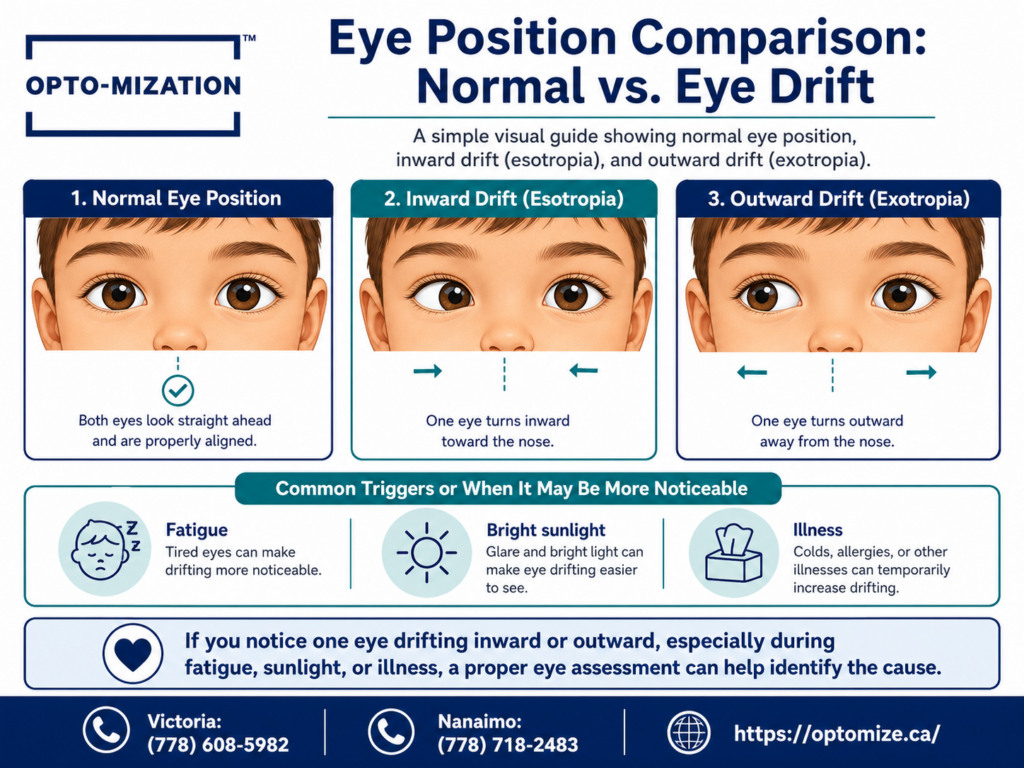
- The eye may drift inward (esotropia) or outward (exotropia), and each has different underlying causes.
- Fatigue, illness, bright sunlight, and visual stress can trigger an episode in otherwise typical-seeming children.
- The brain can start ignoring the turning eye to avoid double vision, which may lead to amblyopia (lazy eye) if left unaddressed.
- Intermittent strabismus does not always resolve on its own and benefits from professional evaluation sooner rather than later.
- Treatment options range from corrective lenses and vision therapy to patching or, in some cases, surgery.
Things You Must Know
1. “Intermittent” Does Not Mean “Minor”
Many parents assume that because the eye turn only happens sometimes, it is not a serious concern. In reality, the brain compensates for the misalignment by suppressing visual input from the drifting eye, a process that can quietly reduce vision in that eye over months or years. Early intervention tends to produce significantly better outcomes than waiting to see if the child grows out of it.
2. A Routine Pediatric Eye Exam May Not Catch It
Standard visual acuity tests (the letter chart on the wall) are not designed to detect alignment problems, especially intermittent ones. A functional or developmental vision assessment covers eye teaming, tracking, focusing, and binocular coordination, which are the areas most relevant when a parent suspects something is off with how their child’s eyes work together. If you have concerns, ask specifically for an assessment that includes eye alignment and binocular vision testing.
3. The Timing of Episodes Can Be a Diagnostic Clue
Noting when the eye turn appears (during reading, after school, in bright sunlight, when the child is tired or sick) helps the optometrist identify the type and severity of the condition. Before your appointment, keep a brief log of when episodes occur, how long they last, and which eye appears to turn. This information can meaningfully shorten the path to an accurate diagnosis.
What Does It Mean When a Child’s Eye Turns in or Out Only Sometimes?
If you have noticed your child’s eye drifting to one side only to correct itself a moment later, you are likely observing intermittent strabismus. This is a form of eye misalignment where the two eyes do not always point at the same target at the same time. Unlike constant strabismus, where the misalignment is always visible, the intermittent type comes and goes, which makes it easy to dismiss or wait out.
The eye can drift inward toward the nose (called intermittent esotropia) or outward toward the ear (called intermittent exotropia). Both types involve a breakdown in the brain’s ability to keep both eyes coordinated under certain conditions. The misalignment typically becomes visible during moments of visual fatigue, stress, daydreaming, illness, or distance viewing.
Why Does the Eye Turn In? Understanding Esotropia
Inward eye turning, where the eye moves toward the nose, is called esotropia. In children, this often relates to the visual system’s struggle to manage focusing demands, particularly for near tasks like reading or looking at screens. The medical term for this specific pattern is accommodative esotropia, and it is frequently associated with uncorrected farsightedness (hyperopia).
When a farsighted child tries to focus on something close up, the brain sends an extra focusing signal to the eyes. This signal is also linked to the inward turning reflex, and in some children, the reflex overcorrects, pulling one eye inward. Glasses that correct the farsightedness often reduce or eliminate the turn because they take the extra focusing effort away.
Accommodative esotropia typically appears between the ages of 2 and 3, though it can emerge earlier or later. It is one of the most common forms of inward eye turning in young children and responds well to optical correction when identified early.
Not all inward turns are accommodative. Some children have a muscular imbalance that causes one eye to turn in even with the right prescription in place. These cases may require additional intervention such as vision therapy or, in some situations, surgical correction of the eye muscles.
Why Does the Eye Turn Out? Understanding Exotropia
Outward drifting, where the eye moves toward the ear, is called exotropia. The intermittent version is the most common form of strabismus seen in older children. It often appears during distance viewing, daydreaming, or when the child is tired. Many parents first notice it outside on bright days, because squinting or closing one eye in sunlight is a classic sign that a child is trying to suppress double vision from an outward-drifting eye.
Intermittent exotropia affects an estimated 1 in 100 children and is more commonly diagnosed in school-age children than in toddlers. Research suggests that without treatment, a portion of intermittent exotropia cases progress to become constant over time.
The brain manages the outward drift by suppressing the image from the deviating eye, which prevents double vision but reduces binocular depth perception. Over time, this suppression can affect how well the two eyes work together as a team, which has real implications for reading, sports, and spatial tasks.

What Triggers an Intermittent Eye Turn?
Understanding what causes the turn to appear helps parents track it accurately and gives the optometrist useful clinical information. The most common triggers include:
- Fatigue: The visual system requires active muscular effort to maintain alignment. When a child is tired, that effort drops off and the weaker control system shows itself.
- Illness or fever: Physical stress taxes the nervous system broadly, including the brain’s ability to coordinate the eyes.
- Bright outdoor light: Strong light causes one eye to suppress more readily, making an outward drift easier to observe.
- Prolonged near work: Extended reading, tablet use, or close visual tasks can overload the accommodative system and trigger an inward turn in susceptible children.
- Daydreaming or reduced attention: When a child’s visual attention relaxes, the underlying misalignment surfaces because there is less active effort to maintain fusion.
How Does Intermittent Strabismus Affect a Child Day to Day?
Children do not always complain about what they are experiencing visually because they have often adapted to it without knowing anything is different. However, the effects can surface indirectly. Poor reading stamina, avoiding activities that require sustained near focus, headaches after visual tasks, clumsiness, or difficulty catching a ball can all connect to underlying binocular vision problems.
The role of eye teaming and depth perception in children’s reading success is significant. When the two eyes are not consistently working together, the brain receives conflicting signals, which makes reading slower, less accurate, and more tiring. A child who avoids books or loses their place frequently may be dealing with more than a motivation issue.
Studies in developmental optometry have found that children with unaddressed binocular vision disorders, including intermittent strabismus, are at higher risk for reading difficulties and academic underperformance compared to children with well-functioning binocular vision.
Comparing Types of Intermittent Eye Turns: A Quick Reference
| Feature | Intermittent Esotropia (Inward) | Intermittent Exotropia (Outward) |
| Direction of drift | Toward the nose | Toward the ear |
| Most common age of onset | Ages 2 to 4 (can vary) | Ages 4 to 8 (can vary) |
| Common trigger | Near work, farsightedness | Fatigue, bright light, distance viewing |
| Key first-line treatment | Prescription glasses (if accommodative) | Vision therapy, patching, or minus lenses |
| Risk if untreated | Amblyopia, constant strabismus | Loss of binocular depth perception, progression to constant |
What Happens If an Intermittent Eye Turn Is Left Unaddressed?
The visual system is most adaptable during childhood, which makes early treatment highly effective. It also means that the brain’s compensatory strategies, like suppression, become more established over time if the problem persists. A child who suppresses the turning eye consistently may develop amblyopia (commonly called lazy eye), a condition where the suppressed eye’s vision pathway does not develop normally.
Children with intermittent strabismus can also develop long-term reductions in stereopsis, the ability to perceive depth using both eyes together. Depth perception underpins a wide range of activities from sports and physical coordination to tasks as everyday as pouring a glass of water or descending stairs accurately.
If you have also noticed signs that your child skips words when reading or has difficulty with focus, these patterns can connect to the same underlying visual system. Understanding why some children skip words when reading can help clarify whether a vision evaluation is the right next step.
What Does Assessment and Treatment Look Like?
If you suspect your child has an intermittent eye turn, the process typically follows these steps:
- Book a comprehensive developmental vision exam: Request an assessment that specifically covers binocular vision, eye alignment, and eye teaming, not just visual acuity.
- Share your observations: Bring notes on when the turn appears, which eye is affected, how long episodes last, and what your child was doing at the time.
- Undergo full testing: The optometrist will assess both eyes independently and together, check for refractive errors like farsightedness, and measure the degree and frequency of the deviation.
- Receive a diagnosis and discuss options: Depending on the findings, the optometrist may recommend corrective lenses, vision therapy, patching of the stronger eye, or a referral for surgical consultation if the case warrants it.
- Follow up consistently: Intermittent strabismus is monitored over time. Progress evaluations help confirm whether the chosen approach is working and adjust the plan if needed.
Common Mistakes Parents Make When an Eye Turn Appears
- Waiting to see if the child outgrows it: Some mild cases do stabilize, but there is no reliable way to predict this without a professional assessment. Waiting while suppression develops is a significant risk.
- Assuming a basic school vision screening is sufficient: These screenings are designed to catch nearsightedness, not alignment or binocular vision problems.
- Dismissing the turn because it only lasts a few seconds: Even brief episodes indicate that the visual system is struggling under certain conditions.
- Attributing all symptoms to tiredness alone: Fatigue may be a trigger, but underlying eye teaming difficulties are the reason the turn appears when the child is tired in the first place.
- Delaying because the child has not complained: Children rarely report visual discomfort because they have no reference point for how vision is supposed to feel.

Frequently Asked Questions
What causes one eye to turn inward?
An inward turn is most commonly linked to accommodative esotropia, where uncorrected farsightedness causes the focusing system to overwork and pull one eye toward the nose. It can also result from a muscular imbalance unrelated to refractive error. A full developmental vision exam will determine whether the cause is optical, muscular, or neurological, and the treatment approach will differ depending on the underlying mechanism.
Why is my child’s eye turning outward?
Outward drifting (exotropia) typically reflects a weakness in the brain’s ability to keep both eyes pointed at the same target, particularly during distance viewing or low-attention states. It is often triggered by fatigue, illness, or bright outdoor light. In children, the brain actively suppresses the drifting eye to avoid double vision, which is why the child may not notice anything is wrong even when the turn is clearly visible to others.
Can an inward eye turn be corrected?
Yes, in many cases it can be significantly reduced or fully corrected depending on the cause and timing of treatment. Accommodative esotropia often responds well to prescription glasses that reduce the focusing overload driving the turn. For cases with a muscular component, vision therapy or surgical correction may be part of the treatment plan. The earlier an accurate diagnosis is made, the broader the range of effective options available.
What causes a turn in a child’s eye?
Eye turning in children can stem from several factors: uncorrected refractive error (particularly farsightedness), imbalance in the eye muscles, neurological differences in how the brain coordinates visual input, or a combination of these. In some children, a family history of strabismus or amblyopia increases the likelihood. Prematurity and certain developmental conditions are also associated with higher rates of eye misalignment.
Why is my 1-year-old’s eye turning inward?
In very young infants, occasional crossing of the eyes is normal in the first few months of life as the visual system is still developing. After about 4 to 6 months of age, the eyes should typically be aligning consistently. If a turn persists or appears after this window, it is worth having evaluated promptly. Infantile esotropia, which can appear in the first year of life, responds best when addressed early. A developmental optometrist or pediatric ophthalmologist can assess whether what you are seeing is within normal development or requires intervention.
Clinical guidelines generally recommend that children have their first comprehensive eye exam by 6 months of age, with follow-up assessments at age 3 and before starting school. Early screenings can identify alignment and binocular vision issues before they affect learning or development.
Treatment Options at a Glance
| Treatment | Best Suited For | Goal |
| Prescription glasses | Accommodative esotropia, refractive error | Reduce focusing demand to decrease the turn |
| Vision therapy | Intermittent exotropia, binocular dysfunction | Strengthen eye teaming and fusion control |
| Patching or penalization | Amblyopia present alongside the turn | Stimulate the suppressed eye to develop vision |
| Surgical correction | Large, constant, or non-responsive deviations | Realign the eye muscles structurally |
A Note on Hidden Vision Problems
Intermittent strabismus sometimes appears alongside other learning-related vision difficulties that parents and teachers may not immediately connect to eyesight. Children with attention challenges or reading difficulties sometimes have underlying binocular vision problems contributing to their struggles. Learning about hidden vision problems in children with dyslexia and ADHD can help clarify whether a vision evaluation is part of a broader picture worth exploring.
Ready to Get Clarity on Your Child’s Eye Turn?
If you have noticed your child’s eye turning in or out, even occasionally, it is worth getting a professional opinion rather than waiting. Intermittent strabismus is manageable when caught early, and a comprehensive developmental vision assessment provides a clear picture of what is actually happening and what the realistic options are.
Opto-mization offers thorough binocular vision and developmental eye assessments designed specifically to catch the kinds of conditions that standard screenings miss. If you have questions or want to book an appointment, call (778) 608-5982. Getting your child’s vision assessed is one of the most straightforward steps you can take toward protecting their visual development and supporting their ability to learn and thrive.