
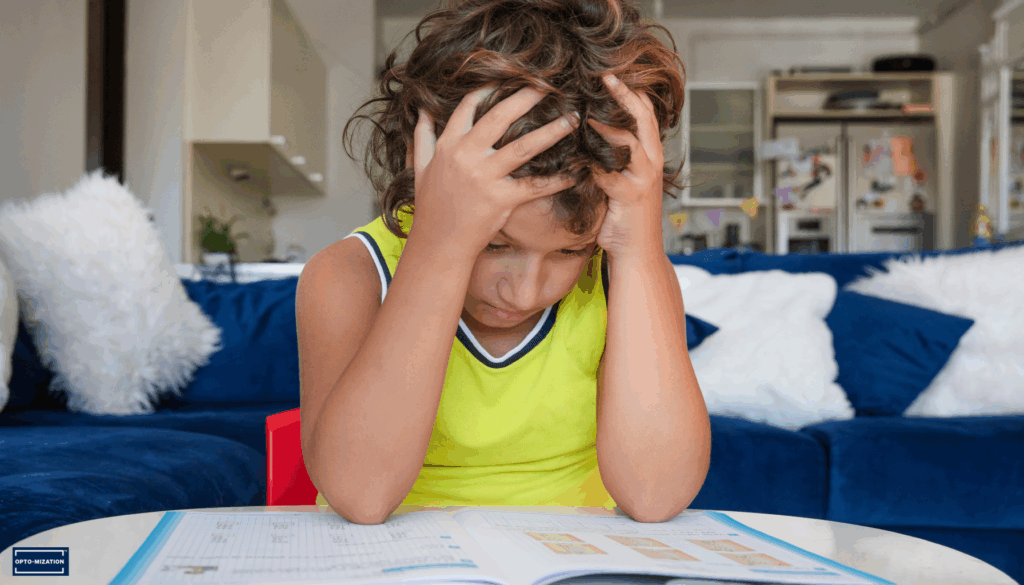
When a child struggles in school, the first concerns often focus on learning ability, attention, or behavior. Parents may hear that their child is easily distracted, unmotivated, emotionally reactive, or inconsistent in their performance. Teachers may notice that a student understands concepts when explained verbally but struggles with reading, writing, or sustained visual tasks. Over time, these patterns can lead to labels such as learning difficulties or behavioral challenges.
What is often overlooked in these situations is how much effort a child’s visual system is using simply to keep up. Vision problems do not always show up as blurry eyesight or failed eye charts. In many cases, they appear as fatigue, avoidance, frustration, declining confidence, or difficulties with word recognition, reading fluency, and comprehension. Because these signs can resemble learning challenges or reading disabilities, vision issues may mimic conditions such as ADHD or dyslexia and are frequently mistaken for behavioral or academic problems rather than visual ones.
Understanding why this misdiagnosis happens can help families and educators take a more complete and supportive approach.
Book a Comprehensive Eye Exam With Functional Vision Testing
If learning or behavior concerns persist, a comprehensive eye exam that includes functional testing can help uncover visual inefficiencies that may be contributing.
Vision Is Foundational to Learning, Not Separate From It
Learning depends heavily on vision. Reading, writing, copying, using screens, and staying visually engaged in the classroom all rely on efficient coordination between the eyes and the brain. When visual skills are working well, these tasks feel manageable. When they are inefficient, learning requires significantly more effort.
As Opto-Mization explains in its discussion of how vision therapy helps children learn and thrive, vision therapy does not teach academic skills. Instead, it addresses how the eyes and brain work together so that learning tasks demand less effort. When visual efficiency improves, children often find it easier to engage with learning, even though their underlying abilities have always been there.
This distinction is critical. Vision problems do not cause learning disabilities, but they can produce many of the same signs and symptoms seen in conditions such as dyslexia, ADHD, dysgraphia, and developmental coordination disorder (DCD).
Why Vision Problems Are Easy to Miss
One of the main reasons vision problems are misdiagnosed is that children rarely complain about their vision. Most children assume that the way they see the world is normal. Rather than saying, “I can’t see” or “this feels uncomfortable,” they adapt.
As outlined in Opto-Mization’s article on signs that a child may have a vision problem, children often compensate in subtle ways. These compensations allow them to function, but at a cost.
Common compensatory behaviors include:
- Avoiding reading or written work
- Becoming restless or fidgety during near tasks
- Relying heavily on listening rather than reading
- Working more slowly than peers
- Becoming frustrated or emotional during schoolwork
Because these behaviors are not obviously visual, they are often interpreted as motivation, attention, or behavior issues.
The Overlap Between Vision Challenges and Learning Concerns
Many visual inefficiencies produce symptoms that closely resemble learning difficulties. A child with inefficient visual skills may appear capable one moment and overwhelmed the next. Performance may fluctuate based on fatigue, lighting, or task length.
This inconsistency often leads to confusion. Adults may wonder why a child can read well one day but struggle the next, or why they understand lessons but fail to complete written work efficiently.
Visual challenges can contribute to:
- Slow reading speed
- Reduced comprehension over time
- Difficulty copying from the board
- Poor visual endurance
- Avoidance of visually demanding tasks
These challenges can easily be mistaken for learning problems when the visual contribution is not recognized.
When Vision Problems Look Like Behavioral Issues
Behavior is often the first thing noticed when a child is struggling. Emotional responses tend to surface when effort outweighs reward. A child who works hard but still feels behind may become discouraged or resistant.
Visual strain can lead to behaviors such as:
- Emotional outbursts during homework
- Resistance to reading or writing
- Withdrawal from school-related tasks
- Appearing inattentive or distracted
- Low tolerance for frustration
These behaviors are often reactive rather than intentional. They reflect how difficult the task feels, not a lack of willingness to try.
The Role of Compensation and Breakdown
Children are remarkably adaptable. When vision is inefficient, they often compensate by using extra effort, relying on memory, or avoiding visual tasks altogether. This compensation can mask the issue for years.
Over time, however, compensation becomes harder to maintain. Academic demands increase, reading volume grows, and visual tasks become more complex. When compensation breaks down, behaviors often change.
This breakdown may look like:
- Sudden drop in academic performance
- Increased emotional responses
- Loss of confidence
- Refusal to engage in schoolwork
At this stage, the child is often referred for academic or behavioral evaluation, while vision remains unexamined beyond basic clarity.
Confidence as a Key Clue
Confidence plays a powerful role in how children approach learning. Repeated struggle, especially when effort does not lead to success, can erode confidence over time.
As discussed in Opto-Mization’s exploration of the link between vision therapy and self-confidence, children who experience ongoing visual strain may begin to doubt their abilities. They may internalize the idea that they are “not good” at reading or school, even when their intelligence and potential are strong.
Signs that confidence may be affected by visual strain include:
- Reluctance to try new or challenging tasks
- Fear of making mistakes
- Negative self-talk related to school
- Avoidance of academic activities
These emotional responses are often secondary effects of visual difficulty, not primary behavioral traits.

Understand Whether Vision May Be Part of the Picture
Learn how visual effort, coordination, and endurance can affect attention, reading, confidence, and classroom engagement.
Why Standard Eye Exams Don’t Resolve the Confusion
Many parents are told that their child’s vision is normal because they passed a standard eye exam. While these exams are essential for eye health and clarity, they do not evaluate how vision functions during learning.
A child can see 20/20 and still struggle with:
- Eye coordination
- Tracking accuracy
- Focusing flexibility
- Visual endurance
Without evaluating these functional skills, it is easy to conclude that vision is not part of the problem, reinforcing misdiagnosis.
Vision Therapy as a Supportive Tool, Not a Replacement
It is important to clarify what vision therapy does and does not do. Vision therapy does not replace tutoring, educational support, or behavioral strategies. It does not treat learning disabilities or behavioral diagnoses.
What it does, as Opto-Mization explains in its learning-focused content, is reduce visual barriers. When visual skills are inefficient, they place additional strain on learning. Addressing those inefficiencies can make it easier for children to benefit from the supports already in place.
When visual effort decreases, children often show:
- Improved stamina for reading and schoolwork
- Greater willingness to engage
- Reduced frustration during tasks
- Increased confidence
These changes can be mistaken for behavioral improvement, when in fact they reflect improved comfort.
Why Misdiagnosis Is So Common
Vision problems are often misdiagnosed because:
- They do not always affect clarity
- Symptoms fluctuate and appear inconsistent
- Children adapt rather than complain
- Behaviors overlap with learning and attention concerns
- Standard screenings do not assess functional vision
When these factors combine, it becomes easy to miss the visual contribution.
A More Complete Way to Look at Struggle
Recognizing vision as part of the learning picture does not invalidate other supports. Instead, it adds clarity. When vision is evaluated alongside learning and behavior, patterns that once seemed confusing often make more sense.
Questions that can help guide this broader view include:
- Does the child struggle more with visual tasks than verbal ones?
- Does performance decline as tasks get longer?
- Is effort high but progress inconsistent?
- Does confidence seem lower than expected for ability?
These patterns often point toward visual strain rather than lack of ability or motivation.
Seeing the Child More Clearly
When children are mislabeled, they often carry that label internally. Recognizing vision as a contributing factor can shift the conversation from “what’s wrong” to “what’s making this harder than it should be.”
At Opto-Mization in Victoria and Nanaimo, every comprehensive eye exam includes functional vision testing to help uncover visual inefficiencies that may be contributing to learning or behavioral challenges. By understanding how vision supports effort, confidence, and engagement, families and educators can move toward clearer answers and more effective support.
Book a comprehensive eye exam to better understand how vision may be affecting learning and behavior.