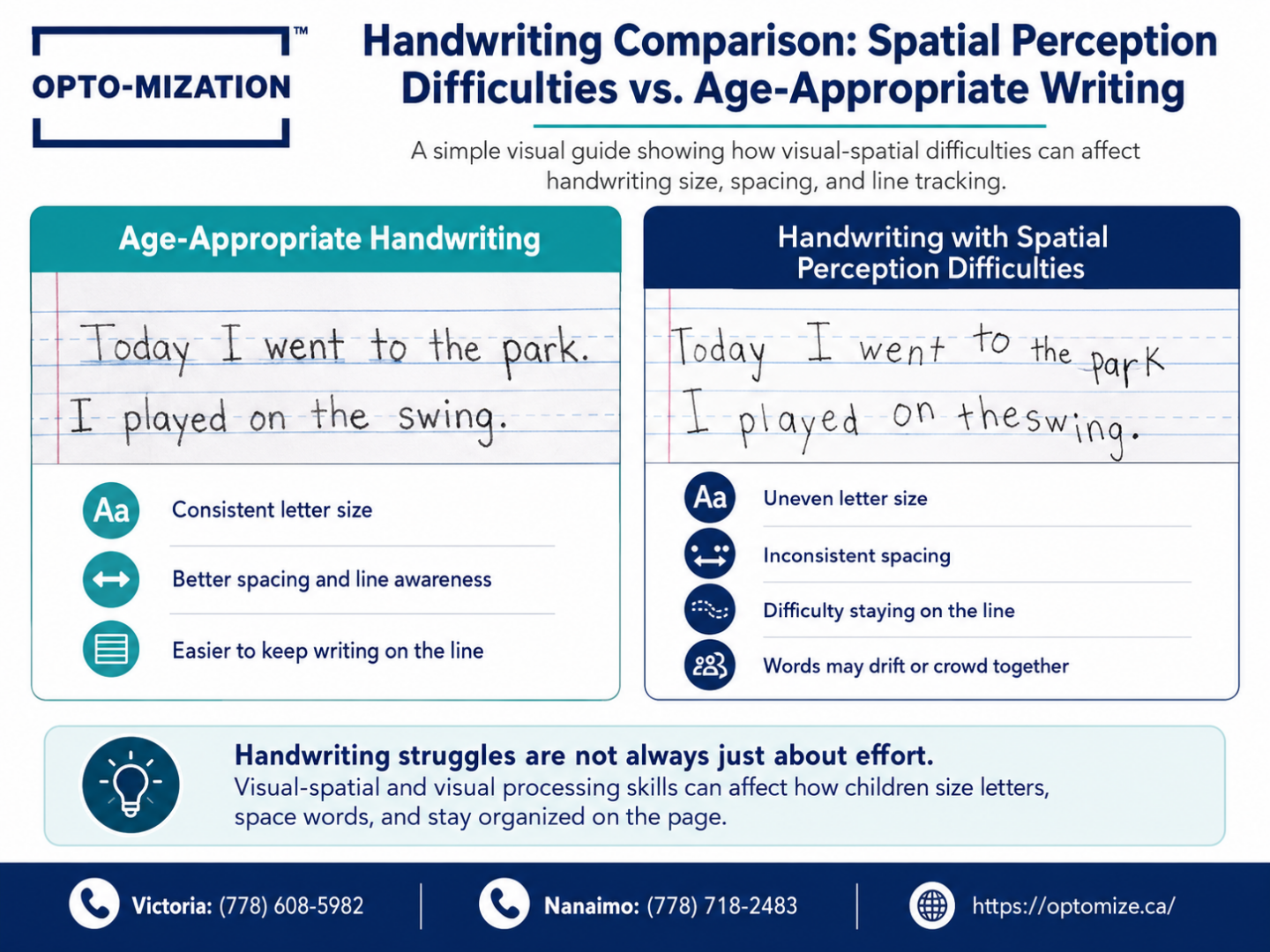
Messy handwriting and difficulty staying on writing lines are often linked to underlying visual processing or motor skill challenges, not laziness or lack of effort. Children who struggle to control letter size, spacing, or line alignment may have visual-motor integration issues, eye teaming difficulties, or other vision-related concerns that respond well to early assessment and targeted support.
Key Takeaways
- Messy handwriting is often a sign of a deeper visual or motor processing challenge, not a behavioral issue.
- Difficulty staying on the line frequently connects to poor visual-motor integration, which affects how the brain and hands work together.
- Eye teaming problems and convergence issues can make it hard for children to track lines or judge spacing accurately.
- Many children with ADHD or dyslexia also have undetected vision problems that worsen handwriting struggles.
- Early assessment by a developmental optometrist can identify root causes that standard eye exams often miss.
- With the right support, most children show meaningful improvement in handwriting legibility and confidence.
If your child’s handwriting is consistently difficult to read, letters float above or below the line, or their writing seems effortful and disorganized despite practice, it can feel frustrating for everyone. Teachers mention it. Homework becomes a battle. And your child may already feel embarrassed. What many parents don’t realize is that the root cause often has very little to do with effort or attitude, and a lot to do with how the child’s visual system is working.
Things You Must Know
1. A Standard Eye Chart Test Does Not Rule Out Vision Problems
Passing a 20/20 acuity test at school or the pediatrician’s office means a child can see clearly at a distance. It does not test how well their eyes work together, how they process visual information, or how accurately they can guide hand movements based on what they see. Children with significant visual-motor or eye teaming problems often pass standard screenings without issue, which is why these challenges go undetected for years.
2. Handwriting Struggles Rarely Improve with “More Practice” Alone
If the underlying visual or motor processing difficulty is not addressed, additional handwriting practice tends to reinforce frustration rather than build skill. Parents and teachers sometimes interpret slow progress as low effort, but the child may genuinely be working harder than peers just to produce the same result. Identifying the cause first allows interventions to actually work.
3. These Challenges Often Overlap with Other Diagnoses
Children already diagnosed with ADHD, dyslexia, or developmental delays are at higher risk for co-occurring visual processing problems. In many cases, addressing the vision component reduces the overall burden on the child and makes other therapies or academic supports more effective. A developmental vision evaluation can clarify what is driving what.
What Is Actually Happening When a Child Can’t Stay on the Line?
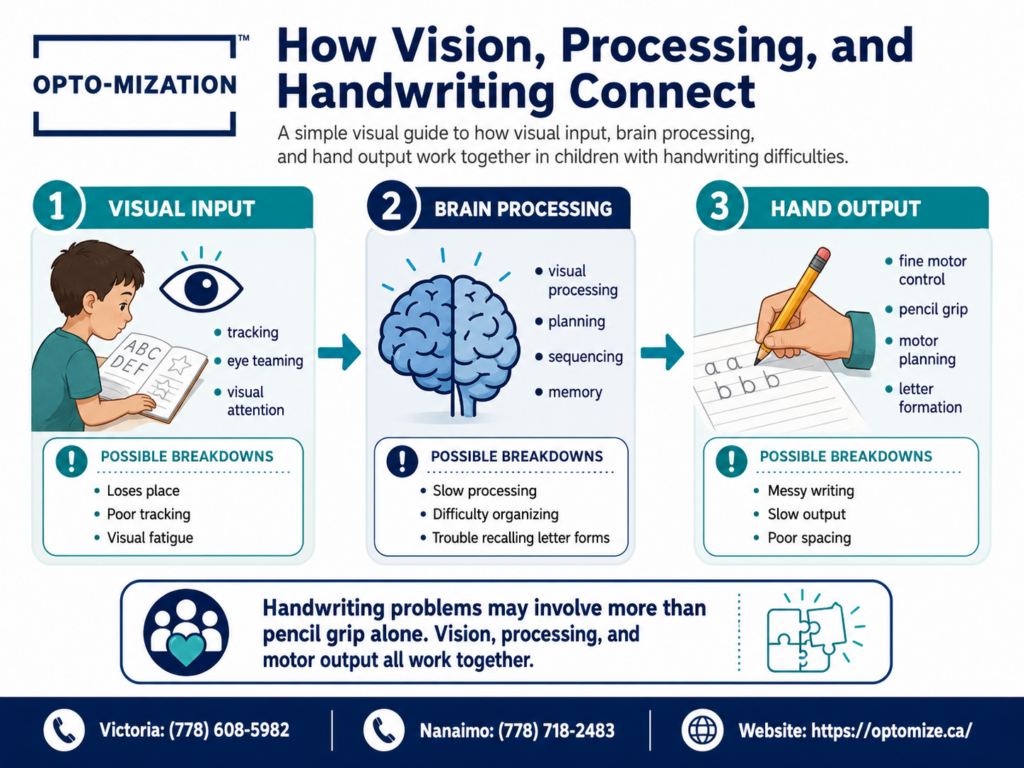
Writing on a line requires several visual and motor systems to cooperate at the same time. The child’s eyes need to aim and move together accurately (eye teaming). The brain needs to interpret the spatial layout of the page correctly (visual-spatial processing). And the hand needs to respond to that visual feedback in real time (visual-motor integration). When any one of these links is weak, the writing falls apart.
For many children, the problem is not the hand itself. The hand is receiving inaccurate or incomplete information from the visual system, so no amount of grip correction or pencil practice will fully resolve it.
The Most Common Visual Causes of Messy Handwriting
Visual-Motor Integration Difficulties
Visual-motor integration (VMI) is the ability to coordinate what the eyes see with what the hands do. A child with weak VMI may be able to see a letter perfectly and even describe it accurately, but when it comes to reproducing it on paper, the translation breaks down. Letters end up uneven, reversed, or drifting off the line.
Research suggests that visual-motor integration difficulties are among the most commonly identified contributors to poor handwriting legibility in school-age children, with some studies estimating that a notable proportion of children referred for occupational therapy assessments show measurable VMI deficits.
Eye Teaming and Convergence Problems
Eye teaming refers to how well both eyes work together as a coordinated pair. When eye teaming is off, the brain receives slightly conflicting signals from each eye. This can make lines appear to shift, blur, or become unstable, particularly during close-up tasks like reading and writing. Children often cannot describe this experience because they have nothing to compare it to. It simply feels like writing is hard.
For a deeper look at how these two systems interact, the connection between eye teaming and depth perception in children’s reading and writing success explains how convergence issues affect near-point tasks in practical terms.
Spatial Awareness and Visual Perception Issues
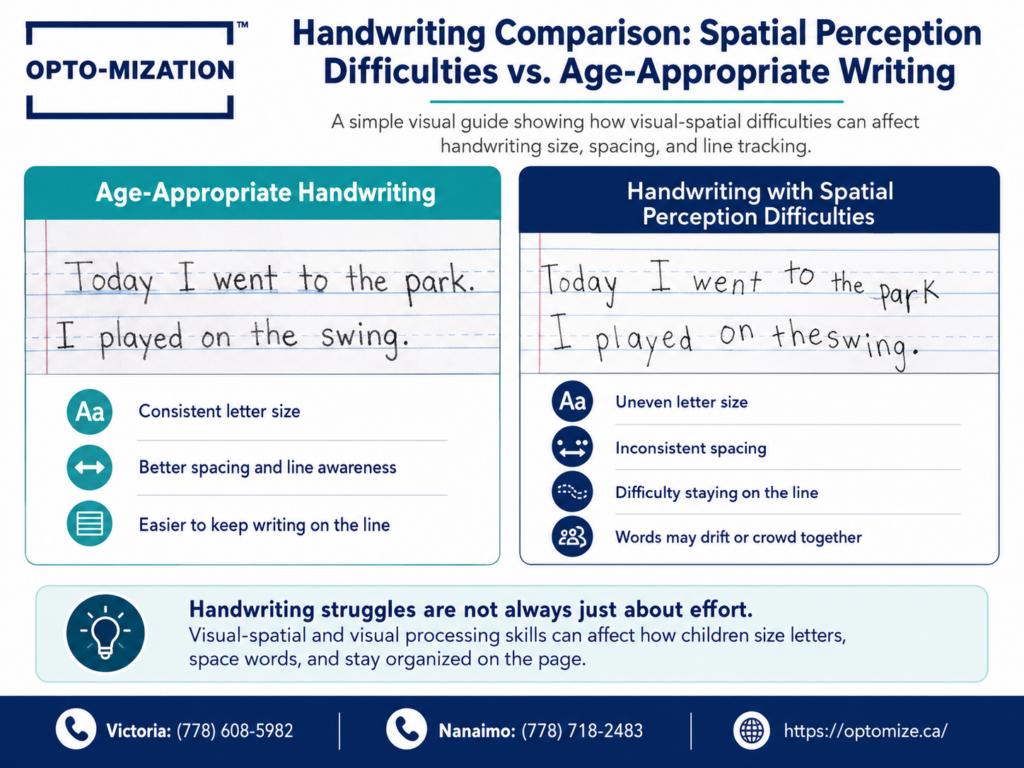
Some children struggle specifically with visual-spatial processing, which affects how they perceive distances, sizes, and the relationships between objects on a page. This shows up in handwriting as inconsistent letter sizing, poor spacing between words, or an inability to judge where one word ends and another should begin.
Is Messy Handwriting Always a Vision Problem?
Not always. Handwriting quality is influenced by several factors, and a complete picture requires considering all of them.
| Possible Cause | Common Signs | Who to Consult |
| Visual-motor integration deficit | Letters don’t match models, drifts off lines | Developmental optometrist, OT |
| Eye teaming or convergence issue | Avoids writing, closes one eye, headaches after writing | Developmental optometrist |
| Dysgraphia | Slow writing, poor grip, difficulty with spelling simultaneously | Psychologist, OT |
| Fine motor weakness | Weak grip, fatigue quickly, difficulty with scissors or buttons | Occupational therapist |
| ADHD-related attention | Inconsistent quality, better when given extra time or reminders | Pediatrician, psychologist |
Vision-related causes are frequently overlooked precisely because they are not obvious. A child whose eyes are working inefficiently will often appear fine in conversation or during play, but struggle specifically with tasks that require sustained near-point visual control, like handwriting, reading, or copying from a board.
What Does Handwriting Look Like When Vision Is the Problem?
There are certain patterns that tend to appear when a visual processing or eye teaming issue is at the root of handwriting difficulty. These are not definitive diagnoses, but they are worth noting.
- Letters consistently drifting above or below the baseline, even after correction
- Uneven letter sizing that changes across the same word or line
- Wide or inconsistent spacing between letters and words
- Letters written from right to left or numbers reversed beyond the expected age range
- The child tilting their head or covering one eye while writing
- Fatigue or complaints of headaches specifically after writing or reading tasks
- Writing that is significantly worse at the end of a page than at the beginning
Convergence insufficiency, one of the most common binocular vision disorders in children, is estimated to affect approximately 5 to 10 percent of school-age children and is frequently associated with complaints of eye fatigue, difficulty concentrating on near tasks, and deteriorating work quality over short periods.
The ADHD and Dyslexia Connection
Children who have already been identified with ADHD or dyslexia are more likely to have co-occurring visual processing difficulties. This overlap complicates the picture because behaviors associated with ADHD (avoidance, distraction, inconsistency) can look identical to behaviors driven by visual discomfort or strain.
Some research indicates that children diagnosed with ADHD show higher rates of visual processing deficits compared to neurotypical peers, and that addressing these visual challenges can meaningfully reduce the overall symptom burden related to academic performance and sustained attention tasks.
Understanding the hidden vision problems common in children with dyslexia and ADHD can help parents and educators avoid attributing all struggles to a single diagnosis when multiple factors may be present.
How Visual Skills Connect to Focus and Writing Endurance
Writing is not just a physical task. It requires the child to sustain visual attention, maintain their place on the page, and continuously monitor the relationship between their hand movement and the line. When the visual system is working inefficiently, all of this demands more mental energy than it should.
Children who tire quickly during writing, lose their place often, or become noticeably more inaccurate the longer a task goes on may be experiencing visual fatigue rather than general attention problems. Learning how visual skills affect focus and concentration in children provides useful context for parents navigating this question.
Common Mistakes Parents and Educators Make
- Assuming that passing a school vision screening means vision has been ruled out as a cause
- Focusing exclusively on handwriting drills without investigating why the child is struggling
- Attributing all handwriting problems to ADHD or laziness before a full assessment
- Waiting to seek help until the child is significantly behind peers, when earlier intervention is more effective
- Using consequences or rewards to motivate better handwriting when the problem is neurological or visual in origin
- Overlooking physical signs like head tilting, eye rubbing, or complaints of blurriness after close work
What a Developmental Vision Assessment Looks At
A developmental optometrist evaluates far more than standard acuity. The assessment typically includes:
- Eye teaming (binocular vision): How well both eyes converge and track together during near work.
- Accommodation: How accurately and efficiently the eyes shift focus between distances.
- Eye tracking: How smoothly the eyes move across a line of text or a writing surface.
- Visual-spatial processing: How the brain interprets the layout, position, and direction of shapes and symbols.
- Visual-motor integration: How accurately the child can translate visual information into controlled hand movement.
- Visual memory and discrimination: How well the child retains and distinguishes letter forms and orientations.
These are distinct from acuity testing and require specialized tools and training to evaluate properly.
| Standard Eye Exam | Developmental Vision Assessment |
| Distance and near acuity (clarity) | All acuity checks plus visual processing skills |
| Basic eye health check | Eye teaming, tracking, and convergence testing |
| Prescription for glasses if needed | Visual-motor integration and spatial processing |
| Does not assess how eyes function during sustained tasks | Identifies functional issues that affect reading and writing directly |
Frequently Asked Questions
Why is my child’s handwriting so messy?
Messy handwriting in children is most often tied to difficulties with visual-motor integration, eye teaming, or spatial processing rather than effort or attitude. When the visual system is not providing accurate feedback to guide the hand, even a motivated child will produce inconsistent, disorganized writing. A developmental vision assessment can identify whether a visual processing difficulty is at the root of the problem.
Is messy handwriting always ADHD?
No. While children with ADHD do sometimes have handwriting difficulties, messy handwriting has many possible causes, including visual processing problems, dysgraphia, fine motor delays, and convergence insufficiency. These conditions can exist independently of ADHD or alongside it. Attributing all handwriting struggles to ADHD without further assessment can delay appropriate support for the actual underlying cause.
What is the condition that causes messy handwriting?
Dysgraphia is a learning difference specifically affecting written expression and the physical act of writing, but it is not the only condition involved. Visual-motor integration disorder, convergence insufficiency, developmental coordination disorder, and visual-spatial processing deficits can all produce messy handwriting. In many children, more than one factor is present at the same time, which is why a comprehensive evaluation is more useful than a single-diagnosis approach.
What does messy handwriting indicate?
On its own, messy handwriting is not a diagnosis, but it can be a signal worth investigating. It may indicate that a child’s visual system is not processing spatial information accurately, that eye teaming is not working efficiently, or that the connection between visual input and motor output is breaking down. When handwriting difficulty is paired with other signs like avoidance of reading, frequent headaches, or poor concentration on near tasks, a developmental vision evaluation is a logical starting point.
What does ADHD handwriting look like?
Handwriting associated with ADHD tends to be inconsistent rather than uniformly poor. A child may write neatly when calm or given extra time, but produce very disorganized work when rushed, tired, or distracted. Letters may vary in size and spacing unpredictably, and the quality often shifts within the same page or even within a single paragraph. That said, these same patterns can appear with visual processing difficulties, which is why a vision evaluation is often recommended even when ADHD is already part of the picture.
Conclusion
When a child’s handwriting is consistently messy or they cannot seem to stay on the line despite effort and instruction, the most useful question to ask is not “why won’t they try harder?” but “what is making this difficult for them?” In many cases, a visual processing or eye teaming issue is doing the heavy lifting behind the scenes, and it has gone undetected because standard screenings are not designed to catch it.
Early identification makes a meaningful difference. Children who receive the right assessment and support earlier tend to build skills more effectively and recover confidence in academic settings faster than those who wait.
If you have noticed signs like drifting letters, line-tracking difficulties, head tilting while writing, or complaints of eye fatigue after desk work, a developmental vision evaluation is a practical and informative next step.
Opto-mization works with children who are struggling with handwriting, reading, and visual processing challenges. To book an assessment or ask questions about what a developmental vision evaluation involves, contact the team at (778) 608-5982.