A blind spot or missing area in your vision can have several causes, ranging from the normal physiological blind spot every eye has, to migraines with aura, retinal issues, or neurological changes. Some blind spots are harmless and temporary, while others signal a condition that needs prompt evaluation. Understanding what type you’re experiencing is the first step toward getting the right answers.
Key Takeaways
- Every human eye has a natural blind spot where the optic nerve connects to the retina, and most people never notice it because the brain fills it in.
- Temporary blind spots that come and go are often linked to migraines, visual auras, or how your eyes and brain are working together.
- Persistent or worsening blind spots can indicate retinal problems, glaucoma, or neurological changes that require evaluation.
- A standard eye exam may not catch all the functional and neurological causes of blind spots or missing areas in vision.
- Functional vision assessments look at how your eyes and brain communicate, which often reveals causes that routine testing misses.
- Treatment options vary depending on the cause, and many functional vision issues respond well to targeted therapy and specialized lens prescribing.
Noticing a gap, dark patch, or missing section in your field of vision can be unsettling, especially when it appears out of nowhere. Sometimes it flickers away after a few minutes. Other times it seems to linger. The experience varies a lot from person to person, and so do the causes behind it. What matters most is understanding what you’re dealing with, because not all blind spots are created equal.
Things You Must Know
1. Your Brain Actively Hides Your Natural Blind Spot
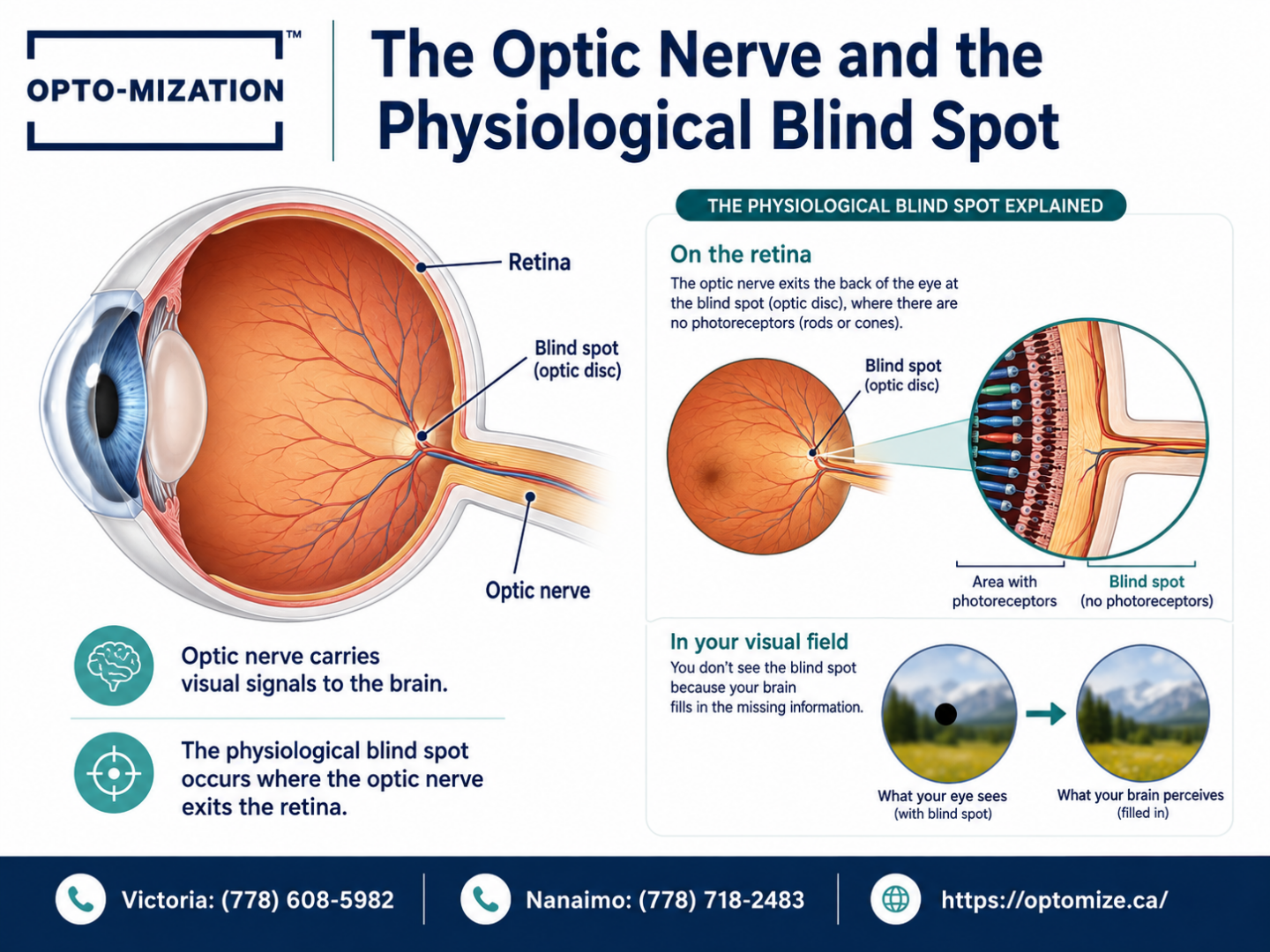
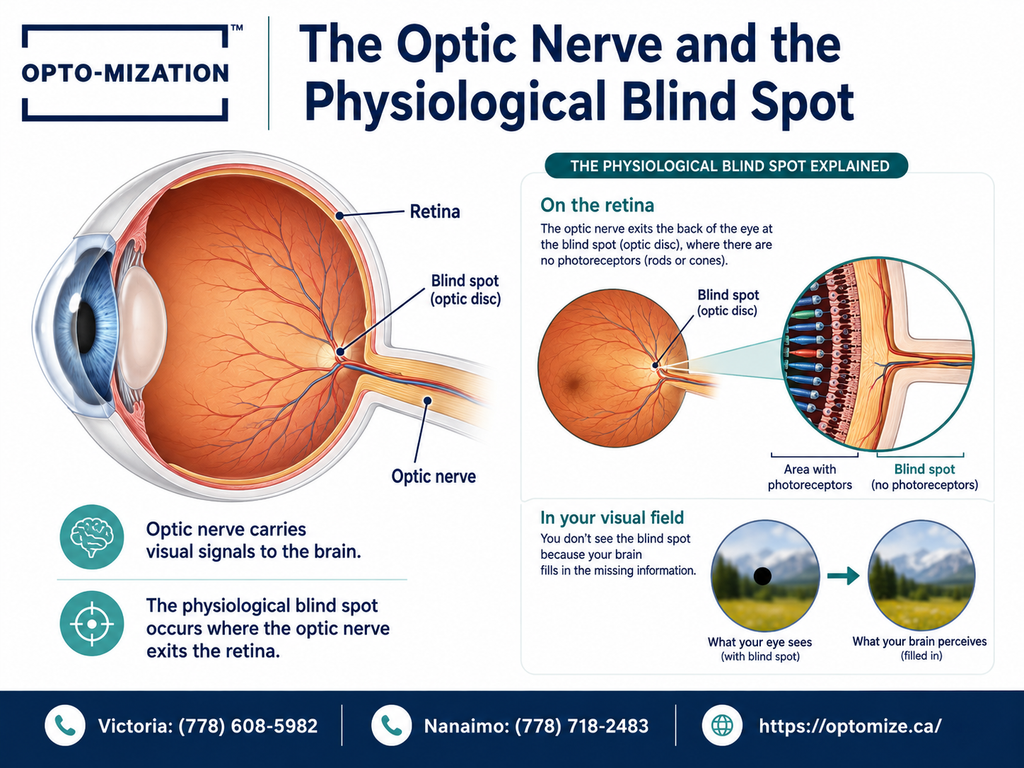
Every human eye has a physiological blind spot located where the optic nerve exits the retina. There are no photoreceptors at this point, which means no visual information is collected there. Your brain compensates by filling in that gap using surrounding visual information, so most people never consciously notice it. This process works seamlessly until something disrupts normal brain-eye communication.
2. Not All Blind Spots Are an Emergency, But Some Are
A sudden blind spot, especially one that appears in one eye only, spreads across your visual field, or comes with other symptoms like eye pain, flashing lights, or floaters, warrants prompt attention. These patterns can be associated with retinal detachment or acute glaucoma, both of which require fast care. On the other hand, a visual aura from a migraine typically resolves within 20 to 30 minutes without lasting damage.
3. Standard Eye Exams Often Don’t Test the Full Picture
Routine eye exams are designed to assess visual acuity and basic eye health. They are not designed to evaluate how your eyes and brain function as a coordinated team. If your blind spot or missing area in vision is rooted in a binocular vision dysfunction, visual processing issue, or post-concussion visual change, it may not be identified without a comprehensive functional vision assessment. Many patients go years with unresolved symptoms for this reason.
What Is a Blind Spot, Exactly?
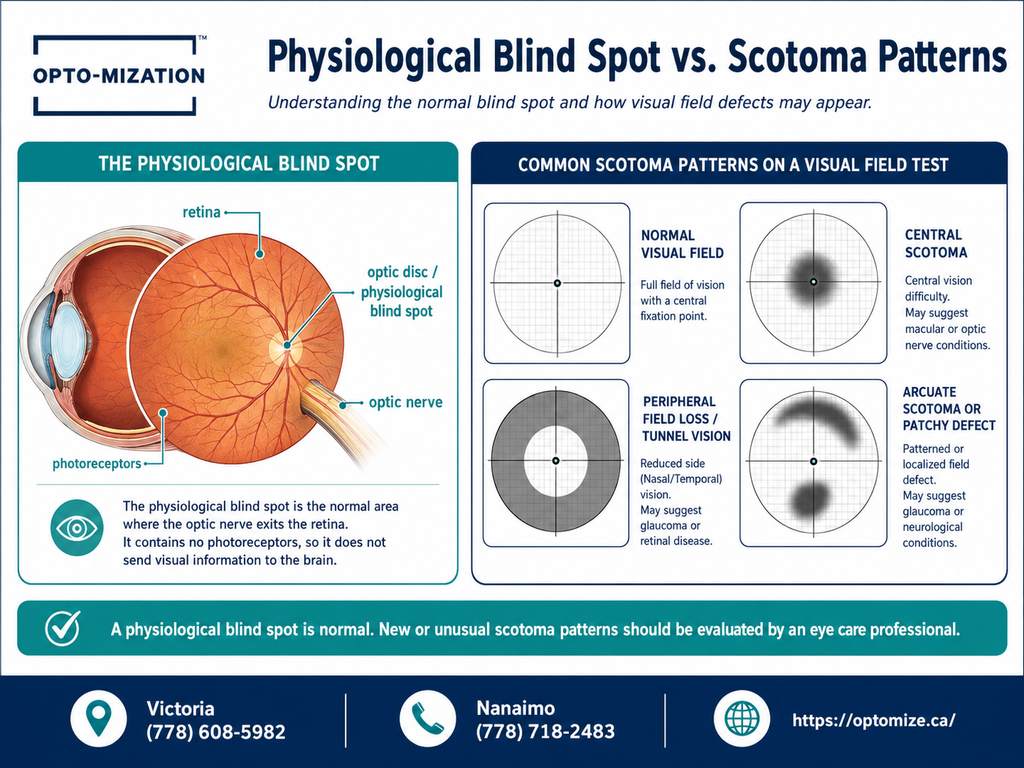
In visual terms, a blind spot refers to any area within your field of vision where you cannot perceive light, color, or detail. There are two broad categories worth distinguishing: the physiological blind spot that every eye has by design, and acquired blind spots (called scotomas) that develop due to a health condition or visual system dysfunction.
The physiological blind spot is not something most people are aware of day to day. It sits just off center in each eye, and your brain performs constant background processing to fill it in. The scotoma type is different. These can appear suddenly or gradually, affect part or all of your visual field, and may be accompanied by other symptoms like light sensitivity, floating shapes, or visual disturbances.
What Causes a Blind Spot or Missing Area in Vision?
There is no single answer here. The cause depends heavily on what you’re actually experiencing, including when it appears, how long it lasts, whether it affects one or both eyes, and what other symptoms accompany it.
| Type of Blind Spot | Common Causes | Typical Duration | Urgency Level |
| Physiological (natural) | Normal optic nerve anatomy | Always present, usually unnoticed | None |
| Visual aura / migraine | Migraine with aura, cortical spreading depression | 15–30 minutes typically | Low to moderate |
| Retinal scotoma | Retinal detachment, macular degeneration, diabetic retinopathy | Persistent, may worsen | High |
| Glaucomatous field loss | Elevated intraocular pressure damaging the optic nerve | Progressive if untreated | High |
| Binocular vision dysfunction | Eye teaming problems, suppression of one eye | Variable, may come and go | Moderate |
| Post-concussion visual changes | Brain injury affecting visual pathways | Variable, often persistent without treatment | Moderate to high |
| Neurological causes | Stroke, lesions affecting the visual cortex | Persistent, often one-sided field loss | High |
Why Do Blind Spots Sometimes Come and Go?
Intermittent blind spots are one of the more confusing symptoms because they don’t follow a predictable pattern. You might notice one while reading, while looking at a screen, or randomly during the day, and then it disappears before you can even think to get it checked. This variability often causes people to dismiss it or wait, which is understandable but not always the right move.
One of the most common culprits behind recurring temporary blind spots is migraine with aura. The aura phase can involve a flickering arc of light, a shimmering crescent, or a patch of missing vision that expands and then fades. This happens because of changes in electrical activity and blood flow in the visual cortex.
Research suggests that visual aura affects approximately 25 to 30 percent of people who experience migraines, meaning roughly one in four migraine sufferers will experience some form of visual disturbance before or during a headache episode.
Binocular vision dysfunction is another frequently overlooked cause. When your eyes don’t coordinate well as a team, the brain may suppress the image from one eye to avoid double vision or confusion. This suppression can create areas of reduced or missing vision that fluctuate depending on your visual load, fatigue, or lighting conditions.
If you’ve had a concussion or head injury and started noticing visual gaps afterward, the injury may have disrupted the neural pathways that handle visual processing. This is more common than most people realize, and it’s an area where a comprehensive functional eye exam can reveal what standard testing often doesn’t.
How Is the Location of the Blind Spot Relevant?
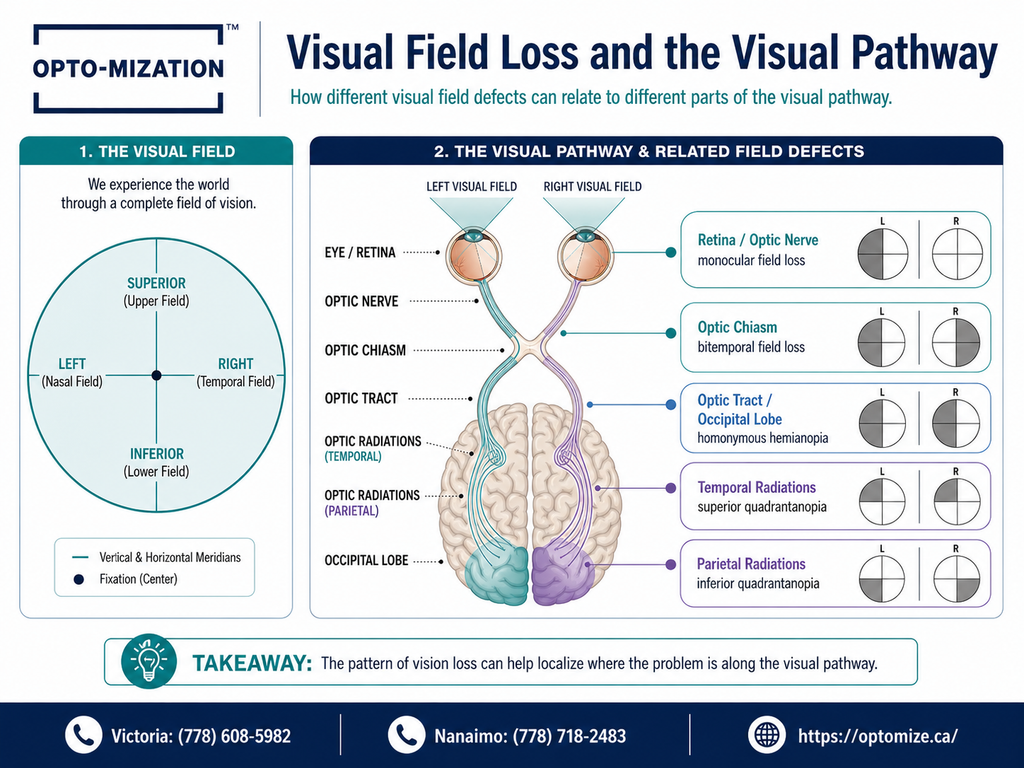
Where the missing area appears in your field of vision provides important diagnostic clues. Clinicians pay close attention to whether the scotoma is central, peripheral, or hemianopic (affecting one side of both visual fields).
| Blind Spot Location | What It May Suggest |
| Central (affecting detail and reading vision) | Macular degeneration, macular hole, optic neuritis |
| Peripheral (edges of vision) | Glaucoma, retinitis pigmentosa, peripheral retinal damage |
| One side of vision in both eyes (hemianopia) | Stroke, brain lesion, neurological event affecting visual cortex |
| Flickering or moving spot | Migraine aura, visual cortex disturbance |
| Spot only during certain visual tasks | Binocular vision dysfunction, eye suppression, fatigue-related |
The specific pattern matters enormously. A missing area that appears only when both eyes are open but resolves when one is closed points toward a binocular vision issue rather than a structural problem with the eye itself. This distinction is exactly the kind of finding that a standard eye exam often misses because it doesn’t test how the two eyes work together.
When Should You Get Evaluated Right Away?
Some symptoms alongside a blind spot call for urgent attention. Don’t wait for a routine appointment if you notice any of the following.
- A sudden new blind spot, especially if it appears in one eye only
- A shower of floaters combined with flashes of light and a missing area of vision
- Loss of vision on one entire side of your visual field
- Blind spot associated with eye pain, redness, or significant pressure
- Visual changes following a head injury, fall, or concussion
- Blind spot that has been growing larger or spreading over days or weeks
Retinal detachment is considered an ocular emergency, with studies indicating that outcomes are significantly better when treatment is received within 24 hours of symptom onset. Symptoms typically include sudden floaters, flashing lights, and a curtain or shadow effect in vision.
What Happens During a Functional Vision Assessment for Blind Spots?
A functional vision assessment goes well beyond checking whether you can read the bottom line of an eye chart. It evaluates the entire visual system, including how your eyes move, how they focus, how they work together as a pair, and how the brain processes the information they send.
- Case history and symptom review: The clinician asks detailed questions about when symptoms appear, what triggers them, how long they last, and how they affect daily activities like reading, screen use, and driving.
- Visual acuity and refractive testing: Basic measurements are taken, though the focus extends beyond simple prescription accuracy.
- Visual field testing: Maps the full extent of your peripheral and central vision to locate any scotomas or areas of reduced sensitivity.
- Eye teaming and binocular vision evaluation: Tests how well both eyes work together, including alignment, convergence, divergence, and suppression patterns.
- Eye tracking assessment: Examines how smoothly and accurately your eyes move across text or a target, and whether tracking issues are contributing to visual gaps.
- Neurological and visual processing checks: Assesses how the brain interprets visual input, relevant for concussion patients and those with persistent unexplained symptoms.
- Findings review and recommendations: The clinician explains what was found and outlines any recommended treatment, which may include vision therapy, specialized lenses, or referral for further evaluation.
Can Vision Therapy Help with Blind Spots?
For blind spots that stem from functional vision problems, binocular vision dysfunction, or post-concussion visual changes, structured vision therapy can make a meaningful difference. The goal is to retrain how the eyes and brain communicate, reducing suppression, improving coordination, and helping the visual system process information more accurately.
Clinical evidence supports vision therapy as an effective treatment for convergence insufficiency, a common binocular vision condition, with studies showing symptom improvement in a significant proportion of patients following a structured program.
Vision therapy won’t reverse structural damage to the retina or reverse glaucoma-related field loss, but for a wide range of functional and neurological visual problems, it addresses causes that prescription lenses alone cannot fix. Specialized prism lenses are sometimes prescribed alongside therapy to support alignment and reduce the visual system strain that contributes to symptoms like missing areas in vision, headaches, and dizziness.
If you’ve been experiencing visual symptoms alongside headaches or dizziness, it’s worth understanding how headaches, eye strain, and poor focus can be connected through underlying visual dysfunction.
Common Mistakes People Make When Dealing with Blind Spots
- Assuming it will just go away: Some transient blind spots do resolve on their own, but waiting without evaluation means potentially missing a condition that worsens over time.
- Relying only on a standard prescription check: Routine eye exams rarely include comprehensive visual field testing or binocular vision assessments unless specifically requested or indicated.
- Attributing everything to screen time: While digital eye strain is real, a persistent or recurring blind spot is not a normal result of screen use and deserves investigation.
- Ignoring the symptom after a concussion: Post-concussion visual changes can be subtle at first and tend to worsen under cognitive or visual load. They benefit from early functional assessment.
- Testing only one eye: Many binocular vision problems only manifest when both eyes are open together. Testing each eye in isolation misses the interplay between them.
Studies on post-concussion syndrome indicate that a substantial percentage of patients experience persistent visual symptoms including double vision, difficulty focusing, and visual field disturbances that go unaddressed because they are not assessed through standard concussion protocols.
Frequently Asked Questions
Why do I have blind spots in my vision sometimes?
Intermittent blind spots can result from a range of causes, including migraine with aura, binocular vision dysfunction, digital eye strain, or fluctuating pressure in the eye. Every eye also has a natural blind spot where the optic nerve attaches, though your brain typically fills this in automatically. If a blind spot appears repeatedly or without a clear trigger, a functional vision evaluation can help identify what’s driving it.
Why is there a blind spot in my eye?
The natural blind spot in every eye exists because there are no photoreceptors at the point where the optic nerve exits the retina. It’s not a sign of a problem on its own. The issue arises when additional blind spots form due to retinal damage, optic nerve changes, brain-eye communication problems, or neurological conditions. Identifying which type you’re dealing with requires a proper examination.
Why does my left eye have a blind spot?
Both eyes have a natural blind spot, but it’s positioned slightly differently in each one. If you’re noticing a blind spot specifically in your left eye, it may be the natural physiological spot becoming noticeable due to a change in your visual habits or workload. Alternatively, it could indicate a problem affecting the left eye’s retina, optic nerve, or the left visual pathway in the brain. Getting both eyes tested independently as well as together provides the clearest picture.
How do you get rid of temporary blind spots in vision?
For migraine-related blind spots, treatment focuses on managing migraine triggers, which can include stress, certain foods, sleep disruption, and hormonal changes. For binocular vision-related blind spots, vision therapy and specialized lens prescribing can reduce suppression and improve eye teaming. The approach depends entirely on what’s causing the symptom. Temporary blind spots that resolve on their own may not require immediate treatment, but recurring ones benefit from professional evaluation to address the underlying cause.
Will a blind spot go away on its own?
Migraine auras and other temporary visual disturbances often resolve within 20 to 60 minutes. However, blind spots caused by structural damage to the retina, optic nerve, or visual processing pathways typically do not resolve without intervention. Some binocular vision-related blind spots can improve significantly with the right treatment. The key distinction is whether the underlying cause is functional and treatable, or structural and progressive. Waiting without evaluation is the main risk factor for avoidable vision loss.
Getting Answers at Opto-Mization
A blind spot or missing area in your vision deserves a real answer, not a shrug and a suggestion to come back if it gets worse. At Opto-Mization, functional vision assessments are designed to find exactly the kinds of issues that standard testing overlooks: binocular vision dysfunction, eye-brain communication breakdowns, post-concussion visual changes, and suppression patterns that only appear when both eyes are working together.
Serving patients across Greater Victoria and Nanaimo, Opto-Mization takes an approach rooted in understanding the root cause rather than managing surface symptoms. Whether your blind spot is linked to migraines, a past concussion, or a visual system that has been quietly struggling, a comprehensive evaluation is where answers begin.
If you’ve been noticing gaps, dark spots, or missing areas in your vision and haven’t found a clear explanation, book a functional vision assessment at Opto-Mization. Visit optomize.ca to learn more or schedule your evaluation.