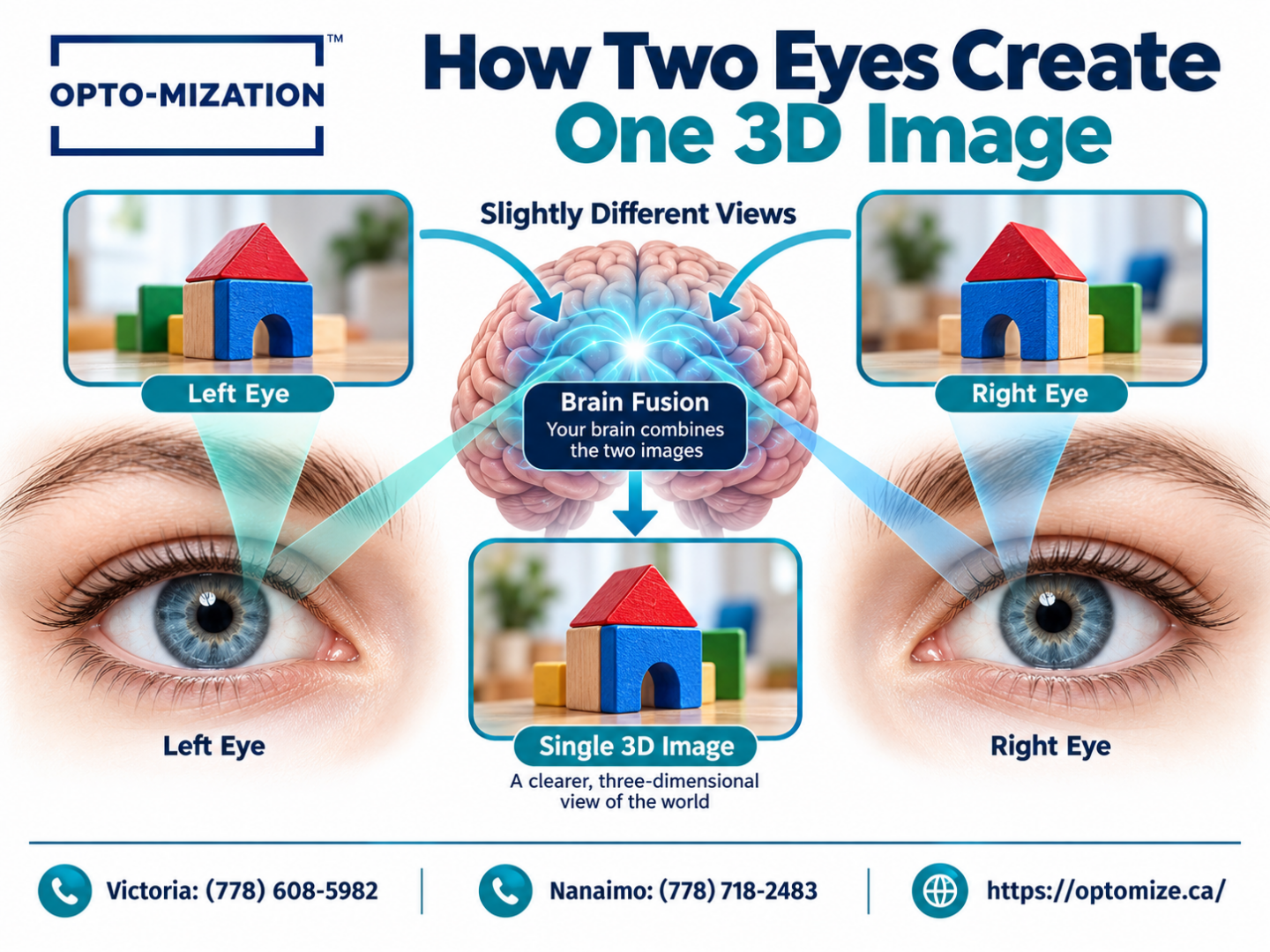
Depth perception is your brain’s ability to judge the distance and spatial position of objects by combining the slightly different images each eye captures. When both eyes aim at the same point and send well-matched signals to the brain, you can reach for a cup, catch a ball, or navigate a staircase with accuracy. Most people never think about it until something goes wrong, and the problems it causes are often mistaken for clumsiness, attention difficulties, or anxiety in busy spaces.
Key Takeaways
- Depth perception depends on both eyes working as a coordinated team, not just on having clear eyesight in each eye individually.
- Reduced depth perception is often linked to binocular vision dysfunction, a condition that standard eye exams frequently miss.
- Symptoms can include difficulty with stairs, misjudging distances while driving, headaches, and feeling overwhelmed in crowded environments.
- Children with poor depth perception often avoid sports or physical activities without being able to explain why.
- A functional vision assessment evaluates the skills that control depth perception, offering answers that a routine prescription check cannot.
Things You Must Know
1. Clear eyesight in each eye does not guarantee good depth perception.
Many patients pass a standard 20/20 vision test yet still struggle with depth. That test measures acuity in one eye at a time. Depth perception requires both eyes to aim, focus, and move together with precision. When that coordination breaks down, even someone with excellent single-eye clarity can experience persistent spatial difficulty.
2. Depth perception problems are often missed for years.
Because the symptoms overlap with ADHD, dyslexia, anxiety, and general clumsiness, the underlying visual cause rarely gets identified in a routine checkup. A functional vision assessment looks specifically at how the two eyes work together, which is the only way to uncover binocular coordination problems that affect spatial judgment.
3. This is a treatable visual skill, not a fixed trait.
Depth perception depends on learned visual skills that can be strengthened. Vision therapy programs designed around binocular coordination have helped many patients improve their spatial judgment meaningfully. In many cases, the improvements extend into reading, balance, driving confidence, and overall daily comfort.
How Does Depth Perception Actually Work?
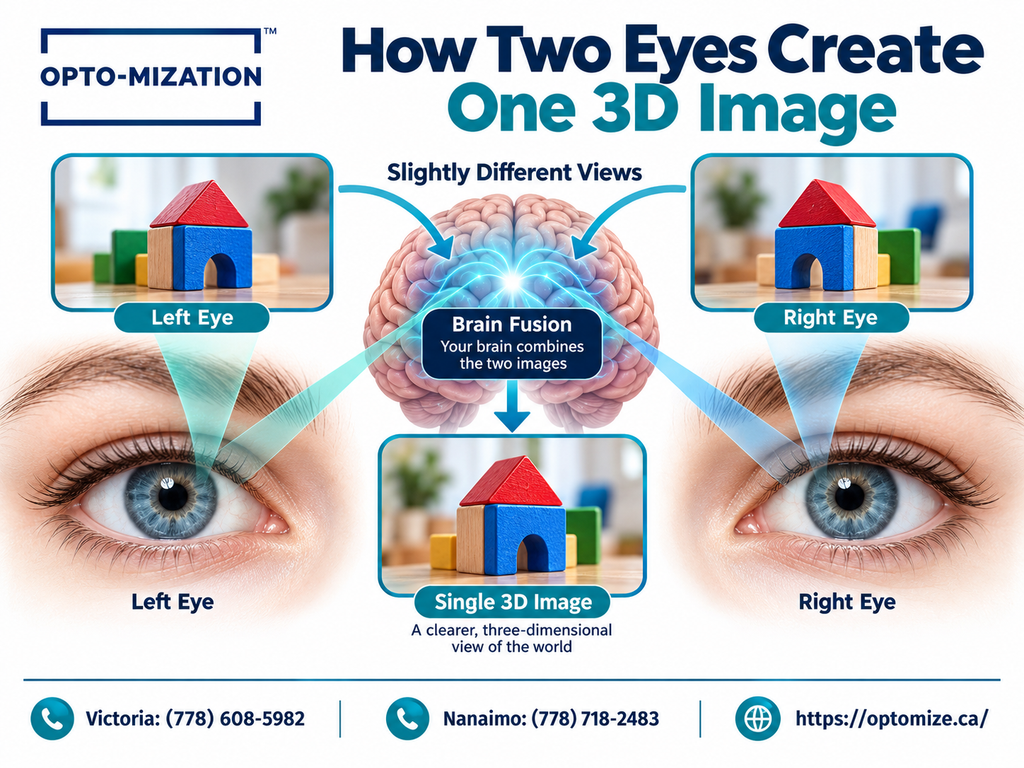
Your two eyes sit roughly 6 to 7 centimetres apart, so each one views the world from a slightly different angle. The brain receives both images simultaneously and measures the difference between them, a process called stereopsis. From that difference, it calculates how far away an object is.
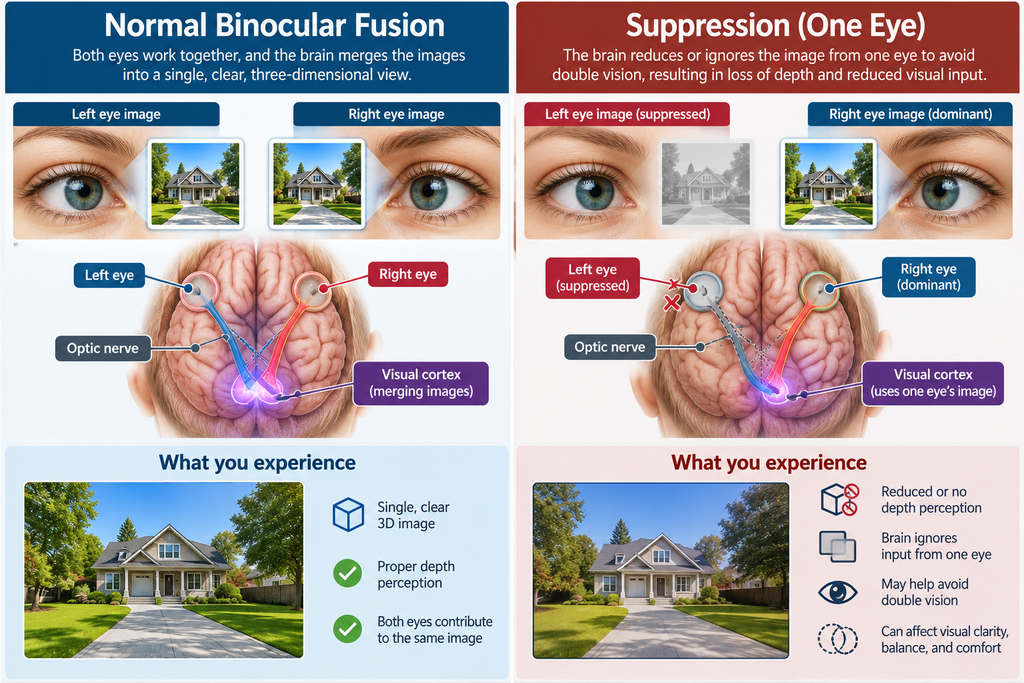
This calculation happens automatically and constantly. Pouring a glass of water, parking a car, reading a line of text, and walking down stairs all rely on accurate spatial information arriving in real time. When the two eyes fail to point at exactly the same place, or when one eye suppresses its image to avoid double vision, the brain loses the comparison it needs and depth judgments become unreliable.
According to convergence insufficiency research published on the NIH Bookshelf, the prevalence of binocular vision dysfunction in school-age children ranges from 2 to 13 percent depending on diagnostic criteria, and the majority of affected individuals have never received a diagnosis through a standard eye exam.
What Causes Poor Depth Perception?
The most common causes involve a breakdown in how the two eyes coordinate with each other. The main categories include:
- Binocular vision dysfunction: The eyes aim at slightly different points rather than converging on the same target. This creates a mismatch the brain cannot fully reconcile.
- Amblyopia (lazy eye): The brain suppresses input from one eye, which removes the comparison needed for stereopsis.
- Strabismus: A visible or intermittent eye turn that prevents both eyes from pointing at the same place simultaneously.
- Anisometropia: A significant prescription difference between the two eyes that causes one image to arrive blurred, reducing the brain’s ability to merge them effectively.
- Post-concussion visual changes: A head injury can disrupt the neurological pathways that control eye teaming, often causing sudden depth perception difficulties that persist long after other concussion symptoms resolve.
Signs That Depth Perception May Be Affecting You or Your Child
Because poor depth perception rarely causes blurry vision on its own, most people do not connect their symptoms to an eye coordination problem. The signs often look like something else entirely.
| Age Group | Common Complaints | Often Mistaken For |
| Children (5–12) | Avoids catching games, trips frequently, loses place reading | Clumsiness, ADHD, developmental delay |
| Teens | Struggles in sports, headaches after school, avoids reading | Anxiety, disinterest, learning disability |
| Adults | Misjudges distances driving, eye strain on screens, dizzy in crowds | Stress, fatigue, vestibular disorder |
| Seniors | Unsteady on stairs, reduced driving confidence, falls | Normal aging, balance disorder |
Parents in Greater Victoria and Nanaimo who notice their child avoiding ball sports or frequently bumping into furniture often assume it is a coordination issue. A functional vision evaluation may reveal that the root cause is binocular, not physical.
Depth Perception and Eye Teaming: The Connection Worth Understanding
Depth perception does not operate in isolation. It depends entirely on eye teaming and depth perception functioning as one system. When the eyes fail to aim together accurately, the brain receives conflicting spatial signals. The result ranges from subtle misjudgments to outright double vision, with many people experiencing something in between without ever knowing why.
Convergence insufficiency, one of the most common binocular vision conditions, is associated with reading difficulties, reduced concentration, and avoidance of near-distance tasks; according to peer-reviewed research on convergence insufficiency in children, clinically significant cases affect approximately 5 to 8 percent of school-aged children.
When binocular vision dysfunction goes unaddressed, the visual system compensates by suppressing one eye’s image intermittently. That compensation reduces headaches and double vision in the short term but at the cost of accurate depth judgment. Many adults who report lifelong clumsiness or difficulty with spatial tasks have been living with exactly this kind of compensation without realizing it.
How a Functional Vision Assessment Evaluates Depth Perception
A standard eye exam tests visual acuity, checks for refractive error, and screens for eye health problems. It does not systematically measure how well the two eyes coordinate under the sustained demands of reading, screen use, or movement.
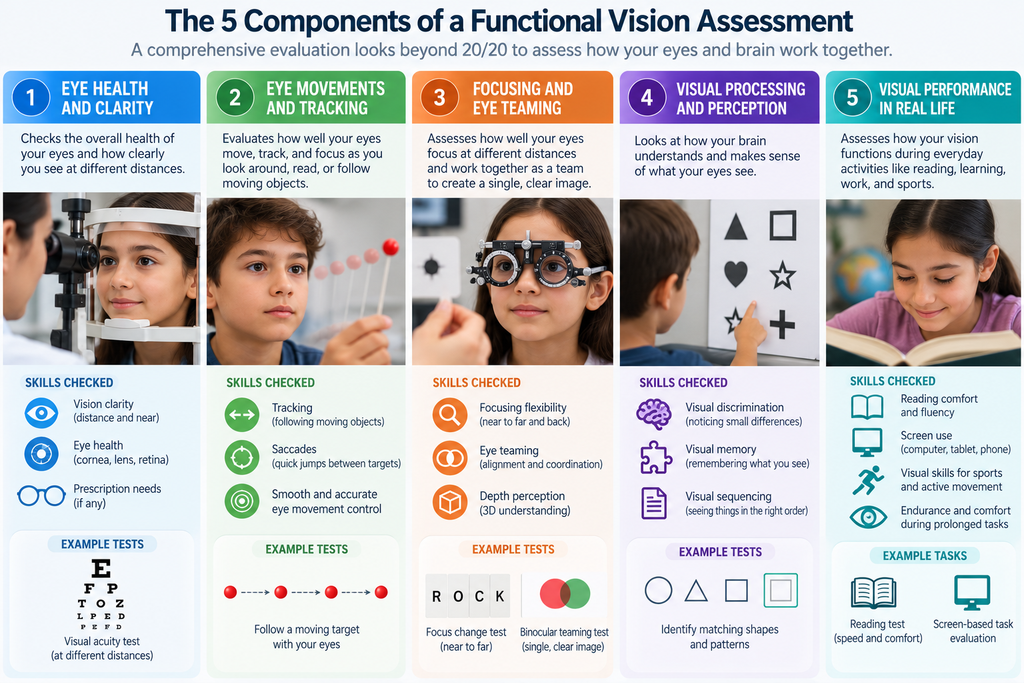
A functional vision assessment goes further. At Opto-mization, the evaluation includes specific testing of:
- Vergence: How well the eyes converge and diverge on targets at varying distances.
- Stereoacuity: The precision of stereoscopic depth judgment, measured with specialized targets.
- Eye tracking: Whether the eyes move smoothly and accurately when following or shifting between targets.
- Suppression testing: Whether one eye is being routinely blocked out and under what conditions.
- Accommodation: Whether the focusing system responds accurately when the eyes shift from near to far.
The combination of these measurements gives a complete picture of why depth perception may be failing, along with a clear direction for treatment.
Can Depth Perception Be Improved?
Multiple randomized clinical trials have demonstrated that structured vision therapy programs restore normal binocular function in approximately 75 percent of children and adults with symptomatic convergence insufficiency who complete a full course of treatment.
For many patients, yes. Because depth perception relies on a learned neurological skill rather than fixed anatomy, structured intervention can produce real change. Vision therapy programs address the underlying coordination deficit through progressive exercises that retrain how the eyes and brain work together. Prism lenses and specialized prescription glasses can also reduce the compensatory strain the visual system has been working under.
Patients who go through vision therapy results frequently report improvements that extend beyond spatial tasks, including reduced headaches, better reading stamina, improved balance, and greater comfort in visually busy environments.
Common Mistakes People Make When Dealing With Depth Perception Problems
- Assuming a passed eye exam means their vision is fine, without realizing that binocular coordination is not part of the standard test.
- Attributing symptoms like dizziness in grocery stores, difficulty on stairs, or misjudged distances to inner ear problems or anxiety without exploring a visual cause.
- Waiting years before seeking an assessment after concussion, not knowing that post-concussion vision changes are treatable.
- Accepting a child’s avoidance of reading or sports as a personality trait rather than investigating whether a visual processing issue is driving the behavior.
- Expecting standard glasses or contact lenses to resolve a binocular coordination problem, since refractive correction alone does not address how the eyes team together.
| Symptom | Common Assumption | Possible Visual Cause |
| Dizziness in busy spaces | Anxiety or inner ear issue | Visual-vestibular mismatch from binocular dysfunction |
| Difficulty on stairs | Balance or coordination problem | Reduced stereoacuity affecting depth judgment |
| Child avoiding reading | Disinterest or dyslexia | Eye teaming failure making text unstable |
| Headaches after driving | Stress or tension headache | Sustained vergence effort causing visual fatigue |
Frequently Asked Questions
How do you know if you have poor depth perception?
The clearest signs are difficulty judging distances accurately during tasks like parking, reaching for objects, or navigating stairs. You might misjudge where a step begins, have trouble catching or hitting a ball, or feel uneasy in visually complex environments. Many people with reduced depth perception also experience headaches, eye strain, or dizziness that they do not connect to a vision problem. A functional vision assessment with specific stereoacuity and vergence testing is the most reliable way to confirm whether a binocular coordination deficit is present.
Can glasses fix poor depth perception?
Standard prescription glasses correct refractive error but do not directly address the binocular coordination problem that causes poor depth perception. In some cases, prism lenses can reduce the demand on the vergence system and help the eyes align more comfortably, which may support improved depth judgment. For most patients with meaningful binocular dysfunction, vision therapy is the primary treatment, sometimes combined with specialized lenses. A functional vision assessment determines which approach, or which combination, fits the specific pattern of findings.
What does depth perception mean?
Depth perception is the visual ability to judge the distance and three-dimensional position of objects in your environment. Your brain creates this spatial map by comparing the slightly different images your two eyes capture from their separated positions. The difference between those two images, called binocular disparity, gives the brain the data it needs to calculate how far away something is. Without reliable input from both eyes, or when the two images do not merge properly, depth judgment becomes inaccurate.
Do people with ADHD struggle with depth perception?
Some do, though the relationship is often misunderstood. A number of children and adults diagnosed with ADHD have an underlying binocular vision problem that creates symptoms similar to attention difficulties, including poor concentration, reading avoidance, and difficulty sitting still. When the visual system is working hard to maintain coordination, sustained focus becomes exhausting. In these cases, what looks like inattention may partly reflect visual fatigue. A functional vision assessment can identify whether a binocular component is contributing to attention-related symptoms alongside or instead of a primary ADHD diagnosis.
Is ADHD linked to a higher IQ?
There is no consistent evidence that ADHD is associated with a higher IQ. Intelligence varies across people with and without ADHD just as it does in the general population. The perception that children with ADHD are secretly high achievers being held back sometimes applies in individual cases, particularly when a different underlying issue such as a functional vision problem is the real driver of academic difficulty. If a child is clearly bright but struggling academically, a functional vision evaluation is worth pursuing before assuming the diagnosis fits completely.
Finding Answers Starts With the Right Assessment
Poor depth perception rarely announces itself clearly. It hides behind headaches, clumsiness, reading struggles, and spatial unease, often for years before anyone connects the dots. The reason those connections get missed is that standard eye exams are not designed to measure how the eyes coordinate under real-world demands.
At Opto-mization, the functional vision assessment covers exactly the skills that routine testing overlooks. For families across Greater Victoria and Nanaimo who are looking for answers that other appointments have not provided, this is the starting point.
If you recognize any of the symptoms described here in yourself or your child, book a functional vision assessment at Opto-mization. The evaluation identifies what is actually happening and gives you a clear path forward.