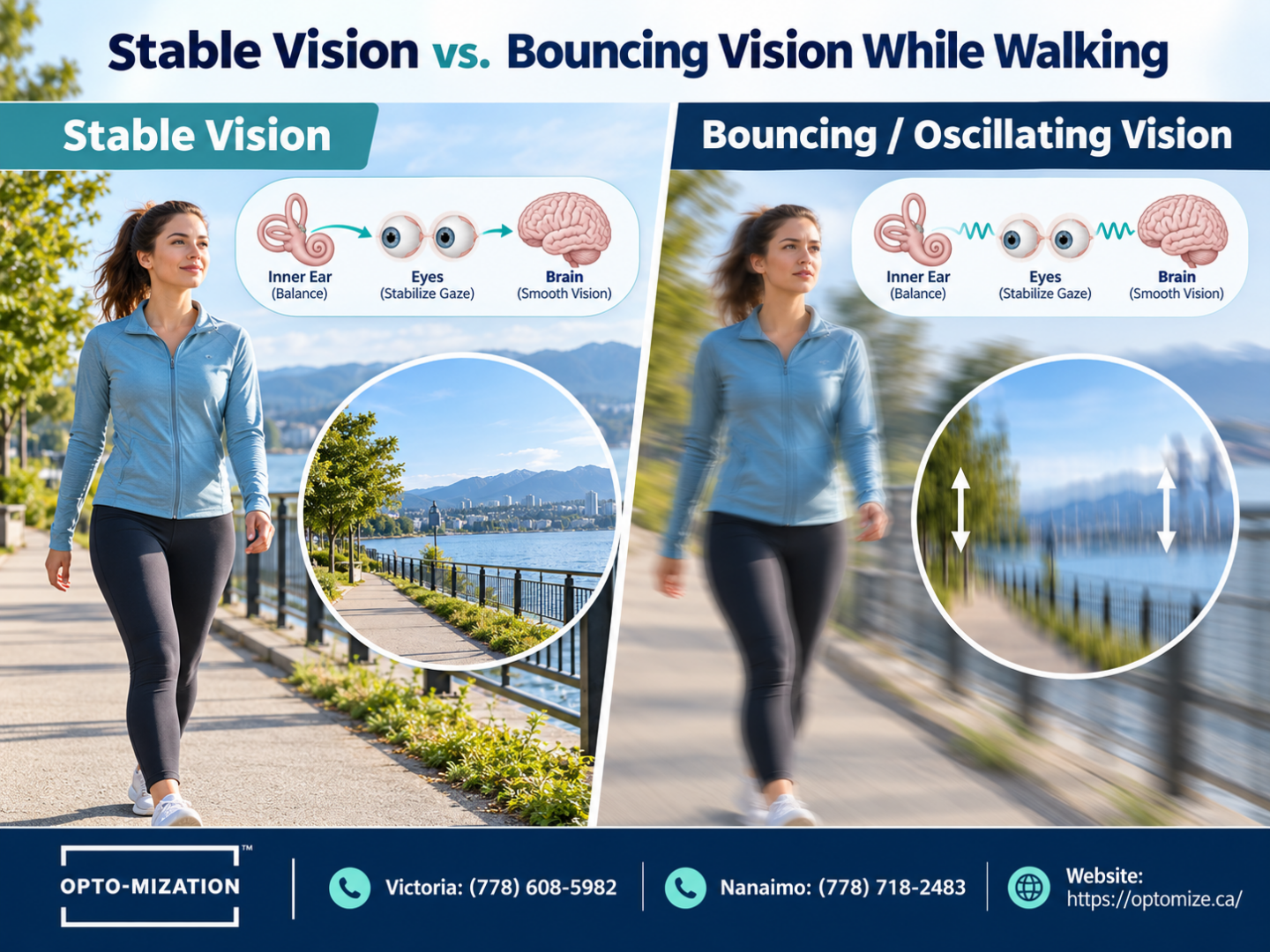
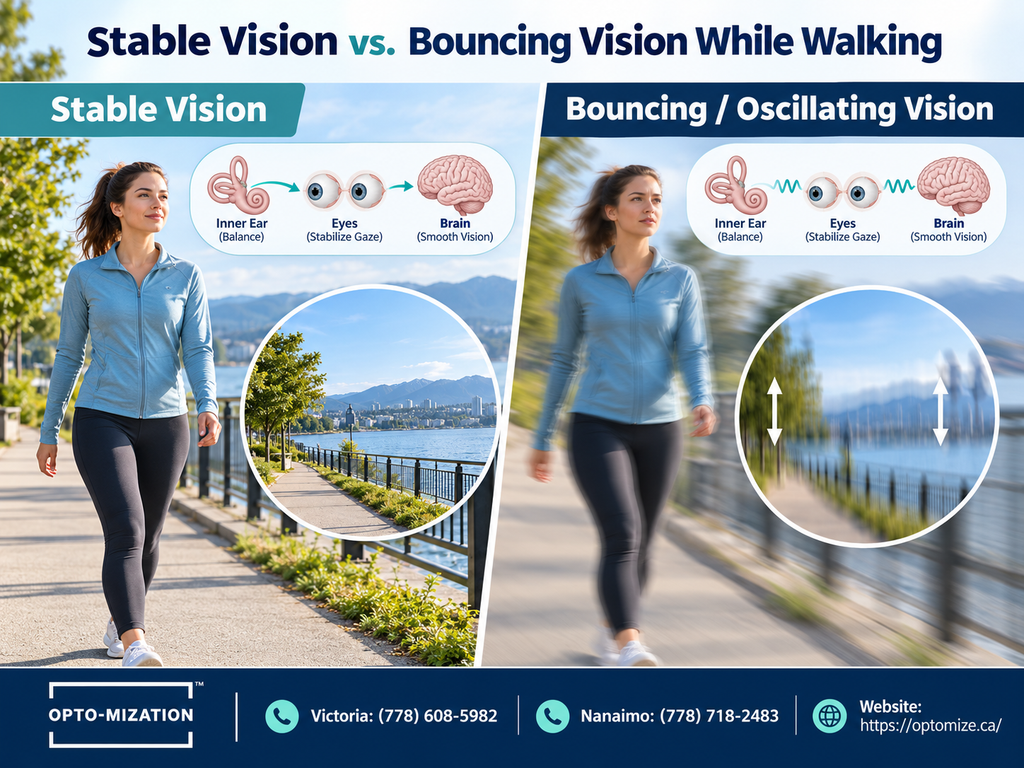
Vision bouncing when walking happens because your visual system loses its ability to keep images stable as your head moves with each step. Most people never notice this under normal conditions because a reflex called the vestibulo-ocular reflex (VOR) constantly adjusts your eye position to compensate for head movement. When that reflex is weakened, disrupted, or overloaded, the world appears to shake, bob, or blur with every stride. In many cases, a functional issue in how the eyes and brain process motion signals together is the root cause, and it can be assessed and addressed.
Key Takeaways
- The vestibulo-ocular reflex normally keeps your vision stable while you move. When it underperforms, the world appears to shake or bounce as you walk.
- Bouncing vision is not always an inner ear problem. Functional vision issues, including binocular vision dysfunction and poor gaze stabilization, can produce the same symptoms.
- A standard eye exam typically checks sharpness at rest. It will not detect the visual stability problems that cause this symptom during movement.
- Post-concussion patients and people with vestibular conditions are especially likely to experience visual bouncing, but it also appears in people with no injury history.
- Targeted vision therapy can retrain the brain-eye connection responsible for gaze stabilization, often producing measurable improvements in daily life.
- A functional vision assessment is the appropriate first step to identify whether the cause is neurological, vestibular, or related to how the two eyes work together.
Things You Must Know
1. “Normal” Eye Exam Results Do Not Rule This Out
Passing a standard vision test with 20/20 acuity means your eyes are clear at rest. It says nothing about how your visual system performs during movement. The reflexes and coordination required to stabilize images while walking are rarely tested in a routine exam, so many people with significant gaze stabilization problems go undiagnosed for years.
2. This Symptom Is Worth Taking Seriously
Bouncing or shaking vision while walking can affect driving safety, increase fall risk, and make everyday tasks like navigating busy environments genuinely difficult. In some cases it signals an underlying neurological issue that needs prompt medical attention. If the symptom appeared suddenly, is worsening, or is paired with hearing loss, severe headache, or sudden double vision, see a doctor or emergency care provider promptly rather than waiting for a specialist appointment.
3. The Cause Shapes the Treatment
Vestibular rehabilitation, neuro-optometric vision therapy, and prism lenses each address different parts of the problem. Getting the right intervention depends entirely on a proper assessment of what is actually breaking down: the inner ear signaling, the brain’s processing of that signal, or the eyes’ inability to coordinate under dynamic conditions. Treating the wrong layer first often delays real improvement.
What Is the Vestibulo-Ocular Reflex and Why Does It Matter?
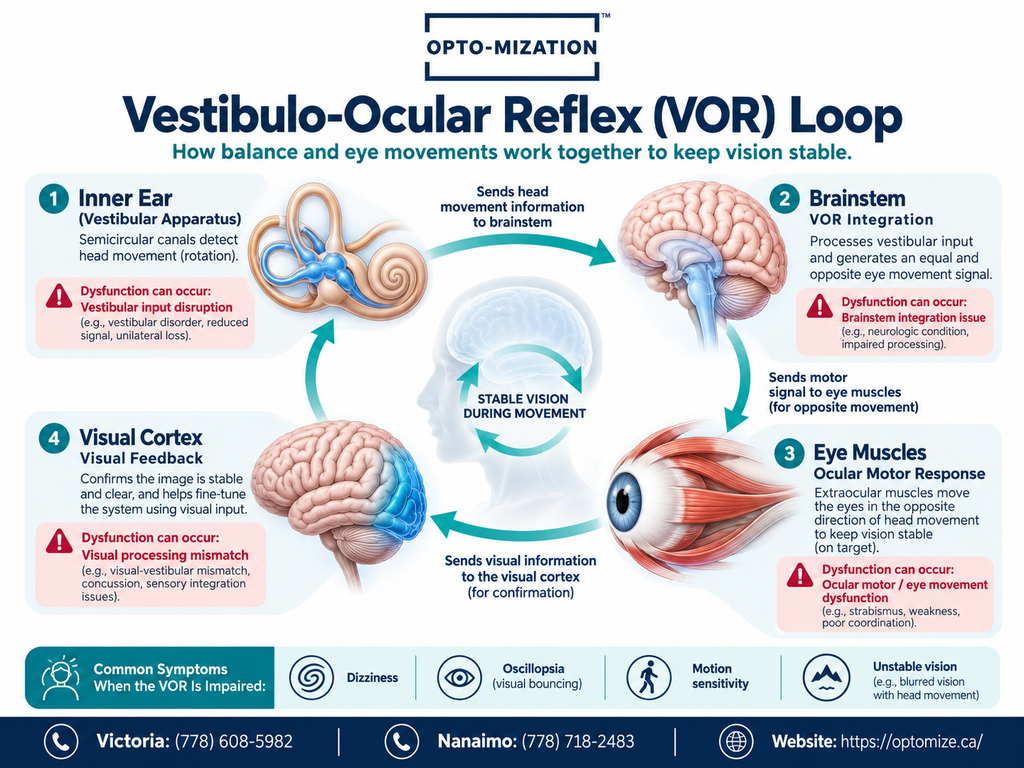
Your inner ear detects head movement and sends that information to your brainstem almost instantly. Your brainstem then fires signals to your eye muscles, moving your eyes in the opposite direction of your head movement at the same speed. The result is that your gaze stays locked on a target even as your head bobs up and down with each step.
When this reflex is calibrated correctly, you can read a sign across a parking lot while walking toward it. When it is miscalibrated or disrupted, the image slips across your retina faster than your brain can correct, and you perceive that as bouncing or shaking. Physicians and therapists call this oscillopsia.
What Can Disrupt the VOR?
Several conditions interfere with vestibulo-ocular reflex performance. Some are structural. Others are functional and highly treatable.
| Cause Category | Examples | Typical Assessment Path |
| Inner ear dysfunction | Labyrinthitis, vestibular neuritis, bilateral vestibular hypofunction | Audiologist, ENT, vestibular physio |
| Post-concussion vision disruption | Gaze instability, convergence insufficiency, motion sensitivity | Functional vision assessment, neuro-optometry |
| Binocular vision dysfunction | Eyes not coordinating under dynamic conditions, poor vergence control | Functional vision assessment |
| Neurological conditions | Multiple sclerosis, cerebellar disorders, brainstem lesions | Neurology referral, MRI |
| Medication side effects | Aminoglycoside antibiotics, anti-seizure medications, some sedatives | Review with prescribing physician |
When the Problem Lives in the Visual System, Not Just the Ear
Most people assume bouncing vision is an ear problem, and sometimes it is. The inner ear and the visual system share responsibility for gaze stability, though, and either side of that partnership can fall short.
Functional vision problems, particularly binocular vision dysfunction, are a frequently missed contributor. When the two eyes struggle to coordinate precisely, the brain receives slightly mismatched signals. Under the extra demand of movement, that mismatch amplifies. The result can feel like the world is subtly shifting or bouncing with each step, even with no inner ear involvement at all.
Research on post-concussion visual symptoms consistently shows that gaze stabilization deficits are among the most common and persistent complaints following mild traumatic brain injury. A one-year follow-up study on visual disturbances after mild TBI found that between 30% and 85% of patients are estimated to have visual disturbances after traumatic brain injury, with eye movement problems reported in up to 90% of concussions, affecting a substantial proportion of patients who report ongoing dizziness and visual disturbance during movement.
Post-Concussion Gaze Instability
After a concussion, the pathways connecting the inner ear, cerebellum, and visual cortex can all be disrupted simultaneously. The eyes may have healed structurally while the neurological coordination between them and the vestibular system remains miscalibrated. This is why some concussion patients pass a standard eye exam and still cannot walk through a busy grocery store without their vision shaking.
Neuro-optometric rehabilitation focuses specifically on rebuilding these connections through structured, progressive exercises. For patients in Greater Victoria and Nanaimo, this level of assessment is not available at a routine optometry appointment. It requires a neuro-optometric evaluation designed to test the visual system under the kinds of dynamic conditions that trigger symptoms.
How Functional Vision Assessments Identify Gaze Stabilization Problems
A functional vision assessment goes well beyond the letter chart. It evaluates how your eyes and brain perform as a team, including under conditions that simulate movement, visual stress, and dynamic tracking demands.
At Opto-Mization, the assessment process measures skills that a standard eye exam does not test, including how well the eyes track moving targets, how smoothly vergence control holds up under load, and how the visual system responds to vestibular input. The findings shape a treatment plan built around your specific deficits rather than a generalized program.
- Intake and symptom mapping: A detailed history of when and how the bouncing vision occurs, including triggers like crowded environments, walking on uneven surfaces, or reading after movement.
- Gaze stabilization testing: Evaluation of the VOR and its ability to maintain stable imagery during simulated head movements.
- Binocular vision assessment: Testing for misalignment, vergence insufficiency, and eye teaming under both static and dynamic conditions.
- Eye tracking evaluation: Measurement of smooth pursuits, saccades, and fixation stability to identify where tracking breaks down.
- Visual processing assessment: Evaluation of how the brain interprets and integrates the signals it receives, including visual-vestibular conflict responses.
- Findings review and recommendations: A clear explanation of what was found, what it means for your daily life, and what treatment options apply.
Treatment Options for Vision Bouncing When Walking
Clinical evidence on vestibular rehabilitation and gaze stabilization exercises shows meaningful improvements in outcomes when treatment is matched to the underlying deficit. An updated clinical practice guideline from the Academy of Neurologic Physical Therapy documents that targeted gaze stabilization programs improve dynamic visual acuity and reduce oscillopsia symptoms, with patients reporting improved functional mobility when exercises address the specific vestibular or oculomotor deficit present.
| Treatment | Best Suited For | Delivered By |
| VOR gaze stabilization exercises | Inner ear dysfunction, post-concussion | Vestibular physio, neuro-optometrist |
| Neuro-optometric vision therapy | Binocular dysfunction, post-concussion, motion sensitivity | Functional optometrist |
| Prism lenses | Misalignment contributing to gaze instability | Functional optometrist |
| Medical or neurological management | Underlying neurological conditions | Neurologist, physician |
Common Mistakes People Make With This Symptom
- Assuming it is just dizziness. Oscillopsia and dizziness can overlap, but they are different problems. Treating dizziness without addressing the visual component often produces incomplete results.
- Waiting for it to resolve on its own. Gaze stabilization deficits, especially after concussion, can persist for months or years without targeted intervention. Early assessment leads to better outcomes in most cases.
- Relying on a standard eye exam to rule it out. A clean prescription and healthy retinas do not mean the dynamic visual system is functioning well. The tests that catch gaze stabilization problems are not part of a routine exam.
- Treating only one part of the system. Vestibular physiotherapy addresses the inner ear side. Vision therapy addresses the eye-brain coordination side. Many patients need both, and knowing which to prioritize requires a proper assessment.
- Attributing it to aging without further investigation. While age-related changes can affect balance and vision, bouncing vision is not a normal part of getting older and should be assessed rather than accepted.
Research on balance and falls in older adults identifies gaze instability as a meaningful contributor to fall risk. A published study in the Journal of Neurologic Physical Therapy found that adding vestibular-specific gaze stability exercises to standard balance rehabilitation resulted in a greater reduction in fall risk in older adults, suggesting that untreated gaze stabilization problems carry real consequences for seniors beyond visual discomfort alone.
People who experience dizziness in busy environments alongside bouncing vision during walking often have a visual-vestibular mismatch at the core of both symptoms. Addressing the visual component can reduce both problems simultaneously.
Frequently Asked Questions
Why does my vision bounce when I walk?
Your vision bounces when the vestibulo-ocular reflex cannot fully compensate for your head’s movement with each step. Normally this reflex keeps your gaze locked on a target even as your head bobs. When it is weakened, disrupted by inner ear dysfunction, a concussion, or a binocular vision problem, the world appears to shake or bob rather than remain stable. A functional vision assessment can identify which part of that system is underperforming.
How do you fix oscillopsia?
Treatment depends on the cause. If the inner ear is the primary driver, vestibular physiotherapy and gaze stabilization exercises are the usual starting point. If the problem lies in how the two eyes coordinate or how the brain processes visual-vestibular signals, neuro-optometric vision therapy is more appropriate. Some patients benefit from precision prism lenses as part of the treatment plan. There is no universal fix, which is why an accurate assessment comes before treatment selection.
How do you stop visual vertigo?
Visual vertigo, where busy or moving environments trigger dizziness and visual instability, typically responds to a combination of graduated exposure therapy and targeted visual rehabilitation. The goal is to recalibrate the brain’s tolerance for visual-vestibular conflict rather than avoid triggering environments permanently. A functional vision assessment identifies the specific visual contributors so therapy targets the right system. Avoidance alone tends to worsen sensitivity over time.
What causes jittery vision?
Jittery or shaky vision during movement is most often caused by a mismatch between what the inner ear reports and what the visual system can stabilize. Post-concussion changes, bilateral vestibular hypofunction, binocular vision dysfunction, and certain neurological conditions can all produce this. Medication side effects and severe uncorrected prescription issues are less common causes. Because the causes overlap in their presentation, testing rather than assumption is the reliable path to understanding what is driving the symptom.
What are the first signs of an eye stroke?
An eye stroke, or central retinal artery occlusion, typically presents as sudden, painless vision loss in one eye, sometimes described as a curtain or shadow falling across part of the visual field. This is a medical emergency. It differs from oscillopsia in that the vision loss is usually sudden, not movement-dependent, and affects a portion or all of one eye rather than causing the whole world to appear to shake. Any sudden, unexplained vision change warrants emergency care, not a wait-and-see approach.
Opto-Mization Can Help You Find the Cause
If your vision shakes, bounces, or blurs when you walk, the answer is unlikely to show up in a standard eye exam. The visual system’s ability to stabilize images during movement is a distinct skill that requires specific testing to evaluate. Many patients with this symptom have seen multiple providers and received normal results before discovering that a functional vision problem was at the root of what they were experiencing.
Opto-Mization serves Greater Victoria and Nanaimo with comprehensive functional vision assessments that test exactly these kinds of dynamic visual performance issues. The advanced eye exams at Opto-Mization go well beyond measuring sharpness at rest. They evaluate how your eyes and brain work together under real-world demands, including movement, so the actual cause of your symptom can be identified and addressed.
If you are in Victoria, Saanich, Langford, Nanaimo, or the surrounding communities and want to understand why your vision bounces when you walk, book a functional vision assessment with Opto-Mization. A clear answer is a better starting point than another round of inconclusive results.